When a Corrupt HOA President Tried to Tear Down My Shop, She Learned What Hard Work Built
Chapter 1: The Paper on the Door
The morning air smelled like damp pine and oil.
I rolled the small brass feeler gauge between my thumb and forefinger, feeling the smooth notch carved at five-thousandths of an inch. It was six in the morning. The neighborhood was dead quiet, save for the hum of my air compressor kicking on inside the shop.
Then I saw the bright neon-yellow sheet taped over the deadbolt of my workshop.
“Notice of Unlawful Structure and Immediate Demolition Order.”
The thick black lettering looked fresh. Below it sat a stamped line demanding $1,500 in accrued municipal fines, payable to the Oakridge Community Association within forty-eight hours.
A heels-on-gravel crunch sounded behind me.
I didn’t turn around immediately. I carefully folded the feeler gauge into my front shirt pocket, smoothing down the canvas of my work apron before turning around.
Brenda Vance stood at the edge of my gravel driveway, clutching a leather-bound clipboard against her floral blouse. Her chin sat tilted upward, her eyes fixed on the steel beam headers framing my shop bay.
“You’re twenty minutes behind schedule, Hank,” Brenda said. Her voice carried that tight, practiced edge she used at the quarterly park meetings. “The crew is scheduled for Thursday morning.”
“The shop has been standing here for thirty-two years, Brenda,” I said, keeping my voice level. “The county inspector signed off on the foundation before your house was even framed.”
Brenda stepped onto the concrete apron of my shop, her polished shoes stopping two inches short of the grease mark near the bay door.
“The county doesn’t set our community standards,” she said, tapping the silver clip on her board. “The board voted on Section 4-B last Tuesday. Auxiliary structures over twelve feet are classified as commercial eyesores. You didn’t attend the vote.”
“I was helping Jim repair his tractor pump last Tuesday,” I said. “And the board needs a two-thirds quorum to amend Section 4.”
“We had the signatures we needed,” Brenda replied. She didn’t blink. “You can voluntarily sign the access easement today, or the association will file an administrative lien against your deed by noon.”
She held out a pen—a cheap plastic ballpoint with her brother-in-law’s realty logo printed on the side.
I reached out, took the pen from her hand, and set it down on the workbench beside a cold iron vise.
“The door stays open, Brenda,” I said softly. “And your paper stays right where it is until I read the meeting minutes.”
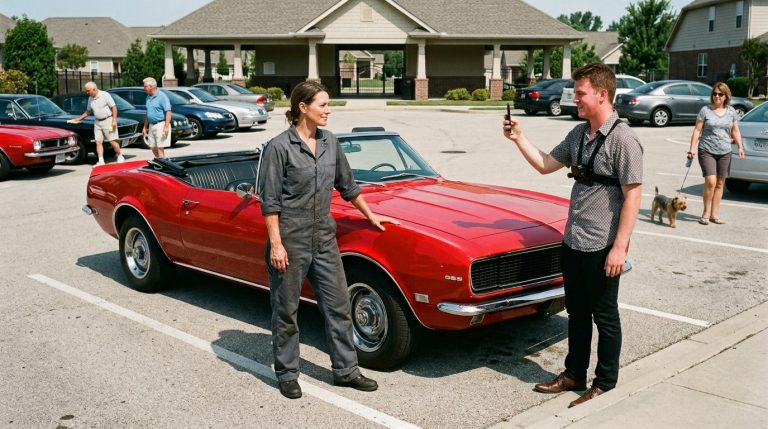
Brenda’s jaw tightened, a tiny muscle twitching beneath her cheek. She reached into her handbag, pulled out a second yellow folder, and tossed it onto the hood of my ’74 Ford pickup.
“Read whatever you want,” she said, turning on her heel toward the street. “Thursday at eight, the backhoes arrive.”
CHAPTER 2: The Paper Trail
I didn’t watch Brenda walk down the driveway. I picked up the folder off the hood of my truck and carried it straight into the back room of the shop, where I kept the filing cabinet and the old desktop computer I used for ordering parts.
The paper inside was crisp, high-grade bond—far too expensive for a volunteer neighborhood committee. At the bottom of the “Special Assessment Notice,” three signatures sat in dark blue ink: Brenda Vance as President, Dennis Miller as Treasurer, and Sarah Jenkins as Secretary.
I pulled out my phone and dialed Dennis. He answered on the fourth ring, his voice competing with the background roar of a lawnmower.
“Hank?” Dennis called out. “Hold on, let me shut this rig down.”
The engine sputtered off.
“Dennis,” I said, leaning against the edge of the steel desk. “I’m looking at a notice for a fifteen-hundred-dollar fine and a demolition order on my shop. Says the board voted on it last Tuesday.”
There was a long silence on the line. I heard the faint click of a zippo lighter, then a heavy exhale.
“Last Tuesday?” Dennis asked. His tone flattened out instantly. “Hank, there wasn’t a meeting last Tuesday. Sarah’s been in Santa Fe visiting her daughter since the tenth. We didn’t have a quorum, so Brenda canceled the session.”
“Her signature is on this paper, Dennis.”
“Then she used the digital stamp from the master drive,” Dennis muttered. “Look, Hank… she came by my place yesterday asking for the physical ledger keys. Said she needed to audit the maintenance reserve for the front entrance project.”
“Did you give them to her?”
“She’s the president, Hank. I gave her the brass ring.” Dennis paused, the sound of his thumb scraping over his lighter wheel coming through the speaker. “She had a guy with her. Sharp suit, driving a brand-new Lincoln. Introduced him as her real estate consultant.”
I looked down at the plastic pen sitting on my bench. Vance & Associates Commercial Properties.
“Where are the physical archives kept now?” I asked.
“In the utility shed behind the clubhouse,” Dennis said. “The deadbolt code is still the street address.”
I hung up, walked over to the shop bay, and pulled the overhead chain until the heavy steel door slammed down, locking the latch in place.
The walk across the common green took less than five minutes. The late morning sun was already baking the dry grass, throwing long, harsh shadows across the vinyl-sided houses lining the cul-de-sac.
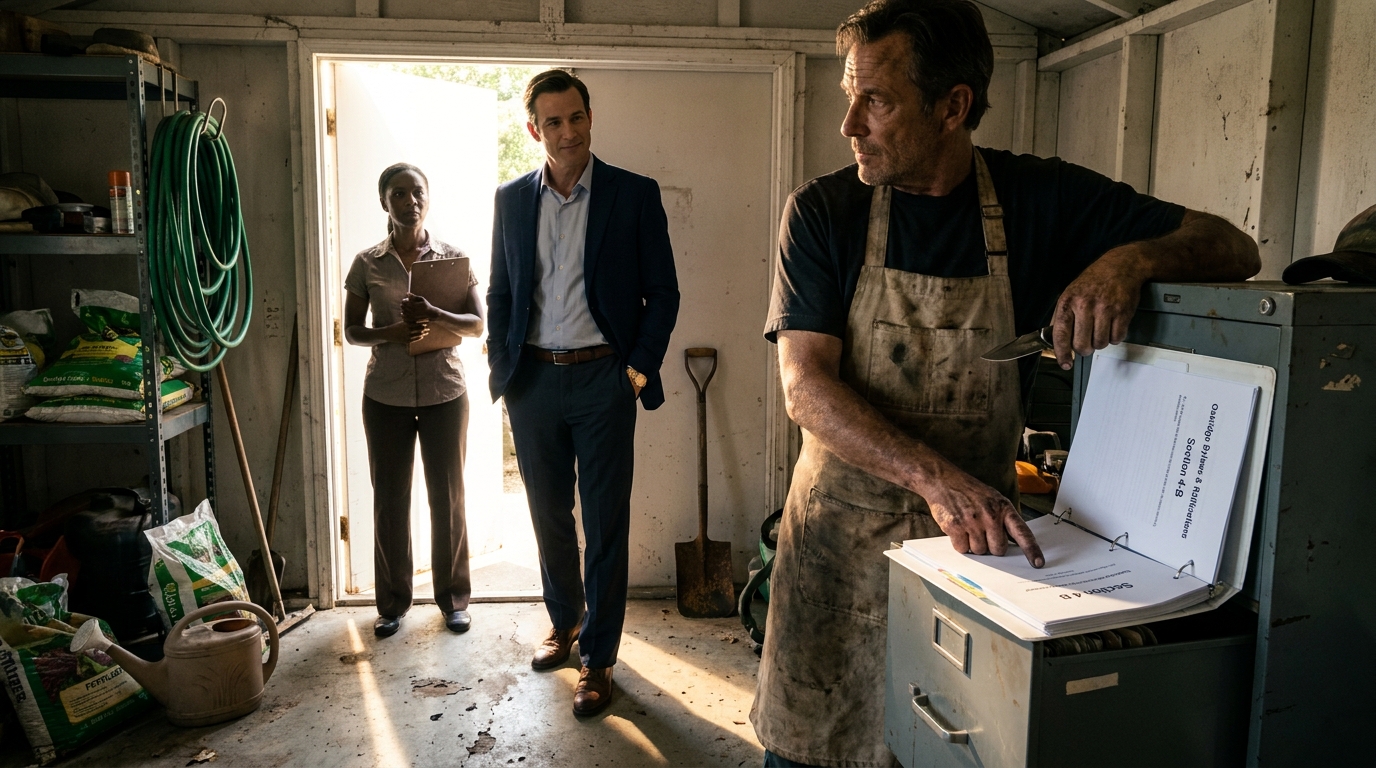
The community utility shed sat tucked between two overgrown arborvitae near the tennis courts. I punched four numbers into the keypad on the doorknob. The lock clicked, yielding to a firm push.
Inside, the air smelled like dry rot, fertilizer, and hot plastic. Three grey filing cabinets were bolted to the back wall. The middle drawer of the administrative cabinet was sitting open about two inches.
I pulled it back. The metal tracks squeaked loudly in the cramped space.
Inside sat the dark green binder marked Oakridge Bylaws & Ratifications: 1992–2020. I flipped open the heavy cover, turning past the original plat maps until I reached the section for Section 4-B—the exact clause Brenda cited on my door.
The page was brand new. The paper lacked the yellowed edges of the surrounding documents, and the staple holding it to the binding was bright, un-rusted steel.
I ran my index finger down the signature block at the bottom of the page. The signatures weren’t even stamped—they were high-resolution color printouts pasted directly over the original document text.
Beneath the fresh page, a faint line of black text peeked through where the alignment was off by an eighth of an inch: Commercial Zoning Variance Request — Pending Review.
A shadow blocked the sunlight streaming through the open door of the shed.
“You’re trespassing on association property, Hank.”
Brenda stood in the doorway, framed by the blinding light of the lawn. Beside her stood a tall man in a navy blazer, his hands tucked casually into his slacks.
“The shed belongs to the homeowners, Brenda,” I said, keeping my thumb firmly planted on the overlapping edge of the pasted document. “And these records are public to anyone on the deed.”
“The records are under administrative review,” the man in the blazer said, stepping forward. He had a smooth, polished face and a gold watch that glinted in the dim light. “I’m Richard Vance. Legal counsel for the development group overseeing the neighborhood land assessment.”
“You’re her brother-in-law,” I said, looking him dead in the eye. “And this signature page was printed on an inkjet printer less than forty-eight hours ago.”
Brenda didn’t flinch, but her grip on her clipboard tightened until her knuckles turned white.
“Accuse me of whatever you want, Hank,” she said quietly. “The board meeting is scheduled for tomorrow night at the park pavilion. Bring your lawyers if you have them. But as of eight o’clock this morning, the city code enforcement officer has already been formally notified of an unpermitted structural hazard on your lot.”
She turned and walked toward the tennis courts without looking back. Richard Vance lingered for a second, offering a tight, patronizing smile before following her down the paved path.
I turned back to the binder, carefully lifted the corner of the forged page with my pocket knife, and snapped a clear photo of the hidden text underneath with my phone.
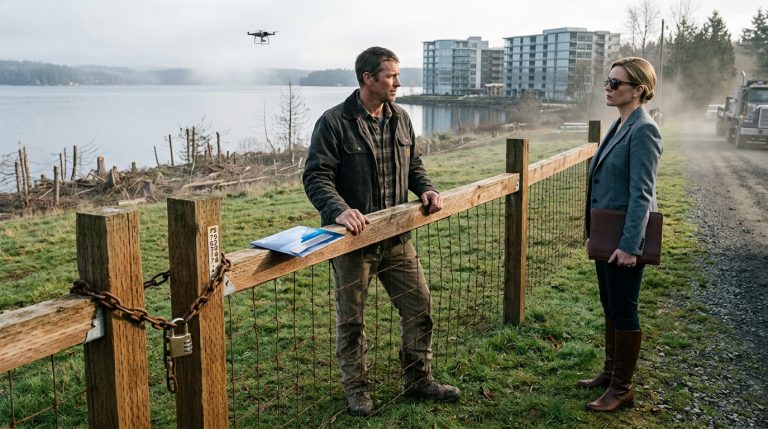
The trap wasn’t just about my shop. It was about the land under it.
CHAPTER 3: The Board Meeting Ambush
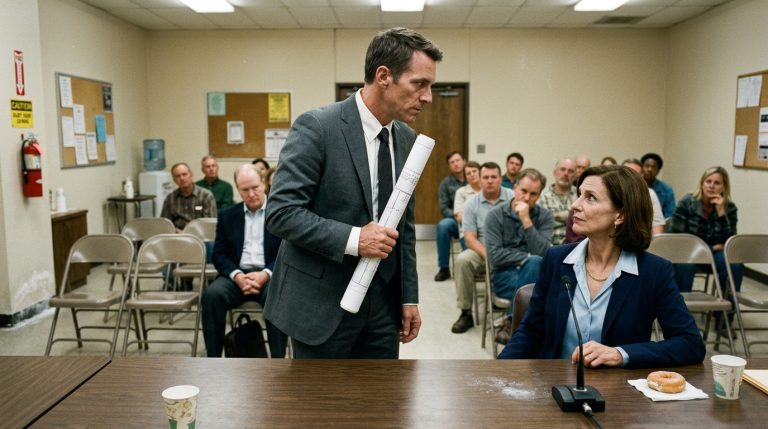
The community pavilion was packed to the screen doors by seven o’clock on Tuesday night.
Loud murmurs bounced off the concrete floor and corrugated metal roof as I walked through the entrance, holding a manila folder tucked firmly under my arm. Dennis sat near the front row, staring straight ahead and refusing to catch my eye.
Brenda Vance occupied the center seat at the folding table up front, tapping a silver gavel against the plastic surface.
“Order,” Brenda said, her voice echoing through the screeching PA system. “We have a packed agenda tonight, and item number one involves community aesthetic compliance and unauthorized structures.”
She didn’t look at me, but her husband nudged her elbow from the side.
I didn’t wait for the floor to open for public comments. I walked right down the center aisle, the heels of my boots clicking sharply against the concrete.
“There’s no quorum for item one, Brenda,” I said, my voice cutting through the speaker whine before she could strike the gavel again.
Brenda flashed a tight, brittle smile that didn’t reach her eyes.
“The board voted unanimously last Tuesday, Hank,” she replied, leaning into the microphone. “The minutes are filed and signed.”
“They’re not signed by Sarah Jenkins,” I said, pulling the printed photograph out from under my arm and laying it flat on the edge of the registration desk. “Because Sarah’s been in Santa Fe since the tenth, and you used an inkjet printer to paste her name over a pending commercial zoning variance.”
A sudden wave of whispers swept through the folding chairs behind me.
Brenda’s hand froze over the gavel handle. The color drained entirely from her face, leaving her cheeks looking like chalk under the harsh fluorescent lights.
“That is a malicious fabrication,” Richard Vance shouted from the back row, standing up so fast his metal chair screeched against the concrete. “The association’s legal counsel demands this meeting be adjourned immediately.”
“You don’t represent the association, Richard,” Dennis muttered from the front row, finally turning his head. “You represent the development group trying to buy out our deeds.”
Brenda slammed the gavel down once, the sharp crack echoing off the corrugated roof like a gunshot.
“This meeting is closed,” Brenda snapped, grabbing her leather clipboard and sweeping her papers into a pile. “Security will escort anyone tampering with association documents off the property.”
“There’s no security here, Brenda,” I said, stepping closer to the table and laying the green binder open for everyone in the front rows to see. “Just neighbors who want to know why our maintenance fund is paying for commercial real estate ads.”
Brenda stood up so fast her chair tipped backward, crashing loudly onto the concrete floor.
CHAPTER 4: The Escalation
The siren cut out right at the base of my gravel driveway.
By the time I walked back to my lot, a white county sedan with yellow municipal strobe lights was parked behind my Ford pickup. A tall man in a steel-toed work jacket stood near my bay door, holding a thick digital tablet in one hand and a clip-on badge in the other.
Brenda stood three feet away from him, her arms folded tightly over her chest, pointing up at the exposed steel headers of my roofline.
“He’s been operating an unpermitted heavy industrial facility in a residential zone,” Brenda told the officer as I approached. Her voice was rapid, breathless. “There are hazardous chemicals, flammable oils, and structural modifications that threaten the stability of the entire slope.”
The inspector looked over at me, his face showing nothing but cold, routine fatigue.
“Hank Vance?” he asked, tapping a pen against his tablet. “I’m Inspector Miller, County Code Enforcement. We received an urgent safety complaint regarding an illegal commercial operation and uninspected structural work.”
“I built this frame thirty-two years ago, Miller,” I said, stepping onto the concrete. “County permit number 92-411. Signed off by Chief Inspector Miller—your dad, if I remember right.”
Inspector Miller blinked, his eyes shifting from my face to the heavy steel support beams inside the shop bay.
“My dad retired twelve years ago,” Miller said, his tone softening by a fraction. “Permit records from ninety-two aren’t on the digital portal. But if there’s an immediate safety hazard reported, I have to conduct a full site evaluation today.”
“He doesn’t have a commercial permit!” Brenda interjected, stepping between us. “He fixes farm tractors and cuts metal in here! It’s an illegal business enterprise!”
“I fix my own tools and help neighbors with their equipment,” I said calmly. “No commercial license, no signs, no money exchanged. Just a man in his own shop.”
“We’ll see about that when he checks the storage tanks,” Brenda snapped, turning back to Miller. “Check the back wall. He has illegal fuel drums stored behind the bench.”
Inspector Miller looked at me, then back at Brenda.
“Ma’am,” Miller said, his voice dropping into an even, professional drone. “I need you to step back to the property line. I can’t conduct an inspection with an unauthorized party inside the work perimeter.”
Brenda opened her mouth to argue, her jaw shifting sideways, but Miller didn’t look up from his screen. He simply waited, his boots planted firmly on the gravel.
With a sharp huff, Brenda turned and retreated down the driveway, her heels kicking up loose stones as she stopped right at the asphalt edge, staring at us like a hawk on a fence post.
Miller turned to me and gestured toward the open bay door.
“Let’s see the structural frame and the storage area, Hank,” Miller said softly. “If everything’s up to standard, we’ll write the clearance report right now.”
I nodded, stepping past him into the cool shadow of the workshop, reaching for the light switch on the main breaker box.
CHAPTER 5: The Inspection Trap
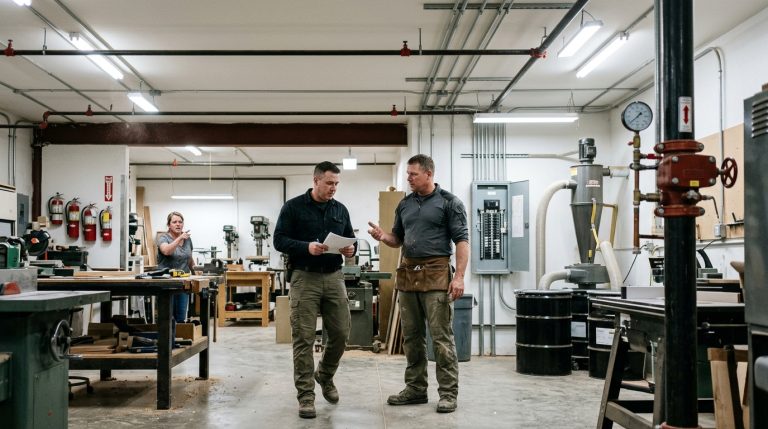
The narrow white beam traced up the five-inch steel column, illuminating the embossed manufacturer stamp near the roof flange.
Inspector Miller tapped the metal with his knuckles, listening to the dull, solid thud. He pulled a digital measuring caliper from his belt, checked the flange thickness, and tapped two entries into his tablet screen.
“Grade-A structural steel,” Miller said softly. “Bolted directly into poured reinforced concrete footers. This thing is built to hold a crane.”
“And the environmental complaint?” I asked, leaning against the anvil block.
Miller turned, sweeping his flashlight over my neatly racked hand tools, the sealed oil-catch basin, and the propane heater sitting in the corner.
“The complaint stated you were storing six unsealed drums of industrial solvent,” Miller said, his thumb flicking off the flashlight beam. “I see one sealed fifty-gallon barrel of motor oil sitting in a spill-containment tray. Fully compliant with county code 404.”
He tapped his tablet once more, and a small wireless printer on his hip whirred to life, spitting out a crisp receipt-sized strip of white paper.
He tore it off, pressed it against my workbench, and stamped it with a heavy blue county seal.
“Full clearance certificate,” Miller said. “Your shop is fully grandfathered under county code, Hank. No violations, no fines.”
Outside, Brenda saw the blue stamp through the open bay door. Her face twisted as she stomped back up the gravel, her fingers digging into the sides of her clipboard.
“You can’t issue a clearance!” she shouted, her voice pitching high enough to startle a blue jay out of the pine tree above my truck. “He is violating community bylaws! As HOA President, I reject this inspection!”
Miller turned to her slowly, his tablet clutched in both hands.
“Ma’am, county safety code overrides private association guidelines in every jurisdiction in this state,” Miller said smoothly. “And while I’m here, I noticed something else on my drive down Oakridge Place.”
Brenda’s posture went rigid. “What are you talking about?”
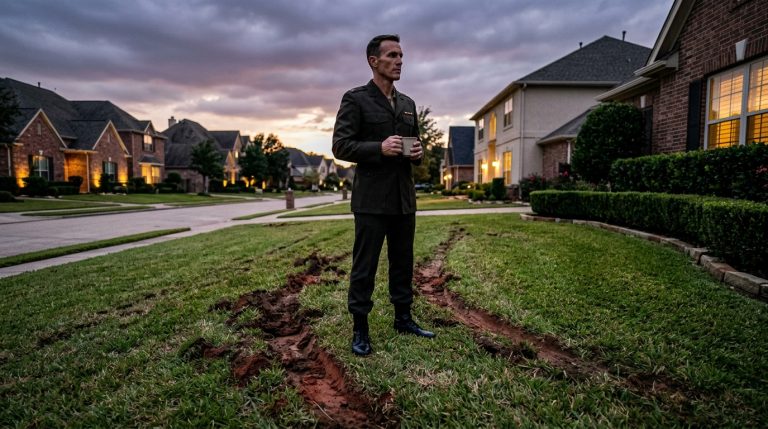
“The drainage ditch behind the community clubhouse,” Miller said, stepping out into the daylight. “There’s fresh backhoe work and unpermitted land grading sitting right on the county culvert line. That work lacks a municipal silt fence and an environmental impact permit.”
Brenda swallowed hard, her throat moving against her collar. “That’s just minor maintenance…”
“It’s a Class-2 watershed violation, ma’am,” Miller cut her off, his voice dropping into a stern, authoritative growl. “And according to county land records, the work permit request was filed under Vance & Associates Commercial Development. I’m placing an immediate cease-and-desist order on that lot before I leave.”
Brenda opened her mouth, but no sound came out. Her eyes darted toward the street, where Richard Vance’s Lincoln was pulling up to the curb.
CHAPTER 6: The Dusty Truth
Richard Vance didn’t look at Brenda. He looked straight at Inspector Miller’s county badge, then at the bright yellow cease-and-desist notice hanging from the inspector’s hand.
“There’s been a miscommunication,” Richard said, his smooth voice cracking slightly at the edges. “We were under the impression the association had already secured the drainage easement.”
“The association didn’t secure anything, Richard,” I said, stepping forward with the manila folder. “Because Brenda forged the board signatures to trigger a municipal violation, hoping to force a tax sale on my lot.”
A crowd of neighbors had gathered along the cul-de-sac—Dennis near the front, flanked by Sarah Jenkins and half a dozen homeowners holding copy packets of the financial audit I’d printed that morning.
Brenda backed away toward the passenger side of the Lincoln, her clipboard trembling against her chest.
“This is an illegal gathering!” Brenda shrieked, her voice echoing off the metal shop roof. “I am the elected president of this association!”
“Not anymore,” Sarah Jenkins called out, stepping across the grass with a rolled-up copy of the county deed registry. “Dennis called an emergency board session an hour ago. We had five signatures out of seven. You’re removed from the board, Brenda. Effective immediately.”
Richard Vance didn’t waste another second. He pulled his door open, slid into the driver’s seat, and cranked the engine, leaving Brenda standing alone on the driveway.
“Richard!” Brenda yelled, pounding her palm against the tinted passenger window as the Lincoln backed out into the street and sped off down Oakridge Drive.
Inspector Miller handed me a copy of the official environmental halt order, gave a short nod to Dennis, and climbed back into his county sedan.
The street went quiet.
Brenda stood in the gravel, her high heels unsuited for the rough dirt, her cheeks flushed bright red under the hot midday sun. She didn’t look at any of us as she turned and walked slowly back down the road toward her house, her leather clipboard trailing loosely by her side.
Dennis walked over, setting a heavy hand on the hood of my truck.
“We’re filing a formal report with the state attorney general’s office tomorrow morning, Hank,” Dennis said quietly. “For the forged signatures and the reserve fund discrepancies.”
“Good,” I said. “Keep the paper trail clean.”
After the neighbors dispersed back to their lawns, I stepped into the cool shadow of my workshop.
The air still smelled like damp pine and oil.
I pulled the brass feeler gauge out of my shirt pocket, opened the five-thousandths blade, and set to work adjusting the intake valve on my tractor engine.
The metal clicked softly into place under my thumb—solid, precise, and entirely my own.