The Weight of Silence: A Journey Toward Truth, Vulnerability, and the Courage to Be Known
CHAPTER 1: The Mirror in the Water
The Harrington estate was a monument to the things money could buy: manicured silence, scentless roses, and the illusion of untouchability. Maria Lopez, however, had spent three years cleaning the cracks in that monument. She knew the dust that gathered behind the heavy velvet curtains and the way the floorboards in the East Wing groaned under a weight they weren’t designed to carry.
She was tired, a deep, bone-weary fatigue that had nothing to do with the physical labor of polishing marble and everything to do with the heavy silence of the house. It was past nine. The staff had gone, leaving the mansion to its own cold echoes. Maria stood in the hallway, her fingers tightening around the handle of her cart, her phone abandoned in the utility closet.
She had only come back for the device. A distraction. A tether to the world outside, where a three-year-old girl named Maya waited with Mrs. Guerrero. But as she passed the indoor pool, a sound cut through the stillness—a splash, rhythmic and intentional.
She stopped. The glass panel in the door was slightly fogged from the humidity. She leaned forward, the cold surface pressing against her forehead.
There, under the shimmering blue light of the underwater lamps, John Harrington wasn’t floating. He wasn’t being cradled by the adaptive equipment the household staff moved around him like holy relics. He was cutting through the water with the violent, beautiful precision of a man who belonged to the ocean. His legs, usually tucked away in the chrome-framed chair, were kicking with a strength that suggested he had been doing this his entire life.
Maria pressed her palm against the glass, her heart hammering a frantic rhythm against her ribs. The chair sat empty beside the pool, a silent, mocking metal witness. The man swimming had no need for it. He possessed the fluid, unthinking mastery of a predator in its natural element.
She backed away, the metal wheels of her cart squealing softly against the stone floor—a sound that seemed to shatter the house. She waited for him to surface, to see her, to accuse her of spying. But he kept swimming, lost in his own private performance.
She turned and fled, her breath coming in ragged, shallow gasps. She didn’t look back, but the image remained seared into her mind: the empty chair, the powerful legs, and the terrible, hollow realization that she had been cleaning for a ghost. She reached the foyer, the grand doors looming before her like a trap, and she realized then that the secret was not just a lie. It was a cage, and she had just walked right into the bars.
Everything about her life—the paychecks, the preschool application, the smallness she had accepted as her lot—suddenly felt like a fragile, paper-thin reality about to be set on fire. She needed to leave, but the house felt like it was holding its breath, waiting for her to stumble.
CHAPTER 2: The Echo of a Lie
The silence of the Harrington estate, usually a comforting shroud of professionalism, had become a physical weight. Maria stood in the shadowed transition between the pool wing and the main hallway, her knuckles white where they gripped the cleaning cart. The squeal of the wheels had sounded like a gunshot in the tomb-like quiet. She was frozen, her breath coming in ragged, shallow hitches, waiting for the heavy footsteps of a man who should have been immobile to come stalking after her.
But there was only the dripping of water from the pool room, a rhythmic, maddening plink, plink, plink that pulsed against her eardrums. She was terrified that if she turned back, she would see him—a silhouette framed against the blue pool lights—realizing exactly how much she had witnessed.
Her father’s voice suddenly echoed in her mind, a memory sharp enough to sting. “Maria, when you work in these big houses, you keep your eyes on the floor. You don’t look at the paintings, and you certainly don’t look at the people. You are the shadow, and shadows do not observe.”
She had been a shadow for three years. She had been the woman who polished the silver until it blinded her, the woman who learned the rhythm of the household so she could disappear before the family ever walked into a room. And yet, she had looked. She had observed. And now, she was a shadow that had seen the light behind the curtain.
She forced herself to move, her boots clicking softly, then steadily, against the cold marble floor. She didn’t run; running was an admission of guilt. She steered the cart toward the East Wing utility closet, her muscles screaming with tension. Every shadow cast by the wall-mounted sconces felt like a grasping hand.
When she reached the closet, she threw the door open and stepped inside, clicking the light on. The room smelled of industrial lemon cleaner and floor wax—a familiar, grounding scent that felt suddenly alien. She found her phone where she had left it on the shelf, the screen dark and indifferent. She grabbed it, her hand shaking so violently that she nearly dropped it.
She turned back to the hallway, but she stopped in the threshold. The pool door was still visible down the long corridor, a panel of opaque glass that held the blue shimmer of the water. If he came out now, he would see her. Her brain began to race, cataloging the potential fallouts. If she said something, she was a troublemaker, an employee who didn’t know her place. If she said nothing, she was complicit in a deception that was, at best, a strange private whim, and at worst, a foundation built on a rotting floor.
She reached into her pocket, her fingers brushing the worn edge of the preschool application form she had folded there that morning. She thought of Maya, asleep in her own small bed, dreaming of ‘flutterbys.’ She thought of the way her mother had cleaned those houses, her back bent, her spirit slowly eroded by the need to stay small, to stay quiet, to stay invisible.
The weight of the lie hit her then, not as an abstract concept, but as a physical pressure against her sternum. It was the same weight that had bent her mother’s spine. It was the weight of secrets held by those who felt they had the right to own the truth, while those who cleaned up after them were expected to swallow it.
She pushed the cart forward again, but her path felt different now. The marble didn’t feel solid; it felt like a thin veneer over something hollow. She passed the grand staircase, the mahogany banister glowing under the dim foyer lights, and walked toward the side exit that led to the staff parking area.
As she stepped out into the crisp night air, the cool September breeze hit her skin, making her shiver. She locked the utility door behind her, the metallic thunk of the deadbolt final and heavy. She walked toward her car, an older model sedan that struggled on the inclines, its engine a low, rhythmic grumble that was the antithesis of the silent, pristine perfection of the Harrington estate.
She opened the door and sat in the driver’s seat, the darkness of the parking lot swallowing her whole. She didn’t start the engine immediately. She stared at the house, the grand facade illuminated by security lights that made the white marble look like bone.
John Harrington was in there, playing the role of a broken man, while out here, the real world was waiting—the electric bill, the rent, the struggle to give Maya something better than a life of quiet subservience. She looked down at her hands, still rough from the cleaning supplies, and realized she wasn’t just afraid anymore. Beneath the fear, a cold, hard ember of clarity was beginning to glow. She had seen him. He was not the person the world thought he was. And for the first time in her life, she understood that the truth wasn’t something you waited to be told; it was something you carried, and the weight of it was starting to demand a reckoning.
She turned the key in the ignition. The engine sputtered to life, a rough, honest sound that shattered the silence of the night. She put the car in reverse, her eyes fixed on the rearview mirror, checking one last time to see if the lights in the East Wing had shifted, if the ghost of the estate was coming to find the witness. The house remained dark, indifferent, and looming, but as she pulled away, Maria knew the silence would never feel the same again.
CHAPTER 3: The Architecture of Deception
The morning sun hit the Harrington estate with a clinical brightness that made the sprawling lawns look like a meticulously rendered painting, one with too many sharp edges. Maria pulled her car into the employee lot, the gravel crunching under her tires—a sound that usually signaled the beginning of a predictable routine. Today, it felt like the breaking of a seal.
She sat for a moment, her hands resting on the steering wheel. The car was silent, but her mind was a whirlwind of questions she wasn’t supposed to ask. Why the wheelchair? If he could walk, why perform this elaborate, daily pantomime? It wasn’t just a lie; it was an investment. It required props, a schedule, a physical therapist who played a part, and an entire household staff trained to look in the other direction.
She stepped out of the car, the cool morning air biting at her cheeks. She walked toward the service entrance, her eyes tracking the familiar geometry of the estate. The marble columns, the perfectly spaced rose bushes, the massive glass windows of the Grand Library—everything was designed to intimidate, to signal power, to define the barrier between those who owned the estate and those who kept it clean.
Inside, the house hummed with the quiet, expensive energy of preparation. The wedding was looming like a storm front, bringing with it a tide of florists, catering teams, and decorators. Maria moved through the service corridor, her cart loaded with fresh linens and cleaning agents. She felt like an imposter. Every smile she offered the other staff members felt brittle, every nod of greeting an exercise in profound, hidden effort.
She reached the Grand Library. John Harrington was already there.
He sat near the east window, bathed in the same golden morning light that had framed him the day before. He was reading, or appearing to read. The wheelchair was positioned with calculated exactness. From the doorway, he looked like the very picture of tragic, intellectual stoicism—the billionaire bachelor, refined and distant, held prisoner by his own broken body.
Maria began her work, the familiar motions of polishing the mahogany end tables providing a thin layer of protection. She kept her gaze low, just as her father had taught her, but her peripheral vision was a trap. She watched him. She saw the way his fingers turned the page—slow, deliberate, practiced.
She began to organize the shelves near his chair, her heart hammering against her ribs. This was the moment she had been dreading. She could hear the soft, rhythmic breathing of the room, the distant sound of a caterer’s van pulling up to the back dock, and the sudden, jarring interruption of a familiar voice.
Dr. Reigns, the estate’s physical therapist, strode into the library. He was a man of stiff postures and professional smiles, a man whose presence in the house was usually marked by the quiet click of a briefcase and the closing of doors.
“Good morning, John,” the doctor said, his voice carrying the practiced cheer of a man who dealt in managed expectations. “Ready for your session?”
John didn’t look up immediately. He finished the paragraph, his thumb tracing the spine of the book before he closed it with a soft thud. “I was just getting to an interesting part, Doctor. But yes. Let’s get it over with.”
Maria kept her head down, rubbing a microfiber cloth over the wood grain until it shone, but her ears were straining. She watched as Dr. Reigns began to adjust the chair, the metal creaking in the silence. She saw John shift, his posture changing ever so slightly, his shoulders hunching into the familiar, forced configuration of a man who needed assistance. It was a subtle transformation, a flick of a switch, and it made Maria feel physically ill.
It wasn’t just a performance; it was a degradation. Why would he choose this?
She moved to the next table, closer to them, her cleaning cart acting as a barricade. She caught a glimpse of the doctor’s face—a momentary flicker of something, a shadow of irritation or fatigue—before he masked it with a professional nod.
“We have quite a bit of work to do today,” the doctor said, turning the chair toward the private elevator. “We’re falling behind the recommended schedule for range-of-motion improvement.”
“I’m sure we’ll manage,” John replied, his voice flat, devoid of the warmth she had imagined he might possess.
As they moved toward the elevator, John looked back, his eyes sweeping the room, coming to rest on Maria for a fraction of a second. She didn’t look up, but she felt the weight of his gaze. It wasn’t the distant, distracted look he usually gave the staff. It was sharp, calculating, almost curious.
When the elevator doors slid shut behind them, the room felt suddenly, intensely empty. Maria stood alone in the library, the smell of old paper and furniture polish clinging to the air. She walked over to the spot where the wheelchair had been, the carpet slightly depressed. She looked at the floor, seeing a small, barely perceptible scuff mark near the mahogany desk.
She knelt, her knees hitting the plush fabric. She traced the mark with her finger. It wasn’t a mark from the chair. It was a footprint—a heavy, decisive tread from a shoe, not a rubber tire. It was fresh.
A cold clarity settled over her. They weren’t just practicing a routine; they were actively managing the evidence of his mobility. The doctor wasn’t a therapist; he was a gatekeeper, a partner in the fabrication.
She stood up, her legs feeling shaky. She had seen the truth of his legs, but now she was beginning to see the architecture of the lie. It was an elaborate cage, and as she stood there, the sound of the house outside—the wedding preparations, the laughter, the life that was being built upon this foundation—seemed to grow louder, more discordant.
She was no longer just a witness. She was part of the scene now, a silent participant in a house of glass, and she knew that the more she saw, the more impossible it would be to simply walk away. She picked up her cloth and resumed her work, her movements sharp, deliberate, and for the first time in three years, entirely aware of the truth behind every shadow in the room.
CHAPTER 4: The Unscripted Question
The walk back to the Grand Library felt like navigating a minefield of her own making. Maria held Maya’s small, trusting hand, the girl’s yellow daisy dress catching the light of the morning sun as they passed through the grand foyer. Maya was chattering about ‘flutterbys’ and the way the gargoyles on the exterior of the house looked like sleeping dogs, her voice a bright, discordant note in the oppressive silence of the estate.
Maria needed to be quiet. She needed to be small. But every step she took felt louder than the last. She looked down at Maya, whose dark, curly hair was caught in a stray breeze, and she felt a sudden, sharp pang of guilt. She was bringing her daughter into the belly of a lie. She was exposing her to the gilded, curated untruths of the Harrington world, and she had no idea how to protect her from the fallout if the truth—that raw, physical secret of the man in the pool—were to collide with the reality they were supposed to be cleaning.
They reached the library. The doors were standing slightly ajar.
Maria froze. She had intended to check the status of the room, to see if the doctor had left, to see if John was still engaged in his staged recovery. She pushed the door just enough to look inside. The room was bathed in that same unforgiving, golden light. John Harrington sat in his wheelchair, his book open on his lap, his gaze fixed on the window. He looked entirely undisturbed, the picture of refined, quiet patience.
He didn’t hear them—or if he did, he didn’t show it. He was a master of his own stillness.
Maria started to back away, her grip on Maya’s hand tightening. It was time to go. It was time to find a corner of the estate where she could finish her work and disappear until it was time to leave. But Maya, whose attention span was a law unto itself, had already spotted something.
“Mama,” Maya whispered, her voice echoing in the vast, wood-paneled room. “Puppy.”
Maria stopped, her breath catching in her throat. She looked toward the far corner of the library, where the golden retriever—the one she had seen through the glass doors the day before—was curled up on a velvet rug. Before Maria could pull her back, Maya had already wiggled her hand free.
“No, Maya—” Maria started, but it was too late.
The little girl trotted across the polished hardwood, her footsteps light and uninhibited. She reached the dog, who lifted his head, tail thumping a soft, welcoming rhythm against the rug. John Harrington didn’t turn at first, his posture rigid. Then, slowly, he tilted his head. He saw the girl.
Maria followed, her heart hammering against her ribs. She was the one who had brought her here. She was the one who had failed to keep her daughter invisible.
“I’m so sorry, Mr. Harrington,” Maria said, her voice strained, her eyes averted from his face. “She… she saw the dog. I’ll take her out immediately.”
She stepped forward to grab Maya, but the child had already turned, her attention shifting from the dog to the man. She stood there, a small, vibrant figure against the backdrop of dark mahogany and shadow, looking up at the man in the chair with the unblinking, terrifying curiosity of a three-year-old.
John didn’t look annoyed. He looked stunned. He watched Maya with a gaze that seemed to peel back the layers of his own carefully constructed persona.
Maya reached out, her small hand pressing against the metal frame of the wheelchair. “Why?” she asked, her voice clear and matter-of-fact.
Maria gasped, a sound that was half-prayer and half-sob. “Maya, don’t—”
“Why do you use that chair?” Maya persisted, her finger pointing at the wheels. “If your legs work?”
The silence that followed was not the quiet of a library; it was the silence of a vacuum. It sucked the air out of the room. Maria felt the blood drain from her face, leaving her dizzy. She looked at John. He was staring at Maya, his expression a kaleidoscope of fractured emotions—shock, fear, and something else, something deeper that looked suspiciously like a profound, dawning shame.
He didn’t speak. He didn’t order them out. He didn’t even look at Maria. He just sat there, his hands gripping the arms of the chair until his knuckles turned as white as the marble columns outside.
Maria grabbed Maya’s hand, her own fingers trembling. “I am so sorry, sir,” she repeated, the words tasting like ash. “She doesn’t know… she’s just a child.”
She began to pull Maya toward the door, her movements frantic. She didn’t look back until they were in the hallway. She didn’t dare. She needed to get out of the library, out of the East Wing, out of the sphere of his influence before the walls collapsed entirely.
But as she reached the corner of the corridor, she heard a sound behind her—a soft, metallic click, followed by the heavy, deliberate thud of feet hitting the hardwood floor.
He had moved.
He hadn’t run, he hadn’t spoken, but he had shifted his weight in a way that left no doubt. The illusion was no longer just cracked; it was beginning to crumble. Maria kept walking, her daughter’s hand warm and steady in hers, but she knew that whatever happened next, there was no going back to the life of the invisible shadow. The question had been asked, and the world had started to shift.
CHAPTER 5: The Weight of the Unspoken
Maria sat on the edge of the sofa in the small study, her back rigid, her eyes fixed on the door. Beside her, Maya was finally asleep, her breathing shallow and steady, a small, warm weight that felt increasingly like the only anchor Maria had left in this shifting, surreal world. The study was a private nook off the main library, a space rarely visited by the staff, its walls lined with leather-bound books that smelled of cedar and dust. It was quiet, but it was a heavy, pressurized quiet.
She could hear the muffled sounds of the estate—the faint, distant hum of the caterers moving through the service corridors, the occasional, sharp clack of high heels on marble—and each sound made her flinch. Her mind was caught in a loop. She had seen him walk. She had seen the way his legs, supposedly dead to the world, had propelled him across the floorboards with terrifying, silent grace.
She kept replaying the moment in the library. Maya’s question. The way John had looked at her—not with anger, not with the cold, aristocratic dismissal she had anticipated, but with a sudden, naked vulnerability that had been far more unsettling. He had been cornered by a child’s innocence.
A sharp rap on the door made Maria’s heart seize. She held her breath, her hand automatically moving to tuck a strand of hair behind her ear, a nervous, habitual gesture.
“Maria?” The voice was low, muffled by the heavy oak of the door. It was John.
She didn’t answer at first. The audacity of him seeking her out in this tucked-away corner felt like an intrusion. She looked at Maya, then back to the door. If she opened it, she was moving from a witness to an accomplice. If she stayed silent, she was declaring war on the man who controlled her livelihood.
“Maria, I know you’re in there,” he said, his tone devoid of the command she expected. It carried a strange, weary resonance, as if he were talking to himself as much as to her. “I need to talk to you. Not as an employer. Please.”
She stood up, her legs feeling leaden. She smoothed her uniform, trying to force herself into the role of the invisible maid, but the armor felt flimsy, cracked. She walked to the door and eased it open just a few inches.
John Harrington stood in the hallway. He wasn’t in the chair. He was leaning against the wall, his hands shoved deep into the pockets of his trousers. He looked different—less curated, less like the statue he had been yesterday, and more like a man who had been stripped of his disguise. He didn’t look threatening; he looked exhausted.
“You should be in the chair,” she said, the words coming out sharper, more defensive than she intended.
He looked at her, his dark eyes searching her face with an intensity that made her want to pull the door shut. “I think we both know that’s not going to happen again today,” he replied, his voice barely above a whisper. He gestured to the study. “Can we? Just for a moment?”
Maria hesitated, the weight of the ‘No’ sitting on her tongue, but she looked past him, scanning the corridor for any sign of the staff, the estate manager, or the doctor. The hallway was empty, draped in long, afternoon shadows. She stepped back, allowing the door to swing open.
He walked into the room. He moved with a slight, almost imperceptible hitch in his stride—not the stutter of a man relearning how to walk, but the cautious, stiff movement of someone who had spent too long playing at immobility. He stopped in the center of the room, looking at Maya, who was curled up on the sofa.
“She’s innocent,” he said, his gaze fixed on the girl’s face. “The way she asked. It was… precise.”
“She’s a child,” Maria said, crossing her arms over her chest, trying to maintain a physical distance. “She sees what is there.”
“And you?” He turned to look at Maria. “What do you see?”
“I see a man who has been lying to everyone, including the woman he’s about to marry,” she said, her voice finally finding its strength. “I see a man who uses a chair like a prop, and a doctor who helps him, and a house full of people who are too afraid or too blind to notice that the ground is shifting.”
He didn’t flinch. He walked over to the desk, his hand trailing along the polished wood, his fingers tracing the intricate carvings. “It’s not as simple as a lie, Maria. It never is. The chair… it’s not just a prop. It’s a protection. It’s the only way I could be sure—” He stopped, his voice catching.
“Sure of what?” she pressed, moving closer. “Sure that she loved you because you were ‘broken’? That’s not love, Mr. Harrington. That’s a gamble you’ve already lost, because you never gave her the chance to love the man you actually are.”
He looked at her, and for the first time, she saw the full, crushing weight of his fear. It was a dark, jagged thing, and it mirrored the anxieties that kept her awake at night, the fears she held for Maya, the terror of being found lacking. “I’m terrified, Maria,” he confessed, the admission heavy in the air. “I’m terrified that if she finds out… if she knows… it will all end. And I don’t know who I am without it.”
“Then you’re already lost,” she said, her voice softening, not with sympathy, but with the cold, hard realization of a truth she had lived her whole life. “Because if you have to hide who you are to be loved, you aren’t loved. You’re just being managed.”
He looked at her, the silence in the room stretching until it felt like a living thing. From somewhere deep within the estate, the sound of a chime echoed—a reminder of the guests, the wedding, the clock that was ticking down toward a day that was supposed to be a celebration, but which now felt like a collision course. John looked at his hands, then back at Maria, his face hardening, the vulnerability being replaced by a flicker of the cold, calculating intelligence that had built his empire.
“I have to find a way to tell her,” he said, the words a promise or a threat, she couldn’t tell which. “But if you go to anyone… if you breathe a word of this before I am ready… you know what that means for you and for her.”
Maria didn’t look away. The fear was there, clawing at her stomach, but she stood her ground. “I’m not a part of your performance, Mr. Harrington. And I’m not your enemy. But I’m finished being the shadow that stays quiet.”
She turned away, walking back to the sofa, picking up her bag. She had reached her limit. The study, once a place of refuge, had become the epicenter of the deception, and she needed to leave it, to step back into the light, even if that light threatened to burn everything down.
CHAPTER 6: The Gardeners Gambit
The garden was a labyrinth of clipped hedges and structured beauty, but to Maria, it had become a place of ambush. She walked the stone path, her head down, her heart a frantic bird against her ribs. She had told him she wasn’t his enemy, but standing in the shadow of the rose arches, she felt exactly like one. She was a threat, a loose thread in a tapestry that John Harrington had spent months weaving with gold and lies.
She needed to move, to get through the work, to be invisible again. But she couldn’t. Her mind kept circling back to the study, to the look on his face, and to the terrifying realization that he was capable of anything to keep his secret. She reached the tool shed tucked away near the rear perimeter of the property, a small, weathered structure that housed the equipment for the estate’s massive groundskeeping operations.
She wasn’t looking for tools. She was looking for distance.
As she entered the shed, the scent of damp soil and gasoline was thick, suffocating. She leaned against the workbench, her breath hitching in her throat. She needed a plan. She couldn’t just walk out of the house; she had a life, a daughter, and a fragile, tenuous grip on a future that depended entirely on the continued functioning of this estate.
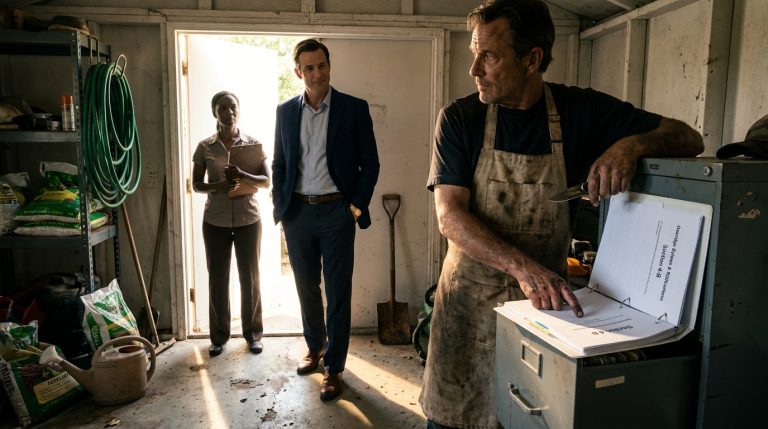
Her eyes scanned the room, landing on a metal filing cabinet in the corner. The estate manager, Mr. Henderson, kept the schedules and inventory logs there. It was usually locked, but the last time he’d been here—just this morning—he had been in a rush, his mind focused on the upcoming engagement party and the endless list of demands.
He had left the drawer ajar.
Maria froze. She knew the rules. She knew the weight of what she was about to do. But the thought of John Harrington’s fear—the way he had gripped the desk—pushed her forward. She reached out, her fingers trembling, and slid the drawer open.
There were folders for everything: floral arrangements, catering, security rosters. And there, tucked behind a thick binder of logistical data, was a slim, unassuming file labeled ‘Harrington/Reigns/Confidential.’
She pulled it out, her heartbeat drowning out the sound of the wind outside. She flipped it open. It wasn’t medical records. It was a timeline. An accounting of ‘milestones’—the date he stopped using the chair in private, the date he began walking in the pool, the dates of the ‘therapy’ sessions that weren’t therapy at all, but rehearsals.
The most damning piece of paper was at the bottom: a draft letter to the board of Harrington Global, dated six months ago, announcing his ‘recovery.’ It had been crossed out. In the margin, in a hand Maria recognized as the doctor’s, were the words: Not yet. Too much at stake regarding the marriage deal.
She felt the air leave her lungs. It wasn’t just about his fear of rejection. It was business. It was a calculated, cold-blooded maneuver to secure his position through the guise of his own vulnerability.
The realization hit her with the force of a physical blow. She had felt empathy for him in the study; she had seen a man terrified of losing the woman he loved. But this… this was the cold reality of the world she had spent her life trying to navigate. The ‘need’ he had played upon wasn’t just emotional; it was a currency he was spending to hold onto his empire.
She shoved the folder back into the drawer just as the sound of footsteps crunched on the gravel outside.
“Maria?”
It was the estate manager. Mr. Henderson’s voice was crisp, expectant.
Maria’s blood ran cold. She slammed the drawer shut, the metal rasping against metal in a sound that seemed to echo for miles. She grabbed a pair of pruning shears from the bench, her movements jerky and forced, and turned toward the door just as Henderson entered.
He looked at her, his eyes narrowing slightly. He was a man who noticed everything, a man who lived to curate the perfection of the Harrington life. “What are you doing in here?” he asked, his gaze drifting to the filing cabinet, then back to her.
“I… I needed to check the inventory for the garden supplies,” Maria said, her voice steady, though her knees were shaking so hard she thought she might collapse. “I was told there might be a shortage of the floral foam for the centerpieces.”
Henderson stepped into the room, his eyes scanning the space. The air felt heavy with the scent of ozone—the atmosphere before a storm. He walked over to the cabinet, his fingers hovering over the handle of the drawer she had just closed.
“The florists handle the foam, Maria,” he said, his voice dropping an octave, becoming a low, dangerous warning. “You have your instructions. You have your areas of responsibility.”
“I was just trying to be helpful,” she said, clutching the shears, her knuckles white.
“Helpful is doing what you are told,” Henderson replied, his eyes finally locking onto hers. There was no kindness in them, only the cold, mechanical efficiency of a machine. “I suggest you return to the house. There is a lot of work to be done, and the Harrington estate does not tolerate… curiosity.”
He didn’t move. He stood between her and the door, his gaze an interrogation. Maria forced herself to take a step toward him, then another, the shears feeling like a weapon in her hand. She had to walk through him to get out, and for a terrifying second, she wondered if he would let her.
“I understand,” she said, her voice a whisper of steel.
She walked past him, her shoulder brushing his arm, the touch a spark that threatened to ignite the whole house. She stepped out into the biting wind, her mind racing. She had the proof now. She had the evidence of his cold, calculated deception.
She walked toward the house, the path stretching out before her like a tightrope. She hadn’t expected to find a business deal in the files; she had expected to find a man, but instead, she had found a corporation. And as she looked up at the towering, white-columned facade of the Harrington estate, she realized that she was no longer just fighting for the truth—she was fighting for her survival.
Every window looked like a watching eye; every shadow felt like a trap. She had to be careful. She had to be quiet. She had to find a way to use what she knew before the estate used her. The wedding was no longer just a wedding; it was a deadline, and the clock was ticking, louder and faster than ever before.
CHAPTER 7: The Fragile Thread
Maria moved through the manicured pathways, the pruning shears heavy in her hand. She felt the weight of the file in the filing cabinet like a phantom limb, a burning secret that demanded to be shouted from the marble rooftops. Every movement felt magnified, every rustle of the wind a potential discovery. She reached the side entrance of the East Wing, her heart a frantic drum in her chest, but before she could slide her key into the lock, the side door swung open.
The wedding coordinator, a woman named Ms. Thorne whose efficiency was as legendary as it was cold, stepped out, clutching a clipboard like a weapon. She looked at Maria, her eyes sharp, darting over her disheveled uniform.
“You,” Ms. Thorne said, her tone clipped. “I need you to handle the floral arrangements in the Grand Ballroom immediately. The delivery arrived early, and the head florist is nowhere to be found. The guests for the pre-reception are arriving in two hours. Do not let me down.”
Maria blinked, the sudden pivot in expectations momentarily grounding her. “I… I was working on the grounds, Ms. Thorne.”
“The grounds can wait,” the coordinator snapped, checking her watch. “The aesthetic of this estate is what we are selling today. Move.”
Maria had no choice. She couldn’t refuse without drawing further attention to herself, not after the encounter with Henderson. She stepped past the woman and into the cool, climate-controlled air of the manor. The ballroom was a cavernous space of glass and gilded light, currently being overrun by a small army of delivery men carrying armfuls of ivory lilies and white roses. The scent was cloying, an intense, funeral-grade floral perfume that made her stomach churn.
She grabbed a bucket of water and a pair of shears, diving into the work. It was a distraction, a way to keep her hands busy and her eyes down, but her mind remained in that metal cabinet in the tool shed. She watched the room, her peripheral vision catching the movement of security personnel circulating through the perimeter. They were tighter today, their presence more pronounced.
As she worked, John Harrington walked into the ballroom.
He wasn’t in the chair. He was walking, his stride measured and careful, his suit impeccably tailored. He looked like the CEO of a global venture, the man who owned the world, but his eyes were darting toward the security personnel, assessing their positions. He caught sight of Maria behind a massive floral arch and stopped.
He didn’t walk toward her, but his gaze pinned her to the spot. It was a look of cold, sharp evaluation. He wasn’t the broken man from the study anymore; he was the owner of the estate, the architect of the lie, and he was deciding, in real-time, whether she was a threat to be removed or a variable to be managed.
He moved toward the center of the room, greeting a few of the decorators with a charm that seemed to shimmer on the surface of his skin. Maria kept working, her hands shaking as she stripped the thorns from a bundle of roses. She could feel the heat radiating off him as he passed her arch.
“The roses,” he said, his voice quiet, for her ears alone. “They need to be symmetrical, Maria. Everything in this room needs to look as if it has been here for a century, entirely natural, entirely perfect.”
Maria looked up, meeting his gaze. She didn’t bow her head. She didn’t look away. “Nature has a way of being messy, Mr. Harrington. Sometimes, the most beautiful things are the ones that are slightly out of place.”
His smile didn’t reach his eyes. “That’s a dangerous philosophy for a day like today.”
He walked on, his footsteps retreating toward the main entrance. Maria watched him go, the shears in her hand feeling less like a gardening tool and more like an anchor. He knew. He had to know that she had been in the shed. He had to know that she had seen the file.
She felt a hand on her shoulder. She spun around, nearly dropping the shears. It was Anna Rodriguez.
The bride-to-be looked ethereal, her skin glowing, her eyes bright with a mixture of excitement and nerves. But there was something else—a shadow of confusion that hadn’t been there before.
“Maria,” Anna said, her voice soft, almost hesitant. “Have you seen John? He seems… distracted.”
Maria looked at the woman—the woman whose entire future was being built on a foundation of sand—and for a split second, she considered it. She could tell her. She could point to the library, to the pool, to the file in the tool shed. She could shatter the fairy tale and leave him standing there, exposed and alone.
But then she looked at Maya, who was playing with a ribbon on the floor near the piano. She realized that if she broke the lie now, here, in the middle of this curated perfection, she wouldn’t just be hurting John. She would be destroying the life of someone who had never done her harm.
“He’s very stressed, Anna,” Maria said, her voice steady. “He wants today to be perfect for you. That’s all.”
Anna looked at her, searching her face, her own expression flickering with a fragile, desperate hope. “I suppose that’s true,” she said, her smile returning, though it didn’t quite reach her eyes. “He’s a complicated man. But I choose him.”
Maria watched her walk away, a wave of sickness washing over her. The complexity of it all was overwhelming. She had the proof, the power to end the performance, but the cost of that truth was a currency she wasn’t sure she was prepared to pay.
She turned back to the roses, the shears snip-snip-snipping into the stems. The room was filling with the scent of flowers, an intoxicating, suffocating aroma. She was waiting for the final act. She had the evidence, she had the motive, and she had the means, but as she looked around the ballroom, she realized that the trap wasn’t just for John—it was for all of them. The wedding was three hours away, and the truth was a fire that was beginning to smoke beneath the floorboards.
CHAPTER 8: The Weight of the Truth
The garden was quiet, a stark contrast to the thrumming, gilded chaos of the ballroom. Maria stood near the rose arch, the cold wind whipping her hair across her face, watching as the sun dipped behind the estate, casting long, bruised shadows over the flagstone paths. She could hear the music—a soft, lyrical waltz—drifting through the open glass doors, but it felt miles away.
John Harrington was standing near the center of the path. He had stopped when he saw her. He wasn’t in the chair, and he wasn’t looking at his security detail; he was looking at her, his face stripped of the cold, aristocratic polish that usually defined him.
Anna was beside him. She had stopped mid-step, her dress a cascade of ivory silk that caught the fading light. She looked at John, then at Maria, her eyes widening as the pieces began to click into place—the whispers she had overheard, the tension that had been radiating off John for weeks, and the strange, haunting clarity of the maid who had suddenly ceased to be a shadow.
“John?” Anna’s voice was a fragile, broken thing. She looked at him, searching his face, her hands trembling. “What is this?”
John didn’t look at her. He couldn’t. He looked at Maria, his eyes raw with the fear he had been hiding for eighteen months. He took a step forward, his gait steady, his posture no longer the hunched, fragile silhouette of a man in need of support. It was the movement of a man who was walking toward his own execution.
“I lied, Anna,” he said, his voice flat, devoid of the charm or the boardroom authority. “The accident… the recovery. It wasn’t what I told you.”
The silence that followed was absolute. The wind seemed to stop; the music from the ballroom became a muted, hollow sound. Maria stepped back, intending to leave, but she stopped. She had to see. She had to know if the truth was worth the destruction.
Anna didn’t speak. She looked at his legs, then at his face, her eyes filled with a sudden, devastating realization. “The chair,” she whispered. “All this time… you were walking?”
“I was afraid,” John said, his voice cracking. “I met you when I was at my lowest, when I was most ‘vulnerable,’ and I fell in love with you in that space. When I recovered, I thought… I thought if you saw the real me—the man who wasn’t broken—you would see that the love you had for me was just a pity, or a project. I thought if I stayed in that chair, I could keep you.”
He reached out to touch her hand, but Anna recoiled. The rejection was small, a sharp, physical flinch, but it hit him like a blow.
“You didn’t trust me,” she said, her voice turning cold, a razor-thin edge of agony cutting through her shock. “You didn’t trust me enough to show me who you were. You kept me in a cage of your own making, playing a role in a story I never agreed to be part of.”
John bowed his head, the weight of his performance finally crushing him. He looked like a man who had been hollowed out from the inside. “I wanted to be enough,” he said, his voice barely audible. “I just wanted to be enough.”
Maria watched as the light in the garden dimmed, the transition from day to night swallowing the scene in shades of gray. She saw the pay-off, the cold, hard reality of the poetic justice John had feared. He had spent his time curating the perfect deception, and in the end, it was that very perfection that had destroyed the intimacy he had been desperate to protect.
Anna stood there for a long time, the wind tugging at her dress. She looked at him, and then she looked at Maria, her gaze lingering on the maid’s face with a quiet, devastating understanding. “You knew,” she said, not as an accusation, but as a statement of fact. “You saw him.”
“I did,” Maria said, her voice steady. “I couldn’t stand to see you both living in a world that wasn’t real.”
Anna looked back at John. She didn’t scream, and she didn’t throw a scene. She simply took a step back, her eyes clouding over with a deep, weary grief. “We have a party to finish, John,” she said, her voice remarkably, frighteningly calm. “The guests are waiting.”
She turned and walked back toward the ballroom, the silk of her dress rustling against the stone path, a sound like dried leaves. She didn’t look back. She walked into the light, leaving John standing in the shadows, a man who had finally, painfully, stood up on his own two feet only to realize that he had lost the very thing he had been trying to keep.
John stood alone in the garden. He looked at his hands, then at his legs, his expression shifting from agony to a strange, distant stillness. He wasn’t the billionaire CEO anymore; he was just a man, standing in the cold, dealing with the wreckage of his own design.
He didn’t move for a long time. Then, he looked at Maria, his eyes clear for the first time in years. “Thank you,” he said, his voice devoid of the performative weight it once carried. “For the truth.”
He turned and walked toward the ballroom, his gait natural, unburdened by the heavy, invisible weight of the chair. Maria watched him go, the garden slowly settling into a deep, atmospheric peace. The truth hadn’t set them free, but it had stripped away the lie, and that was the first, necessary step.
She walked back to the staff entrance, her heart finally quiet. She stopped near the side bench, where Maya was waiting, her small hand clutching a daisy she had pulled from a planter. Maria reached down, taking her daughter’s hand, the touch warm and grounding. She felt the lower back ache, the tiredness of a long, brutal day, and the simple, profound reality of her own life.
She pulled her daughter against her side, the scent of the roses fading into the clean, cool air of the evening. They walked together toward the parking lot, the crunch of gravel beneath their feet a steady, rhythmic cadence. She had done it. She had survived. And as she buckled Maya into the back seat, Maria felt a sense of clarity that made the world seem sharp, distinct, and, for the first time in years, entirely her own. She started the car, the engine’s rumble the only sound in the night, and drove away from the Harrington estate, leaving the gilded cage and its beautiful, broken illusions behind in the fading light.