The Midnight Theft of Desert Vista and the Silent Stand of Lucas Kendrick
CHAPTER 1: THE DARK CIRCUIT
The digital clock on my nightstand was completely dead.
No low electrical whine from my server rack in the hallway. No soft rumble from the kitchen refrigerators downstairs.
I rolled out of bed, pulled on my jeans, and tapped my phone screen.
System Offline. Primary Power Lost.
My heart hit a steady, cold rhythm as I stepped down the dark wooden staircase.
I had invested forty thousand dollars into this house’s power and security grid after the neighborhood break-ins last winter.
Every wire ran through a heavy-duty commercial Generac unit bolted to a concrete slab in my side yard, housed inside a locked steel cage.
I stepped out the side door into the dry Arizona night air.
The beam from my flashlight cut through the dust, hitting the side gate.
The heavy brass padlock didn’t need a key anymore; it was lying in the dry gravel, cut clean through the shank by a pair of thirty-inch bolt cutters.
I walked up to the enclosure.
The heavy steel doors swung uselessly in the breeze.
The concrete pad was bare, stripped down to four sheared anchor bolts and a couple of severed copper leads hanging loose from the conduit.
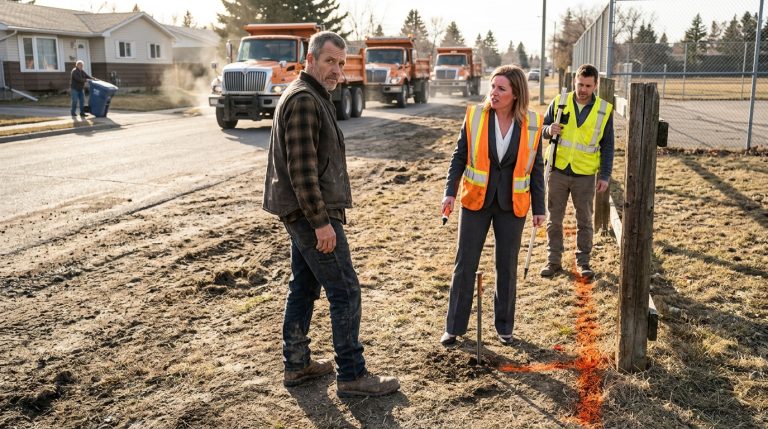
Deep, fresh tire tracks churned straight through my landscaped Bermuda grass, tearing toward the street.
Whoever took it didn’t use a hand truck; they dragged six hundred pounds of commercial iron straight into the back of a flatbed trailer.
I picked up the severed brass shackle from the dirt, rolling the sharp, notched cut mark against my thumb.
The heavy metal felt cold against my skin, hard and jagged enough to bite into the callus.
I followed the churned dirt onto the asphalt, keeping the flashlight beam low against the pavement.
The black tire marks turned hard left at the corner, aiming straight for the Desert Vista community clubhouse three blocks down.
Above the palm trees in the distance, a harsh white glare washed out the stars.
High-power floodlights were blazing over the clubhouse parking lot, running on a deep, familiar motor rumble that vibrated right through the soles of my work boots.
I shoved the cut lock deep into my pocket, my thumb pinned against the sliced edge as I walked toward the light.
CHAPTER 2: THE REQUISITION MASK
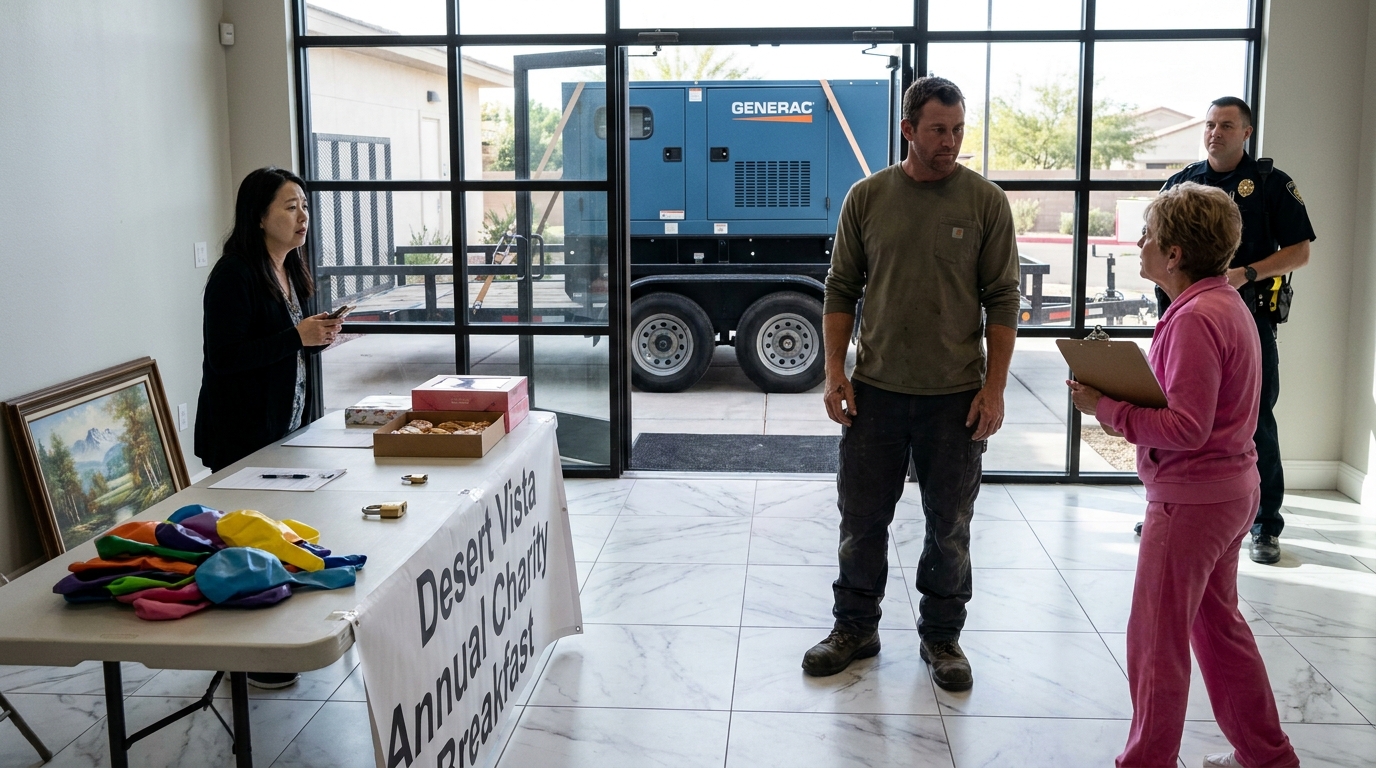
Inside, the clubhouse smelled like powdered sugar, cheap latex balloons, and fresh carpet grease.
A oversized vinyl banner reading Desert Vista Annual Charity Breakfast hung crooked over the main fireplace, half-obscuring the brass HOA plaque underneath.
I stopped five feet inside the doorway, my thumb still digging into the severed edge of the brass shackle in my pocket.
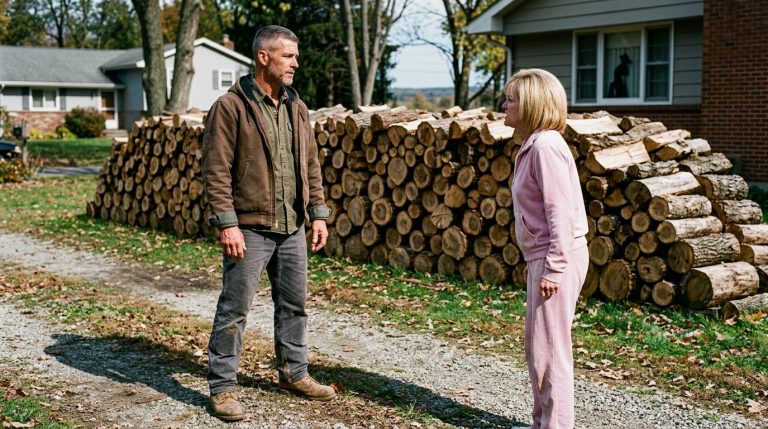
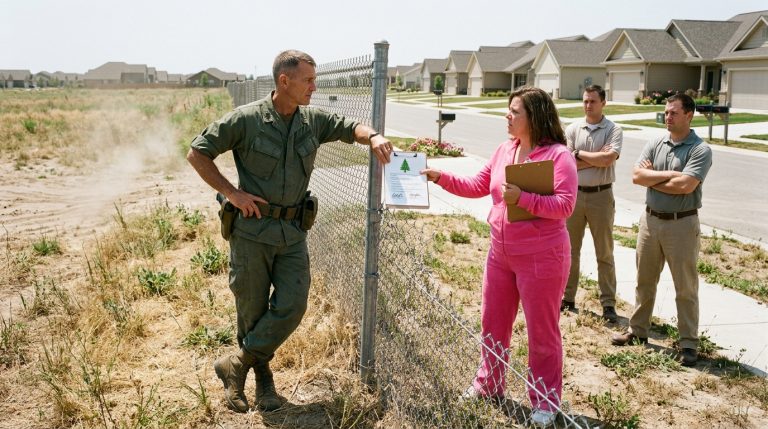
Patricia Williamson stepped out from the kitchen holding a white plastic clipboard, her pink tracksuit rustling with every clipped stride.
She stopped, tapped her dry-erase marker against the top clip, and squinted at me like I was a muddy dog on her imported tile.
“Lucas,” she said, her voice carrying that practiced, brittle cheer she used for budget meetings. “What on earth are you doing here at four in the morning?”
I didn’t answer right away; I just looked past her shoulder out the floor-to-ceiling glass doors, where two black extension cords snaked from my Generac on the trailer straight through the kitchen window.
“That’s my machine outside,” I said.
Patricia didn’t even blink. “We requisitioned it.”
“You cut my gate lock,” I said, my voice staying flat, low, and level. “You drove a flatbed onto my Bermuda grass, sheared my copper leads, and hauled my private property off my land.”
“The clubhouse standby system experienced a critical mechanical failure at midnight,” she said, shifting the clipboard to her hip like a shield. “Over two hundred regional donors are arriving at six. We have caterers coming, refrigerated trucks arriving, and state representatives on the guest list.”
“That doesn’t give you the right to break into my yard.”
“The board has emergency override authority during catastrophic infrastructure failures that threaten community assets,” she replied, her chin tilting up just enough to catch the chandelier light. “It’s in the civic bylaws, paragraph four. We are hosting a non-profit event that reflects on the entire reputation of Desert Vista Estates.”
I drew a deep, slow breath, feeling the cold brass cut into the meat of my thumb inside my jacket. “My generator isn’t a community asset, Patricia. It’s a twelve-thousand-dollar private installation.”
“And we are going to return it the second the luncheon concludes at two o’clock,” she said, waving one manicured hand like she was sweeping away a fly. “I’ve already instructed the grounds crew to top off the diesel tank. We’ll even write you a formal letter of appreciation from the board.”
“You’re going to unhook it right now, or I’m calling the Scottsdale police department.”
Her smile froze, turning paper-thin. “You would disrupt a charitable function for two hundred people over a temporary inconvenience? Don’t be absurd, Lucas. Think about how that looks.”
As she adjusted her grip on the clipboard, the top paper fluttered in the air conditioning vent, briefly exposing a small yellow carbon receipt stub tucked underneath the main stack.
The bold black print at the top read Sunstate Equipment Co. — Commercial Rental Invoice, with a clean red CANCELLED stamp slapped across the center.
Before I could lock my eyes on the line items beneath it, the heavy glass doors swung open behind me, and Margaret Chen walked in carrying three stacked pastry boxes from the local bakery.
Margaret, our elected HOA treasurer, looked at me, then looked out the window at the blue machine running on the flatbed trailer, her face draining of color.
“Lucas?” Margaret set the boxes down on the registration table, her voice trembling slightly. “Patricia… why is Mr. Kendrick’s personal generator parked in the loading bay?”
“I handled the power contingency, Margaret,” Patricia said smoothly, pulling the clipboard flat against her chest. “As president, I exercised my administrative discretion to secure a power source after our secondary line dropped.”
“You said you rented one,” Margaret whispered, her eyes wide as she looked between us. “At yesterday’s emergency session… you withdrew two thousand dollars in emergency petty funds from the treasury account specifically to secure a commercial rental from Sunstate.”
Patricia’s shoulder twitched, just for a fraction of a second, her fingers tightening so hard around the plastic frame of the clipboard that her knuckles turned white.
“The rental agency’s delivery truck broke down,” Patricia snapped, her voice dropping the cheerful mask and cutting through the quiet room like a blade. “I did what any responsible leader would do to save this neighborhood from embarrassment.”
I pulled my hand out of my pocket, walked forward three measured steps, and set the sliced brass padlock silently onto the glass registration table right next to Margaret’s pastry boxes.
“She didn’t use a rental agency, Margaret,” I said. “She used three men with bolt cutters at one in the morning.”
CHAPTER 3: THE SHERIFFS LINE
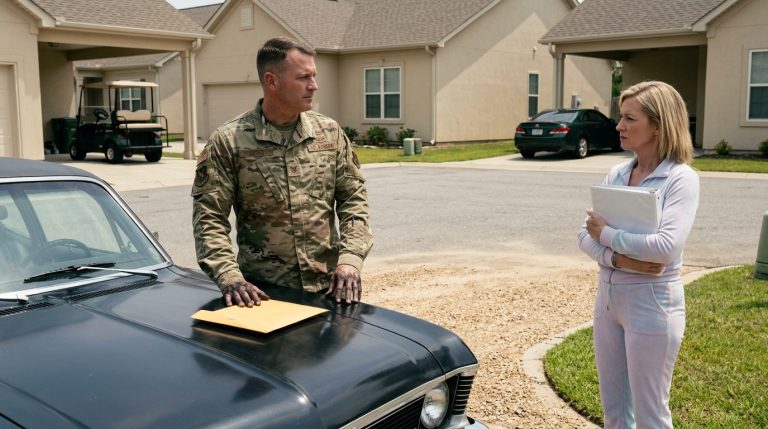
Officer Morrison stepped into the lobby, his boots clicking evenly across the tile.
He didn’t rush; he took in the folded tables, the balloons, Margaret’s pale face, and the cut brass padlock sitting on the registration counter.
“Morning,” Morrison said, adjusting his duty belt. “Got a call about a commercial generator towed off private land.”
“Officer, thank goodness,” Patricia interjected immediately, taking two fast steps forward and extending her clipboard like a badge of office. “I am Patricia Williamson, HOA Board President. We’re hosting a major civic fundraising breakfast here at six o’clock, and we had an urgent operational contingency.”
Morrison didn’t take the clipboard; he stepped past her to the window, looking out at the flatbed trailer where my Generac sat humming.
“Is that the unit?” Morrison asked, looking back at me.
“Custom blue casing, LK stenciled on the back panel,” I said, pointing through the glass. “They cut the lock on my side gate at two in the morning, hauled it off my concrete pad, and severed my primary electrical lines.”
Morrison turned his eyes slowly back to Patricia. “Did you have Mr. Kendrick’s permission to enter his property and disconnect his equipment?”
“We exercised administrative authority under emergency conditions,” Patricia said, her voice rising half an octave into that sharp, defensive register. “The board authorized an emergency procurement yesterday afternoon. The neighborhood’s civic reputation was on the line.”
“Emergency procurement doesn’t grant authority to cut locks on private real estate, ma’am,” Morrison said quietly. “Unless you have a warrant signed by a county judge, taking equipment from a resident’s yard without consent is criminal trespass and grand theft.”
Margaret stepped up to the counter, her hands visibly trembling as she pulled out her phone.
“Officer,” Margaret said, her voice tight. “As board treasurer, I need to state for the record that the board never authorized taking private property. Yesterday at four PM, we approved a two-thousand-dollar cash withdrawal specifically to rent a industrial diesel unit from Sunstate Equipment.”
She turned directly to Patricia, her eyes narrow and sharp.
“Patricia, if you took Lucas’s generator for free… where is the two thousand dollars cash you withdrew from the community account yesterday evening?”
Patricia’s face went completely rigid, her nostrils flaring as she clutched the white clipboard flat against her throat.
A sharp, awkward silence settled over the room, heavy enough that you could hear the low thrum of the extension cords vibrating against the window frame.
“The rental agency cancelled at the last minute,” Patricia stammered, her heels clicking back a half-step. “The funds are… accounted for in the administrative contingency envelope.”
“Show him the receipt stub under your top sheet, Patricia,” I said flatly.
Morrison looked down at her clipboard. “Ma’am, let me see that paperwork.”
With her jaw locked tight, Patricia pulled the yellow carbon slip from behind the stack and handed it over, her fingers twitching as Morrison scanned the bold CANCELLED stamp across the line items.
“Mr. Kendrick,” Morrison said, handing the paper back and looking me dead in the eye. “Your name is on the property, the lock is cut, and there is no authorization on file. Do you want to press formal criminal charges against Ms. Williamson?”
Patricia took a quick, shallow breath, stepping into my line of sight. “Lucas, if you do this, you destroy this event. You ruin months of community work over a simple misunderstanding.”
I looked at the cut lock on the table, then at Margaret, who gave me a single, firm nod.
“Write the citation, Officer,” I said. “And I want my equipment back on my property before six AM.”
CHAPTER 4: THE TRAIL CAM TRAP
The small infrared lens I’d hidden in the saguaro cactus three weeks ago didn’t capture smooth motion; it recorded crisp, motion-triggered bursts at ten frames per second.
Frame one: a dirty white Ford F-250 backing down my gravel driveway without its headlights on.
Frame two: two men in dark work shirts stepping out, one carrying a thirty-inch pair of long-handled bolt cutters directly toward my side gate.
Then came the third frame, and my jaw tightened so hard a sharp ache ran straight up into my temple.
A dark metallic BMW X5 pulled up onto the curb behind the truck, blocking my driveway.
The driver’s door swung open, and Patricia Williamson stepped out under the streetlamp’s amber glare.
She wasn’t wearing her pink tracksuit; she had on a black windbreaker, her hair tied back in a tight bun, holding a high-lumen tactical flashlight in her left hand.
The video clip ran for forty-two seconds.
You could see her pointing the beam directly at my Generac’s steel casing, gesturing impatiently with her hand while the two men severed the electrical leads and muscle-dragged the six-hundred-pound machine onto the flatbed trailer.
At 01:51 AM, she reached into her windbreaker pocket, pulled out a thick Manila envelope, and handed a stack of bills directly to the driver before getting back into her BMW.
I paused the video on frame seventeen.
Her face filled half the screen, illuminated by the flashlight beam as she personally checked the cut lock on the ground.
There was no ambiguity. No administrative oversight. No emergency board proxy.
It was a pre-meditated, late-night property breach directed personally by the sitting president of Desert Vista Estates.
I plugged a USB flash drive into the front tower port, dragged the raw video file into the transfer window, and watched the progress bar hit one hundred percent.
My phone buzzed against the desk pad.
It was a text from Margaret Chen: Emergency Board Meeting called for 7:00 PM tonight at the clubhouse. Patricia claims she has legal council and intends to vote you out of the community pool and recreation access for ‘disrupting civic functions.’
I picked up the flash drive, closed my laptop, and slipped the small metal drive into my front jeans pocket right alongside the cut brass shackle.
“See you at seven, Patricia,” I said to the quiet room.
CHAPTER 5: THE BOARDROOM EXECUTION
Forty residents packed the metal folding chairs, their quiet whispers dying down as Patricia leaned into the microphone.
“This emergency session of the Desert Vista Board of Directors is now in order,” she said, her voice amplified, artificial, and dripping with authority. “Item one on tonight’s agenda is the formal vote to censure resident Lucas Kendrick for malicious interference with community operations and filing a false police report against board leadership.”
I stood leaning against the back wall, my hands resting loosely in my pockets.
I didn’t interrupt; I let her talk.
For seven straight minutes, Patricia wove a story about civic sacrifice, ungrateful homeowners, and how my “uncooperative behavior” threatened the tax-deductible status of the entire neighborhood association.
When she finally paused to sip from a glass of ice water, Margaret Chen stood up from her seat at the end of the board table.
“Before we move to any censure vote,” Margaret said, placing a thick stack of printed bank statements on the desk, “the board needs to address a missing two-thousand-dollar cash withdrawal from yesterday’s emergency fund.”
Patricia set her glass down with a hard, sharp clack. “That administrative detail is under internal audit, Margaret. We are discussing Mr. Kendrick’s hostility toward this board.”
“It’s not an administrative detail,” I said, stepping away from the back wall and walking slowly down the center aisle.
The room turned to watch me.
I pulled the silver flash drive from my pocket and set it squarely in front of the board’s projector laptop on the front table.
“Plug it in, Margaret,” I said.
“I command this board not to access unverified external media!” Patricia shouted, slamming her hand down onto the oak desk so hard her microphone shrieked with feedback. “This is an unauthorized disruption! Security will escort—”
“There is no security here, Patricia,” Margaret snapped, her fingers already slotting the drive into the USB port and double-clicking the single video file.
The main projector screen lowered from the ceiling, flickering to life in bright, high-definition infrared.
The entire room went dead silent.
On the twenty-foot screen, Patricia’s black BMW pulled into my driveway at 01:47 AM.
Clear as day, forty residents watched their board president direct two men with bolt cutters, shine her flashlight on my Generac, and hand a stack of hundred-dollar bills directly to the truck driver before collecting my severed padlock off the ground.
Gasps rippled through the audience.
Someone in the third row muttered, “She hired cut-throat contractors to rob a neighbor.”
Patricia stood up so fast her chair screeched violently backward against the tile.
“That video is an illegal invasion of privacy!” she shrieked, her face flushing a deep, mottled red as her polished mask shivered into pieces. “It’s a setup! I was securing emergency infrastructure for this community! You are all ungrateful—I saved this neighborhood!”
“You stole two thousand dollars from the treasury, pocketed the cash, and used a stolen machine to cover your track, Patricia,” Margaret said quietly, standing up and looking around the table at the three other board members. “I move for an immediate vote of no confidence to remove Patricia Williamson as President and strip her of all executive board powers, effective immediately.”
“Seconded,” the vice president murmured without even looking at Patricia.
“All in favor?” Margaret asked.
Four hands went up instantly—every single board member except Patricia.
Patricia stood frozen at the center of the dais, breathing heavily, her clipboard clutching her chest like a broken shield as forty of her neighbors watched her power evaporate in total, suffocating silence.
She shoved her paperwork messily into her bag, turned on her heel, and stormed out the side exit, the heavy metal door slamming shut behind her with a definitive bang.
CHAPTER 6: THE QUIET CIRCUIT
I sat on the low concrete retaining wall beside my house, a clean microfiber cloth in my hand, wiping down the top steel housing of my Generac unit.
The machine was back on its concrete pad, re-anchored with four fresh steel bolts, its heavy-duty conduit cleanly spliced and sealed with waterproof conduit tape.
A new, heavy-duty hardened steel lock hung through the gate latch, cold and solid under my palm.
Footsteps crunched across the dry gravel driveway behind me.
I turned my head. Margaret Chen was walking down the side path, wearing a comfortable cardigan and holding a small velvet-lined box under her arm.
“Evening, Lucas,” she said, stopping a few feet away with a soft, tired smile.
“Margaret,” I said, setting the rag down on the generator’s blue casing. “How’s the new board holding up?”
“We finished auditing the treasury accounts this afternoon,” she said, leaning slightly against the wooden gatepost. “Patricia accepted a plea agreement with the Maricopa County prosecutor yesterday morning. She pled guilty to misdemeanor theft and property damage.”
I nodded once, quiet and attentive.
“Probation, two hundred hours of community service, full restitution for your wiring repairs,” Margaret continued, her voice steady and clear. “And the judge barred her from serving on any municipal or homeowner association board in Arizona for the next five years.”
“That sounds fair,” I said. “Rules ought to apply to everyone, regardless of the title on their door.”
“She moved her house onto the market on Tuesday,” Margaret added, offering a subtle, wry half-smile. “Turns out it’s hard to order neighbors around when everyone knows you spent a night getting processed at the Scottsdale precinct.”
She reached forward and handed me the small velvet box.
I popped the brass latch open.
Inside sat a small, polished silver plaque mounted on solid walnut wood.
The engraved lettering read: Presented to Lucas Kendrick by the Residents of Desert Vista Estates — For Standing Up for What Is Right and Restoring Common Sense to Our Community.
I held the weight of the wood in my hands for a moment, looking down at the clean silver finish.
“I didn’t do it to get a plaque, Margaret,” I said softly.
“We know,” Margaret said, placing her hand gently on my shoulder. “That’s exactly why you earned it.”
She gave my shoulder a quick squeeze, turned around, and walked back down the gravel drive toward the street, her footsteps fading into the quiet desert twilight.
I stood up, walked inside my side door, and set the walnut plaque on the shelf in my office, right beside the security system’s diagnostic monitor.
The digital screen glowed steady green.
All Systems Operational. Grid Connected. Backup Ready.
I walked back outside, stepped up to the generator enclosure, and pushed the steel access door shut until the heavy latch clicked firmly into place.
I clicked the new padlock shut, pulled the key, and slipped it into my jeans pocket.
The desert night settled around the house, still, dark, and completely peaceful.