The Weight of Water: How a Quiet Civil Engineer and a Four-Generation Stone Dam Outlasted the Paper Empire of Maplerest Hollow
CHAPTER 1: The First Fine Notice
The ink on the letterhead was a sharp, corporate blue that had no business being anywhere near Sycamore Creek.
Daniel stood on the threshold of the back porch, his weight shifted onto his left heel where the rubber had worn completely off the sole of his boot, exposing the grey ribbed foam underneath. The sun had not yet cleared the eastern ridge, leaving the lower pasture in a flat, slate-colored shadow where the frost still clung to the dead goldenrod. In his right hand, he held the paper; in his left, the metal handle of a galvanized bucket filled with cold water and wire brushes.
He did not curse. He did not tighten his grip until the paper crumpled. He simply smoothed the sheet against his thigh with the palm of a calloused hand and read the figures again.
Three hundred and fifty dollars.
The citation number was stamped with an automatic numbering machine, crisp and uniform, referencing a code section that did not apply to land deeded before the county had a zoning board. He knew the section by heart now, not because he was a lawyer, but because he was a hydrologist who spent twelve years reading federal code for the Army Corps of Engineers. When you spend enough time looking at documents written by people who have never stood waist-deep in a fast-running creek, you learn to spot the empty air built into the paragraphs.
From forty feet away, the mill pond caught the early, pale light. It was dead calm, a sheet of gray glass reflecting the bare branches of the sycamores lining the upper bank. Beneath the surface, completely invisible from where he stood, the four-foot granite blocks his great-grandfather had hewn from the ridge in 1909 held their ground against the silt. They had held through the flood of nineteen-seventy-six. They had held through the drought of eighty-eight. They had held through twenty-six years of his father running the farm with a quiet, stubborn rhythm that required no permits and answered to no board of directors.
The screen door groaned behind him. He didn’t turn around. He could hear the gravel crunching under a pair of lightweight loafers—shoes with smooth rubber soles that had no grip on loose shale.
“You got one too, didn’t you?”
It was Gerald’s voice, though Gerald didn’t usually drive out this early unless a fence line had come down or the county road crew had dumped ditch slag across the utility easement.
Daniel folded the letter twice, sliding it into the breast pocket of his canvas work shirt alongside a stub of a carpenter’s pencil. “Third one this month,” he said, his voice level, dropped into the register he used when briefing regional commissioners who wanted to cut corners on a spillway design. “This one has a docket number attached. They’re moving from letters to administrative fees.”
Gerald walked up the two wooden steps, his hands shoved deep into the pockets of an old wool jacket that smelled of sheep dip and pipe tobacco. He looked past Daniel’s shoulder, down at the flat, gray water of the mill pond, then over the ridge toward where the rooflines of Maplerest Hollow peeked above the tree line like rows of white teeth biting into the green slope.
“Sandra Puit doesn’t care about the fine, Daniel,” Gerald said quietly, shifting his weight. “She cares about the paper trail. Every time you send a check or a formal rebuttal, her attorney files it into a cumulative index. By the time they get in front of Judge Beckett, they won’t be arguing about water flow. They’ll be arguing that you’ve acknowledged their jurisdiction by responding to it.”
Daniel reached down, picked up his bucket, and felt the iron bail bite into his palm. The water inside sloshed against the zinc, cold enough to numb his knuckles.
“They don’t have jurisdiction,” Daniel said.
“Jurisdiction is just who has the loudest printer,” Gerald replied, staring down at his loafers with a dry, tired twist of his mouth. “And right now, she’s printing by the ream.”
Daniel looked past him, down the long corridor of the creek bed where the water hummed against the stone dam with a low, steady vibration he could feel through the soles of his boots. He reached into his pocket, his thumb brushing the edge of the folded paper, feeling the sharp, clean cut of the corporate margin against his skin.
“Let her print,” Daniel said.
CHAPTER 2: The Sound of Closed Doors
The kitchen smelled of stale chicory coffee and the faint, mineral reek of well water that had sat too long in the galvanized pipes. Daniel dropped the heavy metal bucket by the back sink, the water sloshing over the rim to form a dark, spreading star on the linoleum floor. He didn’t wipe it up. He pulled out a wooden chair—one of the ladder-backs his grandfather had turned on a lathe in the barn lean-to—and sat down with his ledger open to yesterday’s date.
The house was quiet, but it was the kind of quiet that felt occupied. Every old timber in the ceiling joists expanded and contracted with the morning damp coming up off the valley floor, creaking like a ship’s hull settling at anchor. On the sideboard sat his father’s ledger, a leather-bound book with cracked corners where the calfskin had dried and split during the summer heat waves of the early nineties.
Daniel opened his own blue binder—the current one, labeled with a black Sharpie in block letters: MAPLEREST HOLLOW / DRAINAGE & CORRESPONDENCE—and smoothed the latest fine notice beside the previous three.
The paper was thicker than standard bond. Corporate stationery. It had a faint watermark of a stylized oak leaf near the bottom right corner, visible only when tilted toward the pale light filtering through the small, wavy panes of the kitchen window. Sandra Puit had chosen her materials well. Everything about the correspondence was designed to simulate the heavy, unyielding weight of municipal authority, even though the return address was a post office box in town and the signature block belonged to an LLC registered out of a strip mall off the highway.
He picked up his pen, a heavy brass-barreled Parker that his father had carried through twenty years of agricultural extension meetings, and wrote the date and time in the top margin: April 14, 07:15.
Beneath that, he began a bulleted list of the discrepancies in the citation.
The code section cited—Article IV, Section 12 of the municipal watershed ordinance—applied strictly to artificial diversions constructed after the incorporation of the Maplerest Hollow subdivision in nineteen-ninety-four. The stone dam on the olden property line had been anchored into the ridge granite in nineteen-09. Eighty-five years of prior legal existence. A basic title search, the kind any competent paralegal could pull in twenty minutes at the county clerk’s office, would have shown the original land patent signed by the governor when Tennessee was still logging white oak out of the coves by mule team.
Sandra knew that. Gerald knew that. The question wasn’t whether the citation had legal legs; the question was how many reams of paper she intended to force him to file before the county commissioners grew tired of tossing her complaints into the municipal recycle bin.
A sudden memory pulled at the corners of his focus—his father, back in the drought of ninety-eight, standing knee-deep in the shrinking mill pond with a trowel of lime mortar, shouting over the rattle of the old Case tractor about how water always finds the path of least resistance, whether you pave it or dam it. His father hadn’t worried about ordinances. He had worried about the clay drying out and cracking the stone core.
Daniel set the pen down. The brass barrel was cold against his fingers.
The kitchen door didn’t latch right unless you threw your hip against it, a habit he hadn’t broken since moving back from Nashville. The rattle of gravel in the lane outside brought his head up. Not Gerald’s truck—too light, too fast. The high-pitched whine of a catalytic converter cooling down against the wet grass.
He didn’t get up. He watched through the wavy glass as a white Lexus SUV rolled to a stop beside the weathered timber fence of the lower paddock. The driver’s door swung open with a crisp click, and a woman in a beige trench coat stepped out, her heels sinking half an inch into the soft mud of the vehicle turnaround.
Sandra Puit didn’t carry an umbrella, despite the low, bruised belly of the cloud cover sitting directly over the ridge. She adjusted the lapel of her coat with one gloved hand, her gaze lifting past the pasture, past the empty cattle loading chute, straight toward the stone dam where the water hummed against the granite.
Daniel sat motionless in the ladder-back chair. He watched her pull a small leather-bound notebook from her pocket, click a silver pen against her thumb, and begin to write something down while staring directly at the spillway.
The house remained dead silent except for the low, rhythmic drip of the faucet into the zinc sink. He didn’t go to the door. He picked up his pen again, turned to a fresh page in the blue binder, and wrote: 07:42 – Unannounced site inspection by S. Puit. Unauthorized presence on approach easement.
He didn’t look up again until the Lexus engine turned over, whining once before spitting gravel down the lane toward the county road.
CHAPTER 3: The Secret Trespass
Daniel did not touch his coffee cup. He stood up from the ladder-back chair, the pine legs scraping against the worn linoleum with a dry, protesting shriek.
The mud outside was still soft enough to hold a cast. He walked out through the back door, leaving it unlatched, and stepped directly onto the print Sandra Puit’s heel had left beside the porch step. It was a shallow depression, clean-edged and shallow, pressed by a rubber-soled designer boot that knew nothing about the weight of clay. Beside it, however, running parallel to the rusted wire of the south pasture fence, were twin tracks of a heavier tread—wide, industrial lug patterns that did not belong to a delivery truck, a tractor, or anyone living on the ridge.
He followed the tracks on foot, his stride measured and deliberate. The ground sloped downward toward the narrow gut of the creek where the banks steepened and the shade of the old oaks kept the frost from burning off until noon.
The physical evidence of intrusion was subtle if you weren’t looking for it. A snapped branch of multiflora rose, the bruised stem of a winter creeper vine, and a scattering of fresh, damp clay kicked up onto the dry leaf litter. Someone had driven down here within the last forty-eight hours—probably late Sunday night when the county road was clear of milk tankers and school buses. They had parked behind the thicket of sumac where the old barn’s shadow cut the pasture in half, out of sight from the main house.
Daniel stopped at the edge of the creek bank, just upstream from the granite spillway.
The water here ran fast and black over the limestone shelf, hissing softly against the moss-covered boulders. He crouched down, his knees popping in the quiet morning air, and inspected the soft soil at the base of the eastern abutment. A pair of rubber boot prints—larger than Sandra’s, deep and square-heeled—overlapped the tracks of a small tripod.
They hadn’t just looked at the dam. They had measured it.
He pulled a small pocket notebook from his shirt pocket, uncapped the carpenter’s pencil with his teeth, and jotted down the coordinates of the soil compaction, noting the width of the tread and the exact distance from the anchor stone. In his twelve years with the Army Corps, he had seen landowners try every trick in the book to bypass federal easement laws, but this wasn’t federal work. This was private reconnaissance, dressed up in the clean, sanitized language of a neighborhood civic association.
A sharp rustle in the dry brush across the creek made him snap his head up.
Nothing. Just a gray squirrel scrambling up the rough bark of a sycamore, its claws clicking against the dry wood before disappearing into a hollow fork. But the brief twitch of adrenaline lingered, cold and metallic at the back of his throat. They were building their case file on his land while he was busy building his own on paper.
He stood up slowly, wiping a smear of dark loam from his thumb onto the thigh of his work pants. He looked down at the mill pond. The surface was completely still again, mirroring the heavy, bruised gray of the sky.
If they had brought a tripod down here, they had taken photographs of the mortar lines he had spent three freezing weekends repairing back in November. They were looking for hairline fractures, for lime leaching, for anything that could be photographed out of context and handed to a retired contractor who would sign his name to whatever paper put a price tag on a century of stone work.
Daniel turned his back on the creek and walked back toward the house, his boots sinking a fraction of an inch deeper into the clay with every stride.
He didn’t call Gerald immediately. Not yet. You didn’t waste a lawyer’s time on tire tracks and broken briars. You waited until the picture was sharp enough to frame. Inside the mudroom, he pulled a heavy black plastic case down from the top shelf of the utility closet—an old Pelican case containing two motion-activated trail cameras he had used during the watershed mapping project down in the delta three years ago.
He checked the battery compartments, slid fresh lithium cells into both slots, and loaded two 32-gigabyte cards into the memory slots. If they had come down the pasture once while the ground was soft, they would come back. People who rely on paper tend to get sloppy when they think the paperwork is finally going their way.
He bolted the first camera to the crook of an old walnut tree fifty yards downstream from the spillway, aiming the lens directly at the approach path where the tire tracks had bitten into the sod. The second he mounted higher up, hidden among the dry boughs of a dead pine overlooking the access gate.
When he finished, he wiped his hands on an oily rag, walked back to the kitchen table, and opened the blue binder to a clean page.
April 14, 09:10, he wrote. Physical inspection of south fence line. Evidence of unauthorized vehicular access and tripod placement near eastern abutment. Surveillance countermeasures deployed.
He capped the pen, the click sharp and final in the empty room, and stared out the window toward the gray water waiting in the valley.
CHAPTER 4: The 31Page Model and the Eve of the Excavator
The rain started three days later, not with a sudden squall or the theatrical roll of thunder over the ridge, but with a flat, grey mist that settled into the upper hollow and stayed there.
Daniel sat at the kitchen table with his laptop plugged into the heavy surge protector by the baseboard, the screen casting a pale, rectangular glow across his cheekbones. Before him lay the completed draft of the flood model—thirty-one pages of calculations, elevation profiles, and watershed runoff projections that mapped every cubic foot of discharge Sycamore Creek would hurl toward Maplerest Hollow if the granite dam were breached.
He didn’t rush the keystrokes. Every formula was cross-referenced against the United States Geological Survey streamflow records dating back to nineteen-seventy-five. If Sandra Puit’s attorney wanted to argue negligence in a circuit court, they would have to get past the mathematics of a two-inch rainfall event channeled through a restricted forty-foot concrete culvert.
The heavy oak front door rattled in its frame as a gust of wet wind swept down the valley, smelling of wet cedar and cold mud. Daniel didn’t look up from the spreadsheet. He reached out blindly, his fingers closing around the cold ceramic mug of chicory coffee, only to find it empty.
Before he could stand to refill it, a dull metallic clink echoed from the front porch—not the sound of a fist against wood, but the sharp, flat ring of metal hitting the concrete stoop.
He stood up, his joints popping in the silence, and walked through the dark, high-ceilinged hallway to the front door. He didn’t turn on the porch light. He pulled the heavy wooden panel inward just an inch, his eye pressed to the narrow vertical gap of the jamb.
A man in a yellow slicker was hurrying down the gravel path toward a faded blue pickup idling by the mailbox without its lights on. In his hand, the man carried a small black device—a casing identical to the trail camera Daniel had mounted to the walnut tree three days ago.
Daniel didn’t shout. He pulled the door open the rest of the way, stepping out onto the wet concrete in his wool socks, feeling the damp chill bite straight through the wool.
“Looking for something?” his voice carried across the yard, flat and devoid of anger, cutting through the steady hiss of the drizzle.
The man in the slicker froze with his hand on the truck’s door handle. He half-turned, his face half-shadowed by the hood of his yellow coat, revealing the weathered, sharp features of an older local—the same unlicensed contractor who had authored Sandra’s original structural assessment. He didn’t speak. He tossed the plastic casing onto the passenger seat, hauled himself into the cab, and threw the truck into reverse tires spraying wet gravel in a wide arc before fishtailing out onto the county road.
Daniel walked slowly down the steps, his socks instantly soaked by the puddles on the drive. He stopped at the edge of the walnut tree where the camera should have been bolted.
The brass screws lay scattered in the wet weeds like discarded teeth. The housing was gone. But as he bent down to inspect the stripped bark where the mounting bracket had been wrenched free, he noticed something the contractor had dropped in his hurry: a folded sheet of heavy white stationery bearing the unmistakable oak-leaf watermark of the Maplerest Hollow HOA.
He picked it up, unfolding it with stiff, cold fingers. It was an internal memo, handwritten in a hurried, precise cursive that belonged unmistakably to Sandra Puit. Verify intake capacity at Culvert B before the April 9 filing, it read. If Olden submits the model to TDEC, the injunction must be filed by Friday morning regardless of structural merit.
Daniel stared at the paper for a long, silent moment while the rain soaked through the shoulders of his work shirt. They weren’t just trying to bully him off the land anymore; they were racing against their own ignorance, terrified that the math would catch up to them before the court date.
He folded the paper twice, slid it into his breast pocket alongside the carpenter’s pencil, and turned back toward the warm rectangle of light spilling from the kitchen door. The file was four binders thick now. It was heavy enough to break a table leg.
He sat back down at the desk, plugged the flash drive containing the complete thirty-one-page impact analysis into his laptop, and clicked the print icon. The printer hummed to life, a steady, mechanical grinding that echoed through the empty farmhouse. He printed four copies—one for Sandra’s attorney, one for the Harland County Planning Commission, one for the state environmental division, and one to slide into the fourth binder on his shelf.
The clock on the wall read eleven-fifteen. Outside, the rain beat a relentless, rhythmic tattoo against the cedar shingles, a sound as old as the ridge itself. He closed the laptop, leaned back in the wooden chair, and waited for the morning.
CHAPTER 5: The FourHour Fracture
The morning of April ninth smelled of wet iron and crushed shale.
Daniel stood twenty feet back from the eastern abutment of the stone dam, his hands shoved deep into the pockets of his canvas jacket. The damp cold of the valley floor had risen into his shins, turning his joints stiff, but he didn’t shift his weight. Beside him, the excavator sat with its iron bucket resting heavily against the mud of the creek bank, the diesel engine rumbling with a steady, concussive thump that rattled the loose gravel around his boot heels.
The operator was a local man named Miller—a graying contractor with a weathered neck who had spent thirty years cutting ditches through the county slate. When Daniel had walked out to meet him at first light, Miller had touched the brim of his yellow hard hat, looked past him toward the mill pond, and kept his mouth shut. He didn’t offer a greeting, and he didn’t look Daniel in the eye. He didn’t have to. Everyone within twenty miles knew whose stone was being broken, and everyone knew whose paper had forced the order.
“Whenever you’re ready,” Daniel had said.
That was two hours ago. Now, the face of the nineteen-nine granite was no longer a wall; it was a scar.
The excavator’s hydraulic arm dropped, the steel-toothed bucket biting hard into the lime mortar joints that Daniel had spent three freezing weekends repointing back in November. There was no theatrical explosion, no sudden cinematic collapse. Instead, there was the dull, heavy groan of stressed stone meeting hydraulic force—a sound like thick ice breaking under a heavy boot. A section of the upper course cracked, the ancient mortar turning instantly into gray dust before two blocks of hand-hewn granite slid down the face and splashed into the running water below.
The water didn’t rush immediately; it pooled behind the breach for a fraction of a second, heavy and confused, before finding the new gap. Then the drainage began.
The mill pond, which had held its level stable through four generations of dry summers and spring cloudbursts, dropped an inch in the first minute, then three, then a foot. The surface began to swirl into a gray, muddy funnel as the central current pulled toward the broken weir. With the water went a century of accumulated silt, leaves, and organic debris, turning the clear flow below the dam into a thick, chocolate-colored slurry that smelled of old river bottom and decaying oak mast.
Daniel kept his hands in his pockets, his fingers curled around the heavy wooden handle of his pocket knife. He watched the water level drop against the stone pilings, measuring the speed of the drawdown against the discharge curves he had calculated in his thirty-one-page model. It was matching the projection almost to the minute. The mathematics didn’t care about the poetry of the pond; they only cared about cross-sectional area and velocity.
By eleven o’clock, the pond was gone.
What remained between the granite banks was a raw, wet trench of grey-brown mud, littered with stranded creek stones, water-logged branches, and the jagged, exposed roots of sycamores that had spent a century drinking from the standing pool. In the center of the basin, exposed to the pale mid-morning glare, lay the original foundation cuts his great-grandfather had chiseled into the solid bedrock ridge during the summer of nineteen-09.
Miller cut the excavator engine. The sudden silence that rushed in to fill the valley was heavy, broken only by the steady, rushing hiss of the creek cutting its way through the center of the emptied mud basin.
The operator climbed down from the cab, his boots squelching in the fresh silt. He wiped his forehead with an oily rag, walked over to the edge of the raw trench, and spat into the mud.
“That’s she, then,” Miller said, his voice gravelly and low.
“That’s it,” Daniel replied.
He didn’t stay to watch the crew pack up their lines. He turned his back on the emptied basin, walked up the long slope of the pasture toward the house, and pulled the HOA memo from his pocket. The paper was already damp around the edges, soft from the moisture of his palm. He walked into the kitchen, dropped the paper onto the open page of the fourth binder, and sat down to wait for the rain that the radar models had already mapped over the Cumberland Plateau.
CHAPTER 6: The Spring Rains and the Rising Water
The rain didn’t taper off; it settled into the valley with a gray, unrelenting density that turned the red clay roads into slick ribbons of grease.
Daniel stood at the kitchen window, his palms resting flat against the cool, wavy glass. Down in the hollow, where the mill pond used to catch the early morning light, there was only the grey, churning torrent of Sycamore Creek rushing unobstructed through the raw gash of the emptied basin. Without the stone barrier to slow its initial surge, the water had clawed outward, chewing deep into the raw clay banks of the lower pasture and dragging silt down toward the narrow bottleneck where the valley narrowed before spilling out onto the Maplerest Hollow flood plane.
His phone buzzed on the counter—a single text message from Gerald: Harland County dispatch is logging calls from the lower subdivision. Basements taking water. Drainage culverts maxed out.
Daniel didn’t reply. He picked up his rubber boots, pulled them on over his wool socks without sitting down, and stepped out onto the porch.
The air smelled of wet earth and crushed limestone. By the time he walked the fence line toward the southern boundary, the creek was running three feet above its normal spring baseline, brown and thick with debris. It moved with a brutal, uninterrupted velocity that made the dry grass along the bank shudder. Every cubic foot of water that the old stone dam once would have held back over a four-to-six-hour detention window was now hammering downstream all at once, a concentrated hammer blow hitting the concrete-lined overflow channels of Maplerest Hollow less than a mile below.
He didn’t feel triumph. He didn’t feel the sharp, bitter spark of vindication. He felt only the heavy, grinding logic of physics playing out its final equation. You cannot pave over a flood plane, and you cannot legislate away the path of water.
By the following afternoon, the phone calls had turned into sirens. From the high ground of the north ridge, Daniel could see the flashing amber lights of utility trucks clustered near the entrance of Maplerest Hollow. A county road crew was trying to clear debris from Culvert B, but the water was already backing up over the curbs, spilling across driveways, and pooling four feet deep against the foundation walls of the lowest-lying homes.
Sandra Puit’s house sat directly on the eastern secondary channel. When the county emergency management report was filed three weeks later, it confirmed what Daniel’s thirty-one-page model had predicted down to the inch: fourteen inches of standing water had ruined her ground-floor drywall, warped her hardwood flooring, and soaked through the bottom shelves of the bookcase where she kept her HOA filing boxes.
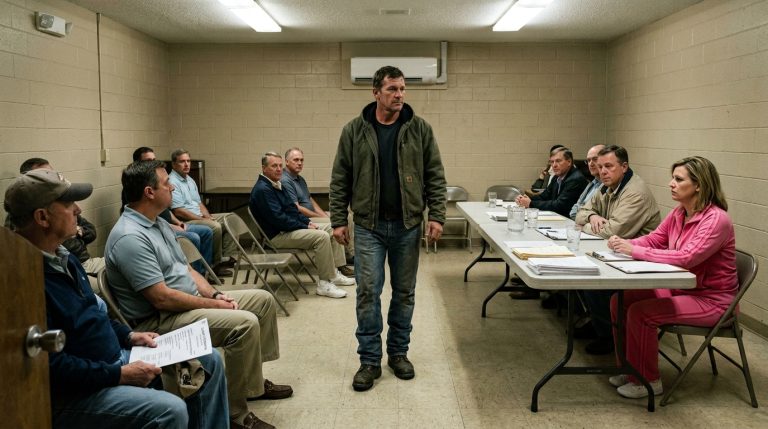
The legal fallout did not happen in a vacuum. Two weeks after the flood, during a special emergency meeting of the Maplerest Hollow homeowners, forty-one households voted to remove Sandra Puit as board president. The neighborhood Facebook page—once decorated with her champagne-toast photograph celebrating the dam’s removal—was flooded with scanned images of Daniel’s certified warning letters, posted by neighbors who realized too late that the paperwork they had dismissed as harassment was actually the only record that could have saved their basements.
Daniel spent that Tuesday afternoon down by the ruined basin, walking the raw edges of the creek bank with a wooden measuring stake.
The water had finally begun to recede, leaving behind a thick crust of dried silt over the exposed bedrock. He bent down and scraped a handful of the gray mud away from one of the original granite foundation blocks his great-grandfather had chiseled in nineteen-09. The stone was scarred by the excavator bucket, its sharp edges chipped and grey, but the anchor hole drilled deep into the ridge granite was still intact.
A pickup truck pulled up along the upper fence line, gravel popping under its tires. Gerald stepped out, leaving the engine idling, and walked slowly down the slope, his hands jammed deep into his wool coat pockets. He stopped a few feet away, looking at the empty mud trench where the mill pond used to be.
“She settled,” Gerald said quietly, his breath forming a thin wisp of white in the crisp air. “Thirty-one thousand five hundred. Covers the legal fees, the property damage from the bank erosion, and the cost of the hydraological study.”
Daniel stood up, wiping his muddy hands on an old rag. “Does she admit fault?”
“Her attorney wouldn’t allow it,” Gerald said, a dry, tired smile touching the corners of his mouth. “There’s no admission of wrongdoing in the text. But the check is drawn on the HOA’s reserve account, and the TDEC investigation into their filing practices is still wide open.”
“The check is fine,” Daniel said. He looked back down at the foundation stone. “The money isn’t what matters.”
“No,” Gerald agreed, turning his gaze toward the distant, shimmering roofs of Maplerest Hollow visible through the thinning line of sycamores. “The study matters. The new board president reached out this morning. Margaret Halt. A retired school teacher. She wants to contract a licensed engineering firm to evaluate the watershed properly—starting with the exact design specs you submitted back in February.”
Daniel nodded slowly. He reached into his pocket, his fingers brushing the smooth wood of the carpenter’s pencil.
“Tell her my rates for consultation are zero,” Daniel said, “provided they pull their own permits.”
Gerald let out a short, dry chuckle, turned collar pulled up against the wind, and walked back up the slope toward his truck. The engine note faded as he backed down the lane, leaving Daniel alone with the sound of the receding creek hissing against the exposed stone.
That evening, the sun finally broke through the heavy overcast, casting a long, pale golden light across the empty basin. Daniel walked to the barn, reached up to the high wooden shelf, and pulled down the heavy iron toolbox his grandfather had left him. Inside sat a jar of grey hydraulic lime mortar, a stiff-bristled brush, and a set of steel chisels.
He walked back down to the creek, sat down on a flat boulder beside the broken granite blocks, and began to chip away the shattered remnants of the old mortar along the foundation cut. The work was slow, methodical, and entirely quiet. By the time the shadows stretched long across the valley floor, the first stone was clean, squared, and ready to be set back into the bedrock. The water ran past his boots, cold and clear, following the path it had always known, back to where it belonged.