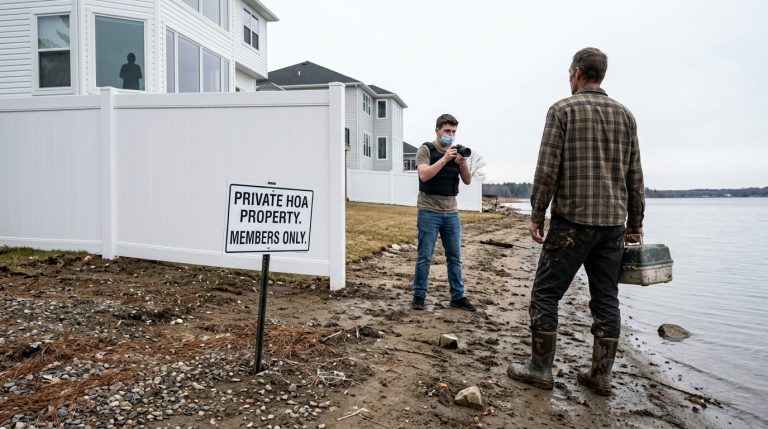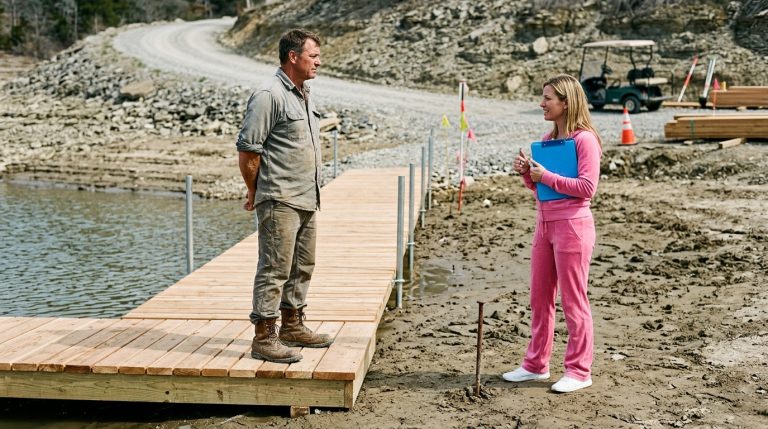
The Iron Boundary: Unyielding Property Rights, Hidden Surveillance, and the Fall of an HOA Tyrant
CHAPTER 1: The Rust on the Line
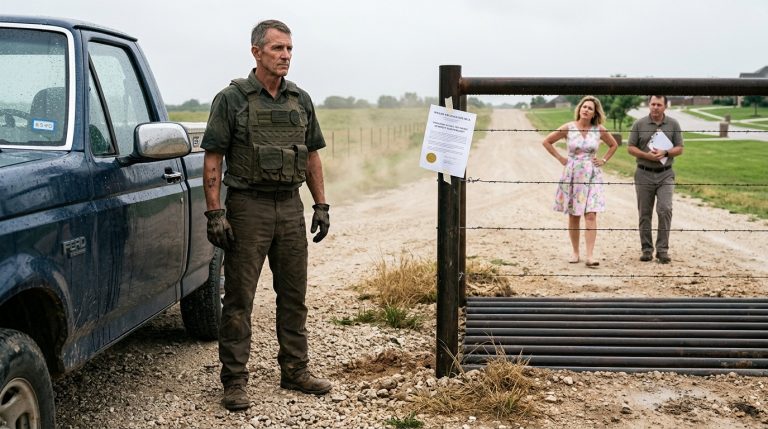
The dashboard clock read 2:47, glowing in the dim shadow of the cab. I left the gearshift in park, my thumb resting on the worn rubber knob, and watched the man with the hard hat tap a steel stake into the dry earth.
Three trucks choked the macadam of the lane, their mufflers popping as they idled. Between them stood Karen De La Croix, her clipboard pressed to her chest like a breastplate forged from bad aluminum and committee bylaws. She was pointing a manicured finger toward the old wooden fence—the one my grandfather had pegged together with square-head nails back when this valley smelled entirely of crushed thistle and sheep manure.
A contractor in a faded high-vis vest knelt beside her, a can of aerosol marker shaking in his gloved fist. A bright, chemical orange welt hissed across the dry grass, cutting a straight, aggressive slash right over the edge of the winter rye.
They hadn’t heard the truck pull up over the grinding whine of the asphalt grader down on the county road. They were too busy dividing up dirt they didn’t own.
My phone buzzed against my thigh—a low, rhythmic double-pulse. Motion alert, camera two, east eave. The wide-angle lens mounted beneath the cedar shingles was already spinning its buffer, logging every decibel of their intrusion onto an encrypted hard drive locked in the den.
I didn’t step out of the cab. In twenty years of federal infrastructure compliance, you learn one immutable law before you ever open a file: never interrupt a trespasser while they are still busy documenting their own mistake. Let them drive the stake deep. Let them spray the grass. The more permanent they try to make the lie look, the heavier the anchor drops when you pull the chain.
Karen’s voice carried over the hood of the pickup, sharp as a rusted tin roof in a gale. “Once the posts are down here, the paving crew moves in Monday. Tie the park directly into the municipal turn-around. It cleans up the frontage.”
“And the owner?” the man with the hard hat asked, thumbing back his sweat-stained strap. “Old man by the deck?”
“He’s not an owner,” Karen snapped, her voice dropping into that smooth, practiced cadence she used whenever she was billing a fine to a mailbox painted the wrong shade of beige. “He’s an omission in the original plat. An oversight we’re correcting today.”
She turned, her eyes sweeping toward the front of my truck. For a fraction of a second, her gaze caught the windshield. She didn’t see me behind the polarized glare, but I saw the micro-twitch in her jaw—the sudden, uneasy friction of a woman realizing her script was missing a page, even if she couldn’t yet see who had torn it out.
I reached down and killed the engine. The silence that rushed back into the cab smelled of hot oil and dry dust. The first post was already down in the dirt, but the ground beneath it was harder than they knew, and the iron was biting back.
CHAPTER 2: The Fireproof Box and the Paper Trail
The engine ticking died away completely, leaving only the sound of my own slow breathing inside the cab. Karen was still standing by the edge of the orange spray-paint line, her shoulders rigid under her tailored blouse, her chin lifted in that defensive, automatic posture of someone who had never once been told no by anyone who mattered.
I didn’t rush. Rushing is for people who are reacting; waiting is for people who own the clock.
I pushed the door open, the old iron hinges giving off a familiar, dry groan that cut cleanly through the murmur of the contractors. The gravel crunched beneath my boots as I stepped down onto the edge of my own driveway. The air tasted of baked clay and the faint, chemical tang of the aerosol paint staining the dormant rye grass.
Karen turned her head sharply, her eyes narrowing as she registered my approach. She didn’t drop her clipboard; instead, she gripped it tighter, her knuckles whitening against the dark cardboard backing.
“Daniel,” she said, her voice dropping into that smooth, performative cadence designed to sound reasonable in front of hired labor. “We were just mapping the preliminary grading for the connection. No need to make a theater out of a standard municipal improvement.”
The contractor with the survey tripod shifted his weight, looking back and forth between Karen’s polished facade and the weathered cedar of my porch. He didn’t look like a man who wanted to be caught in the middle of a title dispute. Men who work construction in this county know that old land lines are like buried wire—you don’t put a shovel through them unless you want a very expensive spark.
“There’s no theater here, Karen,” I said, my voice low and flat, stripped of any neighborly warmth. “Just trespassing on a three-acre parcel that hasn’t seen a public easement since Eisenhower was in office.”
“The board approved the access corridor,” she insisted, stepping forward, her boots crunching on the gravel. She pointed a red-tipped fingernail toward the eastern hedge. “The right-of-way is grandfathered into the sub-division’s master framework. You’ve been ignoring the certified notices for months.”
“I’ve received seventeen letters,” I said, stopping three paces away from her. Close enough to smell her sharp, expensive perfume cutting through the scent of dry dust. “Not one of them referenced a recorded county document. You’ve printed a lot of paper, Karen. But printer ink doesn’t override a deed recorded in nineteen sixty-three.”
Her eyes flicked—just a micro-second of hesitation, a tiny fracture in her composure—before she hardened her expression again. “The county records are being updated to reflect the current municipal layout. This is a community necessity. The neighborhood needs this corridor.”
“The neighborhood can walk around,” I replied.
I didn’t raise my voice. I didn’t point or gesture. I let the absolute weight of the statement sit between us like a dead weight. The man with the hard hat lowered his clipboard, his eyes narrowing slightly as he looked at Karen. He was starting to realize that the person who hired him hadn’t actually cleared the legal clearance.
“Pack up the tripod,” I told the surveyor, my gaze shifting past Karen to the men standing by the flatbed. “You’re standing on private property. If that orange paint touches another blade of grass on this side of the fence, I’ll file the injunction before you load your tools.”
Karen stepped directly into my line of sight, her face flushing a mottled, angry pink. “You don’t dictate what happens on community access lines, Daniel. You’re holding up progress out of sheer spite.”
“I’m holding up my property,” I said.
I turned my back on her before she could formulate her next scripted defense. It was a calculated insult—the kind of dismissal that cuts deeper than an argument because it treats an opponent not as an equal threat, but as an irrelevance. I walked back toward the side door of the house, listening to the sharp click of my boots against the concrete patio.
Behind me, Karen’s voice rose, sharp and brittle, trying to regain control of her crew. “Don’t touch anything yet. Just… pack the tripods. We’ll handle this through the proper channels.”
The proper channels. That was her favorite phrase.
I unlocked the side door, stepped into the cool, shadowed interior of the house, and locked it behind me. The kitchen was quiet, smelling faintly of stale coffee and old cedar. I walked straight down the short hallway to the den, where the light filtered through heavy blinds in dusty, horizontal bars.
The fireproof metal box sat on the bottom shelf of the oak bookcase, exactly where it had been since my father brought it down from the attic after my grandfather passed.
I set it on the desk and flicked the twin brass latches. They popped open with a dull, heavy click.
Inside lay the real history of this valley—not the sanitized, printed-out maps Karen liked to wave around at HOA mixers, but heavy parchment deeds, onion-skin survey transfers with hand-drawn boundaries, and tax receipts signed in fountain pen decades before the first developer ever drove a bulldozer into the orchards east of here.
I lifted the top layer of documents, my fingers brushing the stiff edge of the 1963 deed. But tucked beneath the county assessor’s formal registry was something else—a thin, folded memorandum from a county land-use review board dated ten years ago, back when the subdivision was first being mapped out. It was a routine boundary confirmation, but circled in red ink by my grandfather’s own hand was a specific clause regarding the eastern drainage ditch and the exact limits of the developer’s initial purchase agreement.
The developers hadn’t just bought the farmland; they had signed a restrictive covenant waiving any future claim to the eastern twenty feet of our property line in exchange for municipal water line access.
Karen hadn’t just fabricated a map. She had ignored a signed waiver that her own association’s founding developers had buried in the county archives to secure their permits.
I pulled out my phone, opened the encrypted folder, and cross-referenced the file numbers. The pieces were locking together with the cold, mechanical precision of a safe tumblers falling into place. She wasn’t just an overzealous HOA president protecting property values. She was trying to bury a land-use violation that the original developers had left behind—a vulnerability that her entire administration was built on.
My phone buzzed on the blotter. A text from Tom, sitting three houses down: She’s calling an emergency board meeting for Thursday. Word is she’s telling everyone you’re threatening the safety of the park entrance.
I looked down at the documents, then toward the window where the afternoon sun was casting long, jagged shadows across the lawn. Let her call the meeting. Let her fill the room with more noise.
The more noise she made, the louder the silence would be when the papers were finally served.
CHAPTER 3: The Cold Shoulder at the Property Line
The text message from Tom sat glowing on the dark grain of the kitchen table: She’s calling an emergency board meeting for Thursday. Word is she’s telling everyone you’re threatening the safety of the park entrance.
I didn’t answer right away. I set the phone face down, the glass hitting the wood with a dull, flat thud, and walked out through the back door into the late afternoon chill. The air carried that metallic, sharp bite that comes right before the ground hardens for the frost.
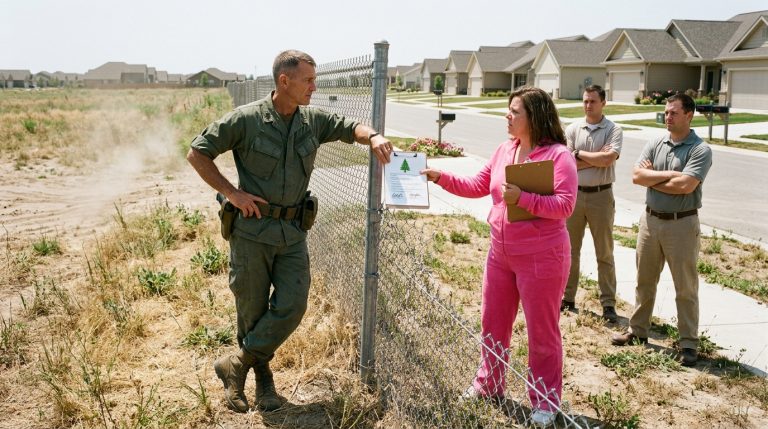
The physical transition from the enclosed shadows of the den to the open expanse of the yard was immediate. My boots crunched over the dry gravel of the side path, the sound loud and solitary against the backdrop of the subdivision’s distant evening traffic. Down at the end of the property line, where the old wooden fence met the municipal park’s chain-link barrier, something caught my eye—a break in the uniform line of the weeds.
I slowed my pace, walking deliberately toward the eastern hedgerow.
A survey marker—a bright pink plastic flag stapled to a thin wood lath—had been shoved into the dirt barely six inches inside my boundary line. It hadn’t been there yesterday when Karen and her crew were driven off by the gravel dust of my truck. Someone had come back under the cover of dusk or early morning, planting a fresh stake to reassert the fiction they couldn’t legally defend in broad daylight.
I crouched down, the joints in my knees clicking dryly in the quiet air. I didn’t pull the stake out. Touching evidence without logging it first is an amateur mistake. Instead, I pulled my phone from my pocket, toggled the camera to high-resolution mode, and captured three sharp, flashless frames of the marker against the weathered grain of the fence post.
The micro-mystery of the stake wasn’t just about an unauthorized piece of wood in my dirt; it was proof of escalation. Karen wasn’t waiting for Thursday’s board meeting to regroup. She was keeping the pressure alive on the ground, bit by bit, needle-prick by needle-prick, hoping I’d lose my temper and tear it out myself so she could point to a hostile act.
As I straightened up, a sharp clatter from across the street drew my attention.
Rick, the neighbor who had spent the last ten years talking football with me over the chain-link boundary before the frost of Karen’s gossip set in, was out by his driveway wrestling with a heavy plastic recycling bin. He lifted the lid, threw in a stack of flattened cardboard boxes, and let the lid drop with a hollow plastic bang.
When he turned around, his eyes met mine across the asphalt.
For a second, the old habit flickered—the instinctive half-raise of a hand, the customary nod between two men who had watched the same map change over decades. But then the weight of the neighborhood whisper campaign caught up with him. His shoulders tightened. His gaze dropped from my face down to the gravel near his sneakers, and he turned sharply toward his garage, his boots scraping against the concrete drive.
He didn’t cross the street. He didn’t wave. He simply retreated behind the closed door of his automated garage, the heavy metal panels sliding down with a slow, mechanical whine until the light was entirely cut off.
The social perimeter was tightening just as fast as the physical one. Karen’s strategy relied entirely on this isolation—making the target feel like an island so that when the legal squeeze came, there would be no witnesses left to verify the truth.
I turned my back on the empty street and walked back toward the house. Every step carried the heavy, unhurried rhythm of someone who knew that isolation cuts both ways. When you have sixty years of ink locked in a fireproof box, you don’t need a cheering section on the sidewalk. You just need the rules to hold when the wind starts blowing from the other side.
I stepped back inside, locked the heavy deadbolt with a solid, satisfying click, and set my phone on the counter. Thursday was coming, and the board room across the way was filling up with air that wouldn’t hold a flame once the draft hit it.
CHAPTER 4: The Hardware Store in the Dust
The interior of the house felt heavy, sequestered from the dry autumn wind sliding down off the ridges. I stood by the kitchen counter for a long moment, my fingers resting on the cool laminate surface, letting the silence settle over me like fine silt. The pink survey stake planted near the eastern hedge was a small piece of wood, but it was anchored to a much larger machine—one that Karen was preparing to rev up in front of two hundred people on Thursday night.
If you let an adversary dictate the timeline, you spend all your energy running to catch up. But if you intercept the logistics before the theater even opens, the stage collapses under its own weight.
I walked back down the short hallway to the coat rack, pulled my canvas work jacket off its peg, and slid my arms through the stiff sleeves. The fabric smelled faintly of machine oil and cedar shavings. Without turning on the overhead lights, I walked out through the side door, locking it behind me, and climbed back into the cab of the truck.
The engine turned over instantly, the heavy diesel block coughing once before settling into a deep, rhythmic vibration that rattled the loose change in the center console. I didn’t head toward the subdivision’s main exit where Rick’s garage door remained stubbornly sealed. I put the truck in reverse, backed down the gravel drive with my mirrors locked on the dark line of the hedges, and pointed the nose west, away from the neighborhood, away from the meetings, and away from the noise.
Forty minutes of open blacktop stretched between my property and the edge of the county seat—a forgotten stretch of highway where the asphalt gave way to cracked gravel shoulders and rusted agricultural supply yards. I didn’t use the local hardware store three miles down the road. Local merchants talk. They remember who bought weather-proof mounts, who asked about continuous-loop hard drives, and who paid cash for high-definition lenses that weren’t meant for backyard birdwatching.
The supply store I headed toward sat behind an overgrown gravel lot choked with dry thistle and rusted tractor frames. A faded hand-painted sign on the corrugated tin roof read Miller’s Industrial & Security. It was the kind of place where contractors, independent loggers, and rural landowners went when they didn’t want corporate registries tracking every bolt and lens they bolted to their rafters.
I pulled the truck up beside a rusted fuel tank, cut the headlights, and sat in the gloom for a full minute, watching the single yellow bulb dangling above the front door. A rusted screen door hung crookedly on its hinges, groaning softly in the evening draft.
When I pushed inside, the bell above the lintel gave off a harsh, metallic jingle that echoed off shelves stacked heavy with galvanized pipe, electrical conduit, and security housings coated in a fine layer of gray dust.
An old man with forearms like cured hickory wood looked up from a battered ledger behind the counter, peering over the top of steel-rimmed bifocals. He didn’t smile. In places like this, a smile is bad for business; people come here because they want discretion, not hospitality.
“Evening,” the old man rasped, his voice sounding like dry gravel shifting under a boot heel. “What kind of line are you running?”
“Hard-wired logic,” I said, stepping up to the counter and laying a small sketch of my roofline down on the scarred wood. “Four channels. Independent power feeds, zero cloud dependence, local encrypted solid-state storage. And I need the hardware off the books—no corporate warranty registration, no online serial tracking.”
Miller didn’t blink. He reached under the counter, pulled out a stack of blank blue invoice pads, and slid a mechanical pencil across the grain. “Cash only for unlisted inventory. You want the wide-angle lenses or the directional zoom?”
“Wide-angle,” I said. “Cover ninety degrees from the eaves. I want to see every boot print that crosses a cedar line, day or night, without the housing catching a reflection from streetlamps.”
He nodded slowly, reaching back into the shadows of the high shelves to pull down four unmarked white boxes wrapped in plain brown packing tape. He didn’t ask what I was protecting, and I didn’t volunteer the name of an HOA president or a fabricated easement map. In rural land compliance, everyone has a neighbor who thinks a fence is just a suggestion. You don’t explain the dispute; you just install the iron and let the record speak for itself.
I paid him in crisp, uncreased bills pulled straight from my inner pocket, sliding the money across the counter without a receipt. He swept the cash into an unpainted wooden cash drawer that slammed shut with a heavy, deadened thud.
I loaded the boxes into the footwell of the passenger seat, tucked a grey tarp over the top so nothing gleamed through the side glass, and climbed back behind the wheel. The sun had dipped entirely below the western ridge by the time I pulled out of the gravel lot, leaving the highway behind in a long, descending gradient of twilight.
The return drive took forty minutes of silent, unbroken focus. My headlights cut long, sharp arcs through the dry brush along the shoulder. I thought about my grandfather sitting on the porch in the summer of sixty-three, watching the dust kick up off the gravel road before a single subdivision had even been sketched on a developer’s blueprint. He didn’t build that fence to keep out neighbors; he built it because a man who doesn’t define the edge of his own world will eventually find himself living entirely inside someone else’s story.
When I turned onto my street, the subdivision houses sat dark and quiet behind their manicured lawns, all of them waiting for Thursday night’s performance, completely unaware that the stage was already wired from corner to corner.
CHAPTER 5: The Red Blue Light in the Driveway
The dashboard clock didn’t matter anymore; the harsh, rhythmic pulse of light washing over the white clapboard of the front porch told the entire story before the motor even died.
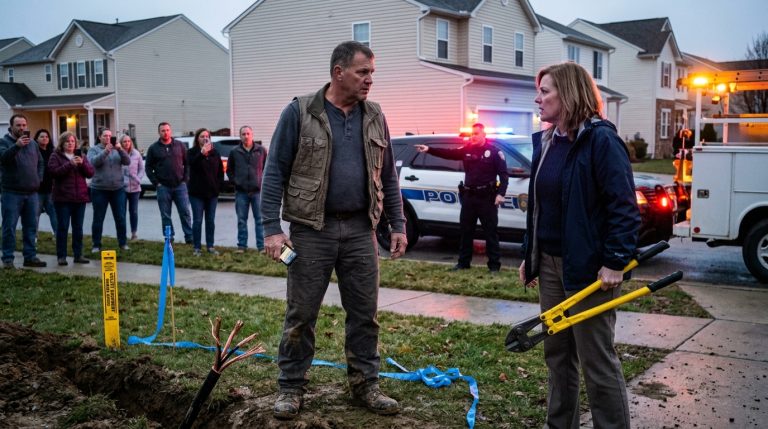
I cut the diesel engine, but I didn’t reach for the door handle. I sat in the cab of the truck, letting the idling vibration fade into a low, metallic ping as the exhaust cooling down ticked against the frame. Out on the paved lane, a county sheriff’s cruiser idled with its emergency bar strobing silent, blinding flashes of scarlet and azure across the windshield.
The deputy standing beside the open driver’s door wasn’t the same local patrolman who usually answered routine noise complaints on the township line. This was a taller, broader man with a flat-brimmed hat and a heavy leather belt loaded down with gear—someone accustomed to boundary disputes that involved more than just stray dogs or overgrown hedge rows.
My phone buzzed against my leg. A silent push notification from the camera array mounted under the eaves: Motion detected – Front Sector A.
I opened the door, the old iron hinges giving off their familiar, dry groan, and stepped down onto the loose gravel. The crisp autumn air hit my lungs like cold water, carrying the sharp scent of ozone and crushed dust.
The deputy turned his head as my boots crunched on the drive, his hand resting casually near the black retention hood of his holster. “Mr. Marsh?”
“That’s right,” I said, keeping my hands empty and clear of my pockets, the way federal compliance training drilled into you when dealing with escalated municipal friction. “What seems to be the trouble on the county lane?”
“We received an emergency dispatch a few minutes ago,” the deputy said, stepping forward onto the edge of my unpaved apron. His boots stopped right at the boundary marker where Karen’s crew had dropped their pink lath the day before. He didn’t cross it. “A formal complaint lodged by the executive board of the East Ridge Homeowners Association. They’re alleging an active obstruction of municipal maintenance and a direct physical threat made against a board representative during an inspection.”
A physical threat.
The lie was clean, bold, and entirely predictable. Karen hadn’t just waited for Thursday’s town hall meeting; she was accelerating the timeline because she could feel the legal soil softening beneath her feet. If she could brand me as aggressive or volatile before the papers were served, every subsequent filing would carry the stain of a personal vendetta rather than a legitimate property defense.
“Is that a fact?” I asked, my voice remaining level, stripped of any defensive spike. “Because I’ve spent the last three weeks working forty miles out of town or sitting right here on my own deeded acreage. My property is fully covered by twenty-four-hour closed-circuit recording. If anyone made a threat, it’s logged down to the millisecond on a hard drive sitting twenty feet from where you’re standing.”
The deputy’s eyes narrowed slightly. He looked past my shoulder toward the dark cedar eaves of the porch where the wide-angle lenses were tucked out of sight against the dark shadow of the roofline. In rural districts, an officer learns quickly that people who invite you to check their cameras usually have the receipts ready to print.
“The board claims you confronted an authorized survey crew yesterday afternoon with aggressive behavior and barred them from completing a certified public access evaluation,” the deputy continued, though the sharp edge had dropped out of his tone. “They presented an administrative map signed by the association president indicating a recognized utility and pedestrian corridor crossing your eastern boundary.”
“An administrative map isn’t a county deed,” I said. I reached into my canvas work jacket, pulled out a thick manila folder containing the stamped assessor copies and my grandfather’s original 1963 parchment transfer, and held it out at waist height. “There is no recorded easement on this parcel. There never has been. That map was manufactured on a desktop printer in a subdivision clubhouse.”
The deputy reached out, took the folder, and flipped open the brass clasp. He didn’t pull the papers out immediately; he just studied the heavy county seals stamped across the front registry. He had seen enough fake neighborhood covenants to recognize the real weight of an unencumbered title when it landed in his hands.
Before he could answer, a black SUV with an HOA parking sticker plastered to the rear bumper rolled slowly past the end of my driveway, braking just enough for the passenger-side window to lower an inch. Inside, half-hidden behind tinted glass, Karen De La Croix was watching us with her phone pressed tightly to her ear, logging every second of the cruiser’s presence to feed back into her network of anxious homeowners.
She wasn’t driving onto the property this time. She was hovering at the perimeter, waiting for the badge to do the heavy lifting she couldn’t manage on her own.
The deputy glanced over his shoulder at the black SUV, then back down at the folder in his hands. A slow, knowing frown settled into the lines around his mouth.
“If there’s no county stamp on their corridor,” the deputy said quietly, closing the manila tab, “then this isn’t a criminal matter, Mr. Marsh. It’s a civil title dispute. And civil disputes don’t get solved by dispatching cruisers to a homeowner’s driveway.”
He handed the folder back to me, his boots shifting back toward the asphalt edge of the lane.
“I’d advise you to keep your cameras rolling,” he added, his voice dropping just enough to clear the wind rustling through the dry weeds. “Because from where I’m standing, the people filing these calls are running out of paper.”
He turned back toward his cruiser, the red and blue strobes painting long, rotating shadows across the dry grass, and climbed behind the wheel. The cruiser pulled away down the lane without its sirens, leaving the dust to settle slowly over the gravel while Karen’s black SUV drifted out of sight around the corner.
The escalation had failed. The manufactured police call had turned into a dead end, leaving her entirely exposed for Thursday’s meeting. I turned, walked back up the gravel path, and went inside to call David Herrera.
CHAPTER 6: The Office of David Herrera
The elevator door of the county legal annex opened with a dry, metallic ping, releasing me into a hallway that smelled of stale carpet glue and floor wax. I didn’t wait for an announcement. I walked straight down the linoleum corridor to Room 412, where frosted glass bore the black-lettered name: David Herrera, Property Litigation Specialist.
The office inside looked less like a corporate law firm and more like an archival archive of land wars. Stacks of yellowed municipal maps, bound survey registries, and thick cardboard banker boxes lined the walls from floor to ceiling. David sat behind a massive oak desk that had seen decades of boundary disputes, his sleeves rolled up to his elbows, a pair of wire-rimmed reading glasses sliding down the bridge of his nose.
When I pushed the door open, he didn’t look up immediately. He finished marking a red line across a photostat copy of a 1970 plat map before slowly removing his glasses and setting them beside a heavy bronze paperweight.
“The deputy left twenty minutes ago,” I said, closing the door behind me with a solid, weighted click.
David leaned back in his leather chair, the springs groaning under his weight. A faint, dry smile touched the corners of his mouth. “I heard. Word travels fast when a county cruiser spends twenty minutes idling in front of a private driveway while the HOA president watches from a black SUV down the lane.”
“She tried to frame the boundary defense as a physical threat,” I said, pulling the canvas folio from my jacket and placing it squarely on his blotter. “She wanted an incident report to take into Thursday’s town hall meeting.”
David opened the folio, his fingers sorting through the printed camera stills, the time stamps from the east eave, and the copy of the county deed. But as he turned past the primary assessment papers, his thumb caught on a thin slip of onion-skin paper that had fallen out of my grandfather’s metal box—the original developer waiver from nineteen ninety-four regarding the eastern drainage ditch.
He stopped. His fingers smoothed the crinkled edge of the paper, his eyes scanning the fine print where the original subdivision developer had signed away any future claim to the eastern twenty feet in exchange for municipal water line access.
“Where did you find this?” David asked, his voice dropping an octave.
“In the fireproof box at home,” I said. “My grandfather filed it the day the developer first surveyed the orchards.”
David pulled a magnifying glass from his desk drawer, holding it over the faded signature at the bottom of the page. He didn’t speak for a full minute. The silence in the room grew thick, broken only by the hum of the fluorescent ceiling fixture overhead.
“Marsh,” David said slowly, looking up from the glass. “This isn’t just an unrecorded easement issue. Karen didn’t just invent a map on a desktop printer. She pulled this specific layout from an old draft that was legally invalidated by this exact waiver thirty years ago.”
He reached into a stack of files beside his desk and pulled out a separate binder—corporate filings for the East Ridge Homeowners Association. He flipped to a highlighted page.
“The developers who built that subdivision didn’t just walk away when the lots sold,” David continued, tapping a finger against the page. “They left behind a deferred liability on the eastern boundary—a historical zoning discrepancy that could cost the original corporate entity millions if it was ever audited by the county. Karen didn’t stumble onto this path by accident. She’s been coordinating with the original developer’s holding company to clear that old liability under the guise of an HOA community improvement.”
The pieces clicked together with the heavy, unyielding snap of a steel latch. Karen wasn’t just a tyrant with a clipboard; she was acting as a proxy for a corporate developer trying to retroactively clear an old title flaw using the HOA’s insurance and membership dues as collateral.
“She’s hosting an emergency board meeting on Thursday night,” I said. “Two hundred homeowners packed into the clubhouse, believing I’m a selfish neighbor blocking a public park.”
David closed the file, slid the onion-skin paper into a pristine plastic sleeve, and stood up from his desk. He reached for his suit jacket draped over the back of the chair.
“Then we aren’t filing a simple civil injunction anymore,” David said, his eyes hard and sharp as flint. “We’re walking into Thursday night’s meeting with a fraud complaint that names not just Karen, but every corporate entity backing her play. Let’s go print the paperwork.”
CHAPTER 7: The Emergency Meeting at the Podiums
The double doors of the East Ridge Community Clubhouse stood wide open, swallowing a steady stream of anxious homeowners murmuring among themselves under the harsh glare of the entryway lights. I didn’t arrive in a rush. I pulled the truck into the outer edge of the asphalt lot, cut the engine, and stepped out into the crisp evening air with the manila folio tucked securely beneath my arm.
Inside, the main hall was packed to capacity. Folding chairs scraped against the polished vinyl floor, and every inch of wall space was claimed by residents standing shoulder to shoulder. Up front, behind the elevated oak podium, stood Karen De La Croix. She wore her polished composure like a tailored armor, her clipboard clutched to her chest, her expression set in the practiced lines of a leader wronged by circumstance.
When I pushed through the double doors, the ambient chatter dropped instantly, rippling outward in a sharp wave of silence until the only sound was the low, steady hum of the ceiling vents. Heads turned. Eyes locked onto the center aisle. Rick, standing near the second row with his hands shoved deep into his jacket pockets, avoided my gaze, staring instead at the tips of his boots.
I walked down the central aisle at an unhurried, measured pace. Every footfall felt heavy against the floor, each step measured against sixty years of unmovable boundaries. I took a seat on an empty folding chair in the third row, resting the manila folio flat across my knees.
Karen cleared her throat into the microphone, the sound echoing sharp and metallic off the drywall.
“We are here tonight,” Karen began, her voice smooth and carrying that practiced cadence of manufactured outrage, “to address an unfortunate obstruction of community progress. As many of you know, the board has attempted to formalize our pedestrian corridor—a vital pathway connecting our neighborhood park directly to the main thoroughfare. Regrettably, an individual property holder has chosen to weaponize technicalities, blocking public access and threatening the safety of our residents.”
A low murmur of agreement rose from the back rows. Someone muttered something about selfishness. Karen raised a hand, playing the part of the besieged steward of the community.
“We have acted entirely within our rights,” she continued, lifting her printed map toward the crowd. “The easement is documented, the corridor is established, and—”
“There is no recorded easement,” I said.
My voice wasn’t loud, but in the dead silence of the hall, it cut through the room like a cold blade. I didn’t stand up. I simply looked straight at the podium.
Karen’s face twitched, the polite smile fracturing for a fraction of a second before she recovered her footing. “Mr. Marsh, this is an official association proceeding. You are out of order.”
“You’re out of jurisdiction, Karen,” I replied, standing up slowly and letting the folio slide onto the seat behind me. “You aren’t protecting a community pathway. You’re executing a deferred liability waiver for the original corporate developers who built this subdivision on top of an old zoning flaw.”
The silence in the room grew absolute. Even the murmur in the back died away.
Phil, one of the veteran board members sitting to Karen’s left, leaned forward, his eyes narrowing. “What did you say?”
“Check your email, Phil,” I said, walking slowly down the remaining steps of the aisle until I stopped five paces from the podium. “Ask the insurance provider who sent your board a three-page letter this morning. Ask them why they classified Karen’s construction contracts as unverified fraud rather than municipal negligence. And ask them why the original developer’s holding company quietly transferred forty thousand dollars into a reserve fund to cover the legal fallout of a fake map.”
Karen gripped the edges of the podium so hard her knuckles turned white, the skin stretching taut over her fingers. “He’s lying! The association records clearly show—”
“The association records show seventeen letters written without a board vote, fourteen thousand dollars spent on contractors without authorization, and a fabricated map drawn from an invalid draft,” I said, my voice cold and flat. “I have twenty-four-hour continuous camera footage of your trespassing, a signed civil complaint filed with David Herrera’s office, and forty years of county registry stamps that say your authority ended at your own property line.”
I pulled a single copy of the county assessor’s certified registry from my jacket and laid it gently on the edge of the speaker’s stand, right beside her polished clipboard.
The room didn’t murmur this time. A heavy, suffocating realization settled over the crowd as neighbors looked at each other, suddenly seeing the empty space where trust used to be. Karen opened her mouth to speak, but no sound came out. The script had run out of pages, and the iron line had held.
CHAPTER 8: The Morning Sun on the Unmoved Fence
Karen didn’t answer. She couldn’t.
The silence in the municipal clubhouse stretched tight, heavy as wet canvas, while Phil and the remaining board members stood up from their chairs to inspect the county registry document resting on the speaker’s stand. The paper didn’t just expose a fake map; it laid bare the entire mechanism of corporate collusion—the deferred liability waivers, the unrecorded sub-committee memos, and the hidden developer funds used to bankroll an illegal land grab under the innocent cover of neighborhood beautification.
Within forty-eight hours of that meeting, Karen formally resigned from the board without a single public statement or a farewell email. Her carefully constructed empire of clipboards, red-pen violations, and manufactured neighborhood outrage collapsed inward. The HOA’s insurance company formally denied coverage for the unauthorized construction contracts, leaving the board and the developer’s holding company to shoulder the fallout of a three-hundred-thousand-liability exposure.
Six months slipped past like water over river stones.
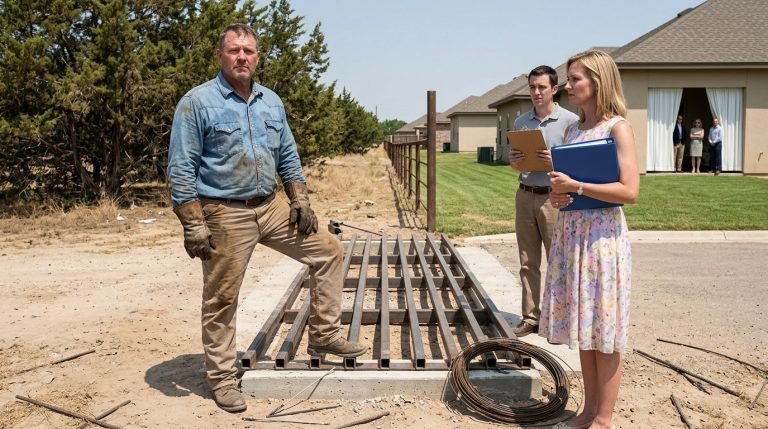
The air on this Sunday morning smelled of cut rye grass and damp autumn earth, crisp with the first real bite of seasonal frost. I stood near the edge of the eastern boundary, my hands resting lightly on the weathered top rail of the wooden fence my grandfather had pegged together back in nineteen sixty-three. Every post stood plumb and true. Not a single board had shifted; not a single inch of the land had yielded.
Down the slope, the newly paved municipal walking path curved cleanly around the perimeter of my three-acre parcel, hugging the subdivision’s side of the ditch without crossing a single blade of my grass. A mother pushed a blue stroller along the smooth asphalt while her young boy pedaled a small bicycle ahead of her, their laughter carrying softly across the dry weeds. When they passed the corner of my yard, the boy raised a mittened hand, and I raised mine in return.
The settlement check from the HOA had cleared three weeks prior, covering every dollar of legal fees, property repairs, and the minor scars left by the spray paint and shovels. More importantly, the interim board had amended their bylaws to require a mandatory two-thirds homeowner vote before any project involving land outside the boundary could even be discussed—a permanent structural wall designed to protect whoever came next from being pushed around by someone with a clipboard and a manufactured map.
I walked slowly back toward the house, my boots crunching a steady, rhythmic pattern into the gravel drive. The fireproof metal box sat securely on its shelf in the den, its papers resting in undisturbed order.
I stepped up onto the back deck, pulled open the side door, and poured myself a cup of dark, steaming coffee from the pot. The kitchen was quiet. The boundaries were secure. The line had held.