The Architect of Silence: A Former Judge Dismantles a Suburban Empire Built on Stolen Dreams
CHAPTER 1: THE WEIGHT OF THE RUBBLE
The silence was the worst part. At 7,200 feet, the mountain wind usually carried the song of the atrium—that custom glass-and-steel structure Elaine had designed to catch the breeze. Now, the wind just whistled through the jagged, exposed timber beams, a hollow, discordant sound.
I swept my flashlight over the debris. The demolition crew had been surgically cruel. They hadn’t just torn the house down; they had dismantled it with the intent of erasing its existence. My boots hit something metallic, a dull, heavy thud amidst the scattered drywall. I shifted the light.
It was the corner of the fireproof safe. The only thing I had left of her beyond the memories.
My hands were shaking, but not from the cold. The air reeked of diesel, that oily, suffocating scent that clung to my jacket. I knelt, ignoring the bite of the gravel into my knees, and started digging. I didn’t use a shovel. I used my hands. I moved jagged chunks of cedar—salvaged barn wood from Montana that had smelled like a century of summers before Vivien Pritchard turned it into a landfill.
Every movement was calculated. A judge’s instinct: assess, categorize, preserve. I saw a fragment of Elaine’s handwriting on a splintered beam and forced myself to turn away. Not yet. I needed the safe.
The metal was cold, biting into my palms as I cleared the dust. It was dented, likely from the heavy tread of the excavator, but the seal looked intact. I punched in the combination—our anniversary—and the lock clicked with a resonant, metallic snap that seemed deafening in the stillness of the mountain morning.
Inside, the blueprints were protected, but it was the folder beneath them that mattered. The receipts. The canceled checks. The paper trail that proved I had paid every single fine—every $38,000 of her fabricated violations—twice over.
I looked up toward the ridge. Vivien’s house was dark, an oversized monument of white stucco sitting comfortably on the adjacent peak. She thought she had erased the evidence by burying it under two tons of debris. She thought a governor-elect would be too busy with state business to dig through a graveyard of dreams.
She was wrong.
I stood up, the safe tucked under my arm, and felt the weight of it—not just the paper, but the leverage. A shadow moved near the property line. I narrowed my eyes, the adrenaline sharpening my vision. A silhouette in a white Cadillac Escalade parked at the perimeter. It didn’t move. It was watching.
I didn’t turn away. I didn’t blink. I stood in the wreckage of my own life, held the cold steel of the safe, and waited for the intruder to make the next move. She wanted a fight? She had just handed me the weapon.
CHAPTER 2: THE ARCHITECTS VAULT
The silhouette didn’t move for ten long heartbeats, its engine idling with a low, rhythmic thrum that seemed to vibrate through the soles of my boots. Then, with a slow, deliberate turn of the tires on the loose gravel, the Escalade retreated, its taillights cutting two sharp, crimson lines through the morning mist. It was a tactical withdrawal, not a departure. Vivien Pritchard was watching, testing the perimeter.
I waited until the tail lights vanished behind the line of pines before I moved. My knees ached—a sharp, throbbing reminder of the hours spent digging through the ruin of my own life. I walked toward the edge of the ravine, away from the prying eyes of the main road, and stepped into the temporary construction shed that had miraculously survived the demolition crew’s efficiency.
The interior smelled of sawdust, stale coffee, and the sharp, metallic tang of cold rain. I set the safe down on a scarred workbench, the heavy steel surface clattering against the wood. My breath hitched in the cramped space, and for a fleeting, jagged second, I saw Elaine here—not in the ruins, but as she had been, sketching lines on a drafting table that used to sit exactly where the safe now rested. She had been precise, meticulous, turning abstract thoughts into load-bearing reality. I forced the memory down, locking it behind the same discipline I had used for years on the bench. Memories were luxury items I couldn’t afford until the paperwork was settled.
I turned the dial, the tumblers clicking like a clock counting down to an inevitable confrontation. The door swung open.
Inside, it was a museum of the last six years. Elaine’s original design journal lay nestled in the back, its leather cover worn soft at the edges. I pulled it out, my fingers tracing the familiar, elegant script of her notations. Structural integrity dependent on the angle of the joists, she had written in the margin. She had known. She had understood that if the foundation wasn’t true, the entire structure would eventually bow under its own weight.
I set the journal aside and reached for the files beneath it. The documentation was exhaustive. Every check, every bank statement, every email correspondence with the HOA’s architectural committee. I laid them out across the workbench, a mosaic of bureaucratic tyranny. The fines had been precise, escalations of a conflict that was never about paint codes or driveway lights. They were an investment strategy. Vivien hadn’t been weeding a community; she had been clearing a path for a buyout, using me as the sacrificial lamb to drive down the property value of the adjacent lots.
A sudden, sharp intrusive thought flared: I remembered the way Vivien had stood in my foyer three months ago, her hands perfectly manicured, her smile tight and hollow. She hadn’t been looking at the trim; she had been looking at the foundation. She knew the land was the prize. The embezzlement, the fines, the bullying—they were just the friction needed to grease the gears of her real estate play.
My jaw tightened. I grabbed my phone, the screen casting a harsh, blue light against the dark, uninsulated walls. I dialed Kurt Bellamy. It was barely dawn, but he would be awake. He lived in the minutiae of statute and litigation as much as I did.
“Tobias?” His voice was gravelly, heavy with the fatigue of a man who worked late into the night. “Tell me you have something.”
“I have the receipt trail, Kurt,” I said, my voice steady, stripped of the emotional exhaustion that threatened to pull me under. “Everything. The committee approvals, the checks, the dates. It’s all here, tucked in a vault she didn’t know existed.”
“And the demolition?”
“Unlawful. She bypassed the board, ignored the committee, and pushed through a foreclosure on a premise that’s demonstrably false.” I spread the papers out, my eyes tracking the logic of her greed. “She didn’t just want the house gone. She wanted it gone before the audit.”
“If we move,” Kurt started, his tone sharpening, “we have to be careful. You’re the governor-elect. If this looks like you’re using your office to settle a personal vendetta, the defense will eat us alive. We need a private citizen’s angle. We need a path that doesn’t involve the Governor’s office.”
“I’m a homeowner,” I replied. “That’s all the standing I need.”
I hung up and looked at the ruined mansion through the shed’s small, dirt-streaked window. The morning sun was beginning to hit the highest peak, turning the jagged rebar into a crown of thorns. The landscape was no longer a personal tragedy; it was a crime scene. I grabbed a pen and began to organize the documents, cross-referencing the fine notices with the bank transfers. The numbers didn’t lie. They never did.
The silence outside was replaced by the distant, morning hum of the waking world—a world that had no idea that beneath the mountain, the ledger was being balanced.
CHAPTER 3: THE ASSEMBLY OF WITNESSES
The drive down from the ridge was a slow, grueling descent through a thick blanket of fog that clung to the switchbacks like wet wool. I kept the safe secured on the passenger seat, the metal frame pressing against my thigh, a constant reminder of the volatile cargo I was carrying. The mountain road, usually a quiet stretch of asphalt and pine, felt different today—more exposed, more fragile. Every curve, every patch of loose gravel, felt like a potential point of failure.
I didn’t rush. The anti-bloat of the morning silence was a necessity, not a luxury. I needed to let the details of the documents settle into the structure of my own strategic understanding. I wasn’t just a judge anymore; I was a plaintiff, and the rules of the game had shifted from the courtroom to the community.
When I pulled into the lot at Kurt Bellamy’s law firm, the building looked just as tired as I felt—a low, brick-fronted structure that smelled of old coffee and radiator heat. Kurt was waiting by the entrance, his coat pulled tight against the mountain chill, his face a map of long nights and too many cups of lukewarm coffee. He didn’t ask how the drive was. He didn’t ask how I was holding up. He just stepped aside to let me through.
“I’ve already got the preliminary filing drafted,” Kurt said, his voice echoing in the nearly empty lobby. “Mariana is meeting us inside. She’s got the statements from the neighbors.”
“Neighbors?” I stopped, looking at him. “I haven’t reached out to the neighboring lots yet.”
“You didn’t have to,” Kurt replied, guiding me toward his conference room. “Vivien’s tyranny wasn’t exclusive to you. When the news of the demolition hit the wire, they started calling. People who had been fined for the wrong shade of white on their mailbox, people who had been bullied for landscaping that didn’t meet her ‘aesthetic’—they’re all looking for a place to put their anger.”
The conference room was a sprawl of legal pads and open binders, the air thick with the smell of toner and stale air. Mariana Soto was already there, hunched over a laptop, her brow furrowed in concentration. She didn’t look up as we entered, but her presence brought a different kind of energy to the room—the sharp, focused intensity of a civil rights attorney who knew exactly what kind of game we were playing.
“The case is larger than the house, Tobias,” Mariana said, finally meeting my gaze. Her eyes were hard, unsentimental. “If we just go after the demolition, we’re fighting a civil dispute. If we go after the pattern—the discrimination against your housekeeper, the intimidation of the widow in the next lot, the selective enforcement of these fines—then we’re looking at a systemic civil rights violation. We aren’t just suing an HOA president. We’re dismantling a machine.”
She slid a document across the table. It was a list of names, twenty-six in total, each one tied to a specific incident of harassment.
“I spent the night vetting these,” she continued. “They’re solid. But they need to feel like they have a shield. You’re the governor-elect. They need to know that their participation won’t result in retaliation.”
“I’m not there yet,” I reminded her, sitting down and opening the safe. I laid out the canceled checks and the committee approvals—the physical texture of the corruption. “But when I am, the law will be the shield. For all of them.”
“We have to be careful with the pacing,” Kurt interjected, his gaze lingering on the financial records I’d recovered. “If we dump everything at once, we lose the element of surprise. We need to build the foundation—the evidentiary foundation—before we present the full picture at the town hall. Vivien is going to expect a legal attack. She’s not going to expect a community uprising.”
I looked at the stack of documents. The paper felt heavy, coarse, a sharp contrast to the sleek, digital efficiency the world had come to expect. This was old-fashioned, grounded, tangible proof.
“The town hall is in three weeks,” I said, my voice steady. “That gives us enough time to solidify the narrative. We don’t just present documents; we present the people whose lives were damaged by those documents. We turn the personal into the public.”
“She’ll try to block the meeting,” Mariana warned. “She’ll try to change the bylaws or move the venue to keep us out.”
“Let her,” I said, the thought of the rusted, broken rebar from the pool still burning in my mind. “Let her try to wall off the community. Every wall she builds is just another piece of evidence for our case.”
I spent the next four hours walking them through the receipts—the mundane, boring details that were the undoing of every tyrant. We didn’t talk about the mansion, or the loss, or the grief. We talked about interest rates, about signatures, about the specific subsections of the bylaws that had been ignored. It was the work of a judge, a process of stripping away the emotion until only the cold, unyielding truth remained.
By the time I left, the fog had lifted, revealing the sharp, clear peaks of the mountains. The road ahead wasn’t clear, but the path was defined. I had the safe, I had the coalition, and more importantly, I had the patience to let the system do its work—provided I was the one pushing the gears.
CHAPTER 4: THE SHADOW AT THE PERIMETER
I put the truck into gear, the metal linkage clicking with a satisfying, heavy finality. My plan had been to drive straight back to the capital to handle a briefing, but the SUV sitting near the gated entrance of Ridgemont Estates wasn’t going to ignore itself. It was parked at an angle that suggested the driver was watching the gate, not waiting for a resident.
As I rolled closer, the sunlight caught the windshield of the SUV, obscuring the interior. I didn’t pull up to the gate. I stopped fifty yards back, where a dense thicket of pines provided a natural barrier of shadows. I killed the engine. The sudden silence of the mountain—a heavy, pressurized quiet—seemed to amplify the faint, rhythmic ticking of my cooling radiator.
I reached into the glove box and pulled out a pair of binoculars I kept for property surveys. The SUV was black, unremarkable, the kind of vehicle that would blend into a suburban driveway as easily as a parking garage. I adjusted the focus. Empty, but the exhaust pipe was still shimmering with heat haze. Whoever was behind the wheel hadn’t left long ago.
Then, a movement caught my peripheral vision. A figure emerged from the tree line, walking with a stiff, unnatural gait toward the SUV. It was Garrett Pritchard.
My pulse spiked, a singular, rhythmic thud against my ribs, but I forced my breathing to slow. The “Sovereign Protector” mindset kicked in—maintenance, endurance, the heavy price of keeping a secret. Garrett wasn’t just a retired state trooper; he was the enforcement arm of the HOA’s petty tyranny. Seeing him here, scouting the perimeter of my land, confirmed the escalation I had feared. They weren’t just protecting their embezzlement; they were tracking my movements.
He reached the SUV, the driver’s side door opening with a metallic squeal that sounded unnaturally loud in the thin air. He stood there for a moment, looking toward my property—toward the ruin of the mansion—and I felt a cold surge of focus. This was no longer just about fines or architectural committees. This was a tactical game of chess, and he had just made a move that left his flank exposed.
I didn’t confront him. To do so would be to surrender the advantage of the observation. Instead, I waited, watching as he climbed into the SUV and drove off, not toward the estate gate, but in the opposite direction, toward the lower valley.
I waited an additional three minutes before following. I kept a half-mile distance, utilizing the natural curves of the mountain road to stay out of his rearview mirror. The chase was mundane, a slow, winding progression through the rusted, red-dirt roads that characterized this part of the state. My truck, a reliable, utilitarian machine, handled the friction of the road with a gritty ease that felt right.
He led me toward a small, nondescript business park on the outskirts of the town—the same area where Vivien’s real estate brokerage was located. He pulled into a side lot behind a series of storage units. I parked two rows over, behind a cluster of dumpsters, and stepped out into the dry, metallic-smelling air.
I wasn’t wearing a suit. I had a faded flannel shirt and work boots, the attire of a man who looked like he belonged to the landscape. I walked toward the back of the building, my eyes scanning the ground for security cameras or signs of motion-activated lighting. There were none. It was a site that had been allowed to degrade, a perfect home for a shell operation.
I reached the corner of the building and peered around. Garrett was gone, but the SUV was parked in front of a bay door marked “Ridgemont Management Services.”
The name hit me with the weight of a physical blow. Kurt’s research had pointed to this—the shell company. Seeing it in the flesh, a peeling sign on a roll-up steel door, turned the abstract accusation into a tangible, rusted truth. This was the vault. This was where the money went, where the road resurfacing funds had vanished, where the “security consulting” fees were laundered.
I didn’t have a warrant, and I didn’t have the backing of the state police yet. But I had the eyes of a man who knew how to read the architecture of a lie. I walked to the bay door, the metal cold and slightly pitted with rust. There were no lights inside, just the faint, rhythmic sound of a ventilation fan somewhere deep in the structure.
I took out my phone and began to document everything. The lack of corporate branding, the strategic placement of the facility in an unincorporated zone, the proximity to Vivien’s main brokerage. It was a crude, desperate operation, shielded by the assumption that nobody would ever look behind the curtain.
I turned to leave, my boots crunching on the dry earth, when the sound of a closing door echoed from the front of the unit. I pressed myself into the shadow of a parked trailer, my heart a steady drum of focused adrenaline. Garrett was back, but he wasn’t alone. He was talking to someone on a cell phone, his voice a low, gravelly drone that carried clearly in the quiet.
“The Governor’s truck wasn’t at his office,” he was saying. “He’s doing something else. You need to tell her. We need to speed up the process on the paving lean. If we don’t foreclose on the amenities before the audit hits, everything unravels.”
I didn’t move until they were gone. I held my position, the weight of the information settling into my chest. The paving lean. That was the decoy, the pressure point they were using to hold the community hostage. If they could force a foreclosure on the clubhouse and the pool, they could dissolve the HOA before the books were ever opened.
It was brilliant in its cruelty and desperate in its execution. I walked back to my truck, my mind mapping the connections. They weren’t just thieves; they were arsonists, setting fire to the community to hide the evidence of their looting. I climbed into the cab and started the engine. The path was set. Tomorrow, I would take this to Rick Delgado. It was time to pull the rug out from under their feet, one section of road at a time.
CHAPTER 5: THE TOWN HALL CONFRONTATION
I didn’t head back to the capital. I didn’t return to the safety of my temporary office. Instead, I sat in the cab of my truck, watching the black SUV disappear into the evening heat haze of the valley, and felt the weight of the coming confrontation. The town hall meeting was now less than forty-eight hours away, and the game had shifted from a civil investigation to an active defensive struggle.
Every shadow in the parking lot seemed to lengthen, taking on the shape of a threat. My hand hovered over the ignition, then dropped. I had to meet Rick Delgado. He was the next piece of the spine—the physical, irreparable fracture in Vivien’s facade. If I could get him on the record, if I could get him to stand in that town hall and detail the unpaid invoices, the embezzlement wouldn’t just be an accusation. It would be a documented fact.
The drive to Mountain Peak Paving was a test of my own internal clock. I drove at the speed limit, my eyes constantly sweeping the mirrors. The paranoia was starting to settle in, a fine, gritty layer of dust over my perception. Was the sedan behind me tailing me, or was it just a local resident coming home from a shift? Was the flash of light in the distance a reflection, or a camera lens? I forced myself to categorize the stimuli: environmental, irrelevant, manageable.
When I pulled into Rick’s yard, the scent of fresh asphalt and motor oil hit me—a smell of honest, hard labor. It was a grounding fragrance. Rick was standing by a paver, his hands stained with grease, looking at a stack of ledgers that seemed to mock the simplicity of the work he did.
“You look like you’ve seen a ghost, Governor,” Rick said, his voice a low, gravelly rumble. He didn’t offer a handshake; his hands were too dirty. He just gestured toward the office trailer.
“I saw Garrett,” I said, following him inside. The trailer was cramped, dominated by a large, grease-stained desk covered in maps of the county. “He was at the shell company office. Ridgemont Management Services.”
Rick stopped, his back to me. The silence in the trailer was absolute, save for the hum of a small desk fan. “They’re using that place to wash the assessment fees,” he said finally, his voice tight. “I knew it. I just couldn’t prove it.”
“I have the proof,” I said, sliding the copies of the bank records and the registration documents I had scraped together. “But they know we’re onto them. They’re moving to foreclose on the HOA’s common property to wipe the slate clean before the audit happens. They’re trying to burn the bridge before we can cross it.”
Rick leaned over the desk, his finger tracing the lines of the paving contract. His face, normally a mask of hard-won pragmatism, twisted into something else—a slow, burning realization. “If they foreclose, the paving company doesn’t just lose the money. The HOA loses the clubhouse, the gate, the pool. The homeowners lose everything.”
“Exactly. It’s a scorched-earth policy,” I said. “Which is why you need to be at the town hall. You don’t just speak for your company, Rick. You speak for the homeowners. You tell them that their money was stolen, and that the only thing standing between them and the loss of their community assets is a fraudulent lien they didn’t authorize.”
He looked at me, a long, assessing silence passing between us. He was a man who had built his life on solid ground, on the literal foundation of the roads he paved. The idea that someone could treat his labor—and the community’s trust—as a shell game was an affront to his entire existence.
“I’ll be there,” he said, his voice hard. “But you’re the one taking the heat, Tobias. You know that. Once I speak, once those papers go public, they won’t just come for the HOA board. They’ll come for you. They’ll try to frame this as you using your office to bully a community organization.”
“Let them,” I replied. “I’m not acting as the Governor. I’m acting as a man whose home they destroyed. They think this is a political theater. They don’t realize that in this specific room, on this specific night, the only thing that matters is the law.”
I left the yard with a sense of grim clarity. As I drove back toward the estate, the sun dipped below the mountains, casting long, distorted shadows across the road. The sense of being watched persisted, a prickle at the back of my neck, but I no longer fought it. I embraced it. Let them watch. Let them see me prepare.
When I finally reached the gate of Ridgemont Estates, I didn’t go home—I had no home to go to, just a plot of dirt and the jagged memory of an atrium. I drove to a nearby motel, a relic of the mid-century, and checked in under a name that didn’t appear in any official capacity.
I spent the night sitting on the edge of the bed, the documents spread out in front of me like a blueprint for an execution. Every fine, every transfer, every act of intimidation—I had the structure, but now I had the evidence. The town hall meeting wasn’t just a gathering of homeowners. It was the place where the illusion of Vivien’s authority would finally shatter.
I checked my phone. No new notifications. Just the countdown. I looked at the window. Outside, a pair of headlights swept across the parking lot, lingered, and then moved on. I didn’t reach for the light. I sat in the darkness, the rust-colored soil of the estate still under my fingernails, and waited for the morning. The escalation had reached its peak; now, there was only the momentum of the truth to carry me through.
CHAPTER 6: THE FRACTURED NARRATIVE
I stared at the paperwork until the text began to blur. Elaine’s voice, a ghost in the machinery of my own memory, surfaced: Trust the foundation, Tobias, not the paint. I had spent months focused on the paint—the fines, the driveway lights, the petty bureaucratic spite—but the foundation was rot. The shell company. The paving lien. The systemic draining of the reserve funds.
My phone, resting on the nightstand, buzzed. It was a message from Mariana. Security update. Vivien’s PR firm is leaking a story to the local morning edition. They’re calling you the ‘Disgruntled Governor.’ They’re framing the entire conflict as an ego clash.
I set the phone down. It was a standard, predictable play: discredit the accuser to render the evidence irrelevant. If the public viewed this as a personal feud between an aggrieved former homeowner and an HOA president, the forensic truth of the embezzlement would be drowned out by the noise of the narrative war. I needed to move the battlefield.
I dressed in the dark, the movements mechanical, my mind running through the logistics of the meeting. The clubhouse. The layout. The bylaws. I had to ensure that the meeting didn’t devolve into a shouting match, because that was where Vivien thrived. She was an expert in the theater of disruption.
I reached the clubhouse at 6:30 a.m., long before the doors were scheduled to open. The morning air was sharp, smelling of pine needles and damp earth. The clubhouse stood against the rising sun, a structure that looked solid but, as I now knew, was a facade held together by hollow promises.
I checked the side entrance. It was unlocked—an oversight by a maintenance crew that hadn’t been fully indoctrinated into Vivien’s new, paranoid order. I walked inside. The air was cold, smelling of floor wax and the faint, lingering scent of Vivien’s perfume—a heavy, floral scent that felt like an intrusion. I walked to the front of the room, to the podium, and visualized the room filled with the people who had lost their voice.
I was startled by the sound of a heavy door creaking in the back. I stepped behind the heavy velvet curtain of the stage just as two figures walked into the room. It was Vivien and Garrett.
“They’re going to be here in an hour,” Vivien’s voice, devoid of its usual public charm, sounded thin, brittle. “If the paving contractor shows up, you have the sheriff’s deputy handle him. Tell him he’s trespassing. I don’t care what the bylaws say.”
“The Deputy is already asking questions about the paving firm,” Garrett replied, his voice a low, gravelly rasp. “He’s not as easy to steer as the last one. We might have to clear the room.”
“Then clear it. Call a vote to close the session. I’ll make the motion, and if anyone objects, have security escort them out.”
I held my breath, my lungs burning. The trap wasn’t just to frame me; it was to prevent the truth from ever being spoken on the record. They were going to weaponize the meeting itself to suppress the evidence.
I stayed in the shadows until they left, their footsteps echoing into the silence of the hallway. When I finally emerged, the room felt different. The “Sovereign Protector” logic I had relied on felt insufficient. The law was a shield, yes, but only if the person holding it was allowed to stand in the room. I took out my phone and dialed Kurt.
“They’re planning to close the session,” I said, my voice barely above a whisper. “They’re going to use a procedural vote to block Rick and the other witnesses from speaking.”
“That’s a direct violation of the HOA statutes,” Kurt replied instantly. “But if they do it, the meeting won’t be a record. It’ll just be a private tantrum.”
“Not if we have a record,” I countered. “I’m going to need you to bring a certified court reporter. If they try to close the session, we’ll continue the meeting on the record, outside, in the parking lot. We’ll make it public enough that they can’t hide the proceedings.”
“That’s a gamble, Tobias. You’ll look like you’re inciting a riot.”
“No,” I said, looking out at the morning sun hitting the parking lot where I had stood watching Garrett just hours before. “We’ll look like we’re the only ones willing to have an open conversation. The truth doesn’t need a clubhouse. It just needs a witness.”
I hung up and looked at the podium. The surface was polished, clean, reflecting the morning light. It was a piece of architecture, like any other. And like any other structure, if you hit it at the right angle, at the right moment, it would reveal its own fragility. I was ready. The fracture lines were visible; all I had to do was apply the pressure.
CHAPTER 7: THE PUBLIC COLLAPSE
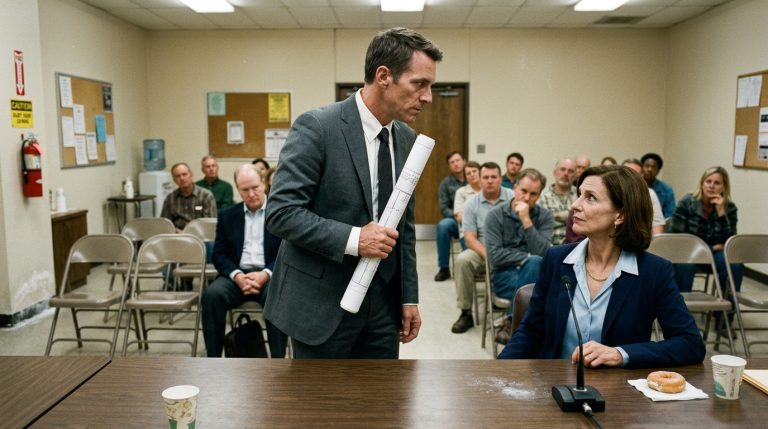
The room was packed. 120 homeowners, their faces a blur of anxiety, curiosity, and hard-earned resentment, filled the folding chairs. The air felt thin, recycled, and heavy with the scent of floor wax and impending friction. I stood by the side wall, my gaze fixed on the front podium where Vivien was settling herself, her movements rehearsed and clipped. She was wearing that same white suit, a piece of armor designed to deflect and intimidate.
Behind her, the two board members who had been kept in the dark were pale, staring at the floor, their hands clutching their agendas. They knew. They didn’t know the full extent of the shell company, but they knew they had been bypassed.
“We have a full agenda,” Vivien began, her voice amplified and eerily hollow in the cavernous room. “I’d like to begin by calling for a procedural vote to limit public comment, given the… distractions of the last few weeks.”
A murmur rippled through the room. It was a classic diversion, a bureaucratic maneuver to drain the oxygen from the meeting before it even began. I saw the court reporter, a middle-aged man in a gray suit, shift slightly, his pen poised. He was my insurance.
I didn’t wait for her to call for the vote. I walked to the center aisle. “Point of order, Madam President.”
Vivien’s head snapped toward me, her smile faltering. “You are not on the agenda, Mr. Kendrick. Please return to your seat.”
“The bylaws allow for a challenge to any procedural motion,” I said, my voice steady, carrying clearly across the quiet room. “And this meeting is being recorded for the record. I suggest you proceed with the business of the community, or I will present the evidence that renders this board’s recent decisions legally null and void.”
The silence that followed was suffocating. Vivien gripped the edges of the podium until her knuckles turned white. I could see the panic in her eyes, a flickering, frantic movement that betrayed her composure. She looked toward the back of the room, toward the door where Garrett was supposed to be stationed.
Garrett wasn’t there.
Instead, standing by the door, were two men in dark windbreakers—federal agents—and Deputy Voss.
The weight of the room shifted. Vivien’s face, usually a study in controlled aggression, crumbled into a mask of pure, unadulterated fear. She wasn’t looking at me; she was looking at the door. Garrett had been neutralized, and with him, the enforcement mechanism of her entire empire.
“Rick Delgado,” I said, gesturing toward the back where the paving contractor stood, his hands deep in his pockets, his posture immovable. “He has an invoice. A $127,000 invoice for road work that this community paid for through a special assessment. I suggest we hear from him before you call for that vote.”
Rick walked toward the podium. His steps were heavy, measured—the sound of someone who had done honest work and had been robbed for it. He held up a file. “I have the contracts. I have the bank records showing the assessment was collected. And I have the transfer records showing where that money went.”
The room erupted. It wasn’t a roar; it was a confused, mounting wave of shouting and questions. Homeowners stood, pressing forward, their faces illuminated by the harsh, overhead lights. Vivien backed away from the podium, her eyes darting between the federal agents and the wall of faces that had finally turned against her.
“This is a mistake,” she stammered, her voice cracking. “This is a setup. The Governor—”
“The Governor is not in this room,” I interrupted, stepping up beside the podium, not behind it. I wasn’t the leader here; I was the witness. “The homeowner is. And the homeowner is asking where the money went.”
I looked at the board members. They were staring at Vivien, not with loyalty, but with a sudden, devastating clarity. The “Sovereign Protector” logic had failed. The house of cards wasn’t just falling; it was being dismantled by the very people who had been forced to live in its shadow.
Vivien tried to leave the stage, but the deputy moved forward, not to arrest her, but to block the exit. “Ms. Pritchard, I suggest you stay. The federal investigators have some questions regarding the paving funds and the shell company registration.”
The scene was a chaotic, beautiful collapse of systemic fraud. I watched, detached, as the reality I had spent months documenting was suddenly projected onto the public record. Every lie was being pulled into the light, every financial inconsistency becoming a matter of public knowledge.
I looked over at Mariana. She was watching me, her expression unreadable. She knew what came next—the federal proceedings, the criminal trials, the long, grinding process of true accountability. I didn’t feel a rush of victory. I felt a profound, heavy sense of exhaustion. The foundation was exposed, and it was rotted through.
Vivien was being escorted out by the agents, her white suit looking absurdly bright against the dark wood of the clubhouse wall. She didn’t shout. She didn’t argue. She just looked smaller, older, a person who had spent her life building a fortress out of deception and had finally realized that the walls were made of nothing at all.
The meeting continued, but for me, it was already over. I walked out of the clubhouse and into the cold night air. The mountains were silent, a vast, indifferent backdrop to the small, human disaster that had finally reached its conclusion. I reached into my pocket and touched the fragment of glass I had recovered from the ruin of my house. The sharp edge bit into my thumb—a reminder that truth, like a broken atrium, was always sharpest at the moment it was finally revealed.