The Landowner’s Reversion: A Cold Accounting for Every Unjust Fine and Stolen Memory
CHAPTER 1: The Silver Ruler
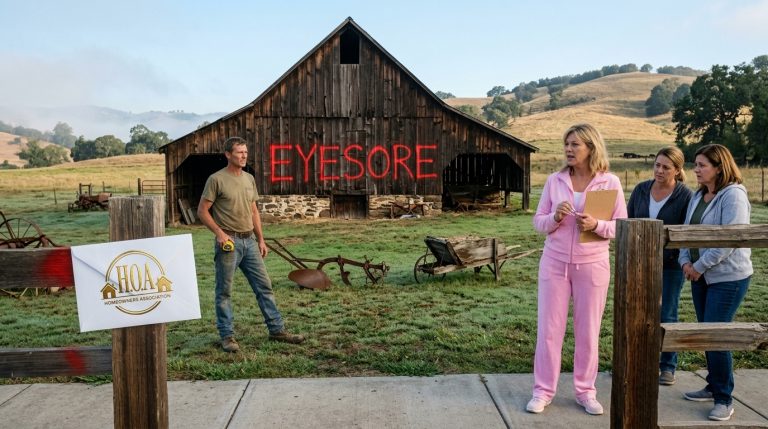
The air in Willow Spring Estates never felt quite right—too sanitized, as if the wind itself had been scrubbed clean to match the manicured lawns. I stood on the edge of my gravel driveway, the same path my grandfather had laid down in 1952, and watched the silver Lexus pulse like a predatory insect at the end of the long, uneven track.
Veronica Ashford stepped out. Even at nine in the morning, she was a study in clinical precision: navy blazer, pearl earrings, and that ridiculous sterling silver ruler clutched in her hand. Behind her, Marcus, the city inspector, lumbered out of his truck. He had the kind of mustache that suggested he’d watched too many reruns of 1980s cop dramas, but his eyes were purely transactional. He tapped his clipboard with a pen that clicked with every rhythmic movement.
“Mr. Brewster,” Veronica said, her voice landing with the weight of a judge’s gavel. She didn’t look at me; she looked past me, toward the stone chimney that had warmed three generations of my blood. “We are conducting a comprehensive structural and safety inspection. Your property has been flagged for significant code non-compliance.”
I didn’t answer. I just watched her. My hand hovered near the pocket of my jeans, feeling the rough texture of a stone I’d picked up from the garden earlier that morning—a small piece of granite, jagged and heavy. It was a reminder of what this place was before she arrived.
“This access road,” Marcus muttered, his voice gravelly as he pointed at the path beneath our feet, “it’s a hazard. Substandard for emergency vehicle ingress. It needs professional paving—industrial grade.”
“It’s served the property for seventy years,” I said, my voice low, controlled. I was counting the beats of his heart in my head, imagining the rhythm of the game. I wasn’t just a widower anymore; I was a man watching a predator overextend its reach.
Veronica moved to the chimney, her silver ruler tracing the mortar joints like a scalpel over a wound. “Deterioration. Structurally unsound, Mr. Brewster. The risk profile is unacceptable. If you cannot meet the standards outlined in the code, the Board is prepared to enforce foreclosure proceedings.”
She clicked her clipboard. It was a sharp, biting sound. She looked at me then, her eyes cold, devoid of empathy, searching for the crack in my composure, the moment I would beg. She didn’t realize she was standing on land that had never belonged to her development company, land that was currently being measured by a ghost.
I looked down at the gravel. A small, out-of-place blue marble lay half-buried near the edge of the drive—a toy from a neighbor’s kid, misplaced and forgotten. It was a tiny, hard detail that felt louder than her legal jargon.
“You’re measuring the wrong things, Veronica,” I said.
She paused, the ruler mid-air. For a split second, the mask of the HOA president flickered. She looked at me as if I were a ghost already, something to be erased by the next quarterly review. “I am measuring reality, Mr. Brewster. And in this reality, you are a liability.”
She didn’t see the trap. She was too busy measuring the height of a fence she intended to tear down, never realizing that the very foundation she stood on was about to be pulled out from under her.
As they walked back to the truck, Marcus scribbling the latest fine into his ledger, I felt the weight of the papers in my back pocket—the draft of the property research I’d started at the county clerk’s office. I didn’t say goodbye. I watched the diesel smoke hang in the air, a thick, suffocating cloud, and I knew exactly which lever I had to pull to bring the entire, pristine structure down.
CHAPTER 2: The Paper Trail of Forgotten Promises
The gravel crunch under my boots sounded like breaking teeth as I walked toward my truck. The silence that followed Veronica’s departure wasn’t peaceful; it was heavy, suffocating, and charged with the residual static of her authority. She thought she was performing a routine inspection, but I knew the truth: she was hunting for a reason to claim the land, unaware that the land had been waiting for the right moment to claim itself back.
The drive to the county courthouse was a blur of shifting gears and the rhythmic thrum of the engine, but my mind was a steady, locked mechanism. I didn’t see the familiar rolling hills or the encroaching subdivision that had swallowed the horizon. I saw only the layers—the cake my grandfather had described in his letters, with the icing of residential development sitting precariously on the foundation of the Brewster estate.
The courthouse basement smelled of damp concrete and the slow, inevitable decay of history. It was a place where paper went to die, or at least to be forgotten by the people who lived in the shiny, modern houses above. I navigated the maze of filing cabinets, my fingers brushing against the cold steel, each drawer a potential trapdoor.
Nancy, the county clerk, was at her station, her head buried in a stack of tax assessments. She didn’t look up when I approached, her fingers tapping a nervous, erratic rhythm against the desk. Her eyes were rimmed with a faint, tired red, and she seemed to be avoiding the very air I occupied.
“I need the 1987 development files,” I said, my voice cutting through the hum of the fluorescent lights.
Nancy’s hands stilled, though she didn’t raise her head. “Mr. Brewster, I told you, those are archived. It takes time to pull them.”
“I have time,” I replied, leaning against the counter. My presence felt expansive in the small, cramped room. I watched her swallow hard, the movement of her throat betraying a pulse that was jumping like a trapped bird.
“Everything is… being digitized,” she muttered, finally looking at me. Her eyes darted toward a hallway that led deeper into the labyrinth of storage. “You can’t just walk back there.”
“Then bring them here.”
I stood there for an hour, watching the way she moved. She wasn’t just working; she was hiding. I noticed the way she avoided the ‘D’ cabinet, lingering instead on the ‘M’ files, her movements repetitive and lacking any actual intent. It was the behavior of a woman holding a secret that was slowly burning a hole in her conscience. My mind cycled through the possibilities: bribery, pressure, or perhaps just the fear of a woman who knew which side of the political fence had the most teeth.
She finally pushed a heavy, dust-covered cardboard box across the counter. It smelled of mildew and stale air. I didn’t open it until I was back at the small, metal-topped desk in the corner of the room, away from the flickering lights of her station.
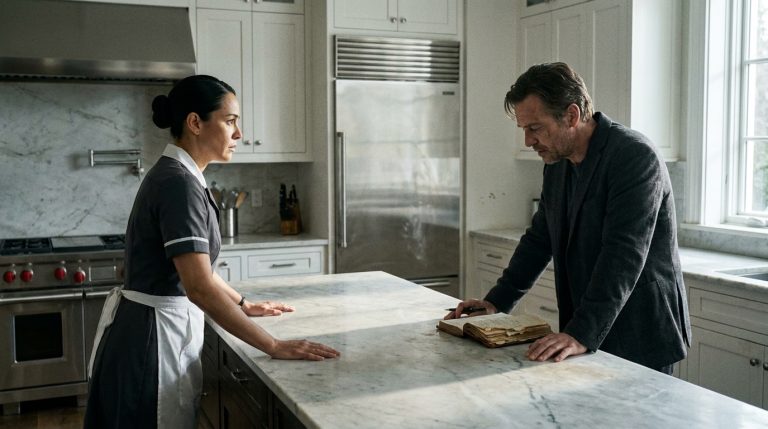
The documents were brittle, the edges yellowed with age, but the ink was as sharp as the day it was pressed onto the page. My grandfather’s handwriting was unmistakable—deliberate, angular, and uncompromising. Clearwater Development Company: Development Rights Lease. The words hit me with the force of a physical blow.
I traced the clauses with a trembling finger. The 99-year lease. The retention of subsurface ownership. The specific mention of land ownership remaining with the Brewster family in perpetuity. There were annotations in the margins, his voice captured in ink: I don’t trust these city developers.
The truth wasn’t a sudden explosion; it was a slow, cold settling of weight in my chest. I had spent months feeling like a trespasser on my own life, fighting a losing battle against fines that felt like a death sentence. But here, in the cold, unyielding language of legal property law, was the proof that I was the rightful king of a kingdom that had been stolen by a group of men who thought they could buy the earth without buying the soul of the land.
I looked at the box again. There were gaps. Missing folders, empty sleeves where deeds should have been. I could see the ghost of where documents had been pulled, a deliberate excision of truth. My gaze shifted to the hallway where Nancy had disappeared earlier. She hadn’t been filing; she had been cleaning.
A chill ran down my spine, sharper than the damp air of the basement. I wasn’t just dealing with a pushy HOA president. I was dealing with a systematic erasure of my family’s identity. I pulled out my phone and took a photo of the lease agreement, the flash reflecting off the glass of my screen like a warning. I wouldn’t let the paper disappear. I would become the ledger.
As I packed the documents back into the box, my movements were precise, devoid of the hesitation that had plagued me for the last two years. I knew now. Veronica wasn’t just a neighbor or a busybody. She was an actor in a play where the script had been written thirty years ago, and I had just realized that I was the one holding the original copy of the manuscript. I walked past Nancy’s desk, my footsteps echoing with a new, heavy authority. She didn’t look up, but she knew. She had to know. I left the courthouse, the sun outside feeling harsh and unforgiving, and the air of the neighborhood no longer felt like a sanitized cage—it felt like a battlefield where I finally knew where the trenches were dug.
CHAPTER 3: The Gardens Scar
I stepped out of the truck and the air felt different—thinner, colder, and sharp with the scent of raw, upturned dirt. My boots sank slightly into the soft, muddy ground where, only yesterday, the earth had been firm and well-trodden. I walked toward the memorial garden, the heart of the property where Sarah’s laughter used to linger in the morning mist, and my breath hitched in my throat.
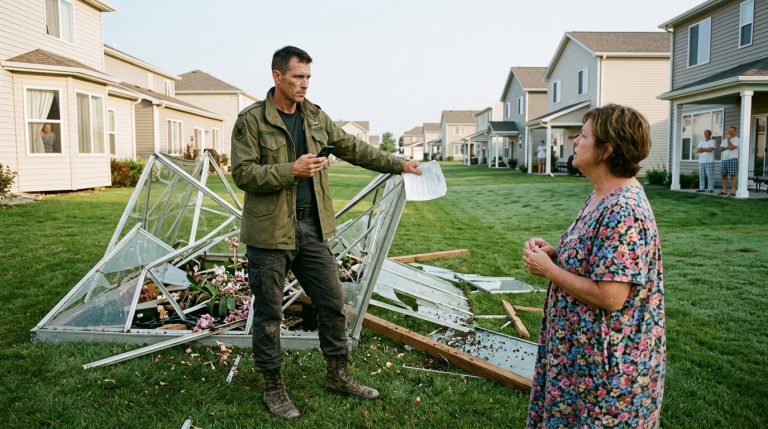
The wooden fence, which had held steady against thirty years of Indiana winters, had been pried loose in the corner. Someone had been here. They hadn’t just walked through; they had dug. Three of Sarah’s prized heirloom tomato plants, the ones we’d started from seed three years ago, lay discarded in the mud like trash. Their roots were exposed, shriveled and pale, stripped of their sanctuary.
A neon-orange citation packet was zip-tied tightly to the cedar post, fluttering in the breeze like a mocking flag. Unauthorized agricultural modification, $15,000 penalty.
The paper felt oily beneath my fingers, the ink too crisp, too new. I didn’t rip it down. I stood there, letting the cold bite into my skin, feeling the steady, rhythmic pulse in my temples. It wasn’t just a violation; it was a message. Veronica wasn’t playing the game of aesthetics anymore; she was moving to take the pieces of my life one by one, using her authority as a blunt instrument to break the things I couldn’t afford to lose.
I crouched down, touching the soil where the roots had been torn. It was wet, clumping under my fingernails—the same dark, rich earth my grandfather had cleared by hand. The physical discrepancy here was too precise to be random. The holes were uniform, dug with professional tools, not the clumsy, rushed efforts of an amateur. They wanted me to see this. They wanted me to feel the violation of the perimeter, to wonder who was watching, and to understand that the security of my own backyard was an illusion.
I stood back up, my knees aching, and scanned the tree line. The subdivision loomed in the distance, a rows of identical rooflines and perfect, sterile lawns. It looked like a graveyard of individuality. I remembered the box in my truck—the lease agreement, the proof of my grandfather’s foresight. The power balance was shifting, but it was a slow, agonizing process.
I walked to the wellhouse, where Sarah used to store her trowels and twine. I checked the lock—untouched. I stepped inside, the darkness offering a brief, claustrophobic reprieve from the wind. I reached behind a rusted shelf, my fingers finding the loose stone where I kept the old brass transit, the one my grandfather used to survey the original boundaries.
The weight of the brass was grounding. It was cold, solid, and had seen more history than any HOA board president would ever understand. As I held it, I realized the vandalism wasn’t just about the tomatoes or the fine. It was a pressure test. They wanted to see how much I would endure before I snapped, or before I made a mistake.
I left the wellhouse and walked back to the house, avoiding the main path. I moved through the shadows of the old oak tree, its branches swaying like heavy arms against the grey sky. I had to be smarter than the paper they pushed through my mailbox. I couldn’t just fight with deeds and surveys; I had to start monitoring the perimeter. If they were going to play this game of territorial encroachment, I would ensure that every step they took onto my property was documented, recorded, and added to the ledger of their undoing.
I went to the garage and pulled out a small, unassuming digital camera, the kind I used for field work when I was still surveying wells. I spent the next two hours mapping the property, not for gardening, but for visibility. I placed the cameras in the hollows of trees and the shadows of the stone foundation, ensuring that every angle of the garden and the driveway was covered.
As I worked, the sun began to dip below the horizon, casting long, jagged shadows across the field. I was tired, a deep, bone-weary exhaustion that sat heavy in my muscles, but my mind was clear. The vandalism of the garden was the first real-world casualty, but it was also the first mistake Veronica had made. She’d stepped onto the land, physically and metaphorically, and in doing so, she had provided me with the evidence of her overreach.
When I finally entered the house, the silence felt different. It wasn’t the lonely, hollow silence of a widower’s home; it was the quiet, attentive silence of a man who was no longer waiting for the next blow, but was actively preparing the defense. I sat at the kitchen table, the citation packet lying before me, and I didn’t reach for my checkbook. I reached for my notebook, and I started to map out the connections—the family ties between the city inspector and the board, the flow of the fines, the way the paperwork seemed to move faster than the law allowed. I was no longer just the victim of their vendetta. I was the architect of the reality they were about to be forced to live in.
CHAPTER 4: The Architecture of Greed
I didn’t sleep. The house was a quiet, living thing, every floorboard creaking under the weight of the night. I spent the hours mapping the paper trail, spreading the photocopies from the courthouse across the kitchen table like a game of solitaire. Every citation Veronica had sent, every formal letter from the HOA board, I cross-referenced with the dates of Clearwater’s original filings.
The patterns began to emerge from the chaos. It wasn’t just harassment; it was a rhythmic, calculated bleeding of my assets. Each violation notice arrived with a precision that suggested someone was watching the land, waiting for me to hit a specific threshold of financial vulnerability. I picked up my grandfather’s transit, its brass casing cold against my palm. I remembered him sitting at this very table, his voice a low rumble, warning me that a man’s property was only as secure as his understanding of the ground beneath his feet. He hadn’t just been talking about soil; he’d been talking about the hidden lines of influence that kept people in power.
I needed to see if the connection reached beyond the HOA. I grabbed my coat and left, the night air biting at my skin. I didn’t head for the subdivision; I headed for the small, secluded office of Eleanor Patterson. Her place was a sanctuary of forgotten stories, tucked away on the outskirts of the county. When I arrived, the light was still on, casting a warm, yellow glow onto the overgrown lawn.
Eleanor opened the door before I could even knock. She looked tired, her glasses perched on the tip of her nose, but her eyes were sharp. She motioned me inside, the room smelling of lavender and the heavy, sweet scent of old ink.
“I found something,” she said, before I could even get the words out. She pushed a folder toward me. “It’s not just the land, Clayton. It’s the money flow. I started looking into the HOA’s banking records, following the trail of the special assessment funds. It’s not sitting in a reserve account. It’s moving through a series of shell companies, each one registered in states where the disclosure laws are paper-thin.”
I flipped through the pages. The names were unfamiliar—entities that sounded corporate, innocuous, and completely disconnected from the neighborhood. Yet, there it was: a consistent, cyclical transfer that mirrored the timing of the violations Veronica had issued. She wasn’t just managing the neighborhood; she was treating the HOA as a private bank, using the enforcement of ‘community standards’ as a pretext to siphon capital into accounts that had nothing to do with property maintenance.
“This is embezzlement,” I said, my voice barely a whisper.
“It’s more than that,” Eleanor replied, her gaze intensifying. “It’s a deliberate strategy of economic dispossession. If they can force you into bankruptcy, the land gets tied up in probate or liquidation. That’s when the shell companies swoop in. They buy the debt, and suddenly, they own the land you’ve been fighting to protect.”
The realization hit me with the force of a physical impact. The vandalism in the garden, the ridiculous fines—it wasn’t just personal spite. It was a tactical depletion of my resources, designed to force me into a position where I’d have no choice but to surrender the property. I looked at the names again, my mind tracing the complex web of ownership. The connections led straight back to Veronica’s husband’s firm in the city, but they also pointed toward a broader network, a group of investors who had been waiting for the original Brewster farm to fall for over thirty years.
I stood up, the chair scraping sharply against the hardwood floor. The room felt smaller, the walls closing in with the weight of the conspiracy. I had been fighting a localized battle, thinking the enemy was a woman with a silver ruler, but I was fighting an entire system built on the assumption that I was too isolated and too grieving to look at the documents.
“They think I’m alone,” I said, looking at Eleanor.
“They don’t know who you are,” she corrected. “They think you’re a farmer who doesn’t understand the difference between surface rights and ownership. You need to talk to Richard Sterling.”
The name struck a chord. I remembered the name from the bankruptcy filings I’d skimmed earlier. “He was Clearwater’s attorney, right?”
“He was,” Eleanor confirmed, her voice lowering. “He’s in Florida now, retired. But he didn’t leave because he was done. He left because he was finished being a witness to what they were doing. He’s been waiting for someone to call him for three decades.”
I felt the shift in my pulse—a steady, cold determination. The mystery of the garden, the vandalism, the manufactured violations—they were the decoy. The real truth was buried in the files of a man who had seen the foundation of the house crumble before it was even finished. I reached for my phone, the screen glowing in the dim room, and began searching for the number. Every move they made was a brick, and I was finally starting to see the blueprint they were trying to build over my life. I wouldn’t just tear it down; I would dismantle it, piece by piece, until there was nothing left but the truth.
CHAPTER 5: The Florida Connection
The rain wasn’t just a weather event; it was a rhythmic assault, a drumming that intensified the isolation of the farmhouse. My phone sat on the kitchen table, a small, black slab of plastic that suddenly felt like a weapon. When the line finally connected, the voice on the other end was raspy, thin, and brittle—like dry leaves skittering across pavement.
“Brewster?” the voice asked. It sounded surprised, perhaps even a little frightened.
“I have the documents, Mr. Sterling,” I said, my voice steady, gripping the receiver. “I have the 1987 lease and the bankruptcy records. I’m looking at the reversion clauses.”
There was a long silence, filled only by the crackle of a distant line and the incessant, violent pounding of the rain against the windowpane. “You shouldn’t have those, Clayton,” Sterling finally whispered. “Nobody was supposed to have those.”
“They’re mine,” I countered, my eyes tracking the rain-streaked glass. “My grandfather bought this land for a reason. And Clearwater was a house of cards that you helped build. Why wait thirty years to tell someone?”
Sterling laughed, a dry, coughing sound. “Because I was a coward. Because I was paid well. And because I thought the Brewster line had ended when your father moved away. You don’t know what you’re dealing with, son. It wasn’t just Clearwater. It was a network. People who don’t leave loose ends.”
I stood up, pacing the length of the kitchen, my boots echoing on the hardwood. The rain was turning into a deluge, the driveway outside likely becoming a river of mud and silt. “I’m not looking for a payout, Sterling. I’m looking for the truth about the reversion. The records say it was automatic. The title is mine. Is that true?”
“Equitable reversion,” he said, the legal term carrying a sudden, cold precision. “Yes. It’s the rubber band. When they failed to complete the purchase, the property rights didn’t dissolve into the ether. They snapped back to the original title holder. You own the subdivision, the streets, the common areas—everything. But that title is only as good as the paper it’s printed on, and they’ve spent three decades ensuring that paper doesn’t exist.”
The thunder rolled, a low, guttural vibration that rattled the window frames. My heart hammered against my ribs, matching the intensity of the storm. “They’re destroying the records, Sterling. They’re burning them.”
“Then you’re running out of time,” he replied. His voice was suddenly urgent, stripped of the fatigue. “Listen to me. There’s a copy. Not in the county records. Not in the company archives. I filed a duplicate with the State Land Commission in Indianapolis in 1991, as part of the bankruptcy dissolution proceedings. It was required by federal law, and it’s the one place they couldn’t reach, even with their money.”
He gave me a file number—a string of digits that felt like a lifeline. As I scribbled it down, the ink bleeding slightly on the wet paper, I heard the faint, distant rumble of a vehicle struggling up my driveway. I dropped the pen and moved to the window.
Through the lashing rain, I saw the headlights of a car—not a Lexus, but something heavier, an SUV churning through the mud. It wasn’t the police; they would have had sirens. It wasn’t the delivery driver. It was someone who didn’t want to be seen, someone who had waited for the storm to mask their arrival.
“Sterling, I have to go,” I said, my voice sharp.
“Clayton, wait—”
I hung up, the silence of the house returning, now amplified by the tension of the headlights cutting through the dark. I didn’t reach for my keys. I reached for the heavy iron fire poker beside the hearth. I walked to the front door, the wood cool and solid beneath my hand.
I didn’t turn on the porch light. I stood in the dark, watching the SUV crawl closer, the rhythm of its engine fighting against the roar of the rain. I knew exactly who it was. If Veronica was the face of the operation, then this was the fist. The revelation of the title fraud wasn’t just an inconvenience anymore; it was a threat that had finally reached the threshold of their comfortable, stolen lives.
I didn’t feel fear. The adrenaline that surged through me felt like cold, clear water. The documents in my truck were safe, hidden where no one would think to look, but the person coming up my drive didn’t know that. They thought I was still the widower, the man grieving in his garden, the easy mark. As the vehicle stopped and a door creaked open, the sound of the latch was a sharp, mechanical punctuation in the roar of the storm. I stood my ground in the shadow of the foyer, ready to meet whatever price they thought I had to pay for the truth.
CHAPTER 6: The Weight of the Incinerator
The silhouette moved against the rain—a bulky, sodden shape navigating the treacherous mud of my drive. I didn’t breathe. I watched as the figure reached the porch, their movements heavy and hesitant. They didn’t knock. Instead, there was a tentative, practiced fumbling at the door latch, a sound I had hoped never to hear. I stepped back, letting the darkness of the foyer swallow me, the iron poker balanced and heavy. The door creaked open, admitting a gust of wind that smelled of wet asphalt and something else—acrid, lingering, like the char of burnt paper.
I didn’t wait for them to adjust to the gloom. I moved, not with the haste of a man in panic, but with the measured, singular focus of a landholder clearing a pest from his porch. I stepped into the light of the hallway just as the figure stumbled inside. It was Nancy. The county clerk. She was soaked through, her hair plastered to her forehead, and her eyes were wide, darting around the room as if expecting to find ghosts.
“Clayton?” she gasped, her voice trembling. She held a heavy, water-logged cardboard box to her chest as if it were a shield. “I… I had to come. I couldn’t let them finish it.”
I kept the poker lowered, but I didn’t let my guard drop. The box she held—it was the same dimensions as the ones I’d seen in the basement, the ones that had been destined for the incinerator. “You were there, Nancy,” I said, my voice barely audible over the roar of the rain. “I saw you at the dump. I saw the fire.”
She let out a sob, the sound jagged and raw. She slid down the wall, the box clattering to the floor. “She made me. Veronica… she said it was just old junk, files that didn’t matter anymore because the development was already settled. But when I saw the Brewster name, I… I remembered my father talking about the original surveys. I kept some. I couldn’t destroy them all.”
She opened the box. Inside, protected by a layer of heavy-duty plastic, were the original deeds—the ones that had been reported as “damaged by a water leak.” They weren’t just scraps of paper; they were the physical history of my grandfather’s integrity. I knelt, my hands moving with practiced care as I sifted through the files. There, at the bottom, was the carbon copy of the 1987 contract, the signature authentic, the terms binding.
“Why now, Nancy?” I asked, looking up at her.
“Because they’re coming for you,” she whispered, her hands shaking so violently she had to clasp them together. “Veronica found out I kept these. She’s not just cleaning up paper, Clayton. She’s cleaning up people. She has the property assessment numbers, the tax leans, the legal team—she’s going to make you disappear before the foreclosure hearing on Monday.”
The pieces locked into place with a terrifying, mechanical finality. The vandalism, the harassment, the shell companies—it was all a preamble to an orchestrated removal. She wasn’t just trying to bleed me dry; she was going to use the law, a system I was only beginning to understand, to erase my claim to the land entirely.
“I need these,” I said, gathering the documents. “These go to the state commission. Not the local office. The state commission.”
“It’s too late,” Nancy sobbed. “She knows you called the lawyer in Florida. She knows everything.”
The sound of a second car engine cut through the storm—a sharp, aggressive revving that echoed in the narrow space of the drive. Two sets of lights swept across the living room window, casting long, distorted shadows that danced like specters against the walls. They hadn’t just sent Nancy. They had sent a cleanup crew.
I looked at Nancy, then at the poker in my hand. I wasn’t a soldier, and I wasn’t a criminal, but I was a man standing on his own ground. “Go through the back,” I instructed, my voice firm. “The mud is deep, but the tree line is thick. Get to Eleanor’s, and don’t stop.”
“What about you?”
I turned back to the door, the heavy oak frame feeling like the ramparts of a fortress. “I have something I need to finish.”
As she scrambled toward the kitchen exit, I checked the bolt on the front door. The cars outside weren’t moving anymore. Doors slammed. Voices, muffled by the torrential rain, began to shout commands. They were testing the perimeter. I walked to the kitchen and grabbed the small, unassuming digital camera I had installed—the one that had captured the vandalism in the garden. I checked the SD card, the data light blinking a steady, reassuring green. The evidence wasn’t just in the documents anymore. It was in the actions they were about to take on my doorstep. I stood in the center of my home, the history of my family in the box at my feet, and waited for the knocking to start.
CHAPTER 7: The Sunday HOA Collapse
The front door took the first impact—a dull, heavy thud that rattled the hinges and sent a shower of dust drifting down from the ceiling. They were confident, these men. They moved with the casual, aggressive arrogance of people who believed that violence was a sufficient substitute for legal authority. I didn’t open the door. I moved to the side, pressing my back against the wall, my breathing slow and deliberate. I knew exactly where the deadbolt held, and I knew how the old oak wood groaned under pressure.
“Brewster! Open up,” a voice shouted—not the city inspector, but someone with a harder edge, a voice accustomed to breaking things. “We have the foreclosure order. Save yourself the trouble.”
I didn’t answer. I reached for the light switch and plunged the foyer into shadow. If they wanted to play on my property, they would have to do it on my terms. I listened to the sound of heavy metal striking the door frame—a crowbar, forcing the gap. The wood groaned, splinters dancing in the dim light. I watched the door buckle, the internal locking mechanism straining. This was the failure point—the moment where the legal pretense of a “foreclosure” dissolved into simple, illegal trespassing.
I moved to the back window, watching the SUVs idling in the downpour. The lights caught the insignia on the side of the vehicles—private security, not county vehicles. Veronica wasn’t even attempting to hide the mercenary nature of her endgame. She wasn’t using the law anymore; she was using muscle.
I picked up the camera I had retrieved, ensuring it was still recording, and set it on the kitchen counter, angled to capture the living room through the hallway. As the front door finally gave way with a sickening, wet crack of splintering timber, I moved into the shadows of the utility closet.
The men who surged into the house weren’t wearing uniforms. They were dressed in black, tactical gear, efficient and cold. They swept the room with flashlights, the beams cutting through the dark like scalpels. They stopped when they saw the kitchen, expecting to find me cowering, waiting for their demands. They didn’t find a frightened widower. They found the house empty, the smell of damp earth and the quiet hum of a camera light on the counter the only evidence of life.
I watched from the closet, my pulse as steady as a metronome. As they began to tear the house apart—flipping the table, throwing my grandfather’s surveying equipment to the floor—I heard the sound of approaching sirens. Not the slow, lethargic arrival of local patrol, but the frantic, escalating pitch of state police cruisers. I had timed the call to the state ethics board and the land commission to arrive exactly when the trespass occurred.
I waited until they were fully engaged in their search, until the house was in absolute disarray, and then I stepped out of the closet. The lead man spun around, the flashlight beam hitting my face, blinding, but I didn’t flinch.
“You’re on private property,” I said, my voice cutting through the noise. “And everything you’ve done in the last five minutes has been recorded.”
The man cursed, reaching for his belt, but it was too late. The blue-and-red strobes of the state police reflected off the windows, illuminating the room in a strobe-light chaos. Doors slammed. Boots hit the porch. The tactical advantage they thought they possessed had vanished, replaced by the crushing reality of the law they had tried to bypass.
As the officers swarmed the house, their weapons drawn, I stood in the center of the debris—the broken furniture, the scattered papers, the shattered history of my family. The leader of the group, a man with a face like a slab of granite, looked at me, then at the camera on the counter. His expression didn’t change, but for the first time, I saw it—the realization that the trap hadn’t been set for me. It had been set for them.
They were led out in cuffs, their tactical gear looking absurd under the harsh glare of the police lights. I watched them pass, their faces hidden behind masks, their posture slumped under the weight of the sudden, devastating failure. Veronica wouldn’t be arriving tonight to collect the keys. She would be dealing with the fallout of a home invasion that had been broadcast to the very people who were now documenting her downfall.
I walked to the kitchen and picked up the camera. The record light was still glowing a steady, defiant red. It was over. The violence had been the final, desperate lunge of an animal that knew it was trapped. As the officers began to take my statement, I looked out the shattered door at the subdivision—the rows of houses that had been built on a lie. The rain was finally beginning to slacken, leaving behind a silence that was clean, sharp, and entirely mine. The long, brutal winter of their reign had ended.
CHAPTER 8: The Harvest of Truth
The aftermath didn’t come with a roar; it came with the slow, meticulous unwinding of a clock. In the days following the attempted home invasion, the state investigation peeled back the layers of Veronica Ashford’s life like skin from a scorched fruit. The forensic accounting of the HOA’s bank accounts exposed the shell companies, the false liens, and the systematic embezzlement, but the true devastation was the unveiling of the title fraud. When the State Land Commission finally released the original 1991 bankruptcy filing documents—the very ones Richard Sterling had fought to protect—the legal foundation of Willow Spring Estates simply ceased to exist.
Veronica sat in a holding cell, her navy blazer stripped of its authority, her pearl earrings confiscated as personal effects, waiting for the federal charges of corruption and conspiracy to hold her in place. She didn’t offer a monologue. She didn’t try to negotiate. When I finally walked past the visitation room glass, she was staring at the floor, her face an unreadable mask of cold, exhausted fury. She had gambled on the belief that I was too weak to fight, and in the end, she had been defeated not by an external force, but by the very system of rules she had tried to subvert. The poetics of it were absolute: she had sought to build a pristine, sanitized world on a foundation of theft, and in doing so, she had created the mechanism of her own eviction.
The transition to the new order was quiet, a steady recalibration of a community that had lived a lie for thirty years. My daughter, Jessica, handled the legal heavy lifting, drafting the new land-use agreements. We didn’t seek the ruin of the 127 families who had been duped by Clearwater Developments. We offered them a path to legitimate ownership, a way to build on land that was finally, legally theirs. Most accepted, their relief palpable. The HOA dissolved within the month, replaced by a simple, cooperative council that prioritized maintenance over enforcement.
Two months later, the harvest festival began. The sun was warm, the kind of light that seemed to pull the very spirit from the soil. The community center, once the site of Veronica’s iron-fisted rule, was now filled with the sound of laughter and the smell of fresh herbs and roasted vegetables. Families stood in the center of Sarah’s memorial garden, the soil now rich and undisturbed. I saw Mrs. Henderson, a woman who had spent two years fighting petty violation notices for her flower boxes, now kneeling in the dirt, showing a younger neighbor how to prune the heirloom tomatoes.
I walked to the wellhouse, now the site of Jessica’s law office. I reached into the rafters and pulled down the old iron trowel I’d used to garden with Sarah, the wooden handle worn smooth by years of use. It had been bent during the initial cleanup after the vandals tore up the patch, but I had spent the last week carefully heating and hammering the metal back into alignment.
I leaned against the wellhouse, the weight of the tool familiar in my hand. It was a small thing—a piece of rusted steel—but it was whole again. The gardens were thriving. The air didn’t smell of diesel and antiseptic; it smelled of growth. I saw Jake Morrison approaching, his hand outstretched, his expression one of quiet, hard-won respect. We didn’t need to speak of the court dates or the legal briefs. We watched the children play near the oak tree, the one Veronica had cited as a hazard, now spreading its branches wide over the garden as if in protection.
The peace that settled over the land wasn’t the silence of absence; it was the quiet of stability. I looked at the surveyor’s transit, which sat on the porch, no longer a hidden instrument of defiance, but a tool for the future, meant to help keep boundaries clear and honest. I had fought for a memory, for the right to sustain the world Sarah had built, and in the process, I had anchored my own life back into the dirt.
As the sun began to dip, casting a golden, amber glow over the rows of vegetables, I finally understood what Sarah had been teaching me all those years ago. Farming wasn’t just about the harvest; it was about the patience of the cycle. You prepare the soil, you plant with intent, and you defend the growth against the weeds. The weeds had been pulled. The garden was open. And for the first time in years, the silence of the land was a promise rather than a threat. I knelt in the garden, pressed my hand into the dark, cool earth, and for a long moment, I simply stayed there, grounded, present, and finally, completely at home.