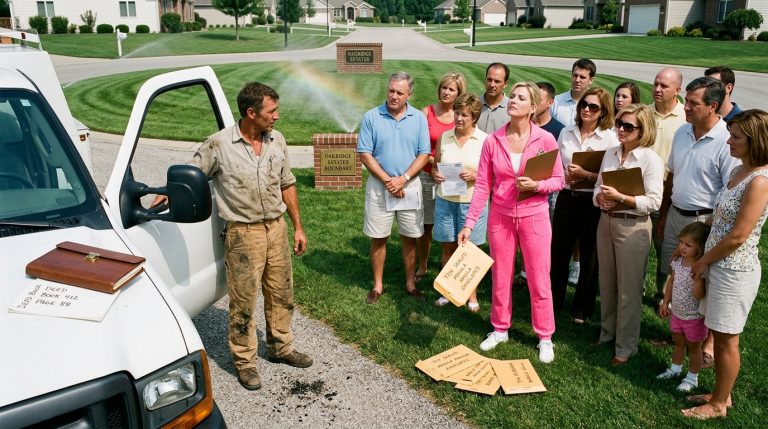
The Iron Line on Miller Road: How a Retired Army Engineer Defied the Suburban Mob
CHAPTER 1: THE ULTIMATUM AT THE STEEL LINE
The smell of acrid iron smoke hung thick over the gravel shoulder, burning raw in the July heat.
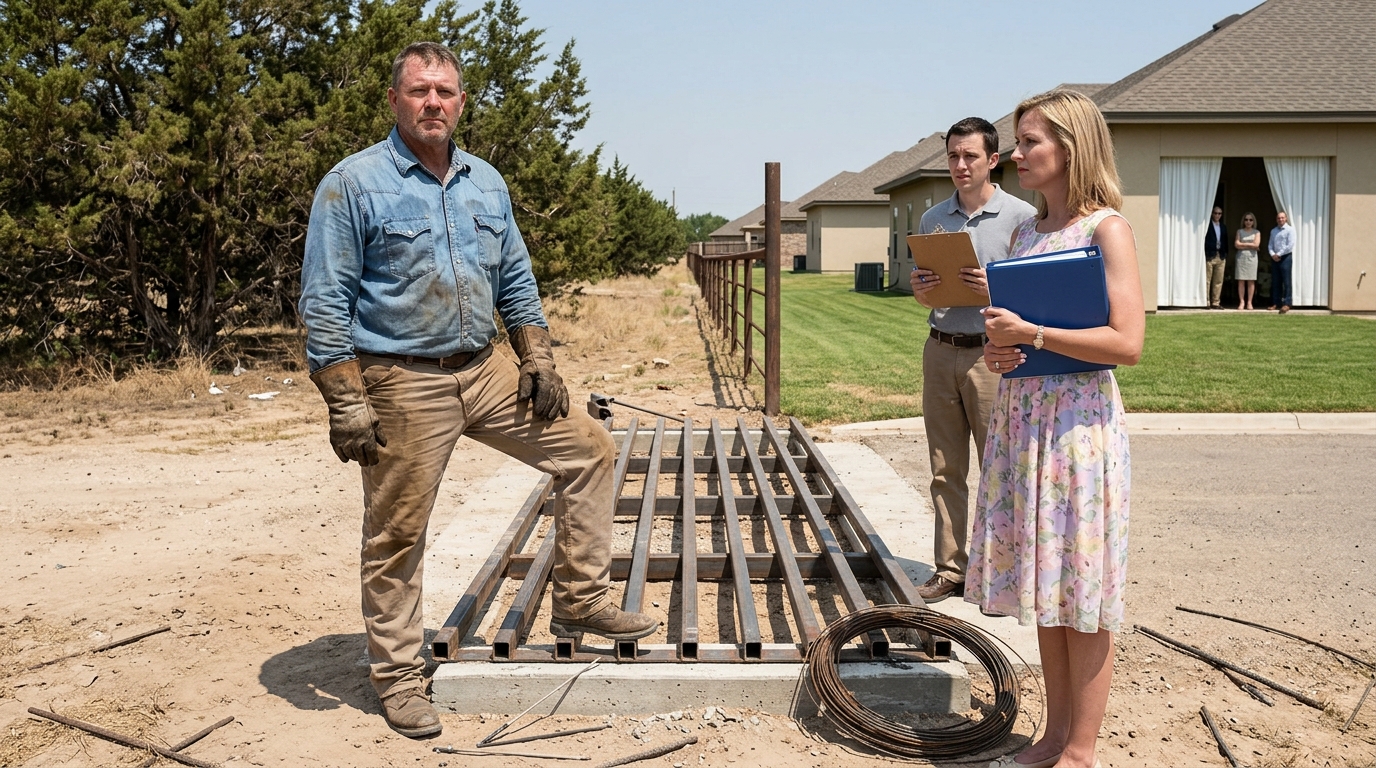
I pulled off my heavy leather welding gloves, the stiff hide dark with sweat and grease, and slapped them against my thigh. The sharp metallic clang of my boot tapping the newly set steel grid echoed off the cedar trees. Six deep concrete footings held that cattle guard tight to the earth.
“That hideous metal contraption is a lawsuit waiting to happen, Mr. McGregor,” Karen Thompson said, her heels crunching on the loose rock as she halted just short of the property marker.
Her floral pastels burned bright against the dry brush, her manicured fingers digging into the side of a thick blue three-ring binder. Behind her, Gary—a thin man in a starched polo—held a wooden clipboard like a riot shield, his eyes darting between my face and the heavy welding torch resting on the tailboard of my truck.
“It keeps my ten Santa Gertrudis heifers from walking onto the county road,” I said, my voice dropping into the flat, quiet cadence forty years of military engineering leaves in a man’s throat. “They’re broad-chested animals. A standard wire gate doesn’t cut it when the teenagers leave it unlatched.”
“Section 7, Subsection B,” she snapped, her chin tilting upward until the folds of her neck pulled taut. “All modifications to shared access corridors require prior written approval from the Architectural Review Committee. You have until Friday to pull those steel rails out of the trench, or we will hire a crew to do it for you—and bill your account for the cost plus a thousand-dollar nuisance penalty.”
Gary nodded once, a nervous, jerky movement, and clicked his ballpoint pen twice.
I didn’t reach for the binder. I didn’t raise my voice. I flexed my bare hand, the calluses on my palm stiff from five hours of holding the torch, and looked past her toward the beige stucco homes of Willow Creek Estates rising up where old pasture used to be.
“This access road is a recorded 1928 easement,” I said softly, stepping closer until the shadow of my work truck fell across her white designer sneakers. “Your covenants stop at my property line, Mrs. Thompson.”
“The board’s authority covers every inch of pavement feeding into this subdivision,” she said, her voice dropping into a tight, theatrical whisper that carried straight through the still air. “You have until Friday morning. Choose carefully.”
She turned on her heel, her floral dress snapping around her knees, and marched back toward the paved cul-de-sac with Gary scurrying two paces behind.
I picked up the heavy leather gloves from the truck bed, feeling the weight of the rough hide against my palm, and slowly pulled them back on. Deep inside the antique desk back at the ranch house, tucked behind our modern title insurance papers, sat a yellowed, thick-paper survey map stamped with a dry county seal from ninety-eight years ago.
The steel under my boots didn’t budge an inch.
CHAPTER 2: THE VAULT OF DEED 1928
The antique oak desk smelled of dried cedar and machine oil. Outside, the night was dead still, the dark oak trees standing like iron posts against the pale Texas sky.
I pulled the crinkling survey map flat against the wood, weighing down its corners with an old brass compass and a rusted box of 12-gauge shells. The ink was faded to a dark sepia, but the line drawn in 1928 didn’t bleed. 30-foot perpetual agricultural and access easement. Volume 12, Page 45, Travis County Records.
Sarah leaned over my shoulder, her fingers resting light against the cotton of my sleeve. “Mac,” she said, her voice dropping into the quiet of the room. “Can an HOA really take a home over a piece of pipe welded into the dirt?”
“They can try if they think you don’t know what you signed,” I said, my thumb slipping into the pocket of my jeans to feel the cold, heavy weight of my brass pocketknife. “Karen’s running a game based on a binder she printed six years ago. This map was drawn when her cul-de-sac was still cotton pasture.”
I didn’t waste time sleeping. By seven in the morning, the old diesel truck was idling in front of the Travis County Records Office, the exhaust blowing thin gray ribbons into the damp morning air.
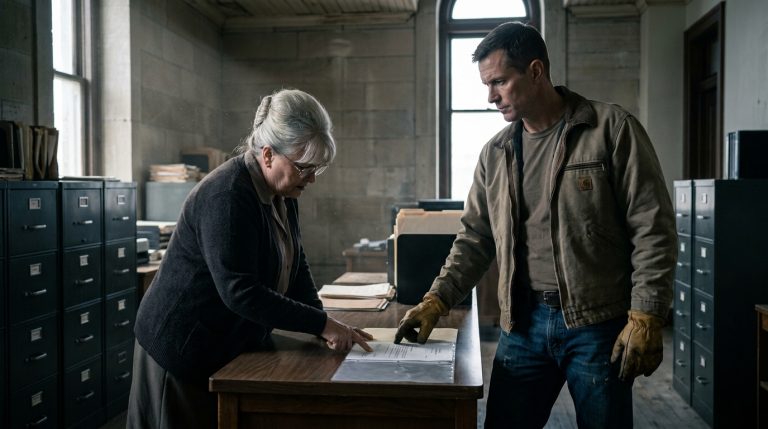
The archive room smelled of old glue, cold marble, and vinegar from the microfilm chemical baths. A woman named Clara, wearing silver-framed glasses on a beaded chain, set the massive leather-bound index ledger onto the high wooden counter with a dull thud.
“Volume 12,” she murmured, running a ink-stained thumbnail down the yellowed page. “That’s deep in the vault, honey. Most of those files haven’t seen daylight since the lake was dammed.”
When the projector light clicked on, the black-and-white micro-image bloomed across the frosted glass screen, dust motes floating in the hot glare of the bulb. My eyes traced the flowing cursive script written by a county clerk on April 17, 1928.
Jedidiah Miller had sold the northern parcel to a regional cattle outfit, but he hadn’t just written a standard right-of-way. He had known what Texas heat, loose livestock, and open county roads did to a man’s livelihood.
…including the right to move, drive, and convey livestock of any and all kinds, the script read, each loop sharp and deliberate, and the right to construct and maintain any and all necessary improvements, including but not limited to fences, gates, and cattle guards…
I sat there in the hum of the cooling fan, staring at those four words until they burned into my retinas: and cattle guards.
“Need a copy?” Clara asked, leaning over the counter with a heavy brass seal in her hand.
“Make it three certified copies,” I said, standing up and pulling two twenty-dollar bills from my leather wallet. “And stamp them heavy.”
When I walked back out into the bright July sun, the heavy paper felt cool against my fingers, the crimson county seal pressed so deep into the corner it raised the fibers of the sheet. Karen Thompson had a three-ring binder and three hundred angry neighbors. I had an old rancher speaking from ninety-eight years in the dirt.
I dialed David Chen before the truck engine even turned over.
“Mac,” Dave’s voice came through the speaker, crisp over the noise of Houston traffic. “Tell me you found more than a vague right-of-way.”
“I’ve got Jedidiah Miller’s own hand,” I said, looking out through the windshield at the asphalt stretching back toward the ranch. “He explicitly wrote ‘cattle guards’ into the perpetual grant.”
Dave let out a short, dry laugh. “That’s not just a defense, Mac. That’s a hammer. Send me the scan. By tomorrow afternoon, Mrs. Thompson is going to get a lesson in senior property rights that her legal team will bill her for by the minute.”
CHAPTER 3: THE PAPER TRAPS AND THE FRONT DOOR COLD WAR
The door swung back, revealing Karen in a pastel knit sweater. Her welcoming smile vanished instantly, her eyes narrowing into two hard slits the second they landed on my work boots.
“What do you want, Mr. McGregor?” she asked, her hand remaining tight on the brass doorknob. “If this isn’t a confirmation that you’ve hired a welder to pull those bars out, you’re wasting my time.”
“This is the official response from my counsel,” I said, holding out the envelope.
She snatched it from my grip with a sharp jerk of her wrist, her manicured thumb ripping through the paper seal right there in the doorway. “You think sending me a formal letter changes anything? Section 7 applies to everyone. You aren’t special because you run a few cows.”
I watched her eyes scan David’s letter. The condescending tilt of her chin began to falter as her gaze hit the highlighted excerpt from the 1928 county deed. Her lips moved silently over the phrase right to construct and maintain any and all necessary improvements, including but not limited to fences, gates, and cattle guards.
A deep red patch crept up from her collar, mottling her throat.
For three seconds, the porch was dead silent. The truth was right there in black ink, backed by a red county seal that predated her entire subdivision.
Then her jaw set into a rigid line, and her eyes flared with pure, unadulterated defiance.
“This is nonsense,” she hissed, crumpling the certified copy in her fist until the heavy bond paper groaned. “A dusty old piece of paper doesn’t mean you can bypass community standards. This is a modern development. We have rules. Your ancient document is completely irrelevant.”
“It’s a recorded property deed, Mrs. Thompson,” I said, my voice staying flat, anchored in the heavy quiet of the driveway. “My attorney is CC’d on that notice. So is your title insurance underwriter.”
“I don’t need a lawyer to tell me how to manage this neighborhood,” she spat, her voice cracking as she threw the crushed paper onto her manicured turf. “That steel is coming out of the ground by Friday, or I will personally ensure a lien is placed on your ranch. We will foreclose on your land before you ever see a courtroom.”
She slammed the front door so hard the decorative wooden wreath rattled against the glass pane.
I didn’t yell. I didn’t knock again.
I bent down, picked up the crushed copy of Jedidiah Miller’s deed from the grass, smoothed the heavy paper against my thigh, and walked back to my truck.
Six days later, the second letter arrived—not in the mail, but taped directly to the steering wheel of my tractor.
The HOA board had voted to assess an immediate $1,700 fine and had officially filed a notice of intent for an illegal property lien with the county clerk. Furthermore, a public notice had been posted on the Willow Creek community page warning residents of an “unauthorized, dangerous industrial hazard on the shared road.”
Karen wasn’t retreating. Cornered by the law, she was doubling down, weaponizing her board’s funds and trying to starve me out through legal fees and public outrage.
I sat in the tractor seat, looking across the pasture at the cattle guard gleaming under the midday sun. My pocketknife clicked open in my palm, the small steel blade paring a quiet sliver off a wooden matchstick.
“She thinks it’s a bluff,” I muttered to the empty field.
I reached for my phone and dialed David. “Dave. She filed the lien, and she’s taking money out of the HOA reserve to hire a contractor. It’s time to set the camera line.”
CHAPTER 4: KINETIC AMBUSH ON OLD MILLER ROAD
The heavy flatbed backed into the gravel turn-off, its air brakes releasing with a sharp hiss that startled a pair of crows from the fence line. Two men in grease-stained work shirts jumped out, unhooking heavy steel transport chains from the rear deck.
I slipped the phone into my front shirt pocket, the lens facing outward through the top button gap, recording clean high-definition video.
“Morning, fellas,” I said, stepping out from the tree line and letting my hands rest loosely on my belt.
The lead operator, a burly guy named Bill with a thick beard, stopped with a heavy towing hook suspended in his right hand. “Morning. We’re here on a job for the Willow Creek HOA. Got a work order to pull this steel grid out of the roadway.”
“I’m Mac McGregor. This is private property,” I said, holding out a sealed folder containing the certified 1928 deed and Sergeant Miller’s dispatch log number. “This cattle guard is legally protected by a recorded county easement. If your hooks touch that steel, you are committing criminal trespass and destruction of property.”
Bill looked at the folder, then at his partner, his grip loosening on the hook. “Look, mister, lady named Karen gave us three hundred bucks down and signed a municipal compliance form. Said it was common area.”
“Read the county seal on page two,” I said softly.
Bill flipped the folder open. His eyes tracked down the highlighted 1928 clause, stopping dead at the official crimson stamp of the county clerk. He let out a low whistle, pulled a flip phone from his hip holster, and dialed.
“Yeah, Karen? Fella out here has a certified county deed from the twenties… No, he says he briefed the sheriff’s sergeant this morning… Well, he says we’re trespassing.”
Three minutes later, a white luxury SUV came tearing down the access road, spraying gravel across the grass before skidding to a halt behind the flatbed.
Karen burst from the driver’s door, her face flushed dark crimson under her designer sunglasses, her heels digging angrily into the dirt.
“What is the delay?” she shrieked, ignoring me completely as she marched up to Bill. “You have a signed contract! Hook those chains up right now!”
“Ma’am, he’s got official county paperwork,” Bill said, stepping back half a pace and holding up the folder. “Says it’s private land and he called the sheriff.”
“Arrested?” Karen let out a shrill, hysterical laugh, waving her manicured hand dismissively. “Don’t be absurd! I am the president of the homeowners association. I represent the governing authority here. That paper is a meaningless historical artifact. Our covenants supersede everything! Hook up the chains or you won’t see another dollar from this development!”
Bill looked at me, his mouth set in a tight line. He took a hesitant step toward the cattle guard, his partner reluctantly raising a heavy tow chain.
“Mrs. Thompson,” I said, my voice cutting through the noise of the idling truck engine like a cold blade. “You have crossed the line.”
I tapped the screen of my phone once.
Behind her SUV, two county patrol cars crested the rise on Old Miller Road, their red and blue lights flashing silently against the bright Texas sun.
Deputy Miller stepped out of the lead cruiser, his hand resting casually near his sidearm as his boots crunched on the gravel. He didn’t look at Karen. He looked straight at me.
“Major McGregor,” Deputy Miller said, nodding once. “Dispatch flagged the address from your call with the sergeant this morning.”
Karen spun around, her voice rising two octaves. “Deputy! Thank goodness. This man is obstructing a lawful HOA maintenance action on common—”
“Ma’am,” Deputy Miller interrupted, his voice dropping into an unyielding, professional wall. “Step away from the work crew and produce your driver’s license. Right now.”
Karen froze, the color draining out of her face so fast her neck looked pale against her floral sweater.
“I am the president of—”
“I don’t care if you’re the Governor,” Deputy Miller said flatly. “You ordered a demolition crew onto land covered by a senior recorded easement after receiving formal legal notice. Mr. McGregor is pressing criminal charges for trespass and conspiracy to destroy property.”
Bill and his partner dropped the heavy tow chains onto the truck bed with a loud, metallic clang, raising both hands in immediate surrender.
Karen stood paralyzed between the two deputies, the cold reality of a criminal record crashing straight through her three-ring binder.
CHAPTER 5: THE SUBPOENA EXECUTION AND BOARD ROOM COLLAPSE
Judge Reyes leaned over her bench, her gold-rimmed reading glasses resting on the tip of her nose as her fingers tapped a rhythm on the oak railing.
“Counselor,” Judge Reyes said, her voice dry as drought-cracked soil. “Your client received a certified copy of a recorded 1928 deed explicitly granting agricultural easement rights. Her response was to file a fraudulent lien and send a hired demolition crew onto private property.”
The HOA’s hired attorney shifted his weight from foot to foot, his collar visibly choking him. “Your Honor, the board was acting under the belief that community covenants—”
“Community covenants do not rewrite Texas land law, sir,” Judge Reyes cut him off with a single sharp gesture. “I am granting the temporary restraining order immediately. Remove the lien from the county ledger before five o’clock today, or your client will answer to a contempt charge.”
Karen sat behind her lawyer, her lower lip trembling as she stared down at her leather handbag. The arrogant posturing that had filled my gravel driveway was completely gone, replaced by the cold, sweating reality of a five-figure legal bill.
Two weeks later, the annual Willow Creek HOA meeting was held in the neighborhood clubhouse.
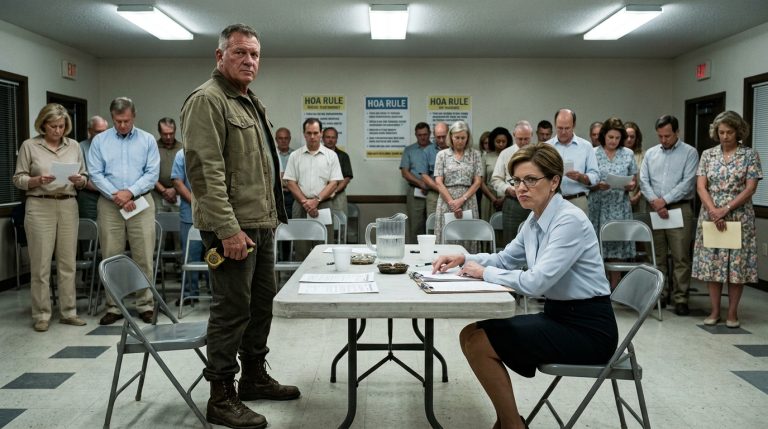
Usually, four people showed up to vote on lawn care bids. Tonight, seventy homeowners jammed into the metal folding chairs, their voices humming like a hornets’ nest under the fluorescent lights.
David walked through the double doors at my side, carrying a black briefcase containing the subpoenaed board emails we had unsealed during discovery.
Karen stood at the podium, her knuckles white as she gripped the wood, attempting to read from her printed agenda. “Item three is the pool resurfacing estimate—”
“We aren’t here for the pool, Karen,” an elderly man in the third row called out, standing up with a heavy oak cane. It was Arthur Henderson. “We want to know why thirty thousand dollars of our reserve fund was spent hiring lawyers to fight a senior county deed.”
“Mr. Henderson, that is an ongoing legal matter—”
David stepped forward, opening his briefcase and laying three printed email threads directly onto the speaker’s table.
“Page four of the internal board log,” David announced, his voice carrying cleanly to the back of the packed room. “Mrs. Thompson was warned by her own treasurer that the 1928 deed was legally binding. Her written response was, and I quote: ‘We must project unwavering authority. He will back down. They always do.'”
A harsh collective murmur rippled across the room.
Mark, the quiet IT guy from two doors down, stood up near the back wall. “She fined me two hundred dollars for my kid’s basketball hoop last month while spending our dues on a personal feud!”
“I move for an immediate vote of no confidence,” Susan, the board treasurer, said as she stood up from her seat at the head table. “And for the immediate removal of Karen Thompson as president.”
Seventy hands shot into the air before the motion could even be formally seconded.
Karen looked around the room, her mouth opening and closing without making a sound, as her little empire of binders and enforcement notices completely dissolved under the weight of her own written words.
CHAPTER 6: THE QUIET FENCE LINE
The hollow clack-clack of their hooves stepping over the steel bars was the only sound in the cool evening air.
No sirens. No screeching tires. No three-ring binders being slammed against car hoods.
Sarah stepped up beside me, leaning her shoulder lightly against mine as she wrapped both hands around her own warm cup. “Susan called from the HOA office twenty minutes ago,” she said softy, looking out over the rolling grass. “The formal letter of apology came through, along with the receipt for the Wounded Warrior donation.”
“Five thousand dollars,” I murmured, taking a slow sip of the dark coffee. “Karen’s personal signature was on the check.”
“She put her house on the market yesterday,” Sarah added, her thumb tracing the rim of her mug. “A sign went up on her lawn right after lunch.”
I nodded once, looking past the fence line toward the quiet asphalt of the suburban cul-de-sac. The sun was dipping below the horizon, painting the Texas sky in broad strokes of deep crimson and dusty violet.
There was no victory dance, no grand celebration. Just the solid, immovable reality of welded steel anchored deep in six feet of poured concrete.
A pair of headlights turned slowly down the gravel access road. It wasn’t a county deputy or a demolition truck—it was Mark’s gray pickup. He rolled his window down, leaning an arm out over the door with a easy, relaxed smile.
“Evening, Mac,” Mark called out, waving a paper folder. “Susan asked me to drop off the draft for the new community bylaws. We’re cutting out about eighty percent of the aesthetic restrictions. Wanted to make sure the agricultural language looked right to you.”
“Set it on the porch table, Mark,” I said, giving him a firm nod. “I’ll take a look at it before breakfast.”
“Appreciate it,” he said, shifting into reverse and backing smoothly out onto the road. “See you at the Saturday barbecue.”
I watched his taillights fade into the distance, turning back to the pasture where the heifers were settling down under the shade of the live oaks.
I reached out and laid my palm against the cool, thick steel rail of the guard. The metal was dead still, grounded deep in the soil where Jedidiah Miller had stood nearly a hundred years before me.
Some lines are written on paper that rots in a desk drawer. But the lines drawn with sweat, protected by law, and rooted in Texas earth don’t give an inch to anyone.
I finished the last cold drop of coffee, turned back toward the warm light glowing from the ranch house porch, and closed the wooden gate behind me.