When a Power-Hungry Security Guard Arrests a Paramedic Mid-CPR, the System Learns the Heavy Price of Weaponized Rules
CHAPTER 1: THE INTERRUPTED RHYTHM
The sound hits the back of my neck before my brain registers the angle of the sun.
It isn’t the shouts of kids playing three-on-three at the end of the cul-de-sac. It’s a high, sharp scream that breaks clean through the quiet air of Pine Ridge’s manicured cul-de-sacs.
I drop the cardboard box of kitchen plates onto the bed of my sister’s truck.
Ten years on the night shift teaches your legs to move before your mind forms a sentence.
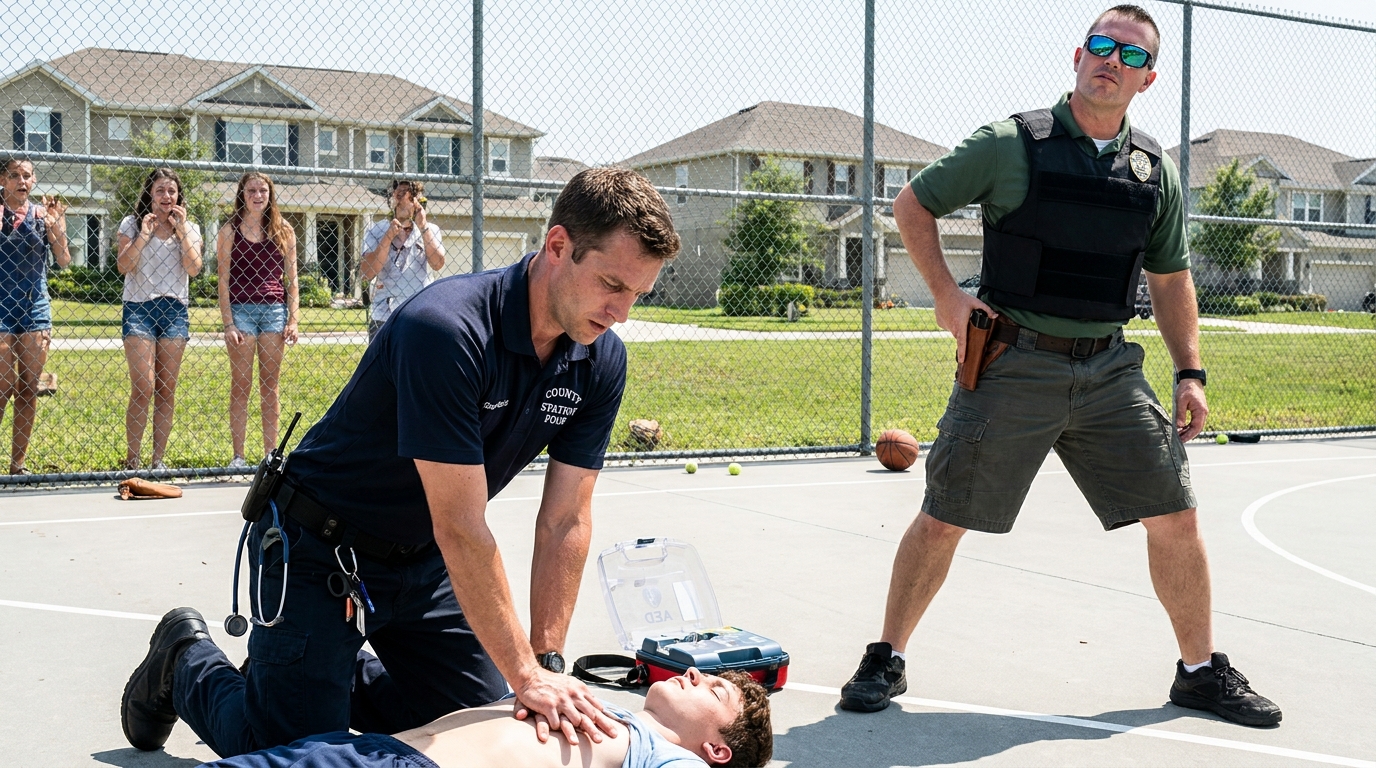
My boots hit the fresh asphalt of the driveway, taking forty-yard strides down the sidewalk toward the chain-link enclosure surrounding the basketball court.
A group of four teenagers stands frozen on the painted concrete key.
In the center, a sixteen-year-old boy lies on his back, his arms lax, his skin draining to a mottled gray-blue.
“Call nine-one-one,” I say, dropping hard onto both knees beside the boy’s chest. “Tell them cardiac arrest, teenage male, CPR in progress.”
One girl’s hands shake so violently she drops her phone onto the court before grabbing it again.
My fingers trace the boy’s neck, finding no carotid pulse, no air moving through his lips.
I stack my hands over the center of his sternum, lock my elbows, and start the rhythm.
One, two, three, four.
The concrete digs straight through my denim, grinding cold against my kneecaps with every compression.
Thirty hard presses, steady and measured, keeping the tempo forced into my head over a decade of highway wrecks and living room collapses.
“His name is Jalon,” the boy beside me chokes out, holding his phone to his ear with both hands. “They’re coming. They said five minutes.”
“Keep him talking,” I tell the kid without breaking the count.
I reach down with my left hand, pulling my personal travel trauma kit across the court surface by its strap, unzipping the main pocket to pull out the portable AED unit.
The plastic casing of the defibrillator snaps open with a sharp clack.
I snap the adhesive pads onto Jalon’s bare chest, smoothing the gel backing against his cold skin while keeping my right hand poised over his sternum.
The machine emits a flat, electronic tone. Analyzing heart rhythm. Do not touch the patient.
A heavy black door slams shut fifty yards away.
Tires crunch against the gravel edging of the court as a black SUV with gold lettering on the door rolls to a stop right against the access gate.
The driver’s door swings open.
A man in mirrored sunglasses, a black tactical vest over a green polo shirt, and heavy cargo shorts steps onto the court with his hand resting flat on a leather holster.
“Step away from the resident,” he says, his voice flat, projected through the lower throat like a military parade command. “Step back right now.”
I don’t lift my head from Jalon’s chest. “Medical emergency. Off-duty paramedic. Back off and clear the gate for the rig.”
The machine beeps twice in rapid succession. Shock advised. Charging.
The man’s heavy boots strike the concrete, stopping two feet from my elbow. “You are not authorized to perform medical procedures on Pine Ridge property. Stand up and state your residence.”
I look up into the reflection of my own face in his dark lenses. “He doesn’t have a pulse, man. Get out of my light.”
“This is private property,” he says, reaching for his belt with a thick, leather-gloved hand. “You are in violation of neighborhood access protocols.”
CHAPTER 2: COLD IRON ON ASPHALT
“I said step back!”
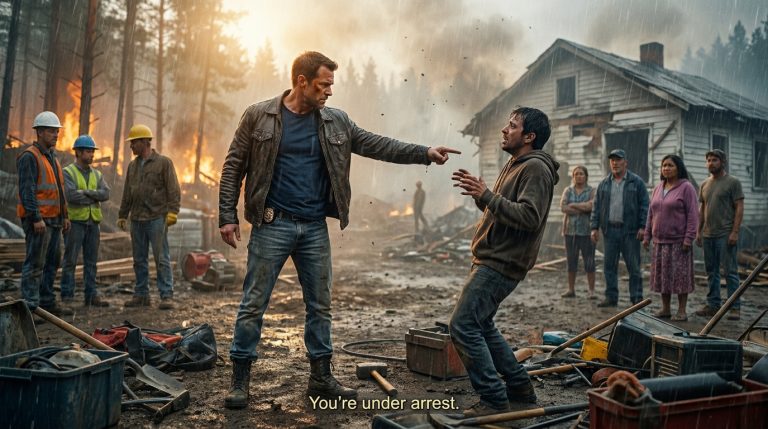
Rick’s leather glove grabs my left shoulder, his fingers digging directly into the muscle behind my collarbone.
He pulls with fifty pounds of dead weight, trying to yank my knees right off the painted asphalt.
“Get your hands off me!” I twist my torso hard to break his leverage, but my boots slip against a patch of loose basketball court gravel.
My hip hits the ground.
The plastic AED casing skitters three feet across the court, its red light pulsing silently in the shadow of Rick’s cargo shorts. Shock advised. Press button now.
“Unauthorized medical procedure,” Rick grunts, bringing his foot down onto the strap of my open trauma bag. “You don’t live here, pal. You don’t get to run a stunt on private property.”
“He’s dying!” The teenage girl by the fence screams, her phone held high in both hands, recording the glare off Rick’s dark lenses. “He stopped breathing! Leave him alone!”
I push up from the concrete, reaching for the defibrillator’s amber button, but metal clicks right against my wrist.
Cold steel snaps tight over my left radial bone.
Rick levers his body weight onto my shoulder blades, forcing my face down until my jaw scrapes the grit of the basketball key.
“Citizen’s arrest for trespassing and public endangerment,” he mutters, his voice raspy from the effort of pinning me.
“Look at the boy!” I yell into the dust on the court, my ribcage aching as he presses his knee directly into my spine. “Look at Jalon! He’s six minutes from brain death!”
Behind Rick’s hip, tucked beneath his tactical vest, a laminated index card slides half an inch out of his chest pocket.
On the white corner, three bold lines of handwritten red ink stand out against the black nylon: CODE 4: NON-RESIDENT RESPONDERS—CONTAIN & DETAIN BEFORE EMS.
“The board handles liability,” Rick says, his breath smelling of stale coffee as he yanks my right arm around to meet the second cuff. “Not you.”
The metal teeth bite into my skin as the second ratchet locks.
Five feet away, Jalon lies completely motionless.
His lips are blue.
The machine beside his elbow continues its soft, high-pitched tone, waiting for a finger that is now locked behind my back.
CHAPTER 3: THE SILENT BAG
The static tone of the defibrillator dies out on the asphalt.
“Subject secured,” Rick barks into the shoulder mic clipped to his tactical vest. “Send the county unit to the south gate for transport.”
The heavy rumble of a diesel engine vibrates through the court fence two minutes later.
A municipal police cruiser comes to a stop behind Rick’s SUV, followed immediately by the long air-brake hiss of a county paramedic rig.
Two city officers step onto the court, their eyes dropping straight from my cuffed wrists to the open trauma bag, then to the unblinking LED monitor on the AED.
“What do we have here, Rick?” the lead officer asks, his voice low, his hand resting casually on his gun belt.
“Trespasser performing unapproved medical interventions,” Rick says, pulling his shoulders back and adjusting his mirrored sunglasses. “He refused to clear the gate.”
I pull myself up onto one knee, the steel cuffs scraping skin off my radial bone as I lean forward. “I’m Diego Rivera. Ten-year paramedic with County Station Four. My badge is in the front pocket of that bag.”
The officer kneels down, unzippered flap in hand, and pulls out my plastic state license.
He turns his head slowly toward Rick. “You arrested an active paramedic during a cardiac arrest call?”
“Private property protocols,” Rick says, his chin lifting higher. “Board policy dictates non-resident personnel cannot operate without clear authorization.”
The officer doesn’t argue.
He pulls the key from his utility belt, inserts it into the cuffs behind my back, and twists.
The pressure releases instantly, leaving red, raw grooves around both wrists.
I stand up, but the county EMTs are already pulling a heavy black vinyl bag off the back gurney.
The zipper sound is a long, low tear across the silence of the court.
Six hours later, I sit on the edge of my sister’s porch steps, turning the plastic battery latch of my AED over and over in my right palm.
My wrists are swollen, and my ribs throb with every breath from Rick’s knee, but the cold weight of the plastic in my hand keeps me grounded.
A black sedan pulls into the driveway without headlights on, its engine shutting down silently.
Emlio steps out, locking his phone screen and sliding it into his suit pocket.
“The video from the teenager’s phone is already past two hundred thousand views,” my brother says, sitting down on the concrete step below me without unbuttoning his jacket. “The HOA president just posted a public statement claiming security acted under standard risk management protocols.”
“It wasn’t a mistake, Emlio,” I say, my thumb catching on the rough edge of the AED latch. “He had a laminated card tucked behind his vest. CODE FOUR: Contain and detain non-resident responders before EMS.”
Emlio freezes, his eyes cutting sideways toward me in the dim porch light. “Handwritten or printed?”
“Handwritten red ink,” I say. “They didn’t just hire a power-tripping guard. They gave him written orders to keep outsiders off their pavement, no matter who was dying.”
Emlio stands up slowly, smoothing the front of his coat with a quiet, lethal precision. “Then we don’t just sue Rick. We pull the roof off the entire board.”
CHAPTER 4: PAPER TRAILS AND LEAKED DIRECTIVES
“We aren’t here to discuss neighborhood guidelines,” Emlio says, his voice flat and perfectly level into the bank of microphones. “We are here because a corporate board decided that legal exposure mattered more than a boy’s heart.”
He taps his finger against the top sheet of paper.
A reporter in the front row leans forward, zooming her camera lens directly onto the highlighted red paragraph at the center of the page.
From: [email protected]
Subject: Protocol 4 Clarification
Body: No unauthorized medical personnel during crises. Control liability and PR optics. If they don’t live here, they don’t touch our residents.
A low murmur ripples through the press pack.
I don’t speak into the cluster of foam-covered mics.
I just stand beside my brother, my right hand resting flat over the hard plastic battery casing of my AED, keeping my thumb anchored against its latch.
“This came from an internal board server less than three hours ago,” Emlio continues, sliding a second document into the light. “A former security volunteer named Lena provided forty pages of zip-tie training logs and instruction manuals copied straight from paramilitary guides.”
My eyes sweep the room, catching a man in a gray suit standing near the back exit doors.
He holds a leather briefcase under one arm, his fingers nervously twitching against the brass buckle as he watches the news cameras record every word.
Pinned to his lapel is a tiny silver pin shaped like the Pine Ridge gate logo.
“They didn’t just instruct Rick Masterson to enforce civil trespass,” Emlio says, turning his head slowly toward the back of the room to lock eyes with the man in the gray suit. “They gave him a mandate to physically suppress outside help before county ambulances arrived.”
The man in the suit turns on his heel and pushes through the double doors into the hallway.
Emlio doesn’t even pause.
“The federal inquiry opened this morning,” my brother adds, locking his hands together over the podium. “And by tomorrow, the state legislature starts drafting Jalon’s Law.”
A reporter shouts over the noise of shuffling notepad pages. “Diego, what do you say to the board after reading those emails?”
I lean forward, my mouth two inches from the center microphone.
“I hope you enjoyed your power trip,” I say quietly. “Because the real authorities are coming.”
CHAPTER 5: THE PODCAST DEPOSITION
“Real paramedics follow rules,” Rick says into the broadcast mic, his voice booming through the studio speakers with unearned confidence. “If you let every outsider run onto private property without proper security clearance, you don’t have a safe community. You have anarchy.”
In the green room behind the set’s glass partition, Emlio doesn’t even lift his eyes from his legal pad.
He simply uncaps his fountain pen with a quiet, metallic click.
On the studio monitor, the podcast host leans forward, tapping a printed sheet of paper against the desk. “Mr. Masterson, you were wearing a tactical vest and military-style patches during this incident. Did the state authorize your organization to execute physical detentions?”
Rick folds his arms across his chest, the fabric of his green polo stretching tight over his shoulders. “We operated under internal neighborhood enforcement directives. Protocol four clearly states—”
“Protocol four,” the host interrupts, pulling up the leaked document on a secondary screen facing the camera, “was written by an unaccredited HOA board to avoid insurance claims, correct?”
Rick’s left eyelid twitches.
A single bead of sweat rolls slowly down his temple, glistening under the hot overhead lights before catching in the stubble at his jawline.
“I acted to protect property standards,” Rick mutters, his voice suddenly dropping an octave as his posture stiffens. “I carried out the mandate given to me by the board.”
“And that mandate,” Emlio’s voice echoes through the studio door as he steps out of the green room, holding a freshly signed deposition notice, “just resulted in the complete resignation of your entire board of directors.”
Rick turns his head sharply, his boots dragging against the soundstage carpet as he stares at my brother.
“The federal inquiry finalized its preliminary findings twenty minutes ago,” Emlio says, stopping right at the edge of the broadcast floor. “The Pine Ridge HOA has withdrawn all legal defense. You’re standing on that stage completely alone, Rick.”
The red recording light on the main studio camera flickers once and shuts off.
Rick looks at the silent lens, then down at his own leather gloves, his hands trembling slightly as the illusion of his authority shatters in real time.
CHAPTER 6: THE UNBROKEN LINE
The cotton fabric rustles softly under her knuckles.
His father sits beside her, his hands clasped firmly over his knees, watching the quiet drift of dust motes in the warm air.
I step down the carpeted center aisle, stopping two paces from the wooden pew.
The weight of my trauma kit hangs lightly from my left shoulder, its freshly inspected straps buckled tight.
Jalon’s mother doesn’t lift her head right away.
She smoothes out a crease over the varsity number on the chest, her breathing slow and measured.
“Do you think he could have made it?” she asks softly, her voice barely carrying across the empty rows of chairs. “If nobody had stopped you?”
I look at the dark blue jersey in her lap, then down at my own hands—clean, free of steel cuffs, the raw marks on my wrists fully faded.
“Yes,” I say. “He had a chance.”
She nods once, a quiet, deliberate movement of her chin, accepting the truth without tears or flinching.
His father turns his head, meeting my eyes directly.
“Then make sure nobody forgets this,” he says, his voice steady as iron.
“We won’t,” I say.
Outside the double doors, the afternoon air smells faintly of rain and exhaust.
The settlement papers were filed in county court two hours ago, stripping Pine Ridge of its private enforcement permits and codifying Jalon’s Law across three state lines.
Rick Masterson’s uniform vest sits in a police evidence locker, and the HOA board’s bank accounts have been frozen under federal civil rights mandates.
I walk down the stone steps toward the station rig parked in the side lot.
My partner, Dennis, sets his coffee cup on the dashboard and slides into the driver’s seat, holding out the vehicle logbook and a fresh ballpoint pen.
I take the pen, uncap it, and write my badge number across the shift ledger.
The dispatch radio on the console crackles to life, its static snapping through the quiet cab. Unit Four, respond to a priority call on West 4th Street.
I click the pen shut, drop it into the console tray, and reach for my seatbelt.