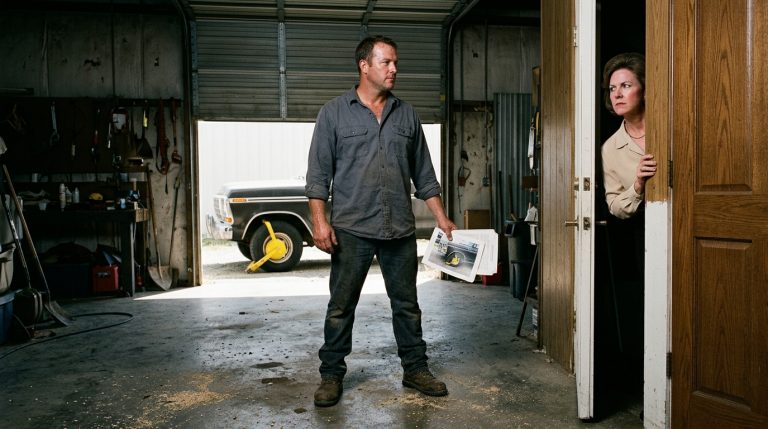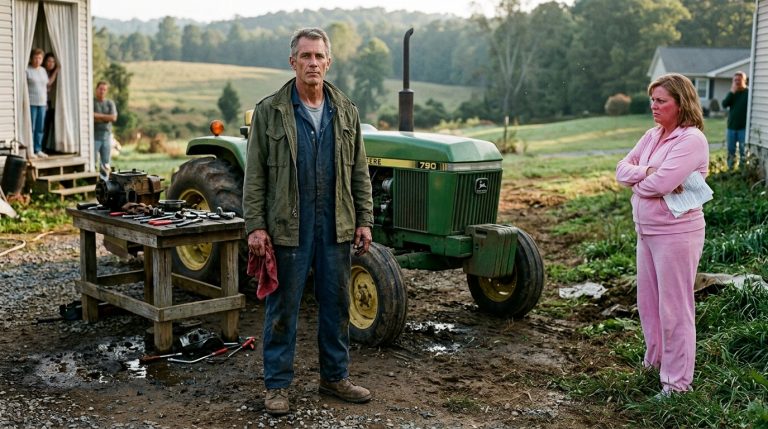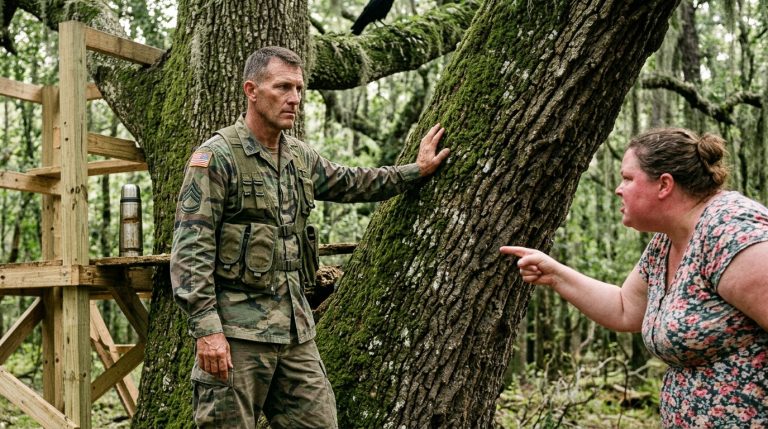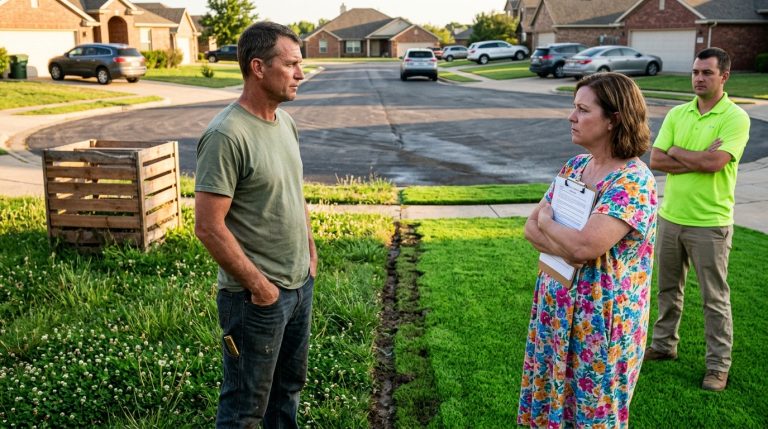
The Iron Boundary: How a Retired Engineer Weaponized a Forgotten Survey to Dismantle an HOA Tyrant
CHAPTER 1: THE BOARDROOM EXECUTION
The plastic gavel hit the folding table with the cheap, hollow crack of a dollar-store toy, but Karen Miller’s voice carried all the weight of a hanging judge.
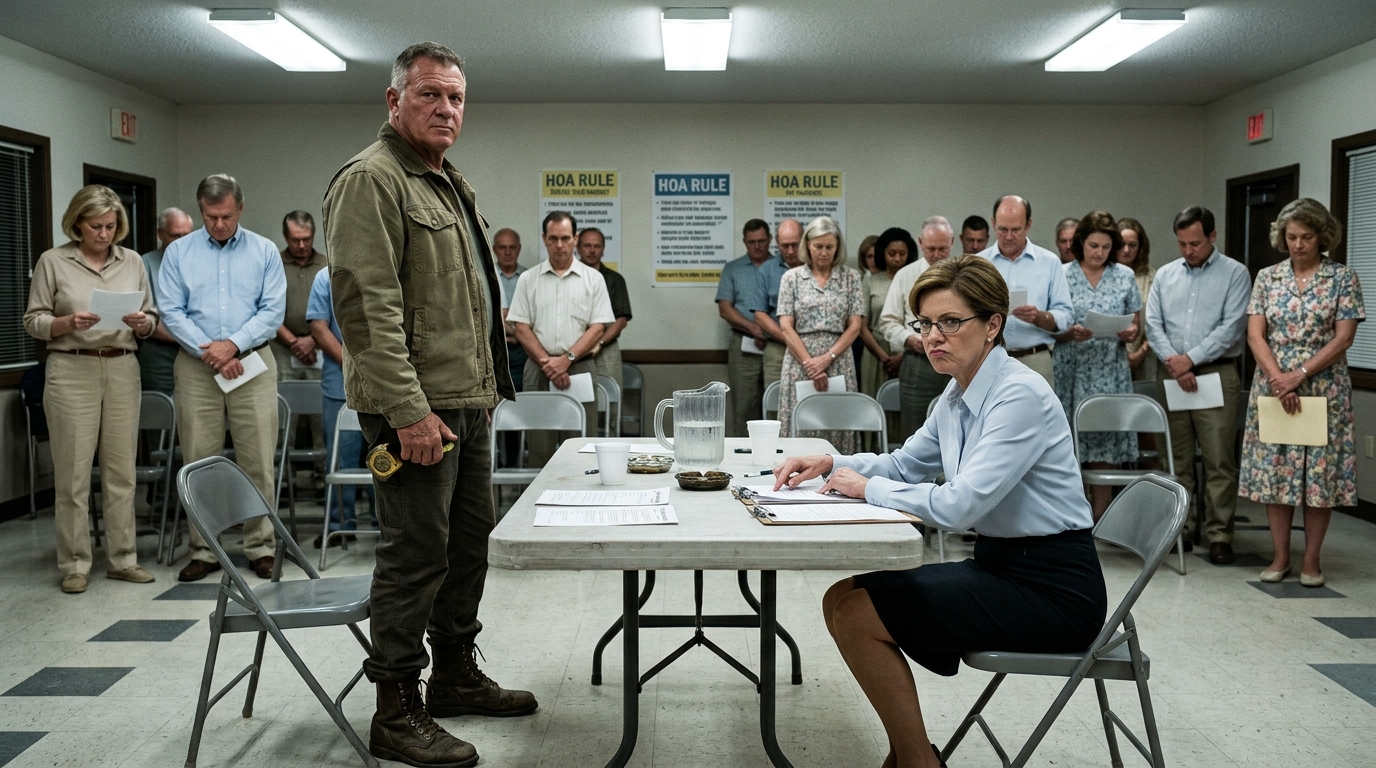
“Thirty days, Mr. Caldwell,” she purred into the screeching public address microphone, leaning her forearms over the rim of a lukewarm diet soda. “You have thirty days to dismantle the unapproved stone masonry along the access road and restore the slope to approved beige-graded sod. Failure to comply results in immediate third-party demolition at your expense, alongside a ten-thousand-dollar non-compliance fine levied against your parcel.”
I didn’t blink. I sat on a grey metal folding chair that groaned under my two hundred pounds, my thumb tracing the worn, notched edge of an old brass-bound surveyor’s tape measure resting inside my jacket pocket. The metal was cool, smooth from forty years of field work, and entirely unbothered by the air-conditioned humidity of the community clubhouse.
To my left, two board members nodded in rhythmic synchronization, like plastic toys glued to a dashboard. Around us, twenty neighbors kept their eyes locked strictly on the linoleum floor. Nobody wanted to draw the eyes of the woman who fined the Henderson family two hundred dollars last month because their garden gnome was displaying what the violation letter called “an unapproved whimsical attitude.”
“That wall,” I said, keeping my tone down in the low, quiet register I used when evaluating bridge stability under mortar fire, “was stacked by my great-grandfather in 1922. Dry-stacked fieldstone, four feet high, two hundred feet long. It sits on Caldwell land.”
Karen pulled her glasses down the bridge of her sour nose, her lips curling into a tight, triumphant smile that didn’t reach her eyes.
“Covenant 7.4, Subsection B is explicit regarding unapproved construction materials, Frank,” she replied, relying on that sickeningly sweet tone people use when they think they’re speaking to a child. “When you chose to construct your new residence on that ten-acre lot and utilize our paved access road, you brought your entire boundary under the authority of Oakwood Preserve. History doesn’t excuse a safety hazard.”
She tapped her clipboard once with a manicured fingernail. The sound was sharp. Final.
I didn’t yell. I didn’t reach across the plastic table or throw legal terms around the room. I simply stood up, smoothing the front of my canvas jacket, feeling the heavy, solid weight of the brass tape measure slide back into the bottom of my pocket.
“Thirty days,” I said softly, meeting her gaze until she was the one who looked away first to clear her throat. “Understood.”
I walked out through the double doors, the quiet hum of the room dying behind me, stepping into the muggy North Carolina evening. Karen thought she was executing a petty eviction of an old pile of rocks. She had no idea she had just fired the opening salvo at a retired Sergeant Major who spent twenty-five years reading blueprints in war zones.
CHAPTER 2: ARCHIVES AND PAPERWORK
Unrolling a heavy roll of yellowed county parchment paper across the dining room table, the iron smell of aged ink and decaying leather filled my lungs.
Sarah placed a fresh mug of black coffee right beside my hand, her thumb brushing my shoulder as she leaned over the map. She didn’t offer empty comfort. She didn’t tell me to let the HOA take the stone wall. She knew better.
“What are we looking at, Frank?” she asked quietly.
“The paper trail,” I said, tapping a calloused finger against the 1919 deed signed by my great-grandfather. “Karen thinks a three-page pamphlet of subdivision rules overrules a century of property law. She’s operating on audacity. I operate on certified plats.”
For forty-eight hours, I made the Foresight County Records Office my forward operating base. The clerk—a quiet woman named Martha who had worked the microfilm machines since the Carter administration—didn’t ask questions when I pulled every deed book from 1919 to the present. She just kept the light tables humming.
I overlayed the transparent copy of my family’s original survey onto the master plat filed by the Oakwood Preserve developer in 1998. The lines aligned along the southern creek bed, and they aligned along the western treeline.
Then my eyes caught the northern boundary line—the edge bordering the HOA’s paved access road and common grounds.
The lines split. A subtle, jagged shift ran along the northern ridge. The developer’s 1998 plat showed a straight vector, effectively claiming roughly twenty feet more than my family’s historical deed ever conceded.
I sat back in the metal chair, the hum of the light table vibrating through my palms. An error made during a massive commercial land grab twenty-eight years ago. A twenty-foot shift sounded small on paper. In land development, twenty feet is an abyss.
I didn’t rush to conclusions. I didn’t call the news or march into Karen’s house. A bad map in a county archive is just an anomaly until a certified surveyor drives an instrument into the actual dirt.
Instead, I focused on the immediate threat: the thirty-day clock on my great-grandfather’s wall.
I opened the blue binder containing the Oakwood Preserve HOA Founding Charter, turning to Article 4, Section 2. The text was clear, printed in dark, unyielding ink: The authority of the Association shall be strictly limited to structures and parcels for which building permits were issued subsequent to the filing date of this charter.
The dry-stack wall was built in 1922. The charter was filed in 1998. No permit had ever been issued, nor could one be retroactively required for a structure that predated the subdivision by three-quarters of a century.
I closed the binder, the snap of the plastic rings echoing in the quiet dining room like a rifle bolt closing.
“She has no legal standing,” I whispered to the empty room. “None at all.”
I picked up my pen and began organizing the tabbed presentation for the next board meeting. I was going to give Karen Miller one chance to read her own governing documents before I changed the battlefield entirely.
CHAPTER 3: THE LINE IN THE DIRT
Gus scraped away three inches of sod, his thumb wiping dark North Carolina clay off a heavy, rusted metal cylinder embedded deep in the earth.
“That’s not a sprinkler line,” I said, stepping closer to inspect the top of the iron marker.
“No, sir,” Gus muttered, wiping sweat off his leathered forehead with the back of his sleeve. He pointed his GPS rover rod directly at the center of the pin, clicking the capture button on his digital receiver. “That’s an original one-inch iron rebar corner marker, driven into the subsoil with a sledgehammer. Standard practice for rural boundaries back in 1920.”
He stood up slowly, looking from the small hole in the grass toward the two-story brick building forty feet away. His expression went flat.
“Shot’s locked,” Gus said, his voice dropping an octave. “I’ve pulled three separate satellite vectors and cross-referenced with the county monument on Route 42.”
“And?” I asked.
Gus held up his digital pad, turning the screen toward me. A bright red boundary vector cut straight across the digital map.
“According to the certified 1920 deed,” Gus said, pointing a calloused finger at the screen, “your northeast boundary doesn’t stop at the woods. It extends another eighty feet east.”
He turned and gestured toward the brick community clubhouse, the Olympic-sized swimming pool, and the fenced tennis courts behind it.
“The developer made a major mapping error in ninety-eight,” Gus continued, taking a breath. “Or they just built wherever they felt like it. About a third of their clubhouse building, their entire deep end, the pump house, and both tennis courts are sitting right on your deeded land, Frank. Exactly one point two acres of it.”
I stood still in the middle of the putting green, feeling the heavy brass tape measure inside my pocket as the full weight of the discovery settled over me.
Karen Miller wasn’t just trying to bully an old veteran over a stacked stone wall. She was enforcing rules from a clubhouse that sat on my private property.
“Get this recorded with the county clerk first thing tomorrow morning,” I told Gus quietly. “Timestamped and officially stamped.”
“Consider it done,” Gus replied, picking up his gear. “What are you going to do?”
I looked toward the clubhouse doors where an HOA golf cart was parked in the shade.
“Nothing,” I said. “Not a single word. I’m going to let her thirty-day clock run all the way down to zero.”
CHAPTER 4: THE TRAP TRIGGERS
The diesel exhaust hung thick in the cool morning air as the heavy steel tracks met the asphalt with a metallic clatter.
Karen zipped her golf cart up to the gravel edge, her hot pink visor shimmering in the morning sun as she raised a mega-phone to her mouth.
“As of seven-thirty AM, Mr. Caldwell, your thirty-day cure window has officially expired!” she announced, her voice echoing down the street where half a dozen neighbors were standing on their porches. “The contractor will now clear the illegal masonry obstruction, and the cost will be added directly to your ten-thousand-dollar compliance lien!”
I ignored her completely, stepping past the idling golf cart straight toward the burly foreman who was unhooking the safety chains from the excavator’s boom.
“Morning,” I said, holding out a thick Manila envelope. “Before you turn that bucket toward that stone wall, you’ll want to read what’s inside here.”
The foreman paused, wiping grease off his hands with a red shop rag. “What’s this?”
“An injunction from Foresight County Superior Court,” I replied smoothly, “alongside a notice of criminal trespass against your company, and a certified boundary survey recorded with the Registrar of Deeds three days ago.”
Karen slammed her golf cart into park, stepping out so fast her clipboard nearly tumbled to the street. “Don’t listen to him! He’s stalling! I am the President of this Homeowners Association and we authorized this work!”
“Lady,” the foreman grunted, tearing open the flap and unfolding the top document. His eyes scanned the bold text stamped at the top before moving down to the attached blueprint. “I don’t care if you’re the Governor. This is a judge’s signature and a fresh county seal.”
He pointed a thick finger at the red line drawn across the survey map.
“Wait a minute,” the foreman muttered, his brow furrowing as he looked from the paper to the brick building across the green. “According to this court-filed map, my tracks are sitting on private deeded property right now. And your clubhouse is sitting on his land.”
Karen snatched the paper out of his hands, her face shifting from a furious red to a pale, blotchy grey as she stared at the red vector slicing straight through the drawing of the HOA pool, the manager’s office, and the tennis courts.
“This is a fake!” she shrieked, her voice cracking as the clipboard slipped from her numb fingers, hitting the pavement with a sharp clatter. “This is a forged document!”
“It’s registered in Book 412, Page 88 at the county courthouse, Karen,” I said, my tone remaining as steady as the stone wall behind me. “You wanted to fight over four feet of dry-stacked granite. You didn’t check who actually owned the ground under your own feet.”
The foreman turned back toward his rig, motioning to his driver. “Reload the equipment. We’re done here.”
Karen stood frozen on the asphalt as the diesel engine roared, her eyes locked on the red line that had just dismantled her entire kingdom.
CHAPTER 5: THE REVERSAL AT THE CLUBHOUSE
Karen slammed her plastic gavel down three times, the wood veneer on the podium chipping under the frantic impact.
“Order! This emergency session will come to order!” she yelled, her voice straining through the small speaker system. “We are here tonight to discuss a fraudulent campaign of disinformation being waged against this board by a single non-compliant resident!”
Mr. Henderson stood up in the third row, pointing a trembling hand toward the ceiling. “Fraudulent? Karen, the sheriff’s office served a freeze on community facility repairs this afternoon! Is it true or not? Does this building sit on Frank Caldwell’s dirt?”
“The developer’s original plat is a matter of public record!” Karen shot back, her jaw clenching so tight a muscle twitched beneath her ear. “Mr. Caldwell has manufactured a legal nuisance using expired ninety-year-old survey pins to extort this community!”
Dave Jensen leaned over, opening his charcoal briefcase with two sharp metallic clicks. He didn’t raise his voice when he stood up, but the simple movement of his six-foot-two frame in a crisp tailored suit drew every eye in the room.
“For the record,” Dave said, stepping toward the aisle with a thin paper folder, “my name is David Jensen, counsel for Mr. Frank Caldwell. And the document filed with the county clerk on Tuesday is not a nuisance. It is a certified boundary survey validated by GPS satellite telemetry and grounded on the senior 1920 deed.”
He turned to face the crowd, holding up a single blue-stamped document.
“Every dollar this HOA has collected in dues to maintain this clubhouse, heat that pool, and resurface those tennis courts,” Dave continued, his voice ringing with absolute clarity, “has been spent improving my client’s private property. You have been operating a trespass on one point two acres of Caldwell land for twenty-eight years.”
The room erupted. Neighbors turned on each other, shouting over the table as the two board members flanking Karen pulled their chairs back, actively distancing themselves from the microphone.
“This is a conspiracy!” Karen screamed into the mic, her face contorting into a mask of pure desperation as she pointed a shaking finger directly at me. “He’s doing this out of malice! He wants to bankrupt us all because he refuses to move a simple pile of rocks!”
I didn’t answer her rage. I simply pulled the heavy brass tape measure from my jacket pocket, setting it down on the edge of the counsel table with a solid, unyielding thud.
“I didn’t build your clubhouse on my land, Karen,” I said, my voice cutting through the noise like a cold wind. “You came after my great-grandfather’s fence. All I did was measure where the real line was.”
CHAPTER 6: RESTORATION AND TERMS
Mr. Henderson walked up the gravel drive, holding a leather-bound folder under his arm. He didn’t wear a board badge or carry a clipboard.
“The new interim board signed off on the final settlement terms twenty minutes ago, Frank,” Henderson said, setting the folder down on the porch step beside me. “Fair market value for the one point two acres. The check is certified and written to your family trust.”
“And Karen?” I asked.
“Resigned. Her letter of apology to every homeowner went out in the evening mail,” Henderson replied, looking out over the stone wall toward the access road. “And the covenants have been stripped down to six pages of basic maintenance. No color charts. No gnome bans. Just common sense.”
Dave Jensen stepped out from the screen door, taking a slow sip from a mug of coffee before sliding a pen from his breast pocket. He laid the deed transfer document across Henderson’s folder.
“Sign at the red tab, Mr. Henderson,” Dave said calmly. “That officially conveys the clubhouse footprint back to Oakwood Preserve as a legal, permitted easement. My client keeps the senior deed to every inch behind the newly surveyed pins.”
Henderson signed his name in dark blue ink, handing the pen back with a sigh that carried ten years of accumulated neighborhood frustration. “It’s good to have peace back on the line, Frank.”
“Boundary lines exist so people know where peace starts, Henderson,” I said, leaning back against the porch railing.
The masons finished setting the final corner capstone, brushing away loose mortar dust from the grey granite face. The wall stood four feet high, straight and true, stretching two hundred feet down the ridge exactly where my great-grandfather had stacked it a century ago.
I pulled the old brass tape measure from my pocket, setting it down on the porch table next to the signed deed. The metal was cool in the fading light, solid, unyielding, and completely at rest.