Rusted Earth and Silent Water: How a Retired Veteran Built an Unbreakable Legal Fortress Against a Power-Crazed HOA President
CHAPTER 1: THE NOTICE ON THE LINE
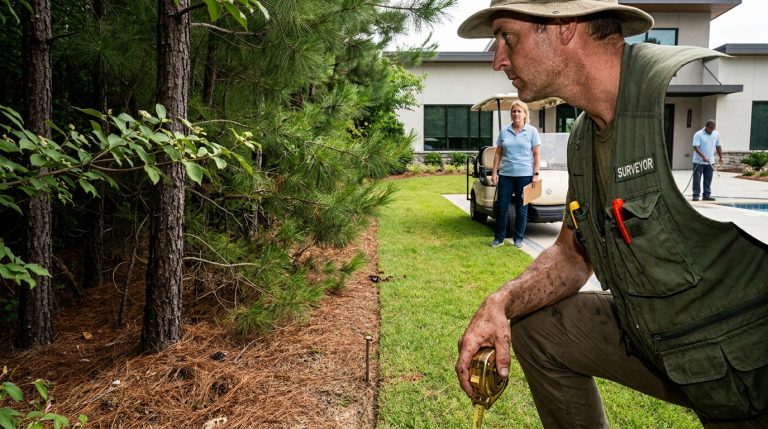
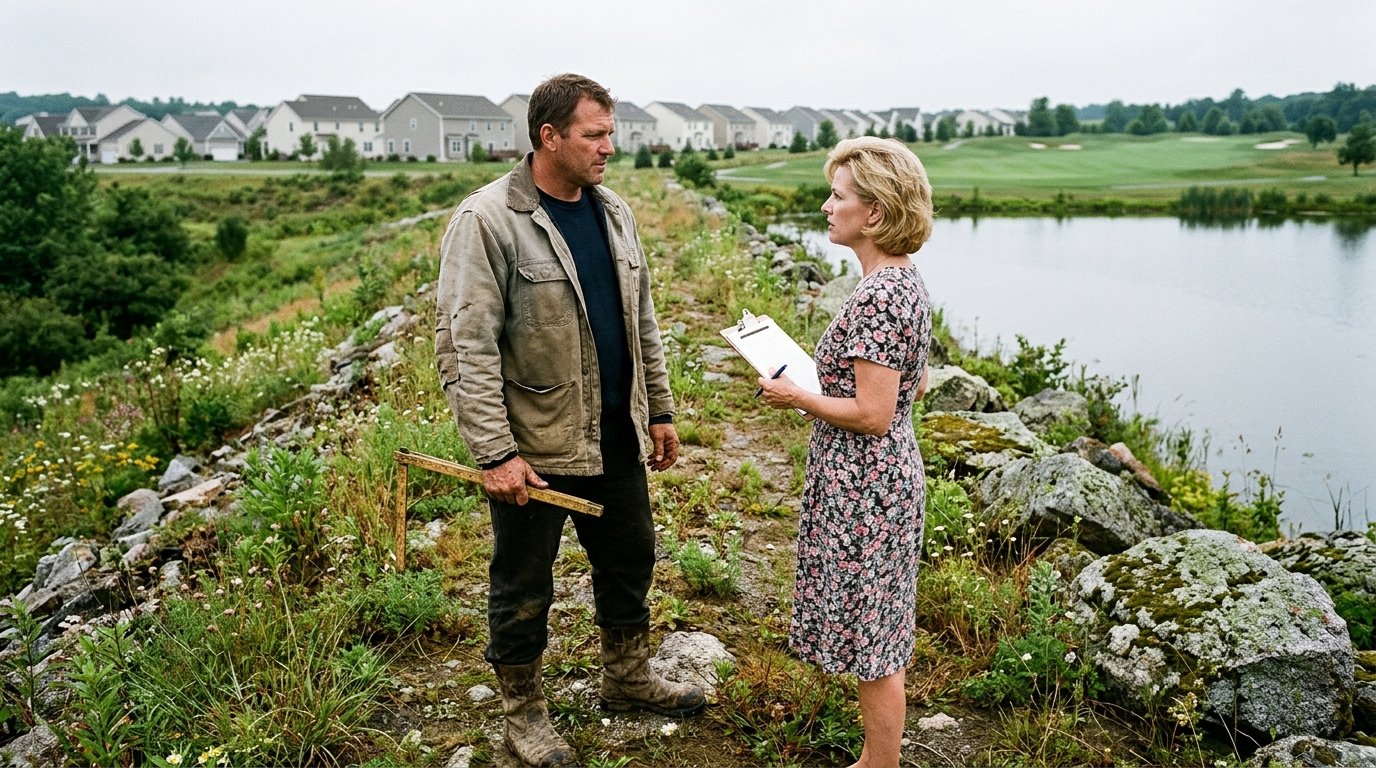
The mud in the retention pond squelched under heavy boots that had no business being on my side of the county line.
Karen stood squarely on the moss-covered granite of my grandfather’s dam, her lacquered blonde hair defying the breeze rolling off the water.
She clutched a white clipboard to her chest like an armor-plated shield, her smile stretched thin and tight across a face completely unacquainted with doubt.
“Mr. Miller, as per the vote last night,” she announced, her voice carrying across the basin with the practiced volume of a school board president, “the association is taking eminent domain over this section of your property.”
I didn’t reach for a weapon, and I didn’t raise my voice.
Instead, my thumb simply slid into the pocket of my faded canvas jacket, tracing the worn, cold brass edges of my grandfather’s folding carpenter’s rule.
The metal felt heavy and familiar against my palm, grounding the sudden, hot spike of fury rising in my throat.
“Eminent domain,” I said, keeping my tone flat, dry, and entirely devoid of performance. “That’s a bold word for someone standing on private land without a sheriff.”
“We checked the municipal guidelines, Jack,” she snapped, dropping the neighborly pretense as her eyes hardened into slate. “The board has the authority to abate any nuisance for the good of the community. That swamp of yours is dragging down property values, and our engineers will begin draining it for the new driving range on Monday.”
She turned sharply on her heel, her floral print rustling as she marched back toward the manicured perfection of Lakeside Meadows.
I stood motionless on the earthen crown of the dam, letting out a slow, measured breath that misted slightly in the damp morning air.
The simple title deed in my desk drawer wasn’t going to stop her; she had bypassed normal law entirely through sheer bureaucratic arrogance.
I unfolded the brass rule one clicked section at a time, watching the rusted hinge settle into place as I calculated the exact distance between her retreating back and the hard, cold reality waiting for her down the hill.
CHAPTER 2: DUST IN THE ARCHIVES
The microfilm spool clicked forward with a dry, metallic rattle that echoed off the damp concrete walls.
I kept my thumb pressed against the rubber advance knob, my eyes straining against the blue-white glare of the reader screen as the engineering specs for Lakeside Meadows rolled past in a blur.
The county records basement was silent save for the hum of the dehumidifier humming a low, grinding note in the corner.
My fingers felt dry and coated in the fine, gray powder of decades-old paper preservation.
I slowed the advance down, letting the spool creep backward until a specific stamp caught the light.
There it was, buried deep inside a thick environmental impact binder filed thirty years ago.
The original developers had not merely crossed their t’s; they had explicitly anchored their entire drainage calculus to the natural topography of my grandfather’s land.
A handwritten note in the margin—signed by a county hydrologist long since retired—pointed directly to Miller’s Pond as the primary upstream retention basin for the entire lower valley.
They hadn’t built a standalone stormwater system because the natural earth-and-stone dam already did the work for them, holding back the seasonal runoff before it could swamp the clay-heavy soils below.
I reached into my canvas jacket and pulled out the brass carpenter’s rule, laying it flat across the cool metal housing of the reader as if to measure the distance between their official lies and this forgotten truth.
The microfilm didn’t care about Karen’s floral muumuu or her laminate clipboards.
It recorded physics, elevation drops, and structural dependencies in cold, unyielding black and white.
I flipped the toggle switch on the machine and fed another roll into the gate, hunting for the specific engineering signatures that would tie their modern development plans to my private spillway.
The spool whirred, spinning faster as I tracked the paper trail toward the exact date the permits were granted.
A faint, distorted watermark near the bottom corner of a topographical schematic caught my attention—a jagged line showing historical flood peaks from the spring of 1989.
The water hadn’t just reached the lower pasture; it had crested right where the first row of McMansions now sat on fresh, manicured foundations.
I reached for the request slip pad on the desk, dipped a plastic ballpoint pen into my hand, and began copying down parcel numbers and permit registry codes with methodical slowness.
The legal foundation Karen was using to claim eminent domain depended entirely on the fiction that my dam was an isolated, non-compliant nuisance.
These documents proved it was the load-bearing spine of their entire neighborhood.
I tore the yellow carbon sheet from the pad, folded it twice, and slid it deep into my breast pocket against the steady, rhythmic thrum of my own pulse.
The courthouse air was heavy with the smell of old glue and damp stone, but the cold weight of the evidence sitting in my pocket felt solid enough to crack concrete.
I packed my notes into the canvas bag, switched off the reading lamp, and walked out of the basement into the sharp, blinding glare of the afternoon sun.
CHAPTER 3: THE COLD SIMULATION
The screen flickered, painting green and red contour lines over a 3D wireframe of the entire subdivision.
Sapper tapped his pen against the mouse pad, his eyes fixed on the simulation parameters loading in the corner of the display.
“The math doesn’t lie, Jack,” he muttered, pulling a heavy ceramic coffee mug toward him without looking away from the model. “If they cut through that earth dam without a massive retention alternative, the physics take over whether Karen likes it or not.”
He clicked the mouse, and the software initiated a simulated 100-year rain event over the northern hills.
Blue water rushed down the digital ravines, gathering speed and volume as it funneled straight toward the narrow bottleneck where my grandfather’s stonework stood.
In the model, the dam held firm, absorbing the initial shock and spilling the excess smoothly through the over-engineered concrete spillway into the lower drainage culverts.
“Now watch what happens when we remove the restraint,” Sapper said, hitting the spacebar to run the second scenario.
The digital dam vanished from the screen with a keystroke.
Instantly, the wall of simulated brown water surged forward down the ravine, slamming into the narrow HOA culverts with terrifying force.
The undersized pipes choked within seconds, backing up millions of gallons of runoff across the manicured asphalt and pristine front lawns.
Bright red color-coding crept up the foundations of the houses on Primrose Lane, swallowing driveways and pouring over front porches until nearly a third of the neighborhood was submerged under two feet of stagnant muck.
“Forty-seven homes,” Sapper said quietly, leaning back in his chair and rubbing the back of his neck. “Total structural inundation within ninety minutes of a heavy cloudburst.”
I stared at the glowing screen, watching the digital houses drown in their own ignorance.
Karen had spent two years writing bylaws about mailbox colors and grass heights, completely blind to the fact that her entire multi-million-dollar community sat in the belly of a natural watershed.
I reached into my pocket, my fingers brushing the folded yellow carbon sheet from the courthouse archives.
“Export the simulation video and the data logs onto a thumb drive,” I said, my voice steady against the hum of the cooling fans. “We’re going to need more than paper to show people what happens when ego overrides gravity.”
Sapper nodded, plugging a small metal drive into the USB port as the progress bar crept toward one hundred percent.
“They wanted a driving range,” he muttered, pulling the drive free and tossing it across the desk into my open palm. “Looks like they’re about to get swimming pools in every basement instead.”
CHAPTER 4: PLANTING THE SEED
George was on his knees by the flowerbed, trowel in hand, working mulch around a neat row of hostas.
He looked up as my boots crunched on the asphalt, his expression tightening with a familiar, defensive caution.
“Afternoon, Jack,” he said, keeping his grip on the garden tool as if deciding whether to stand or stay grounded. “People around here are still talking about that notice Karen sent out.”
“They should be,” I said, resting my hand against the cold metal post of his mailbox. “That notice wasn’t about beautifying the neighborhood, George. It was about creating a hazard where none existed.”
I didn’t hand him the USB drive yet; I gave him the simple history instead, keeping my voice level and deliberate.
I told him about my grandfather building the stone dam in the fifties, not as a decorative pond, but as an engineered barrier to stop the spring runoff from turning this exact street into a swamp.
George lowered his trowel, his brow furrowing as the pragmatic reality of the land began to sink past his neighborly politeness.
“The newsletter called it an unstable, non-compliant structure,” he muttered, dropping his gaze to the mulch. “Karen said the board had an independent survey proving it was a public nuisance.”
“She lied,” I replied, letting the two words drop flat and heavy between us. “The original developers relied on that dam to keep your basement dry, and the county records prove it in black and white.”
I pulled a single folded copy of the developer’s water management summary from my pocket and laid it across the top of his pristine mailbox.
George stared at the official stamp, his fingers twitching against the wooden handle of his trowel as he read the parcel numbers linking his property directly to my spillway.
“If they tear that wall down,” I added quietly, watching his eyes track across the text, “the water coming off those hills won’t have anywhere else to go.”
He looked up slowly, the color draining slightly from his face as the implication cleared away his last doubts.
“Forty-seven homes on this side of the development,” he whispered, folding the paper with trembling fingers. “We need to talk to Ellanor before tomorrow morning.”
CHAPTER 5: THE CLUBHOUSE AMBUSH
The room hummed with the aggressive chatter of a hundred anxious homeowners packed shoulder-to-shoulder in the stifling heat.
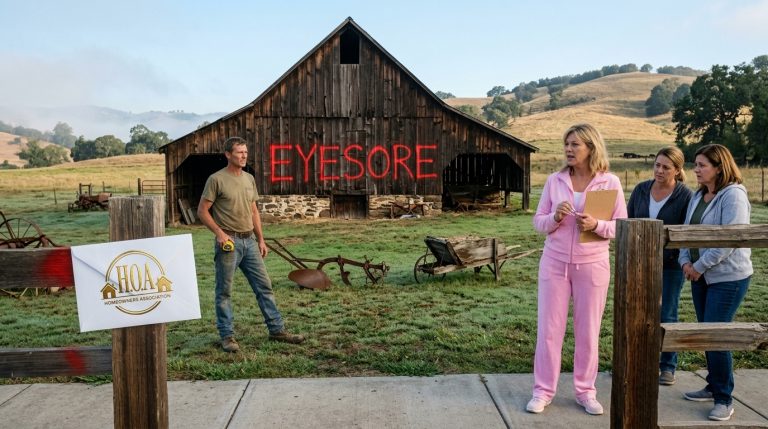
Karen wore a bright pink pantsuit that looked like a neon warning flare against the dreary walls, her smile stretched tight and brittle as she surveyed the crowd.
“The project is fully approved by the board,” she announced, her voice slicing through the noise with practiced authority. “We are moving forward with the drainage of that nuisance property next week.”
George stood up in the third row before she could drop the gavel again, his hand gripping the back of a metal chair.
“You didn’t mention the stormwater report, Karen,” he called out, his voice steady and calm. “The one showing our homes sitting right in the path of a flood.”
Karen’s pink-rimmed eyes locked onto him, her smile instantly evaporating into a sharp, defensive scowl.
“That is an unauthorized scare tactic,” she snapped, pointing a trembling finger toward the back of the room where I stood leaning against the exit doors. “He is trying to sabotage our property values because he wants to keep a swamp in our backyard.”
I didn’t shout back, and I didn’t raise my voice above a conversational hum.
Instead, I reached into my canvas folio, pulled out Sapper’s oversized topographical flood map, and mounted it onto the metal easel beside the stage.
The blue inundation overlay, stark and undeniable under the harsh overhead bulbs, cast a cold shadow over the front row.
“This isn’t a rumor,” I said, stepping forward into the aisle as the room went dead silent. “This is county elevation data showing forty-7 homes submerged if the dam is touched.”
A wave of angry murmurs rolled through the rows of folding chairs as neighbors leaned forward to read the bold black lettering on the map.
Karen slammed her gavel down twice, her face flushing a deep, mottled crimson as she realized she was losing control of the narrative.
“This meeting is adjourned!” she shrieked, her voice cracking with sudden, uncontained panic. “You are all out of order!”
“Sit down, Karen,” Ellanor called out from the second row, her voice carrying the quiet, crushing weight of a senior resident who had seen enough corporate bullying to last a lifetime.
The room erupted into open revolt, shouting down the board faster than any gavel could silence them.
CHAPTER 6: THE DUSTY GRAY AFTERMATH
The autumn sun broke over the eastern ridge, cutting clean amber lines across the smooth, placid surface of the water.
Down the slope, the cookie-cutter roofs of Lakeside Meadows sat dry and secure behind their manicured borders, protected by a restored spillway that hummed softly under the weight of the morning current.
Karen was gone, her pink pantsuit and laminate clipboards replaced two counties over by the quiet anonymity of a forced relocation and a shattered personal balance sheet.
Her desperate counter-moves—filing retaliatory threats and screaming about fraudulent documents—had evaporated the moment the association’s insurance carriers audited the board’s gross negligence.
The new interim board, led by George and backed by a legally binding deed covenant, had paid every cent of the engineering restoration out of reserve funds without a single word of protest.
I traced the cold brass edge of my grandfather’s carpenter’s rule where it rested safely in my pocket, feeling the solid weight of an ordinary boundary defended against extraordinary foolishness.
On the far bank, a blue heron stood motionless in the shallow reeds, hunting for breakfast in an ecosystem that had survived its self-appointed queen.
Bill walked across the newly laid gravel path near the property line, his grandson trailing a few steps behind with a pair of collapsible fishing rods slung over his shoulder.
“Morning, Jack,” Bill called out, slowing his pace as he reached the edge of the stone wall. “Water’s looking about as clear as glass today.”
“Clear enough,” I said, taking a slow sip of coffee and gesturing toward the southern bank. “Best spot for bluegill is right near the fallen oak.”
The boy grinned, scrambling down the grassy slope toward the water without a second thought.
I leaned my forearms against the solid granite of the dam, letting the cool morning breeze settle over my shoulders as the distant hum of morning traffic filtered through the oak grove.
The war over the 10 acres was finished, leaving behind no triumphant speeches or cinematic fanfares—just the steady, unyielding quiet of a sanctuary restored to common sense.