The Granite Line: How a Retired Army Engineer Turned a Petty Neighborhood Fine into a Calculated Tactical Victory
CHAPTER 1: The Briefing Room
The dining room smelled of cold instant coffee and old paper. Outside the window, the North Carolina pines stood motionless in the heavy afternoon humidity, their needle-laden branches framing the distant, manicured roofs of Oakwood Preserve.
Sarah did not ask if he wanted more coffee. She simply set the ceramic mug down beside the open ledger, her knuckles brushing his shoulder with a quiet, grounding friction. She knew the rhythm of his focus. When Frank locked onto a coordinate, the rest of the world dissolved into terrain and obstacles.
“They think it’s about a pile of rocks,” Frank said, his voice low and level. He tapped the corner of the map with the blunt edge of a brass compass.
“Karen Miller doesn’t look like someone who reads land grants,” Sarah observed, leaning against the doorframe, her gaze steady. “She looks like someone who reads violation notices.”
“She’s a symptom,” Frank replied, his fingers tracing the contour lines of the northern boundary. “Her lawyer called it re-engagement. He thinks a new house on an old deed gives them jurisdiction over the whole parcel. But jurisdiction cuts both ways.”
The survey report from Gus sat dead center on the table, crisp white paper held down by a heavy steel paperweight. The GPS coordinates were highlighted in neon yellow. According to the data collected just three hours ago, the luxury clubhouse—the very room where Karen Miller had smugly recited her thirty-day ultimatum—encroached twenty-four feet past the legal property line. It held the eastern half of the tennis courts, the pump house, and the entire reinforced concrete pad of the swimming pool’s deep end.
Frank picked up a red grease pencil, his movements deliberate and unhurried. He did not feel anger anymore. Anger was a wasted expenditure of energy; it clouded the telemetry. What remained was the cold, clinical clarity of a sapper evaluating a compromised perimeter.
“If we file a standard injunction,” Sarah said, reading his posture instantly, “they’ll tie it up in local arbitration for years. Their association insurance will pay for the legal fees.”
“Let them try,” Frank said, drawing a clean, unbroken red line across the blueprint, right through the center of the clubhouse lounge. “We aren’t filing an injunction. We’re serving a notice of structural seizure.”
He looked up, meeting his wife’s eyes. The house outside was dead silent, save for the faint hum of the refrigerator in the next room. The battle lines were no longer drawn at a four-foot stone wall built in 1922. The battlefield had just expanded to cover five million dollars’ worth of suburban asphalt and concrete.
CHAPTER 2: The Soft Target
The morning air outside carried the faint, chemical scent of over-chlorinated pool water drifting across the tree line from the Oakwood Preserve amenity center. Frank did not take the truck. Instead, he walked the perimeter of his northern boundary, his boots finding purchase on the thick bed of pine needles that had accumulated over decades.
The brass tape measure in his jacket pocket felt heavy, a cold cylinder of dead weight against his ribs. Every step was deliberate, calculated to measure distance not just in yards, but in leverage.
According to Gus’s total station data, the clubhouse patio was twenty-four feet past the historical iron pin. Twenty-four feet of manicured sod, decorative pavers, and poured concrete. From the safety of the tree line, Frank could see the community’s morning routine already underway. A lone maintenance worker in a pale blue polo was hosing down the concrete pool deck, the water hissing as it struck the drain.
Across the asphalt parking lot, a beige golf cart drifted toward the clubhouse entrance. At the wheel sat Karen Miller, her clipboard resting on the passenger seat like an emblem of office. She wore her usual expression of tight-lipped vigilance, scanning the pristine flower beds for weeds or stray twigs that dared violate the community code.
Frank stood completely motionless behind a screen of low-hanging dogwood branches, his eyes narrowed against the glare of the mid-morning sun reflecting off the clubhouse windows.
V-2: For a sharp, uninvited second, the smell of chlorine dissolved under the phantom scent of wet lime mortar and crushed granite. He was twelve years old again, standing beside his grandfather as the old man tapped a jagged gray stone into place with a wooden mallet. His grandfather had never cared about property lines on a paper map; he cared about the plumb line, the weight of the gravity bearing down on the lower courses, and the absolute truth of what a man built with his own two hands.
The memory vanished as quickly as it had surfaced, replaced by the sterile geometry of the modern subdivision. Karen pulled the golf cart to a sharp stop near the side entrance, stepping out with the practiced stiffness of a petty magistrate. She didn’t look toward the tree line. To her, the thick woods bordering the neighborhood were nothing more than a passive backdrop, a lifeless wall of green that existed solely to enhance the property values of the beige McMansions facing it.
She had no idea that the foundation beneath her feet belonged to a completely different legal reality.
Frank did not approach her. Not yet. A sapper does not detonate a charge before the circuit is fully tested. He pulled a small, weather-worn leather notebook from his back pocket and clicked his pen, noting the exact time of her arrival and the maintenance worker’s schedule. Data was ammunition, and the morning patrol was always predictable.
He turned away from the clearing without making a sound, retracing his steps through the pine thicket toward his house. The real work wasn’t out here on the lawn; it was in the documentation, the coordination with Dave, and the careful preparation of the notice that would make that golf cart look like a child’s toy.
CHAPTER 3: The Cold Calculus
The screen door latched with a dry, metallic click that echoed faintly through the quiet kitchen. Frank stepped inside, the cool air-conditioning brushing against the sweat on the back of his neck. He tossed the weather-worn notebook onto the wooden table beside a half-empty mug of lukewarm coffee.
Sarah looked up from the counter, her eyes measuring the set of his jaw before she spoke. “She’s consistent,” she said quietly, anticipating the report.
“Clockwork,” Frank replied, pulling out a heavy oak chair and sitting down. “The maintenance worker hits the pool deck at 0830. Karen follows in the golf cart twenty minutes later. She spent five minutes inspecting the northwest flower beds before heading into the clubhouse office. She didn’t check the perimeter fence once. Her focus is entirely inward.”
“Because she thinks the boundary is safe,” Sarah noted, setting a fresh glass of iced water within his reach. “People who spend their lives policing minor infractions rarely look at their own foundations.”
“They assume the paperwork filed twenty years ago is an immutable law of physics,” Frank said. He reached for the phone resting beside the survey binder. “It’s time to pull Dave back into the loop. We need the data structured before we make the next move.”
The call connected on the second ring. Dave Jensen’s voice came through the speaker with the crisp, efficient cadence of a senior partner who spent his mornings reviewing briefs and his afternoons destroying opposing counsel.
“Frank,” Dave said without preamble. “I got the preliminary GPS coordinates you emailed over yesterday. If Gus’s survey holds up under judicial scrutiny, we aren’t just looking at an easement dispute. We’re looking at a structural collision.”
“It holds up,” Frank said, his thumb running along the edge of the leather notebook. “Gus found the original 1920 iron pin ten feet from the clubhouse corner. The whole setup—the deep end of the pool, the pump house, half the admin office—it’s sitting squarely on my grandfather’s acreage.”
There was a brief pause on the line, the kind of professional silence where a lawyer recalculates liabilities and exposures in real-time.
“If we drop a formal notice of encroachment right now,” Dave said cautiously, his tone dropping into a lower register, “their corporate counsel will try to claim adverse possession or a prescriptive easement based on twenty years of continuous use. They’ll bury us in motion practice, depositions, and local injunctions. Karen Miller will use the association’s contingency fund to drag it out for eighteen months.”
“I’m aware of their playbook,” Frank said, his eyes fixed on the red grease pencil line slashed across the blueprint. “That’s why we don’t give them eighteen months to organize a defense. We don’t file a standard lawsuit.”
“What’s your play, Frank?”
“We hit them with an administrative stop-work order combined with a notice of private property remediation,” Frank said, his voice measured and devoid of emotion. “They’re threatening me with a ten-thousand-dollar fine for a dry-stack stone wall built in 1922. Under municipal code section nine, an unauthorized commercial structure built over a recorded property boundary without an explicit cross-easement is classified as an actionable trespass. We give them forty-eight hours to post bond or face a commercial lockout of the amenity center.”
Dave let out a short, sharp whistle. “A commercial lockout. You’re talking about padlocking the clubhouse gates.”
“I’m talking about enforcing the exact letter of the law they love to weaponize,” Frank answered. “They want to play bureaucrat? Let’s see how the residents react when they can’t access the pool or the tennis courts because their board president built a country club on stolen dirt.”
“It’s aggressive,” Dave admitted, a hint of professional satisfaction creeping into his tone. “It cuts right through their insurance buffer. But it requires absolute precision. If one measurement is off by an inch, their lawyers will tear the notice apart in twenty-four hours.”
“The measurements were taken with a total station and verified against three separate county monument pins,” Frank said. “There is no error. Send me the formal demand template by noon. I’ll hand-deliver it to Karen’s office myself.”
“All right, Frank,” Dave said, the line crackling slightly with static. “I’ll draft the notice and file the duplicate with the county recorder’s office this afternoon. But be prepared—once that paper hits her desk, the polite letters stop.”
“They stopped a month ago,” Frank said, and ended the call.
He set the phone down on the table. The kitchen was silent again, save for the hum of the refrigerator. He picked up his glass of water, taking a slow, deliberate sip as he stared out the window toward the distant, manicured roofs of Oakwood Preserve. The first phase of the reconnaissance was complete. The perimeter was mapped, the data was verified, and the trigger was cocked.
CHAPTER 4: The Reconnaissance Run
The afternoon sun had burned through the morning haze, casting long, sharp shadows across the overgrown grass of the property boundary. Frank walked with a measured, deliberate stride, his canvas field jacket zipped to the collar despite the rising humidity. In his hand, he carried a heavy carpenter’s mallet and a bundle of red-flagged wooden stakes.
He needed to re-verify the northern alignment before Dave’s paperwork hit the county recorder’s desk. In a dispute built on boundaries and metes, memory was a liability and assumptions were fatal. Every coordinate had to be nailed down—literally.
The boundary transition from his ten-acre plot to the manicured common areas of Oakwood Preserve was marked by a sudden, jarring shift in flora. The dense wall of wild pines and sweetgums abruptly gave way to commercial sod, chemical fertilizer, and ornamental shrubbery planted by the developer twenty-eight years ago.
As Frank reached the edge of the tree line, he knelt down beside a cluster of exposed roots to drive the first wooden stake into the earth.
V-1: His hand swept through the damp soil where Gus’s survey notes indicated a secondary brass reference pin should be embedded. His knuckles struck bare dirt. The pin was gone. The small, hammered-brass marker that had been verified during the initial GPS sweep had been cleanly wrenched out, leaving a shallow, muddy indentation in the turf.
Frank paused, his fingers resting inside the empty depression. Someone had disturbed the soil recently. The edges of the small hole were still crumbly, untouched by the overnight rain.
He stood up slowly, his eyes scanning the open expanse of the clubhouse parking lot fifty yards away. The lot was quiet, populated only by a pair of empty delivery vans and Karen Miller’s signature white golf cart parked neatly beside the side entrance. No one was in sight, but the missing pin was a tactical data point. It meant the discrepancy wasn’t entirely invisible to the other side. Someone on the board, or perhaps the maintenance crew, had noticed a survey flag or a measurement marker and pulled it out of the ground in an act of petty administrative vandalism.
They thought a missing stake erased a coordinate. They didn’t understand that GPS data lived in satellites and digital ledgers, completely independent of a piece of hammered brass in the dirt.
Frank retrieved his mallet, adjusted his position by three inches according to his pocket GPS unit, and drove the red-flagged wooden stake deep into the earth with two solid, echoing strikes. The red nylon ribbon fluttered lightly in the humid breeze, a bright, unmistakable beacon planted squarely inside the twenty-four-foot disputed zone.
He didn’t rush his work. He walked the entire northern line, driving stakes every fifty feet right up to the edge of the clubhouse concrete apron. Each strike of the mallet was deliberate, a physical assertion of ownership mapped out in wood and red nylon.
By the time he finished, the boundary was impossible to ignore. Anyone walking out of the clubhouse side doors would step right over a red-flagged stake planted firmly in what the association assumed was their private turf.
Frank wiped a thin sheen of sweat from his forehead with the back of his hand, looking across the manicured asphalt toward the blank glass windows of the administrator’s office. The reconnaissance was complete, the markers were set, and the physical theater of the dispute had officially moved from paper into the open air.
CHAPTER 5: The First Salvo
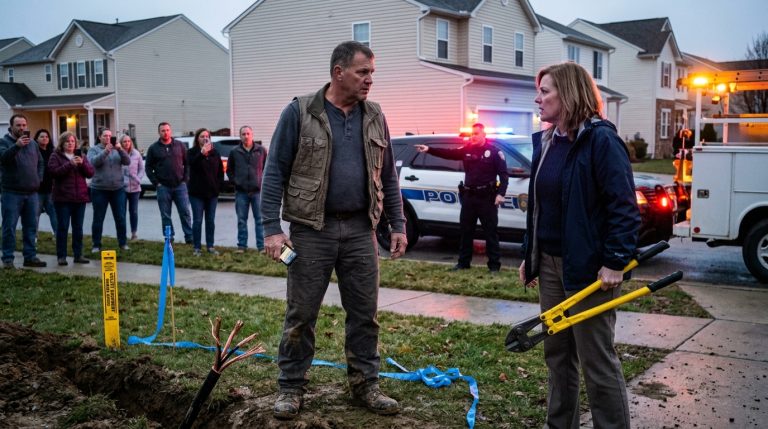
The sky above the northern tree line bruised into a deep, slate gray within minutes. Frank did not head back to the house. Instead, he stood fifty feet from the clubhouse side entrance, his heavy jacket absorbing the initial bite of the driving rain as the storm broke over the subdivision.
In his breast pocket, the formal notice of encroachment drafted by Dave rested against his ribs like a cold iron plate.
The sliding glass doors of the clubhouse parted with a pneumatic hiss, and a young man in a beige maintenance uniform stepped out onto the concrete pad, holding a plastic trash bag. He stopped dead in his tracks. His eyes locked onto the row of freshly driven wooden stakes with their bright red ribbons fluttering violently in the sudden gusting wind. The stakes cut a straight, unyielding line right across the corner of the paved service lane, slicing through the edge of the association’s manicured landscaping.
The maintenance worker dropped the bag against the doorframe, his expression shifting from casual boredom to sharp confusion. He stepped off the dry concrete into the wet grass, reached down, and grabbed the top of the nearest red-flagged stake.
“Hey!” Frank’s voice cut across the rising wind like a dry whip.
The worker froze, his hand clenched around the wood. He looked up, his eyes widening as he recognized the retired engineer standing motionless at the edge of the tree line, his silhouette framed by the dripping pines.
“You can pull out the brass pins in the dark,” Frank said, his voice level, carrying effortlessly over the hiss of the rain, “but every time you touch a marker on my property line, you’re compounding a federal survey violation. Put the wood down.”
The worker’s hand hovered over the stake for three long seconds. The tension in the air was thick, charged with the sudden friction of two opposing worlds colliding in the mud. Without a word, the man slowly let go of the wood, backed away two steps, and retreated inside the clubhouse, the glass doors sealing shut behind him with a sharp click.
Frank didn’t move. He let the rain soak into the shoulders of his canvas jacket, watching the empty glass doors. It took less than four minutes for the inner office to react.
The doors parted again. This time, it wasn’t a maintenance worker.
Karen Miller stepped out onto the covered concrete porch, her golf cart parked just behind her. She wore a tailored rain jacket over her blouse, her hair stiffly sprayed against the wind, her face locked into that familiar, unyielding mask of sour authority. She spotted Frank standing at the edge of the treeline and marched straight toward him, ignoring the puddles splashing against her sensible shoes.
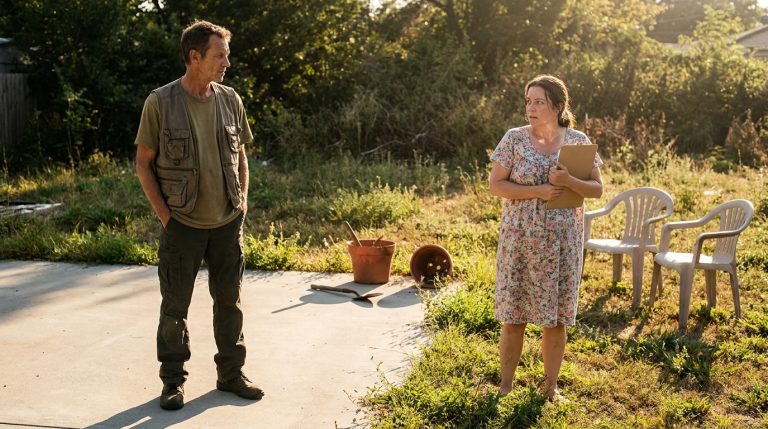
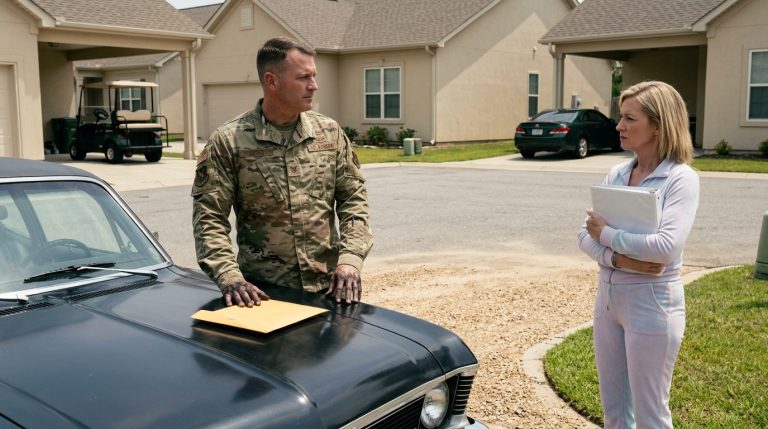
“What do you think you’re doing, Mr. Caldwell?” Karen demanded, her voice sharp and shrill as she stopped three feet from the boundary line, refusing to step any further into the mud. “Vandalizing common area landscaping with pointed sticks? The board has already given you notice regarding your non-conforming wall. This juvenile retaliation will only add another thousand dollars to your non-compliance penalties.”
Frank did not blink. He reached slowly into his breast pocket, pulled out the thick, waterproof legal envelope, and held it out.
“This isn’t retaliation, Mrs. Miller,” Frank said, his tone as cold and hard as the stone wall behind him. “This is a formal notice of structural seizure and commercial trespass.”
Karen stared at the envelope, her fingers twitching at her side as if she wanted to swat it away. “I am not accepting any more of your frivolous paperwork. Your thirty-day clock is running out, and the demolition crew has already been booked for next Tuesday.”
“Let them show up,” Frank said, stepping forward until he crossed the red-flagged line, standing squarely inside the twenty-four-foot disputed zone on the concrete apron just inches from her face. “Because when your demolition crew arrives on Tuesday, they’re going to find out they don’t have legal clearance to tear down a wall on property that sits four hundred feet inside my family’s registered deed—and that your entire clubhouse, swimming pool, and tennis courts are currently operating under an illegal trespass.”
Karen’s face lost its color, the smug authority flickering behind her eyes for a fraction of a second before hardening into pure, defensive panic. “You’re insane,” she whispered, her voice dropping an octave as the wind whipped past them. “That’s community property. It’s been here for thirty years.”
“Then I suggest you call your lawyer,” Frank said, dropping the heavy legal envelope onto the wet concrete right at her feet. “Tell him to check the 1998 master plat against the 1920 survey pins. Ask him who owns the north twenty-four feet.”
He turned his back on her without waiting for an answer, walking steadily back through the driving rain toward the shelter of the pine thicket, leaving the envelope in the mud and the first real crack in the association’s armor.
CHAPTER 6: The Crack in the Armor
The rain drummed a relentless, heavy rhythm against the roof of the clubhouse overhang, turning the manicured lawn into a series of shallow, grey puddles. Frank did not look back as he crossed the wet grass back toward the tree line, but his peripheral vision tracked the exact moment Karen bent down, her fingers snatching the waterproof envelope off the concrete with a sharp, jerky motion.
By the time he reached the dry shelter of the pine thicket, his canvas jacket was soaked through at the shoulders, clinging to his skin like cold lead. He did not rush home. He waited at the edge of the woods, blending into the dark vertical lines of the tree trunks, watching the clubhouse entrance.
Inside the glass double doors, shadow figures moved with sudden, chaotic urgency. The maintenance worker who had tried to move the stake earlier was now standing near the reception desk, pointing frantically toward the northern boundary. Within minutes, a second figure joined them—a tall, middle-aged man in a charcoal suit jacket, holding a cellular phone to his ear with one hand while gesticulating wildly with the other.
That would be association counsel, or perhaps one of the board’s corporate proxies, dragged into the open by an unexpected legal counter-weight.
V-4: For a fleeting second, the distorting sheet of rain made the glass windows look like rippling water, creating an illusion that the entire building was shifting, sliding off its concrete footings and sinking back into the raw earth of the old North Carolina woodland. It was a phantom sensation, born of cold fatigue and hyper-focus, but the structural reality beneath it was entirely solid. They were standing on ground they did not own.
The man in the charcoal suit pushed open the glass door, stepping cautiously onto the porch just far enough to stay out of the downpour. His eyes swept the treeline, searching the shadows for the man who had just dropped a multi-million-dollar land claim at their feet. He didn’t see Frank standing ten yards deep in the gloom.
Frank turned away, his boots sinking slightly into the wet pine needles as he began the quiet trek back to his house.
The dining room command center awaited him, warm and dry, smelling faintly of old paper and the fresh coffee Sarah had left in a thermos on the counter. He pulled off his wet jacket, tossing it over the back of a wooden chair, and sat down at the table. The blueprint of the 1998 subdivision plat lay unrolled beneath a heavy glass pane, its blue ink clean and legible under the brass desk lamp.
The envelope had been delivered. The thirty-day demolition clock Karen had so proudly brandished at the community meeting was no longer ticking in her favor; it was counting down the hours until the association realized they were staring down an existential financial crisis.
The phone on the table buzzed softly, vibrating against the polished wood.
Frank picked it up. It was Dave.
“I just got a ping from the county recorder’s office,” Dave’s voice came through the speaker, crisp and steady. “The formal notice of structural encroachment was logged at 1415 hours. Furthermore, copies were automatically routed to the municipal zoning board and Oakwood Preserve’s corporate registered agent.”
“How long before their legal representation reaches out?” Frank asked, his eyes tracing the red boundary line.
“Give them two hours to review the survey data,” Dave replied, a dry chuckle on the other end of the line. “Right now, Karen Miller and her board are discovering that their pristine clubhouse parking lot, tennis courts, and pump house are legally classified as unpermitted fixtures on another man’s deed. They aren’t going to call us screaming, Frank. They’re going to call us terrified.”
“Let them sweat,” Frank said. “We hold the pins.”
He ended the call and leaned back in his chair, staring out the window as the afternoon storm began to clear, leaving a heavy, steely twilight settling over the woods. The escalation phase was locked in motion.