An Old Fence, a Buried Iron Pin, and the Day a Stubborn Landowner Broke a Corrupt Subdivision
CHAPTER 1: THE FIRST NOTICE
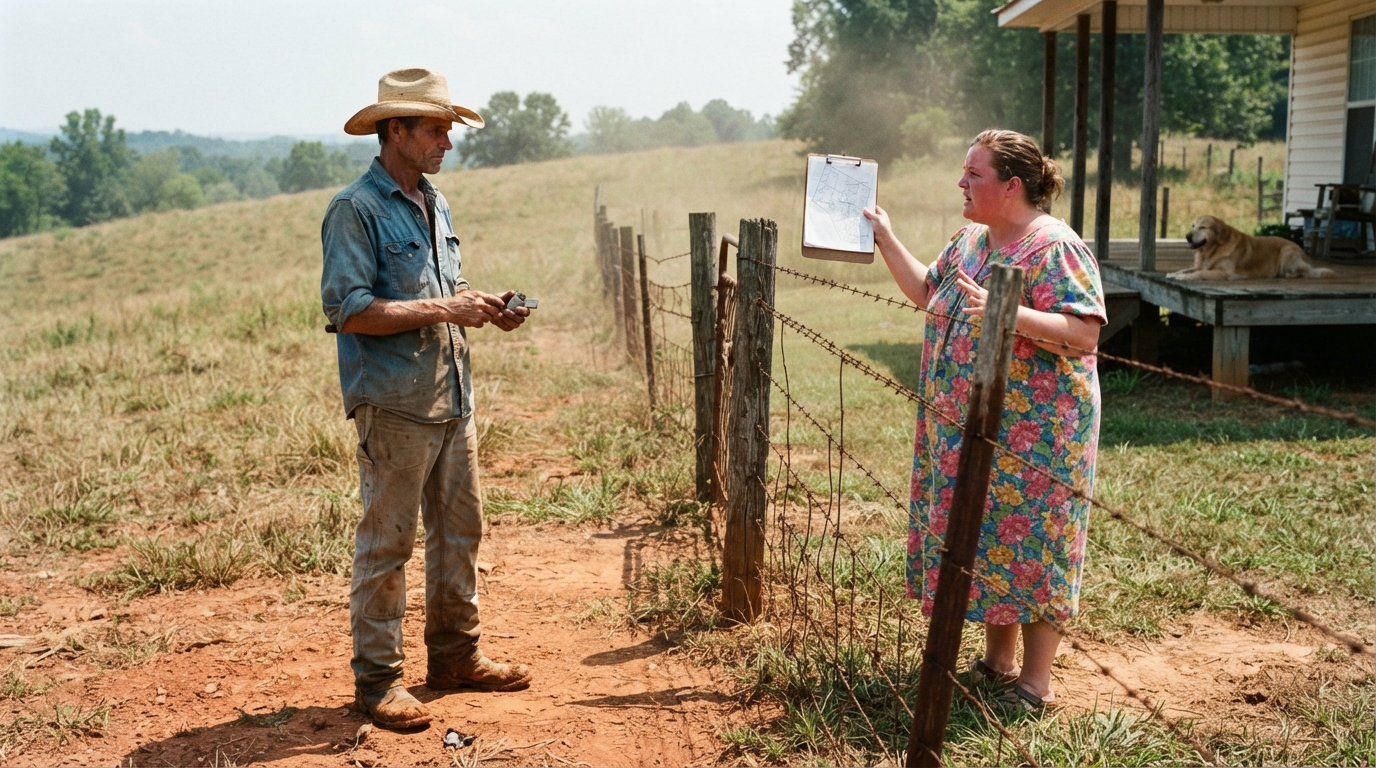
The rusted strands of barbs sagged between weathered cedar posts my grandfather had sunk into the red dirt seventy years ago.
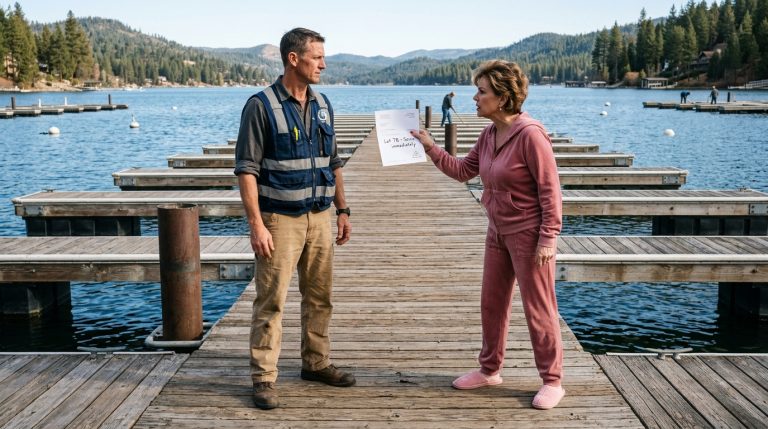
“According to our bylaws and the plat map filed with the county, you are currently trespassing,” Karen said, her floral-print muumuu straining against her shoulders as she puffed for air.
She held her clipboard like a scepter while her small, hard eyes scanned the ten rolling acres of Tennessee hillside.
I rolled a scarred metal Zippo lighter between my thumb and forefinger inside my pocket, feeling the cool friction of the brass hinge.
“There is a crew scheduled for Friday morning to remove it and install proper community standard fencing,” she continued, her voice rising with administrative certainty.
You will be billed for the removal, the new installation, and escalating fines dating back thirty days.
The wire was more a suggestion than a barrier, marking the edge of our world long before Whispering Pines was anything more than pine trees and kudzu.
“My property,” I said, my voice flat, “my rules.”
Karen didn’t blink, entirely convinced that a three-ring binder gave her feudal authority over dirt she had never worked a day in her life.
She turned on her heel, her heavy loafers crunching over gravel as she retreated back toward the beige labyrinth of her subdivision.
Duke let out a low rumble from the porch, his golden eyes tracking her departure until the distance swallowed her silhouette.
CHAPTER 2: THE PAPER TRAIL
The courthouse basement smelled of damp paper, iron piping, and a century of accumulated legal friction.
Martha looked up from behind a high wooden counter, her steel-rimmed glasses slipping halfway down her nose as she recognized my boots on the linoleum.
“Whispering Pines,” she said, the name tasting like something spoiled on her tongue before I even spoke a word.
I set the modern developer’s plat map down beside the heavy leather-bound registry from 1946.
“They’re trying to push the line twenty feet past the old cedar posts,” I said, my voice dropping into the quiet cavern of the records room.
Martha pursed her lips, her fingers tracing the faded ink of my grandfather’s entry without hesitation.
“We’ve had more boundary complaints and title search issues with that subdivision than all the others combined,” she muttered, sliding a heavy magnifying glass across the wood.
The old deed used the language of the land itself—meets and bounds, referencing physical geography rather than digital coordinates.
“Thence north eighty-nine degrees fifteen minutes west for a distance of eight hundred twelve point five feet to an iron pin set at the base of a tri-trunked white oak.”
Martha tapped the glass against the page right over the iron pin entry.
“Find that pin, Jack,” she whispered, her eyes sharp. “Find that pin and you’ll have them dead to rights.”
I didn’t answer with words, only lifted the binder back into my grip and turned toward the heavy exit door.
CHAPTER 3: THE IRON PIN
The thicket was a choked maze of briars and second-growth pine that made every inch of progress a grueling wrestling match against nature.
Beads of sweat rolled down my forehead, stinging my eyes as the detector screamed a high, warbling false positive over an old rusted soup can.
I tossed the trash aside, wiped my palm across my thigh, and kept moving deeper into the wedge of disputed timber.
The heat was heavy and oppressive, wrapping around my shoulders like a wet wool blanket while mosquitoes whined around my ears.
“The difficult we do immediately,” I muttered to myself, echoing the old Corps of Engineers standard while sweeping the coil over a triangle of rotting oak stumps.
The tone changed instantly from a sharp chatter to a deep, solid, sustained hum that vibrated straight up through the aluminum shaft.
I dropped the detector, grabbed the hand trowel, and began hacking through a dense web of stubborn tree roots.
Six inches down, the metal blade struck something round, heavy, and completely unyielding.
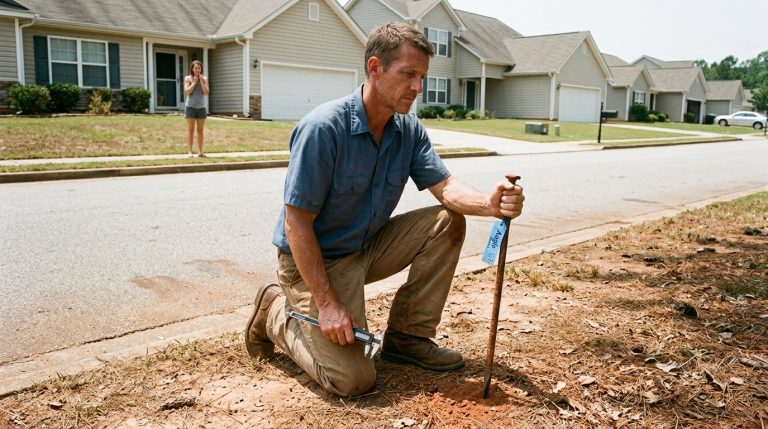
I scraped away the wet soil with my bare fingers, revealing the mushroomed top of an old steel rod hammered deep into the earth seventy years ago.
It was pitted with rust, immovable, and positioned precisely where the 1946 deed said it would be.
CHAPTER 4: THE SATURDAY RAID
The heavy thud of a commercial posthole digger vibrated through the dry soil well before the truck came to a full stop.
Karen stood near the fence line with a clipboard pressed against her hip, directing a crew of hourly laborers setting steel posts deep inside our property.
I didn’t yell across the grass or wave my arms in a panic.
I pressed record on the camera and kept my breathing slow, watching them drop concrete mix into a hole dug fifteen feet past the old boundary.
“Reporting a trespass in progress and the destruction of private property,” I said into the phone receiver while keeping my lens locked on the crew foreman.
Deputy Miller’s cruiser rolled up ten minutes later with its amber light flashing against the canopy of maples.
Karen marched straight toward the cruiser window with her clipboard raised like a shield.
“This man is encroaching on subdivision common ground according to our official map,” she said, her voice carrying a sharp, practiced edge of administrative authority.
The deputy stepped out, looked past her at the fresh concrete footings, and then nodded quietly toward me on the porch.
“Ma’am, you’re standing on private land with a posthole digger,” the deputy said, his hand resting casually on his utility belt.
Karen’s face mottled into a deep, furious crimson as the laborers immediately dropped their shovels and backed away toward the truck.
CHAPTER 5: THE PRECISE SURVEY
Art Davies clicked a thumb latch on the robotic total station, his eyes narrowed against the glaring Tennessee sun.
“When you mentioned that 1946 deed and the iron pin, I knew this wasn’t just another routine line call,” he said, tapping data points into his controller.
Two men worked methodically across the property line, dragging a rover pole over every post and wire of the disputed boundary.
I handed Art a clean water bottle, watching the digital receiver log coordinates down to a fraction of a centimeter.
“We found the original pin yesterday,” I said, my thumb rubbing the brass edge of the Zippo lighter in my pocket.
Art stopped walking, his expression shifting from professional detachment into sharp professional curiosity.
“Show me,” he insisted, packing up the rover unit with practiced speed.
We walked down into the briars where the old oak stumps marked the corner, and Art cleared away the flat stone covering the buried steel rod.
He swept his digital sensor directly over the mushroomed top, staring at the readout with absolute reverence.
“For seventy years ago, this surveyor was a true master,” Art muttered, shaking his head. “He missed the modern projection by less than an inch.”
CHAPTER 6: THE FOUNDATION CRUMBLES
Art tapped the transparent screen overlay with the blunt eraser end of a yellow pencil.
“The original Whispering Pines survey used a temporary construction benchmark instead of the official section corner,” he said, his voice dropping low.
I traced the red boundary line with my thumb, seeing the fourteen-foot westward translation stretch across every single backyard backing up to my timber.
“They didn’t just misjudge my property line,” I said, looking up from the kitchen table.
“They shifted the entire subdivision right off its legal foundation,” Art confirmed, shaking his head slowly.
Every house, fence, and sprinkler system along that eastern ridge sat on ground that belonged somewhere else entirely.
The error was systematic, deep-rooted, and entirely unassailable by casual neighborhood denial.
I folded the certified survey report shut, the heavy spiral binding clicking against the wood.
“Karen built an empire on paperwork,” I murmured, rolling the Zippo lighter between my knuckles. “And she just filed her own eviction notice.”
CHAPTER 7: THE UNYIELDING STAND
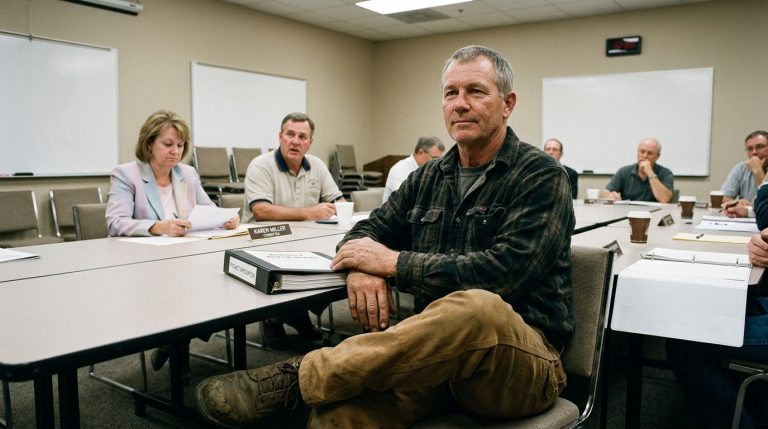
Karen sat at the center of the mahogany table wearing a navy blue pantsuit that strained at the seams, her small eyes locked on my binder with open hostility.
“This is a manufactured trick designed to extort our association,” she snapped, her voice vibrating with shrill disbelief before anyone else could speak.
I didn’t blink or reach for an attorney, because there was no attorney standing beside me—just the cold, hard weight of the certified survey map laid out across the wood.
“It’s not a trick, Ms. Miller,” I said, my voice cutting across the room with flat, measured exhaustion.
“Your developer’s surveyor missed the official section corner by over fourteen feet, throwing every title in Whispering Pines into total legal jeopardy.”
The two male board members flanking her turned pale, staring down at the colored grid lines showing their backyards resting on my property.
“You’re making that up—you have no right to question our subdivision plat,” Karen shrieked, slamming her palm hard against the polished tabletop.
She doubled down instantly, refusing to yield an inch, demanding that the board reject the data and maintain the fines.
“You can call it whatever you want,” I said, sliding the heavy documentation right across to the terrified board members.
“You can fight the math in court and watch your property values vanish, or you can sign the boundary correction and restore order.”
Karen’s face mottled into a deep, furious purple as the other directors pulled the binder toward themselves, entirely abandoning her defense.
CHAPTER 8: THE SILVER GRAY FENCE
The old rusted barbs were gone, hauled away to clear space for timber that stood true against the GPS-verified boundary.
Tom walked up the incline from the subdivision, leaning his forearms against the top rail with an easy, unburdened sigh.
“That’s a fine-looking boundary, Jack,” he said, nodding toward the solid oak boards separating our worlds.
I rolled the Zippo lighter once in my pocket, letting the brass click shut as the tension finally bled out of the afternoon air.
“A good fence makes good neighbors,” I replied, quoting the old saying while watching the sun dip behind the western ridge.
Karen had sold her home at a steep loss and vanished into the quiet obscurity she deserved, her rule broken by nothing more than simple geometry and common sense.
The new board was busy healing the community, repairing titles, and learning how to govern without an iron fist.
“We were all terrified of you when we first moved in,” Tom admitted, offering a firm hand over the top rail.
“Turns out we were scared of the wrong person.”
I shook his hand, feeling the solid, honest grip of a man who understood what it meant to stand on his own land.
The war was over, the legacy was secure, and the hills belonged to the quiet rhythm of the earth once again.