A Foundation of Lies: One Man’s Precision War Against the Tyranny of Azure Lake Estates
CHAPTER 1: THE CEDAR FRONTIER
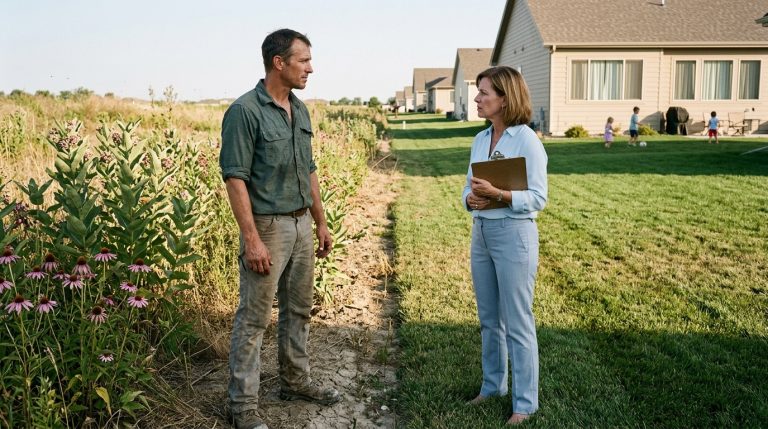
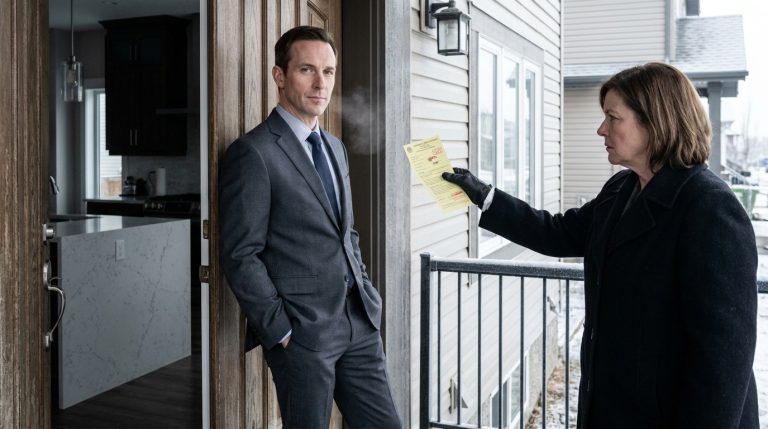
The fine was a crisp, heavy sheet of paper, cold to the touch and radiating a sense of entitlement that didn’t belong on my water. I watched her thumb trace the edge of the invoice as if she were tallying her own heartbeat. Five thousand dollars. A number pulled from thin air to punctuate the silence of a Tuesday morning.
“The fine for the unapproved construction,” she said, her voice a precise, syrupy vibration. “And we’ll be taking possession of it tomorrow morning. It’s now Azure Lake Community Dock number three.”
She shoved the paper toward my chest. I didn’t reach for it, letting her hand hang in the air for a second too long until the embarrassment of being ignored forced her to drop the invoice onto the cedar planks. It landed with a soft, dismissive thud.
Behind her, the lake was a sheet of polished obsidian, perfectly still. My dock, a masterpiece of over-engineered support pylons and double-bolted joists, felt like a silent soldier beneath our feet. I had built it to withstand the biting winds of a North Atlantic winter, not the petulant whims of a woman in a velour tracksuit.
“You’re trespassing, Karen,” I said, my voice barely rising above the rhythmic lapping of the water against the barrels.
She laughed, a sharp, staccato sound that grated against the early morning quiet. “Trespassing? On community property? I suggest you check the bylaws, Jack. You seem to think that because you served in the Navy, the world operates on your timeline. It operates on mine.”
I looked at her, noting the slight tremor in her left hand—the frantic energy of a control freak pushed into a corner by something she couldn’t categorize. She needed this fight. She needed to see me scramble for my wallet or crumble into a defensive posture. She was looking for a reaction that would confirm her position at the top of the food chain.
I didn’t give it to her. I kept my posture loose, my eyes fixed on the horizon where the fog was just beginning to burn off the water. Every Seabee knows that the first step in any construction project is the site survey; the second is knowing exactly where the foundation lines end and the enemy’s interference begins.
“This dock is private property,” I repeated, my tone steady, devoid of the heat she was trying to provoke. “I have the county permits. You have a clipboard.”
She stepped closer, the smell of her perfume—something floral and aggressively cloying—seeping into the clean, piney scent of the cedar. She leaned in, her eyes narrowing into dangerous, calculated slits. “The county doesn’t govern taste, Jack. And it certainly doesn’t govern Azure Lake. By tomorrow morning, this dock belongs to the association. You’ll be lucky if we let you walk on it at all.”
She spun on her heel, her sneakers squeaking aggressively against the wood, and marched toward the gangway. As she climbed the bluff, she pulled her phone out, already punching in numbers with a frantic, rhythmic intensity. I watched her go, a dark, jagged silhouette against the rising sun.
I reached down and picked up the invoice. I didn’t tear it up; I folded it carefully, lining up the edges with the precision of a master builder. Then, I noticed something that made the hair on my arms stand up. In the corner of the invoice, where the HOA logo was printed, the ink was slightly blurred—a sign of a rushed print job. But underneath that, there was a faint, handwritten notation in the margin: Lot 7B – Seize immediately.
It wasn’t a standard penalty. It was a targeted internal memo. She hadn’t just decided to fine me today; she had been planning this extraction for weeks.
CHAPTER 2: THE PAPER ARCHIVE
The walk back to my truck was heavy, not because of the paper I held, but because of the shift in the air. Karen’s voice was still vibrating in the space between the cedar planks, a low-frequency hum of manufactured crisis. I kept the invoice folded in my pocket, the sharp corner digging into my hip with every step up the bluff.
The county records office was a twelve-mile drive, a transition from the manicured, artificial calm of Azure Lake Estates to the decaying, honest grit of the city center. The building itself was a relic, a concrete monolith that smelled of ozone, damp concrete, and the dry, suffocating dust of a million forgotten lives. I walked through the double doors, my boots echoing against the linoleum, a sound that felt alien in this tomb of bureaucracy.
For a moment, the dim fluorescent flicker overhead triggered a phantom sensation—the smell of wet sand and reinforced rebar from an island base project in the Pacific. I felt the familiar weight of a transit level in my hand, the need for absolute, unyielding precision. The ghosts of my service years didn’t just haunt me; they provided the lens through which I viewed the world. Karen thought she was playing a game of social status. She had no idea she was playing against a man who had spent twenty years ensuring that million-dollar foundations didn’t sink into the mud.
I reached the archives desk, a wooden counter scarred by decades of heavy files. The clerk, a man who looked like he’d been sitting in the same chair since the Truman administration, peered over his spectacles.
“Help you?”
“I need access to the original survey maps for the Clarion River valley,” I said, sliding a small slip of paper with the parcel number toward him. “Pre-1928.”
He grunted, not looking at the paper. “That’s the basement level. Box 402 through 410. You know the drill—no pens, no liquids, and don’t be surprised if the pages crumble when you breathe on them.”
The basement was a labyrinth of steel shelving. The air down here was different—stale, cold, and heavy. I found the box, the cardboard bowing under the weight of history. I sat at a metal table, the surface cold enough to make my fingertips ache. I didn’t rush. I laid the maps out with a methodical slowness, my hands steady, my mind stripping away the layers of modern development.
I looked at the original 1920s plat maps. These were hand-drawn in India ink, the lines delicate but precise, mapping the river as it was before the dam—the “Original Channel.” I tracked the path of the riverbed, seeing the contours of the land that was now thirty feet under the surface of Azure Lake. My lot was an anomaly, a long finger of land that had served as a natural jetty for the old river.
My finger traced the ink lines. According to the state law I’d uncovered—a relic meant to ensure equitable land access during the industrial expansion of the twenties—riparian rights didn’t stop at the water’s edge if the deed predated the flooding. It followed the original river channel.
The realization hit me with the force of a structural collapse. My dock didn’t just sit on the shore. The entire structure, every cedar plank and every bolt, was suspended over my own underwater property. Karen’s “community water” was a fiction, a layer of paint over a reality that she hadn’t bothered to look beneath.
I sat back, the silence of the room pressing in. This wasn’t just a win; it was a total tactical reset. I pulled my notebook out and began to draw, recreating the survey with the precision of a field map. Every fine she sent, every threat she issued, was a piece of information I could feed back into this, creating a cycle of escalation that she was destined to lose.
As I worked, a realization solidified: I couldn’t just fight this in court. I had to let her commit. I had to let her believe she was winning, let her sharpen the blade of her own destruction. I needed to document the harassment as if I were logging the progress of a hostile force, keeping the record flawless, the timeline exact.
I glanced at the invoice in my pocket one last time. Karen was already moving to seize the dock tomorrow morning. I didn’t need to stop her. I needed to witness it. I needed to film every second of their encroachment. The more they did, the deeper they sank.
I packed my notes away, my movements clipped and efficient. The clerk didn’t look up as I passed by, but I felt the weight of the information in my bag like a loaded weapon. My retirement had promised me peace, but the terrain had dictated war. And looking at the map one last time, I knew exactly how to terraform the battlefield.
CHAPTER 3: THE ALLIANCE OF THE OVERLOOKED
The sunlight outside the county office hit with the jarring intensity of a spotlight. I adjusted the strap of my bag, feeling the sharp corners of the ledger and the rolled survey maps pressing against my ribs. The walk back to the truck was a series of measured, calculated steps. I wasn’t just returning to Azure Lake Estates; I was returning to a hostile operating environment.
Every house I passed now looked different. The pristine manicured lawns, the aggressive uniformity of the mailboxes, the carefully curated garden beds—they were no longer just decorations. They were markers of a managed territory. Karen didn’t just want order; she wanted total compliance. She had turned a neighborhood into a prison camp where the guards were the inmates themselves, terrified of the next fine, the next notice, the next target on their back.
As I turned onto the street leading to my own lot, the sound of a struggle caught my ear. It wasn’t physical; it was the sound of a scraping brush against metal. I slowed, my stride becoming deliberate. Two houses down, Sarah was hunched over her mailbox post, her hands covered in a streak of “peppercorn white” paint. It was raining—a light, miserable drizzle that turned the paint into a streaky mess. She looked defeated, the kind of exhaustion that isn’t just physical, but soul-deep.
I didn’t keep walking. I stopped, letting the rain blur the sharp edges of my vision.
“The regulation is satin, not flat, isn’t it?” I asked, my voice low.
Sarah jumped, nearly dropping the brush. She turned, her eyes wide, startled. “Jack. I—I didn’t see you. Yeah. Satin. I didn’t have the right sheen. If she sees this tomorrow, it’s another hundred.”
I looked at the mailbox. It was a perfectly functional, unremarkable object. But under the rules of the HOA, it was a liability. I felt a surge of cold, focused anger—not the chaotic, hot-headed fury that might make a man yell, but the sharp, clear-eyed rage of a commander seeing a civilian caught in the line of fire.
“Put the brush down, Sarah,” I said, stepping onto her lawn.
She hesitated. “I have to finish it before dawn.”
“You don’t,” I said, reaching into my bag. I didn’t pull out the maps—not yet. I pulled out a spare notebook, a plain, nondescript item. I kept it tucked away, a place where I logged every observation, every interaction. “You’re not the problem. The system is the problem.”
She looked at the notebook, then at me, her brow furrowing. The fear that had been her default setting for months seemed to flicker, struggling against something else: a desperate, buried hope. “She’ll just find something else, Jack. She always does.”
“Only if we let her,” I replied, glancing toward Karen’s house down the street. It stood like a silent sentinel, its windows dark. “I’m starting a record. Not just for myself, but for everyone who’s been squeezed by this. If you’ve been fined, if you’ve been harassed, I want to know about it. Date, time, the specific infraction, and the supposed clause they’re citing.”
“Why?”
“Because records are power,” I said. “And because I’m done playing by rules that are being used as a weapon.”
As we stood there, a sudden, sharp crack echoed through the air. A branch, weighted by the rain, snapped from an overhanging oak in the common area and crashed down, smashing into a decorative stone wall—one that Karen had personally overseen the construction of. It was a small, chaotic intervention by nature, a reminder that the environment itself wasn’t interested in her rules. Sarah looked at the wreckage, then at me, a tentative smile touching her lips.
“She’s going to be furious,” Sarah whispered.
“Let her be,” I said, turning back to my own property. “Let her spend her energy worrying about a pile of rocks. We have work to do.”
I continued the walk, feeling the weight of the bag, now bolstered by the knowledge that I wasn’t the only one who felt the friction of the machine. I had seeded the idea. I had planted the first marker in the ground. The next step was Mr. Henderson. If I could get the widower to open up, to see that his grief wasn’t a liability to be exploited, I would have the foundation of the alliance I needed.
I reached my lot, the path down the bluff waiting for me. The dock was still there, a sturdy, silent sentinel in the dark water. Tomorrow morning, when the van pulled up, it wouldn’t just be an argument about property lines. It would be the opening maneuver in a campaign that would reach all the way to the board’s front door. I checked the lock on the gate, my hands steady, my mind moving three steps ahead, already calculating the logistics of the defense.
CHAPTER 4: THE BAIT AND THE BLADE
The morning air held a biting, crystalline quality that turned my breath into ragged plumes of vapor. I was standing at the edge of the gangway, the camera mounted on the tripod near the pylon, the lens cap removed, the recording light a steady, reassuring crimson pulse. My coffee in the ceramic mug had gone cold twenty minutes ago, but I didn’t move. I didn’t even shift my weight. Every nerve ending was mapped to the gravel path leading down from the street.
At 7:58 a.m., the crunch of tires on packed stone signaled the arrival. A white van, the logo of Azure Lake Maintenance peeling slightly at the edges, pulled to a halt at the top of the bluff. It was a mundane, utilitarian vehicle, but it felt like a tactical insertion. Two men emerged, their movements heavy and hesitant, as if they were performing a task they understood was fundamentally wrong, but lacked the agency to refuse. They carried a heavy chain, a padlock the size of a man’s fist, and a fresh sign—Community Dock Number Three: HOA Property.
I watched them descend. They walked with the rhythmic, plodding pace of men who wanted the clock to run out before they reached their objective. I stayed in the shadows of the bluff’s overhang, my breathing shallow and controlled.
“This is it, Frank,” one of them murmured, his voice carrying clearly over the dead water. “Just chain the piling, put up the sign, and get out.”
“I don’t like it,” the other replied, glancing nervously at the surrounding trees. “Riley hasn’t said a word. It feels too quiet.”
As they stepped onto the cedar planks, the wood groaned under their weight—a familiar, structural sound that I had fine-tuned with my own hands. They were halfway to the central piling when I stepped out of the shadow. I didn’t rush. I didn’t shout. I simply blocked the path, my presence absolute and immovable.
“Good morning, gentlemen,” I said, my voice cutting through the stillness. “That’s as far as you go.”
The reaction was instantaneous. Frank froze, his fingers tightening around the cold, iron link of the chain. His partner, the lanky kid with the nervous twitch, stumbled backward, nearly tripping over the edge of the dock. The air seemed to charge with a sudden, sharp tension, the kind that precedes a structural failure.
“You’re on private property,” I continued, keeping my eyes fixed on the lanky one. “The equipment you’re carrying—that chain, that sign—is for the express purpose of seizing assets without due process. If you take one more step, I am calling the sheriff to report a trespassing and attempted theft in progress. And for the record, this entire interaction is being recorded, from the moment you stepped onto this dock.”
Frank’s face went pale. He wasn’t a criminal; he was an employee who had been fed a narrative by Karen, and that narrative was currently colliding with the cold, hard physics of a man who owned the ground beneath his feet. He looked at his partner, then at the camera blinking on its tripod.
“We were told this was HOA property,” Frank stammered, his voice lacking any conviction.
“You were told wrong,” I said, my tone clinical. “You’re being used to break the law, Frank. Are you willing to lose your job, or worse, face criminal charges, because Karen wants to play monarch?”
The lanky kid looked toward the bluff, his panic rising. “I’m calling her, Frank. I’m not doing this.”
As he fumbled for his phone, I maintained my stance. I didn’t offer them an exit, and I didn’t offer them a fight. I simply existed as a blockade—a living, breathing obstacle to their mission. The psychological weight of the moment was palpable. I could see the way they looked at the dock, the way they realized they were in a space that didn’t belong to their boss.
Five minutes later, a golf cart screeched down the gravel lane. Karen was at the wheel, her hair tucked under a visor, her face a mask of incandescent fury. She didn’t slow down; she slammed the cart into the side of the bluff and vaulted out, her heels clicking aggressively on the stone.
“What is the meaning of this?” she shrieked, the sound jagged and discordant. “I told you to secure the property!”
I didn’t turn to look at her. I kept my eyes on Frank, forcing him to witness the clash. The van, the men, the chain—it all felt like theater now, a staged performance of power that was rapidly losing its audience. The “clue” I had spent weeks preparing—the survey—was still tucked safely in my home office, but its presence was felt here, a silent, unseen variable that Karen couldn’t possibly account for. She was playing for optics, for the fear she could generate; I was playing for the structural integrity of the legal truth.
“I am preventing a crime, Karen,” I said, finally turning to face her. My voice was calm, a sharp contrast to her shrill agitation. “And you are currently trespassing on land that has been surveyed and registered with the county as mine. If you don’t leave, I will make that call to the sheriff.”
She stopped, her chest heaving. For a second, her gaze flickered to the camera. She knew the optics were failing. She knew the narrative was slipping. But she was too far committed to retreat now. The trap was sprung, and she was already walking into the center of it, unaware that her next move—the one that would seal the foreclosure—was the very thing that would trigger the legal demolition of her entire kingdom.
CHAPTER 5: THE WEIGHT OF THE GAVEL
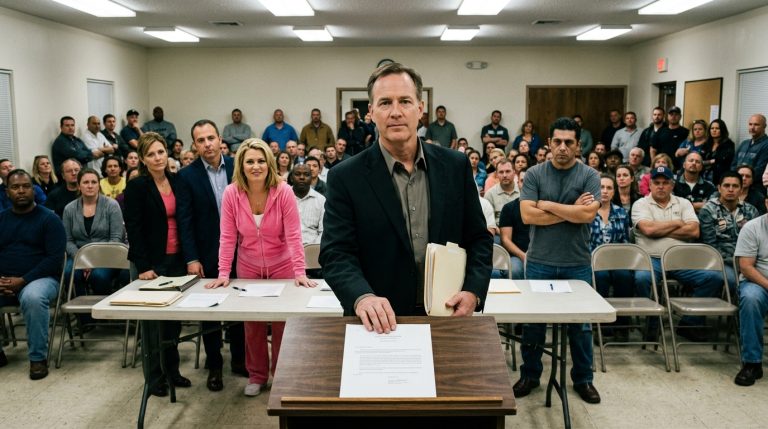
The silence in the clubhouse was not merely the absence of noise; it was a physical pressure, heavy and suffocating. Karen stood at the head of the long table, her posture rigid, her face drained of its usual synthetic confidence. The gavel in her hand felt like a relic from a regime that had already collapsed. Around her, the four board members were motionless, their eyes fixed on the projection screen where the red, jagged lines of my survey map glowed with cold, indisputable authority.
Ms. Davis didn’t pace. She stood perfectly still, her hands clasped lightly in front of her, her presence a silent, lethal counterpoint to the chaos Karen had tried to incite. She had delivered the truth with the clinical precision of a scalpel, and now, we were watching the wound bleed.
“Ladies and gentlemen,” Ms. Davis said, her voice soft but carrying easily to the back of the room, “what you see on the screen is not an interpretation. It is a certified hydrographic survey, filed with the county. It defines the boundaries of Lot 7B with multi-beam sonar accuracy. It proves, beyond any legal doubt, that the structure you have been targeting—the dock—is situated entirely on private property. Property that the HOA has absolutely no jurisdiction over.”
She paused, letting the statement hang. I watched Mr. Abernathy, the board member to Karen’s left. His face had gone a sickly, parchment gray. He was looking at Karen, his mouth opening and closing in a silent, panicked rhythm. He was finally doing the math: the fines, the threats, the personal legal liability he was now sharing.
Karen slammed the gavel down, the sound sharp and desperate. “This is a deception! It’s a staged map, designed to intimidate the board! We have our own records, our own bylaws!”
“Your bylaws are secondary to state law, Madame President,” Ms. Davis replied, her tone perfectly even. “And your ‘records’ are based on the flood line, which, as this survey demonstrates, has no legal bearing on riparian rights for properties surveyed prior to 1928. You are not enforcing rules. You are engaging in tortious interference with private property rights. And I believe you are all aware of what that means for your personal assets.”
The room erupted. It wasn’t the polite murmurs of a homeowners’ association meeting; it was the frantic, jagged noise of a collapse. I saw Sarah, Mr. Henderson, and Frank in the back rows. They weren’t cheering—they were watching, their expressions a mix of disbelief and vindication. They were seeing the facade dissolve in real-time.
“This is not authorized!” Karen shrieked, pointing at Ms. Davis. “You cannot present evidence during an executive agenda! This is a closed hearing!”
“This is an open proceeding regarding a lien and foreclosure on my client’s home,” Ms. Davis corrected, never taking her eyes off the board members. “Every document I have presented is now part of the official record. Should you choose to proceed with a vote, you are doing so with full, documented knowledge that you are acting outside the law. That is no longer a mistake. That is willful negligence.”
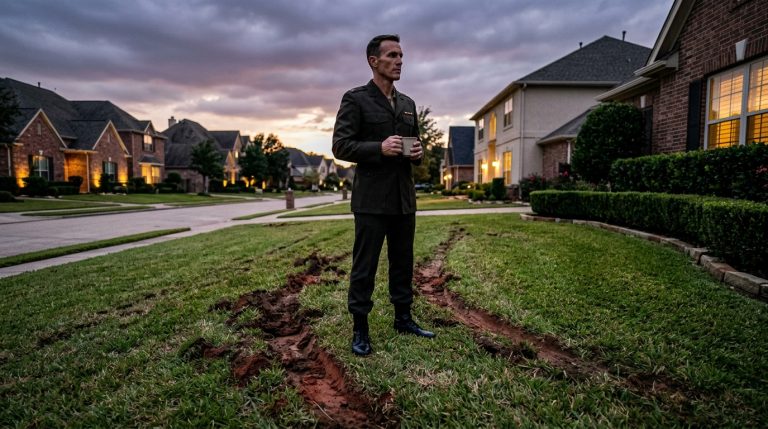
I stood up. I didn’t say a word, but the movement was enough. All eyes shifted to me. I wore my service dress uniform, the fabric crisp, the lines clean. I wasn’t there as a disgruntled neighbor. I was there as a man who had built things for twenty years and who knew exactly what happened when you tried to build a structure on a faulty foundation. I looked at each board member, holding their gaze until they were forced to look away.
“You have been misled,” I said, my voice steady, carrying the weight of the facts I had spent months gathering. “You were told I was the aggressor. You were told I was violating the community. You were never told that the person giving you those orders didn’t have the legal authority to enforce them.”
Abernathy leaned forward, his hands trembling as he reached for the document package Ms. Davis had placed on the table. He flipped through the pages, his eyes darting across the legal language. The silence from the rest of the board was the most chilling thing I had ever witnessed—a collective, dawning realization that they had been maneuvered into a position of total ruin.
Karen tried to speak, but her voice failed her. She looked around the room, searching for the sycophants who had cheered her only an hour ago. But the room had changed. The atmosphere was no longer one of orchestrated conformity; it was cold, analytical, and unforgiving. The threat of personal liability, the fear of losing their homes, had stripped away the petty allegiances she had cultivated through fear.
“I move that we table the motion,” Abernathy whispered, his voice cracking. “I move that we table the motion regarding lot 7B indefinitely.”
One by one, the others nodded, their movements jerky and small. They were abandoning the ship, and they didn’t care who was left on the bridge. The gavel remained on the table, unused. Karen looked as though she had been struck physically, her posture crumpling under the weight of the realization that she was no longer a leader, but a liability. The trap had closed, but it hadn’t just caught her—it had left her entirely, devastatingly alone.
CHAPTER 6: THE SILENT DEMOLITION
The room didn’t erupt; it dismantled.
Karen stood paralyzed at the head of the table, her hands clutching the edges of the mahogany surface until her knuckles shone white. She scanned the faces of her former allies—the board members—who were busy folding their notebooks, avoiding her eyes as if her very presence were a contaminant. Mr. Abernathy was already walking toward the door, his briefcase tucked under his arm, his pace brisk, eager to put as much distance between himself and this room as physically possible.
I didn’t move. I remained standing, a calm, static point in the middle of the drifting chaos. My uniform felt heavy, the weight of the medals pinning me to the floor of a battle that had been won with paper rather than ordnance. The silence was the sound of a total strategic victory.
“The meeting is adjourned,” Mr. Abernathy called out, his voice thin and hollow, not even looking back at the podium.
One by one, the board members followed him out. They didn’t glance at me. They didn’t speak to Karen. They simply evaporated into the hallway, their exits punctuated by the rhythmic, sharp clicks of dress shoes on tile. The clubhouse, once a theater for Karen’s manufactured authority, was becoming a tomb for her reputation.
I looked at Karen. She was staring at the empty chairs, the red lines of the survey map still projected on the screen behind her. It was a digital ghost, a map that had effectively erased her power. She turned slowly, her movements uncoordinated, the visor she wore slipping slightly to the side. Her face wasn’t just pale anymore; it was vacant. The realization that she had been defeated not by an equal, but by the very bureaucracy she had perverted, had hollowed her out.
“You think you’ve won,” she whispered, the words barely audible. “You think this is over.”
“It’s not about winning, Karen,” I said, my voice low and devoid of malice. “It’s about order. You were building a structure on a foundation of sand. It was always going to collapse.”
I walked toward the exit, my steps measured. As I passed her, I didn’t stop. I didn’t offer a parting insult or a final justification. I simply left her in the glare of the projector, a small, inconsequential figure framed against the map of the property she had failed to steal.
The exit into the evening air was a sensory shock. The humidity of the night hit me, carrying the scent of damp earth and pine needles. The parking lot was filled with the fading glow of taillights. Our alliance—Sarah, Henderson, Frank—was gathered near the entrance, their voices hushed, their expressions transformed by a relief that bordered on disbelief. They looked at me as I approached, not with the look one gives a conqueror, but the look one gives a man who has finally allowed the storm to break.
Mr. Henderson stepped forward, his hand extended. His grip was firm, grounded. “You did it, Jack. You didn’t just stop the foreclosure. You leveled the whole field.”
“The field was already tilted, Henderson,” I said, keeping my tone pragmatic. “I just helped it find its level.”
The weeks that followed were a quiet, methodical dismantling. The legal fallout was swift—the insurance companies settled, the punitive damages were assigned, and the community board underwent a total reconstruction. Henderson, steady and methodical, became the new interim president, scrubbing the bylaws of the poisonous language that had enabled the tyranny. The fines vanished, the liens were dissolved, and slowly, the neighborhood began to breathe again.
I returned to my dock the morning after the final audit was signed. The frost was heavy on the cedar, turning the wood into a silver-gray path leading out into the lake. I sat on the edge, my feet dangling inches above the surface. I held the “Community Dock Number Three” sign—the one that had been left behind—in my hands. It was heavy, a useless piece of painted tin.
I didn’t feel a rush of adrenaline. I felt a quiet, profound settlement of the spirit. I had come here for peace, for a project that had no purpose other than its own existence. The war had been an interruption, a test of the structural integrity of my own life. I had held the line, not because I craved power, but because I knew that if you allow one line of your life to be compromised, the entire structure eventually succumbs.
I walked to the fire pit I had prepared in the clearing above the bluff. I broke the sign across my knee—the metal groaned, a satisfying, sharp sound—and tossed the pieces into the flames. I watched them curl into ash, the black flakes rising into the night sky, disappearing into the vast, silent expanse of the stars.
The repair was finished. The dock was stable. The ground beneath me was mine. I sat by the fire until the embers died, the cold settling into my bones, a reminder of the season, of the struggle, and of the absolute, necessary silence that follows a completed operation. I wasn’t a hero, and I wasn’t a villain. I was a builder, and for the first time in a long time, the foundation was set.