The Architect’s Retribution: How a Quiet Workshop Dismantled a Suburban Tyrant’s Carefully Constructed Empire of Control
CHAPTER 1: The First Cut
The planer went quiet, leaving a vacuum of sound in the workshop that made the blood rushing in my ears sound like a waterfall. I didn’t reach for the kill switch; I let the momentum of the machine die naturally, a slow, deliberate deceleration.
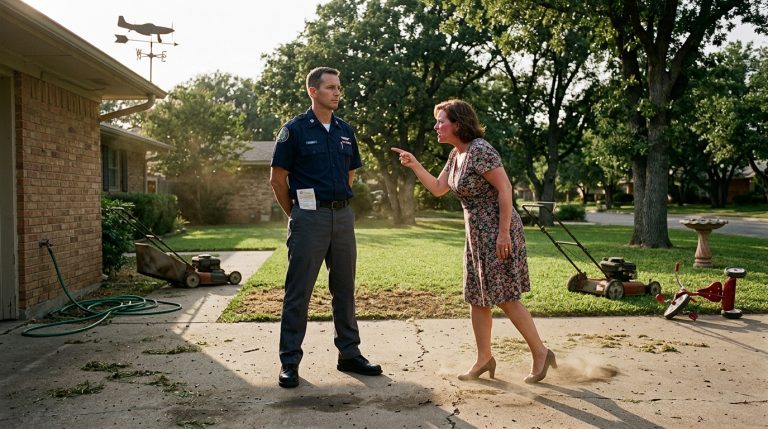
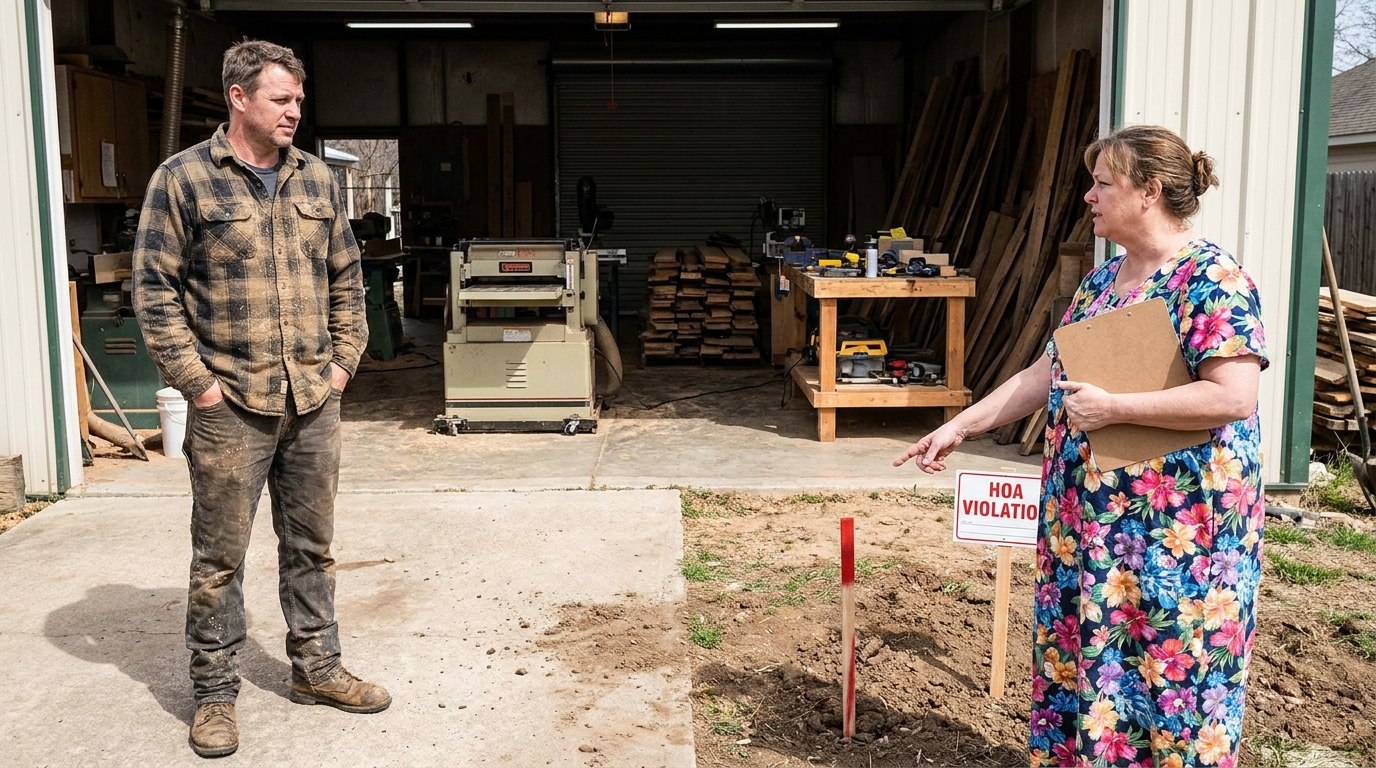
Outside, the autumn light was brittle, casting sharp shadows across the drive. Through the open bay door, I saw her. Karen. She looked like a billboard for middle-management misery, clutching her clipboard as if it were a shield against the reality of her own insignificance. Her floral mumu was a chaotic riot of colors that felt fundamentally incompatible with the precision of my woodshop.
She drove a stake into my grass—the very turf I had spent three years treating with a soil-analysis-driven fertilization program. It was a jagged, ugly movement. She pressed the plastic-sleeved violation notice against the wood with a flourish that reeked of rehearsed entitlement.
I stepped out into the light. I didn’t hurry. I didn’t let my pulse spike. My years in the Corps had taught me that the moment you move with urgency, you surrender the initiative.
“Mr. Garrison,” she said, her voice a serrated blade designed to slice through peace of mind. “The Heritage Hills Homeowners Association does not tolerate industrial noise pollution in a residential sanctuary.”
She turned, her heels digging into the lawn with arrogant ownership. She didn’t look at the workshop; she looked at the status of her own power. She was already mentally drafting the next memo, already calculating the weight of the fine. She saw a guy in a sawdust-coated flannel shirt and a pair of worn work boots. She saw a target for revenue generation.
She had no idea she was looking at the man who had drafted the load-bearing beams of her own living room.
“You’re in violation of Article 4, Section 2B,” she continued, not waiting for a rebuttal. “The fine is five hundred dollars. Recurring weekly at eight hundred. We expect payment by Friday.”
She snapped the clipboard shut. The sound was a finality, a period at the end of a sentence she had written on my property. She spun around, ready to march back to her golf cart, already anticipating the hollow victory of the paperwork.
But as she turned, her shoe caught on a slight unevenness in the sod—a spot where I had recently re-seeded to correct a drainage issue. She stumbled, a frantic, ungraceful mess of limbs, and for a fleeting second, the mask of the Queen of Heritage Hills slipped. Her eyes widened, losing their cold focus, replaced by a raw, startled fear of falling.
I didn’t reach out to steady her. I stood perfectly still, my hands in my pockets, watching the precise mechanics of her loss of control.
She caught herself, straightening her mumu, her face flushing an angry, blotchy red. She didn’t apologize. She couldn’t afford to be human. She simply pointed to the red sign.
“This is not a suggestion, Mr. Garrison.”
“I see the sign, Karen,” I said, my voice quiet, devoid of the heat she was clearly fishing for. “And I see the stake.”
She huffed, a sharp, dismissive exhale, and marched toward her golf cart. She climbed in, the plastic frame creaking under her weight, and put it into gear. As she drove off, the wheels left deep, jagged ruts in my lawn.
I walked over to the stake. I didn’t pull it out. Not yet. I looked down at the plastic sleeve. A small drop of oil from my planer had flicked onto the sleeve, staining the HOA crest. It was a minor, almost imperceptible detail, but it was out of place. It didn’t belong in her perfect, rigid little world.
The house on lot one—the flagship—was missing its final trim, and the mahogany library needed a hand-sanded finish. I had a deadline, but that could wait. The real work had just been delivered to my front door. I realized then that she hadn’t just made a mistake in targeting the wrong lawn; she had committed a tactical error by failing to identify the architect of her own environment.
I looked back at the workshop. The silence was still heavy, but now, it held the hum of something more dangerous. The real question wasn’t how I was going to pay the fine. The question was how I was going to deconstruct her empire, board by board, until she finally saw the foundation she was standing on was made of glass.
Then, I saw it—a small, dark smudge on the back of the sign’s stake. It wasn’t mud. It was dark, dried paint, perfectly matching the specific trim color of her brother-in-law’s company van.
Everything about this sign felt curated.
CHAPTER 2: The Tactical Assessment
I didn’t pull the stake. To remove it now would be a reflexive, emotional response, and in my experience, the first person to get emotional in a negotiation is the first person to lose. Instead, I left the red warning standing in my turf like a poorly placed landmine, a constant, visual reminder of the terrain I was currently occupying.
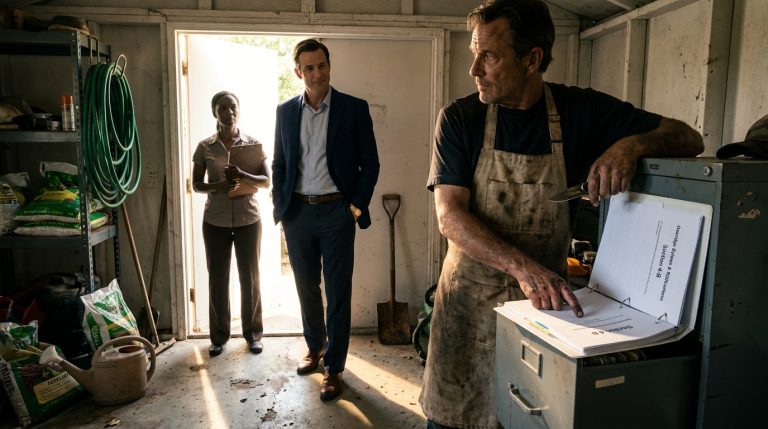
I turned my back on the sign and walked into the workshop. The air inside was cool, layered with the scent of kiln-dried cedar and the sharp, metallic tang of the planer’s blades. I walked over to my drafting table—a massive, solid oak surface that had survived three deployments and two cross-country moves. It was the only place where I could truly think.
I cleared a space, pushing aside a set of blueprints for a custom stairwell. I pulled the thick binder from the shelf, the one containing the county deeds and the original plat maps. My hands, still steady despite the lingering vibration of the planer, began to organize the documents into a visual flow.
As I laid out the plat map, my eyes caught the sharp, intersecting lines of the property boundaries, and for a moment, the room seemed to shift. I wasn’t in my workshop anymore; I was back in the mud of an operating base, staring at a schematic for a bridge that needed to be load-bearing enough to hold a convoy while under fire. The stakes had been different—lives instead of property values—but the principle was identical. You identify the weaknesses in the structure, you calculate the stress points, and you apply pressure only where it will force the entire design to collapse on its own weight.
Karen was a variable I hadn’t calculated for, but she was a predictable one. Her aggression was thin. It had the frantic, desperate quality of someone who was trying to maintain a facade of authority because they lacked any actual power.
I traced the boundary line of Lot 7B with my index finger. The language in the master development plan was ironclad, written in the dry, unyielding prose of land-use law. It was an island. I was the king of a five-acre republic, and she was a foreign agitator attempting an illegal annexation.
I picked up the violation letter again. It wasn’t just a fine; it was a test. She wanted to see if I was a pushover, someone who would write a check just to avoid the hassle. The fine was meant to intimidate, but the threat of a recurring penalty was a tactical blunder. It demonstrated that she was overextended.
I reached for my notebook, a small, leather-bound volume where I recorded my material costs and structural calculations. I didn’t write about feelings. I wrote about facts.
Jurisdictional proof: Request county records.
Physical evidence: The sign, the ruts in the grass, the stained plastic.
Patterns: The brother-in-law’s company connection.
I looked at the third point, remembering the smudge of paint I had seen on the stake. It was a small detail, but in engineering, details were where the failure usually occurred. If her brother-in-law was the vendor for her HOA enforcement—the company that made the signs, the stakes, the “approved” equipment—then this wasn’t just about my workshop. It was about a closed-loop system of profit.
I opened my laptop. I didn’t browse; I searched. I looked for public business registrations, for vendor lists, for any paper trail that linked the Heritage Hills HOA to private contractors. The process was slow, methodical, and entirely necessary. I wasn’t rushing toward a confrontation. I was building a barricade of evidence.
The sun began to dip, casting long, lean shadows across the floor of the workshop. The light hit the wood shavings on the floor, turning them into a dusting of copper. I was hungry, but hunger was a sensation I could compartmentalize. The only thing that mattered was the document I was drafting—a response that wouldn’t be an apology, but a clinical statement of fact.
I thought about Sarah. She would be worried. She was the one who valued the peace of these rolling hills more than I did. I had to ensure that when this was over, our life here remained as stable as the house I had built for her.
My fingers stopped typing. I heard a soft crunch of gravel outside—someone driving slowly past the property. I didn’t look up. I didn’t reach for the window. I just kept my eyes on the screen, feeling the weight of the room around me. Whoever it was, they were looking for a reaction. They were looking for a sign that the noise had stopped, that the craftsman had been silenced.
I reached over and flipped the power switch on the table saw, just for a second. The sudden, violent scream of the blade cutting air was my only answer to the passerby. It was a sharp, aggressive sound, the mechanical equivalent of a warning shot.
The car didn’t stop. It accelerated, the sound of the engine fading into the distance.
I returned to the drafting table. The evidence was piling up. I had the jurisdictional exemption, I had the photographic proof of her trespass, and now, I had the suspicion of a profit motive that tied her behavior to her own wallet. Karen thought she was the one holding the gavel, but she didn’t realize that she was already sitting on a structure that I was quietly taking apart, one bolt at a time.
I leaned back in my chair, the metal frame groaning under the shift in weight. The evening was settling in, and for the first time since she had walked onto my lawn, I felt the cold, sharp clarity of a campaign beginning to take shape. I wasn’t just defending my land anymore. I was initiating a maneuver.
CHAPTER 3: The Formal Response
The screen of my laptop was still warm, the cursor blinking rhythmically against the draft of the letter. It was a masterpiece of cold, clinical restraint. I had avoided all emotive language. No “I am angry,” no “This is unfair.” Just facts, cited references, and a clear, unwavering assertion of jurisdiction. It was a document designed to be read by a lawyer, or failing that, a bureaucrat who had relied too long on the assumption that nobody would ever bother to check the math.
I stood up, the chair legs scraping against the concrete floor—a harsh, dissonant sound that seemed to ring out longer than usual. I walked to the bay door. The afternoon was bleeding into a bruised, purple twilight. The shadows of the pine trees stretched across the yard, long and thin, like fingers pointing directly at the red violation sign that still sat in my grass.
I didn’t reach for the pliers this time. I walked to the house, the gravel under my boots feeling like broken glass. Inside, the kitchen was quiet. Sarah was in the living room, a book open on her lap, but her eyes weren’t moving across the pages. She looked up as I entered, her gaze finding mine immediately. She saw the set of my jaw, the rigidity in my shoulders. She knew the rhythm of my work, and she knew when that rhythm was being interrupted by something external.
“You’re sending it?” she asked. Her voice was steady, but there was a tremor of concern underneath.
“I’m sending it,” I said, grabbing the envelope from the counter. I’d printed the letter on my official Garrison Custom Homes letterhead—heavy, cream-colored stock with a watermark that I had sourced specifically for its professional gravitas.
I looked at the embossed crest on the return address. It felt solid, permanent. I then looked at the envelope from the HOA, the one Karen had sent. I held them side-by-side. The difference in quality was jarring. Her crest was printed on cheap, thin paper; the edges of the logo were slightly blurred, as if the image had been copied and pasted one too many times.
A thought flickered in my mind, a jagged piece of doubt. If she couldn’t even afford proper letterhead, how was she running an HOA for a multi-million-dollar development? It was a small discrepancy, but it gnawed at me. The lack of attention to detail was either a sign of gross incompetence or a sign that the entire organization was a veneer, a hollowed-out shell built on the assumption that no one would ever look closely enough to see the flaws.
I walked back out to my truck. The air was colder now, with a sharp edge that bit at my exposed skin. I drove to the local post office, a nondescript brick building that felt like the only place in the world that dealt in objective reality. Certified mail, return receipt requested. The green card was the key. Once she signed for it, she couldn’t claim she hadn’t received it. She couldn’t claim it was a misunderstanding. She would be entering a paper trail that would eventually lead exactly where I intended to take her.
As I pulled the envelope from the truck and walked toward the drop-box, I felt the weight of the decision. By sending this, I was closing the door on any possibility of a casual, neighborly resolution. This was no longer a misunderstanding over a planer’s hum; it was a legal engagement.
I dropped the envelope into the slot. The sound of it hitting the bottom—a dull, final thud—was the most satisfying sound I had heard all day.
I turned back to the truck, but I didn’t get in immediately. I stood for a moment, looking at the streetlights flickering on in the distance, illuminating the edges of the Heritage Hills subdivision. It looked perfect from here—the manicured lawns, the uniform architecture, the carefully orchestrated silence. But I knew better. I knew that beneath that perfection was a fragile ecosystem of rules and fines, and I was now the fracture point.
My phone vibrated in my pocket. A text from an unknown number. I opened it.
Your noise is still an issue. We are escalating the fine. Check your mail tomorrow.
No name. No signature. Just the cold, mechanical delivery of a threat.
I stared at the screen, the blue light reflecting in my eyes. She wasn’t just doubling down; she was desperate. The fact that she was texting me from a private number, rather than through official HOA channels, was the biggest tell of all. She was panicking. The authority she wielded so publicly was being used to hide her private fear.
I didn’t reply. I didn’t call. I didn’t feel a spike of adrenaline or a surge of anger. I just put the phone away, got into the truck, and started the engine. The sound of the diesel engine, steady and powerful, felt like the only real thing in the world.
I drove home through the dark, the headlights carving a path through the night. I wasn’t just driving back to my workshop; I was returning to the center of my own design. The board was set. The first piece had been moved. Now, I just had to wait for her to make the move that would trap her in the very logic she had tried to impose on me.
When I pulled back into my drive, the workshop was dark, save for the single security light I kept on over the side door. I walked past the red sign, not even glancing at it, and stepped inside. The space was waiting for me—tools lined up, materials waiting to be shaped, a sanctuary of order. I looked at the planer, sitting in the corner like a dormant beast. Tomorrow, I would turn it on again. And I would keep turning it on, as long as it took to see that smug, red-faced woman realize that she had been playing a game she didn’t know the rules to.
I was Jack Garrison, and I didn’t just build homes. I built systems that lasted. And hers was already beginning to show the cracks.
CHAPTER 4: The Escalation
I didn’t turn on the overhead lights. The workshop was a cathedral of shadows, each tool rack and workbench silhouette a dark, familiar sentinel. I sat in the captain’s chair by the drafting table, the same chair I’d used to oversee every major project in the Corps. It was a space designed for focus, and tonight, that focus was entirely on the waiting game.
The second notice arrived at 10:00 AM the following day. It wasn’t handed to me by a mail carrier; it was shoved into the door frame, a blatant act of intimidation.
I pulled it out with deliberate slowness. The envelope was thick, the edges crinkled from the forced insertion. I took it back to the drafting table and used a fine-bladed marking knife to slice it open. The paper inside was crisp, formal, and utterly detached from the reality of the situation.
Be advised: Pursuant to Article 9 of the HOA bylaws, any unpaid fines and fees after 30 days may result in the placement of a continuing lien on your property.
My eyes scanned the document. It was a masterpiece of legalistic posturing, designed to trigger exactly the kind of panicked, reactive response Karen was banking on. It quoted bylaws that weren’t applicable to my parcel, referenced authorities that didn’t exist, and projected a confidence that felt brittle, like thin ice over deep water.
I took the envelope and held it up to the desk lamp. I scrutinized the Heritage Hills crest at the top of the page. It wasn’t embossed into the fiber of the paper as it had been on the previous letter. I ran my thumb over the surface. It was slightly raised, an adhesive-backed decal applied after the fact.
I stopped. I set the letter down and pulled a jeweler’s loupe from my top drawer. I leaned over the desk, the light concentrated in a tight, clinical pool, and peered through the lens at the crest. The edges were uneven, the alignment a fraction of a millimeter off-center, and there was a faint, shimmering halo of adhesive residue around the perimeter.
This wasn’t a standard print job. It was a DIY fabrication, a high-quality copy designed to mimic the weight of authority.
The realization hit me with the force of a physical blow. If the letterhead itself was a forgery, a cheap, improvised tool of state, then the board wasn’t just abusing their power—they were struggling to maintain the illusion that the board even functioned as a proper corporate entity. It was an institutional facade. They were broke, or they were terrified, or both.
I sat back, the chair groaning in the silence of the shop. This changed the entire calculus. If I were dealing with a legitimate, well-funded HOA, the legal battle would be a grind—slow, expensive, and predictable. But I wasn’t fighting an institution; I was fighting an individual’s desperate grasp at legitimacy.
I picked up the phone. Marcus Thorne’s office. I didn’t need a lawyer to argue about noise; I needed someone who could recognize a fraud when they saw one.
“Garrison,” Marcus said. His voice was tired, the kind of exhaustion that comes from long days of billable hours and legal theater. “I got your email. You’re asking for an audit of the HOA’s governance?”
“I’m asking for a look at their legitimacy, Marcus,” I said. “I’m looking at their documentation, and it’s a house of cards. The crest is a decal. The bylaws they’re citing don’t have the standard county filing stamp. I think they’re not just acting outside their jurisdiction—I think they’re acting outside the law.”
There was a long silence on the line. I could hear the faint rustle of papers, the low-frequency hum of city traffic in the background of his office.
“If what you’re saying is true, Jack, this is a beautiful overreach,” Marcus finally said, his voice dropping into that familiar, predatory cadence. “Threatening a lien on property they don’t control is a crime. Filing a fraudulent lien is a serious, actionable tort. We’re talking about slander of title. If they go through with this, we don’t just win—we gut them.”
“How long until they realize they’ve pushed too far?” I asked.
“People like this? They don’t realize anything until they’re served with a subpoena. Let them file the lien, Jack. Let them commit the act. That’s the kill shot.”
“And in the meantime?”
“In the meantime, you keep doing exactly what you’ve been doing. Be the quiet man in the workshop. Let them think they’re winning. The more they double down, the deeper the hole they dig.”
I hung up. I looked at the workshop around me. The planer sat dormant, but for the first time, I looked at it not as a tool for work, but as a component of a larger machine—a machine designed to keep the status quo of the neighborhood alive while I dismantled it from the inside.
I walked to the window and looked out toward the subdivision. The Heritage Hills entrance was visible, a sweeping curve of asphalt and meticulously maintained flowers. It looked serene, perfect, and orderly. But I knew better. I knew that beneath the surface, there was a rot, and I was holding the key to the cellar.
I didn’t feel like a victim anymore. I felt like a patient, calculating force of nature. I walked over to my bench and picked up a block of oak, turning it over in my hands. The wood was dense, heavy, and honest. It was something you could build on.
I reached for the switch on the planer. I didn’t just want to work; I wanted to make the loudest, most precise noise I had ever made in this workshop. I wanted them to hear every single pass, a rhythmic, mechanical countdown to the moment they realized they had targeted the wrong hill.
As the machine roared to life, the vibration traveling up through my arms, I felt a sense of clarity. The letter wasn’t a threat; it was a surrender. By escalating, by threatening the lien, Karen had finally stepped out of the shadows and into the light where the facts could find her.
I wasn’t the one who was in danger. I was the one who had drawn the map, and now, I was watching her walk right into the center of the trap.
CHAPTER 5: The Reconnaissance
The blue sedan that pulled into my drive was not one I recognized. It didn’t belong to the neighborhood, nor was it a utility vehicle. It sat idling for a moment, the headlights washing over the workshop’s open bay, before the engine cut out with a reluctant, rattling shudder.
I stood in the doorway, my hands still covered in a fine layer of sawdust, watching the silhouette emerge. It was Maria. I’d seen her pushing her stroller along the subdivision’s winding paths, always keeping her head down, but today, she didn’t look like someone who was just out for a walk. She looked like someone carrying a burden that had finally become too heavy to hold.
She walked toward me, her pace hesitant. She reached the edge of my workshop floor and stopped, looking at the tools, the stacks of raw timber, and the quiet order of my space.
“I saw the sign on your lawn,” she said, her voice barely rising above the evening wind. “And I heard the talk. They’re saying you’re taking her on.”
I didn’t answer immediately. I wiped my hands on a rag, the coarse fabric scratching against my skin. “I’m not taking her on, Maria. I’m just establishing the boundaries of my property.”
She let out a dry, humorless laugh. “The boundaries of your property? Jack, that woman doesn’t know what a boundary is. She thinks she owns the air we breathe. My husband and I… we wanted to put up a swing set for the kids. A simple one. We submitted the paperwork, and she denied us.”
I watched her, my analytical mind already dissecting her frustration. “Why deny a swing set?”
“Because it wasn’t the ‘approved model,'” she said, the bitterness dripping from the words. “She gave us a brochure for a plastic, overpriced monstrosity that looked like it belonged in a daycare, not a backyard. And when David dug into the company that made it, he found that the distributor, the one who handles the logistics and the ‘approved’ installation, is a firm owned by her brother-in-law. It’s not just a rule. It’s a racket.”
The pieces fell into place with the precision of a mortise and tenon joint. The decal-heavy letterhead, the selective enforcement, and now this—a closed-loop system of profit hidden behind a veneer of “aesthetic harmony.”
“Did you document any of this?” I asked, my voice low and measured.
“We were too afraid,” she confessed. “We have a mortgage. We have kids. She threatened to put a lien on our house if we didn’t comply.”
I felt a cold, hard resolve crystallize in my chest. This wasn’t just about my workshop. It was about the way she held an entire community hostage with the threat of financial ruin.
“Maria,” I said, stepping closer. “You don’t have to be afraid anymore. If you have any record of those emails, any receipts from that company, I need you to give them to me.”
“Why?”
“Because she’s not going to stop at my lawn. And the only way to stop a bully is to show them that the people they’ve been pushing around are finally standing together.”
She stood there for a long time, the silence of the evening wrapping around us. She was processing the risk, weighing the safety of her quiet life against the anger that had been festering for three years. Finally, she nodded.
“I have the emails,” she said. “I kept everything. I was too scared to speak up, but I wasn’t scared enough to throw away the evidence.”
As she walked back to her sedan, the weight of the moment wasn’t lost on me. I had crossed the threshold. This was no longer an island of resistance; it was the start of an alliance.
I went back into the workshop, but I didn’t return to the workbench. I walked to the drafting table and opened the file I had started on Karen. I added the new information: the vendor’s name, the brother-in-law’s connection, and the specific bylaw she’d used to bully Maria’s family.
I sat back and looked at the wall. The shop felt different tonight. It was still a place of work, but the work had changed. I was building a case, a structure designed to support the truth of her corruption.
My phone rang. An unknown number again. I answered it, expecting another sterile, automated threat.
“Mr. Garrison,” a voice said—this time, it wasn’t a text, but a human voice, strained and thin. It was Janice, the board member I’d seen sitting beside Karen. “We know what you’re doing. You’re asking questions you don’t have the standing to ask. If you don’t cease this harassment, the board will have no choice but to involve the authorities.”
I laughed, a short, sharp sound that seemed to surprise her. “The authorities, Janice? That’s an interesting choice of words. I look forward to it. In fact, I’ll tell you what—why don’t we do it right now? I have the county plat map in front of me, and I have evidence of financial self-dealing. Are you sure you want the authorities involved?”
There was a frantic clicking on the other end, followed by a dial tone.
She had panicked. They were all panicking. The structure of their control was failing, and every move they made to reinforce it only created more friction, more heat, and more cracks.
I looked at the piece of tiger maple on the bench. I wouldn’t finish it today. Today was for the map. I took a pencil and began to circle the properties of the people I had already spoken to, connecting them with thin, precise lines. It looked like a network, a grid of resistance.
I was the architect, and I was just getting started.
CHAPTER 6: The Coalition
I didn’t move for a long time. The workshop was quiet, a vacuum where the only sound was the steady, rhythmic beat of my own heart. The dial tone had been an admission of defeat, a frantic retreat from a truth that was beginning to loom larger than their ability to suppress it.
I set the pencil down, the lead snapping with a sharp, clean sound. I had the map. I had the network. Now, I needed the catalyst.
I spent the next three hours in a state of high-functioning motion. I reached out to the people I had been quietly gathering for the last two weeks. Not over the phone—I didn’t trust the lines—but by walking the neighborhood, knocking on doors with the unassuming, neighborly confidence of a man who belonged exactly where he was.
Each conversation was a careful, measured piece of theater. I didn’t frame it as a revolution. I framed it as a “community interest check.” I spoke to Arthur, the retired accountant, in his garden. I didn’t show him my map; I just listened as he recounted the history of the clubhouse pool’s recurring maintenance failures. He had the receipts, he told me. He had a file of every time a contractor had been hired and subsequently fired before the work was completed.
“They don’t want the work finished, Jack,” Arthur had whispered, his eyes scanning the street for the telltale glint of a golf cart. “They want the contracts open so they can keep shuffling the invoices.”
Then I went to see David, Maria’s husband. He was in his garage, working on a project of his own—a heavy, steel-framed trellis for their garden. We talked for an hour about structural integrity, about the difference between building something that looked good for a season and building something that lasted a generation. He was the skeptic, the man who had been burned before, but he was also the man who now realized that his fear had been the very thing keeping the cycle in motion.
“We have twenty-five signatures,” I told him. “We have the bylaw in hand. We have a lawyer on standby who knows how to tear a board apart piece by piece.”
David looked at his trellis, then at me. “If we do this, there’s no going back. She’ll come after us with everything she has. She’ll try to foreclose, she’ll try to sue, she’ll try to make us social pariahs.”
“Let her,” I said. “Every move she makes from here on out is another point of failure. We’re not the ones in danger, David. She is. She’s the one who’s been breaking the law.”
The momentum was shifting. It wasn’t a sudden explosion; it was a slow, inevitable accumulation of pressure. The “community interest check” was rapidly becoming a mobilization.
I returned home just as the streetlights began to flicker to life. Sarah was in the kitchen, the warmth of the house a stark contrast to the cold, tactical atmosphere I had been cultivating all day. She didn’t ask questions. She saw the set of my eyes, the way I moved with a focused, deliberate energy, and she handed me a glass of water, her touch grounding me, pulling me back from the edge of the engagement.
“It’s almost over, isn’t it?” she asked.
“It’s just beginning,” I corrected. “But the foundation is set. Tomorrow, we hand in the petition. Tomorrow, the machine stops.”
I walked to the workshop one last time. I didn’t work. I just stood in the center of the room, looking at the tools, the wood, the space I had turned into a sanctuary of order. I had built a home here, and I had built a life here. And if I had to tear down the corrupt structure of the HOA to protect it, then that was exactly what I would do.
I checked my watch. The deadline I’d set for the initial challenge had passed. The silence from the board was absolute. They were hunkered down, likely arguing amongst themselves, trying to decide whether to double down or flee.
I sat down at the drafting table and opened the file one more time. I traced the property lines of the five flagship homes—the ones I had built, the ones Karen didn’t even realize she had no authority over. They were the key. They were the most prestigious, the most expensive, and they were, by the original county declaration, entirely immune to the HOA’s architectural review.
I had been waiting for this. I pulled a clean sheet of paper from the stack and began to draft the final notification. It wasn’t an invitation to a debate. It was a formal notice of the special meeting, backed by the signatures, the bylaws, and the legal threat that would render their entire board null and void.
I didn’t feel the weight of it anymore. The fear, the anger, the frustration—it had all been distilled into this one, simple piece of paper. I was ready.
CHAPTER 7: The Ambush
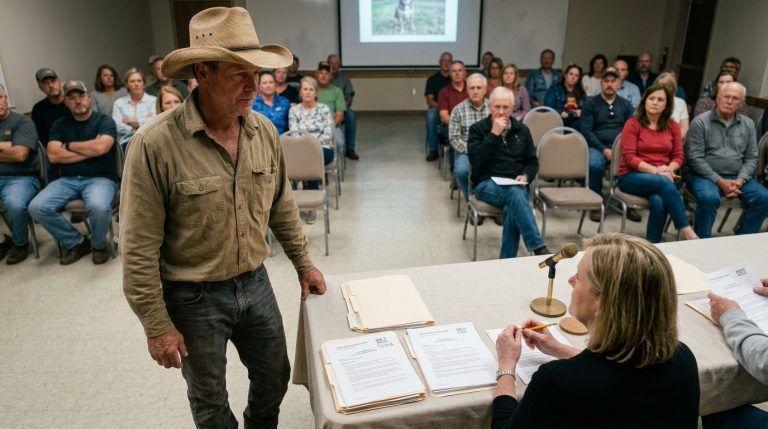
The clubhouse was a space designed for social harmony, for neighborhood mixers and polite conversations about pool maintenance. Tonight, it felt like a tactical staging area. I stood in the foyer, the heavy portfolio case in my hand, feeling the weight of the work I’d put into it. It wasn’t just paper; it was a blueprint for an eviction.
Arthur was waiting for me near the double doors. He looked nervous, his tie slightly crooked, his fingers drumming against his leg. But there was a new glint in his eyes—a reflection of the resolve we’d built over these last few weeks.
“The room is packed, Jack,” he whispered, leaning in close. “She doesn’t know what’s coming. She thinks it’s just another forum where she can lecture us into submission. She’s already at the front, setting up her projector.”
“Good,” I said, my voice steady. “Let her maintain the illusion. It makes the reality that much harder to ignore.”
We walked in together. The room was dense with the sound of a hundred conversations, a low-frequency hum that spiked as people saw me. I didn’t acknowledge the glances. I didn’t look for Karen. I kept my focus on the front, on the folding table where she sat with her board members, Janice and Gary, looking as untouchable as a monarch.
She saw me. Her eyes narrowed, the smug smile she had been wearing for the crowd flickering for a fraction of a second. She reached for her gavel, a small, polished wood mallet that she treated like a scepter, and tapped it against the table. The sharp crack didn’t cut through the conversation; it barely punctured it.
“If everyone could please take their seats,” she announced, her voice strained, the veneer of command showing its first real crack. “We have a full agenda tonight.”
I didn’t take a seat. I stood along the wall, the portfolio tucked under my arm, watching her. She wasn’t leading a community; she was defending a perimeter.
She spent ten minutes talking about the “violation” of my workshop, her words calculated to paint me as the outsider, the disruptor, the man who cared nothing for the sanctity of their suburban dream. I listened, my mind detached, analyzing her delivery. She was exhausted. The frantic edge in her voice told me that she hadn’t slept, that she was reacting to the pressure we had been applying, piece by piece, day by day.
When she finally paused, a silence settling over the room, I stepped forward.
“Karen,” I said, my voice projecting with the practiced, calm resonance of an engineer addressing a crew. “Before you continue, there are a few facts that need to be entered into the record.”
The room went dead silent. She froze, her hand hovering over the gavel. “Mr. Garrison, you are out of order. This is a closed session for residents of—”
“I’m here with the support of forty-two homeowners,” I interrupted, my voice neither raised nor aggressive, just absolute. “And I have a petition for a special meeting.”
I walked toward the front. The crowd parted, a slow, wave-like motion of anticipation. I placed the portfolio on the table directly in front of her. It was a heavy, physical gesture—the sound of the leather hitting the table was final.
“This,” I said, tapping the folder, “is not a request for a forum. This is a formal petition for a forensic audit and a vote of no confidence.”
Karen stared at the folder. She didn’t open it. She looked at me, her face pale, her hands trembling. “You can’t do this,” she whispered, the arrogance replaced by a raw, naked fear. “You don’t understand the rules.”
“I understand the rules better than you do, Karen,” I replied, the truth hanging in the air, cold and heavy. “Because I’m the one who read them.”
Arthur stood up, his voice ringing through the clubhouse. “I second the motion for a formal audit of all financial records, contracts, and expenditures for the past three years.”
The room erupted. It wasn’t the polite applause of a mixer; it was the sudden, collective release of three years of frustration, intimidation, and silent resentment. The sound was a roar, a physical force that hit Karen like a wind.
She looked at Janice, who was staring at the crowd with eyes wide with dawning realization. She looked at Gary, who was already sliding his chair back, distancing himself from the front table. She was alone.
I stood in the center of the room, watching the collapse. I didn’t feel triumph; I felt the calm satisfaction of a project completed according to plan. The structure had held as long as it could, but it had been built on a foundation of rot, and all it had taken was the application of pressure in the right places.
“Karen,” I said, my voice dropping to a conversational tone that only she could hear. “The audit is just the beginning. We know about the vendor. We know about the brother-in-law. And we know about the decal letterhead.”
She didn’t look at me. She kept her gaze fixed on the folder, her body slumped, the scepter of her authority finally falling from her hand.
The room was shouting now, calling for the vote, calling for the audit, calling for the end of her reign. I turned away from the table, looking out over the faces of the people who had finally found the courage to stand up. They weren’t looking at the front anymore; they were looking at each other, realizing that they were the ones who held the power.
I walked toward the back of the room, my job finished. The ambush was complete. There was no way out for her now, no bureaucratic trick, no vague bylaw to hide behind. The facts were out, and the machine she had tried to build was, piece by piece, coming down.
I stopped at the doors and looked back one last time. Karen was standing up, her hands gripping the edge of the table as if it were the only thing keeping her upright. She looked small. She looked tired. And for the first time, she looked exactly like what she had always been: a person who had tried to build a kingdom on land that didn’t belong to her.
I pushed the doors open, the cool night air hitting my face, a clean, sharp, and welcome contrast to the stagnant heat of the clubhouse. I stepped out, the gravel crunching under my boots, and started the walk back to the workshop. The work was done. The structure was sound. And for the first time in months, the air in the neighborhood finally felt like it belonged to everyone.
CHAPTER 8: The Aftermath
The silence of the night was different now. It wasn’t the heavy, accusatory silence that had followed the planer’s hum weeks ago; it was the hollowed-out stillness of a space that had been scrubbed clean. As I walked, the lights of Heritage Hills seemed dim, the glow of manicured perfection revealing itself as a thin, artificial sheen over a neighborhood that was finally waking up to its own reality.
I reached my property line and stopped. The red violation sign was still there, but in the moonlight, it looked pathetic—a jagged, plastic splinter in the side of a home that didn’t belong to the HOA anyway. I didn’t rip it out. I walked over and unscrewed the metal bracket with the same precision I used for a custom door frame. It came apart with a soft, metallic click. I laid the pieces neatly on the grass, right on the border between my land and the subdivision’s manicured hedge, and left them there. A monument to a failed regime.
I entered the workshop and flipped the light switch. The hum of the fluorescent tubes—a harsh, flickering, industrial sound—felt like a homecoming. I walked to the workbench where the tiger maple mantelpiece waited. It had been sitting there, unfinished, throughout the entire ordeal.
I picked up the block of wood. It was smooth, the grain tight and honest. During the height of the conflict, I had worried that the time away from the bench would have made me lose the rhythm of the work, but as my fingers traced the surface, I felt the familiar weight of the task. I wasn’t an architect of power, and I wasn’t a soldier of the Corps. I was a man who built things to last, and I was going to finish this.
I took the sanding block and began the final pass. The sound was rhythmic, steady, and entirely productive. This was the cool-down. This was the moment where the adrenaline of the meeting bled out of my system, leaving behind a sharp, clean sense of purpose.
Arthur arrived twenty minutes later. He didn’t knock; he just stood in the bay door, his coat damp with the night mist. He didn’t look like an accountant, and he didn’t look like a rebel. He just looked like a neighbor who was finally breathing.
“They’re filing the papers in the morning, Jack,” he said. His voice was soft, stripped of the tension that had defined it for weeks. “The district attorney’s office has the audit file. They said the embezzlement is clear—the landscaping contracts, the reserve fund transfers. It’s all there.”
“And Karen?” I asked, not stopping my work.
“She’s gone,” he said. “She packed her car before the sun even started to rise. She knew the audit would pull the thread that unraveled the whole thing. The brother-in-law is under investigation, too.”
I stopped sanding and set the block down. The mantelpiece was perfectly smooth, the grain of the tiger maple catching the light in a deep, shimmering wave. I walked over to the corner of the shop, where I kept a small, rusted hand-plane I had rescued from a scrap heap years ago. It had been my first real challenge—a tool that had been dismissed as useless, too damaged to ever hold an edge.
I picked it up. It had sat on the shelf, a silent reminder that anything could be restored if you were willing to put in the time. I spent the next hour cleaning it, oiling the adjustment screw, and honing the blade until it could shave a whisper of cedar off a board.
“You built this,” Arthur said, gesturing to the entire shop. “You built the houses, you built the community, and you built the bridge that finally led us out of that nightmare.”
“I just followed the plans,” I said, a faint smile touching my lips. “Every structure has a load-bearing capacity. You just have to know where to test it.”
“What now?” he asked.
“Now?” I walked to the bay door and looked out at the rolling hills. The stars were bright, the night air crisp and clean. “Now, we maintain. We make sure the clubhouse roof gets done, and we make sure the neighborhood stays a place where people can actually live, not just perform.”
He stayed for a while longer, and we drank coffee as the darkness retreated, replaced by the soft, gray light of a new morning. There was no more talk of fines, no more talk of bylaws, and no more talk of Karen. The conflict had been a storm, and like all storms, it had passed, leaving the landscape changed but essentially sound.
When Arthur finally left, I turned back to the workbench. I picked up the mantelpiece and held it to the light. It was beautiful. It was solid. And it was a piece of art that would stand for fifty years, long after the petty tyrants of Heritage Hills were a distant, forgotten memory.
I walked to the main breaker and flipped the switch for the planer. The machine roared to life, a deep, resonant sound that vibrated through the floorboards and into the foundation of the shop. It was the sound of a return to the natural order. I pushed a fresh piece of oak through the blades, the long, curling ribbons of shavings falling to the floor like autumn leaves.
The war was over. The tyranny had collapsed under the weight of its own dishonesty. And in the quiet, steady rhythm of the machine, I found the only thing I had ever really wanted: the peace of a job well-done, and the knowledge that, in the end, it was the quality of the work that mattered most.