The Golden Thread of Willow Creek: A Legacy of Slow Smoke and Whispered Reconciliation
CHAPTER 1: THE FRAYED PERIMETER
“Your little hobby shed is a public nuisance and a fire hazard, Mr. Callahan. I’m having it condemned. Consider this your final warning.”
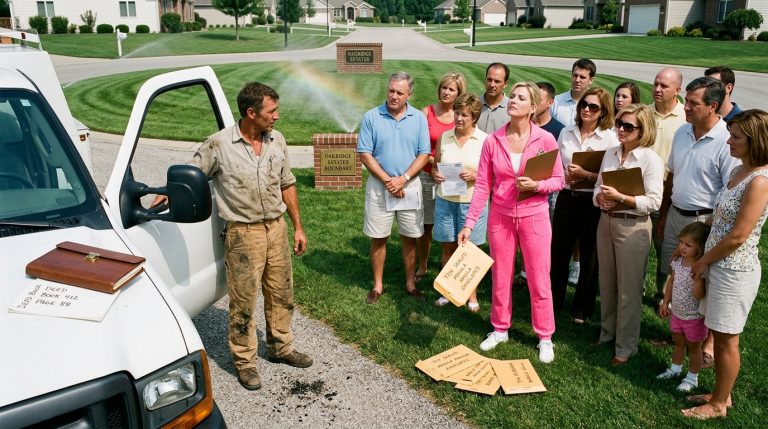
The words drifted across the yard, carrying the fragile, brittle quality of dry leaves scraping over concrete. Karen stood exactly at the edge where the over-watered, bright green turf of her lawn met the unplowed, sun-bleached earth of my eastern boundary. The low evening light caught the fraying edges of her floral muumuu, turning the garish patterns into soft, watercolor shadows. She held her heavy plastic clipboard close to her chest, her knuckles pale, her shoulder line tense with a vulnerability she tried desperately to mask behind a rigid posture.
I didn’t move from my spot on the porch, my hands wrapped around a warm, chipped ceramic mug of tea. The heat of the clay seeped slowly into my palms, a quiet contrast to the cooling breeze. In my thirty years of service, I’d learned that conflict was rarely about the ground being fought over; it was almost always about the quiet panic of those trying to hold onto a slipping piece of the world.
“The smokehouse isn’t a hobby shed, Karen,” I said, keeping my voice soft, letting it carry the calm rhythm of the old oaks swaying behind me. “It was built with Sarah’s hands as much as mine. You know the history of this plot.”
“History doesn’t pay the municipal upkeep, Jack,” she said, her voice dropping, losing its sharp edge for a fraction of a second before she pulled her clipboard tighter against her. The gold band on her ring finger, slightly loose and sliding down her knuckle, caught the amber reflection of the setting sun. “The board has voted. It is a direct violation of Covenant 4, subsection B. If the structure isn’t removed in thirty days, the association will place a lien. I don’t want to do this, Jack, but the rules are the only thing keeping this place from falling apart.”
She turned, her sandals crunching softly on the gravel path. But as she moved, the lateral light illuminated the back of the papers clamped to her board.
My eyes caught a faint, faded violet watermark on the corner of the document—the distinct, hand-stamped crest of the original Miller development firm from 1956. Beneath it was a penciled, elegant signature in a handwriting I recognized from old neighborhood deed transfers. It wasn’t Karen’s hand. It belonged to her late husband, Arthur, the man who had laid the original foundations of Willow Creek before the developers took it over.
Next to his name, written in the faded, blue ink of a vintage fountain pen, was a single, trembling notation: Clause G must protect the slab.
CHAPTER 2: THE ANCHOR IN THE FOUNDATION
The faded violet ink of the crest seemed to absorb the last, flat amber rays of the afternoon sun, casting a long shadow across the worn denim of my thighs. My thumb brushed the corner of the heavy paper. The texture was fibrous, thick, and slightly damp from the humidity rolling off the creek bed—real draftsman’s rag from a half-century ago, completely distinct from the slick, cheap copy paper the homeowners association usually stuffed into our mailboxes. Clause G must protect the slab. The script was precise, the letters leaning slightly to the right, written with the unmistakable steady hand of an engineer who spent his life drawing straight lines on unyielding soil.
Outside, the crunch of Karen’s orthopedic sandals grew fainter, transitioning into the soft, rhythmic thud of rubber soles hitting the manicured Bermuda grass of her own property line. A car door clicked shut in the distance, the sound clean and sharp across the open field.
I didn’t pull my gaze from the blueprint. I stood up slowly from the porch glider, the old springs giving a familiar, low-pitched groan that resonated through the floorboards. The ceramic mug in my left hand had grown lukewarm, the remaining tea dark and unmoving. I walked back into the house, my boots tracking a few loose grains of dry earth across the threshold, and moved straight toward the long oak dining table that served as my field desk.
I laid the document flat under the yellow glare of the single overhead bulb. The table surface was covered in small, shallow valleys—scratches left by decades of heavy plates, keys, and cleaning solutions. I placed the mug down on a coaster, its weight a grounding presence as I smoothed the edges of the 1956 map.
“Jack?” Emily’s voice drifted down from the short hallway leading to the kitchen. The sound was soft, carrying the hesitant cadence she always used when she sensed the old military focus taking over my posture. She stepped into the room, a frayed flannel shirt draped over her shoulders to cut the damp chill of the evening air. Her fingers were lightly stained with blue tempera paint from her afternoon class, and she was turning a worn silver bracelet around her wrist. “Was that Karen again? I thought I heard her delivery voice from the garden.”
“It was,” I said, my voice remaining in the quiet, low register of the house. I pointed to the bottom corner of the unrolled blueprint. “She left the field template behind. Or rather, she didn’t realize what was stapled to the back of the formal notice.”
Emily stepped closer, the soft fabric of her sleeve brushing against my arm. She leaned over the table, her eyes scanning the faded purple stamp of the original Miller development firm. Her brow furrowed slightly as she read the handwritten note beneath it. “Arthur’s handwriting. I haven’t seen that script since we signed the annexation papers twenty years ago. Why would she be carrying his old engineering notes to a property line dispute?”
“She isn’t,” I murmured, my finger tracing the structural border where the old agricultural outbuilding met the original county boundary line. “She’s carrying the documents her legal team pulled from the county archive to verify our deed. But she missed the appendix. Look at the title block.”
At the absolute edge of the paper, partially obscured by a dark smudge of graphite, was a small, three-digit reference code: MMT-1956-Ex.
The letters stood out against the yellowed background like a silent marker on a map. My mind automatically began categorizing the data, stripping away the emotional weight of Karen’s threats and focusing strictly on the geometry of the text. The Miller name was everywhere in this valley, but the specific combination of those characters didn’t align with the standard zoning abbreviations.
“We need the original file box from the garage,” I said, turning away from the glare of the lamp. “The one with the metal latches from the 2005 transition.”
Emily watched me, her hand resting quietly on the edge of the scratched wood. “Jack, if this is just about the smokehouse, we can adjust the roofline. We don’t have to turn every disagreement into a campaign.”
“It isn’t about the wood, Emily,” I replied softly, looking down at the faded text. “It’s about the footprint. Someone spent a lot of time trying to make sure this specific piece of concrete stayed exactly where it is. And I intend to find out why.”
CHAPTER 3: THE EXCAVATION OF MEMORY
The floorboards didn’t cry out under my boots; they merely breathed, a soft, familiar sigh of old timber settling into the evening chill. I reached into the shallow brass bowl by the doorway, my fingers brushing past loose copper coins and the cold, machined edges of house keys until they found the heavy, tarnished ring at the bottom. The key to the garage was a solid spade of iron, its surface pitted with microscopic craters from years of exposure to the damp creek air.
“I’ll go with you,” Emily said. Her voice didn’t disturb the stillness of the room; it seemed to rise out of it, gentle and grounded. She adjusted the frayed collar of her flannel shirt, her hand lingering for a moment on the smooth wood of the table. “The air is turning cold out there, Jack. The fog is already rolling off the bottomland.”
“Keep the tea warm,” I said softly, offering a faint nod. “I know exactly where the footlocker is. I don’t want you tracking through the garage dust with those clean sleeves.”
I stepped through the back door, the screen door catching on its rubber bumper with a dull, hollow thud. The transition from the warm, yellow lighting of the house to the exterior was immediate. The golden twilight had faded into a desaturated, violet dusk, the air smelling strongly of wet earth, fallen pine needles, and the clean, sweet scent of cedar wood from the smokehouse chimney. A thick ribbon of white fog was creeping along the fence line, swallowing the lower rails of the pasture.
My boots crunched rhythmically on the gravel path as I walked toward the detached garage. The structure was older than the house, clad in cedar siding that had weathered to a soft, silvery gray. I inserted the heavy iron key into the padlock on the side door. The mechanism turned with a solid, metallic click that echoed in the quiet space.
Inside, the air was cool and still, thick with the scent of motor oil, dry sawdust, and old canvas. I didn’t flip the overhead fluorescent lights; the harsh buzz would have broken the quiet focus of the evening. Instead, I clicked on a small, hand-held brass flashlight, its warm beam cutting through the gloom to illuminate the organized shelves.
My eyes swept past the neatly arranged tools—the socket sets, the oiled hand saws, the timber-framing chisels—and settled on the heavy green military footlocker tucked beneath the workbench. It was an old Olive Drab M1910 locker, its steel latches showing small flecks of rust along the rivets. My name and old unit designation were still faintly visible in faded stencil paint across the lid.
I knelt on the cold concrete floor, the pressure against my knees a sharp, physical reminder of the years spent on gravel and hardpack. I flipped the heavy latches. They snapped open with a sharp, echoing crack.
As I lifted the heavy wooden lid, a sudden, unexpected scent drifted up from the dark interior. It wasn’t the smell of gun oil or canvas. It was the distinct, sweet fragrance of dried lavender and cedar shavings—the small sachets Sarah used to place in her storage chests to keep the moths away. For a split second, the garage seemed to vanish. I was back in the sunroom, the sound of her quiet, shallow breathing filling the spaces between the ticking of the wall clock, her small hand resting weightlessly in mine during those final, quiet days of autumn.
I closed my eyes for a brief heartbeat, letting the memory settle, letting the grief exist not as an obstacle, but as a quiet, steady weight in my chest.
“Always organizing, Jack,” I murmured to myself, my voice barely a whisper in the empty garage.
I reached into the chest and pulled out a thick, leather-bound volume: the 1956 Annexation Ledger. It was wrapped in a protective oilcloth sleeve, the fabric stiff and slightly greasy to the touch. This was the document Arthur Miller had kept during the initial parceling of the county land, long before the modern developers began laying out their identical asphalt cul-de-sacs.
Beneath the ledger lay a single, typed document on heavy bond paper. I held the flashlight closer, the beam illuminating the title block at the top of the page: The Miller Memorial Trust – Clause G Ordinance.
My thumb ran along the bottom edge of the paper, feeling the distinct impression of a raised seal. It was the same crest that had been watermarked on the clipboard Karen had held against her chest. I didn’t need to read the entire document to understand the immediate tactical picture. The smokehouse slab wasn’t just grandfathered in because of its age. It was the physical anchor for a private community trust, an agreement designed to protect the original property lines from eminent domain.
The sound of a car engine idling at the end of the lane broke the silence. I quietly closed the footlocker, gripped the heavy ledger under my arm, and walked back toward the garage door, my eyes scanning the dark driveway through the small window pane.
CHAPTER 4: THE VEILED VISITATION
The low, mechanical thrum of the idling engine vibrated through the silvering cedar planks of the garage walls, a deep resonance that seemed to travel up through the concrete slab and settle in the soles of my boots. I remained motionless near the small window pane, my thumb hooked beneath the stiff oilcloth wrapping of the 1956 Annexation Ledger. The warm beam of my brass flashlight was pressed securely against my thigh, reducing its light to a faint, orange outline between my fingers.
Through the glass, the yard had vanished. The white fog had risen with startling speed, thick as wet wool, swallowing the gravel path, the outline of the porch, and the lower branches of the old growth oaks. The world had shrunk to a radius of three feet.
The idling sound shifted—a sudden, wet exhaust note as the vehicle reversed slowly, its tires crunching on the wet limestone at the very edge of the county easement. A single, wide beam of pale white light cut horizontally through the mist, illuminating the floating water droplets like millions of tiny, suspended silver beads. It didn’t turn up my driveway. Instead, the vehicle lingered at the boundary line, its high beams painting the swirling fog before the engine notes slowly decayed, receding down the damp tarmac of Willow Creek Lane.
I let my breath go, a slow, silent exhalation that misted briefly against the cool window pane.
“Jack?” Emily’s voice was a soft, urgent thread coming from the direction of the back porch, muffled by the dense humidity outside. “Jack, the lights on the lane just went out. Did you find it?”
“I have it,” I called back, keeping my tone measured and steady. I tucked the ledger tightly under my left arm, feeling the cold, rigid cardboard of the cover pressing through the thin cotton of my shirt.
Stepping out of the garage, the cold air hit my face like a damp cloth. The gravel under my boots was slick, the moisture coating each stone with a thin layer of lubrication. I didn’t rush. Rushing in low-visibility terrain was how a man lost his footing or missed a subtle change in the ground. I kept my left hand extended, my fingers brushing the damp, rough-sawn cedar siding of the garage, using the familiar physical texture to guide my path back toward the main house.
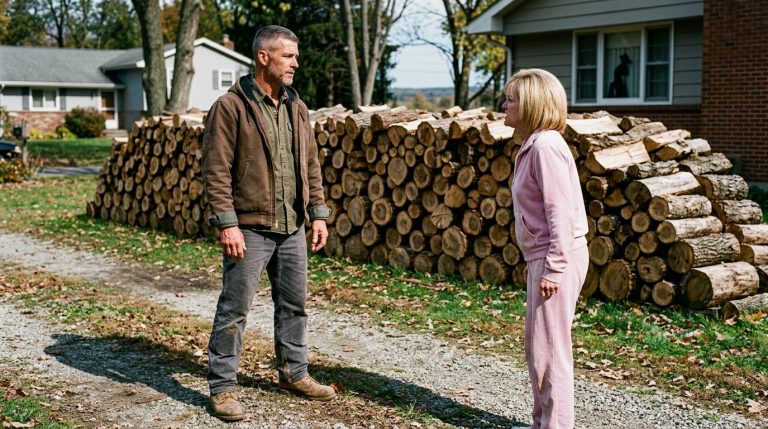
A shadow materialized out of the white wall directly ahead—a tall, broad silhouette waiting at the corner of the woodpile.
I paused, my boots freezing on the wet stones, my right hand instinctively dropping to my side, fingers curling slightly. The posture was a reflex, a forty-year-old muscle memory that didn’t care about neighborhood boundaries.
“Chief Evans?” I asked, my voice cutting through the damp silence.
The shadow shifted, the fabric of a heavy, water-resistant utility coat rustling softly. The tall figure stepped forward, the warm light from the kitchen window finally catching the silver edges of his magnificent gray mustache and the gold badge pinned to his wet lapel. He carried a leather-bound clipboard under his arm, the plastic cover sheet beaded with condensation.
“Mr. Callahan,” Evans said, his low baritone carrying a quiet, apologetic weight. He adjusted his uniform hat, the brass insignia dulled by the heavy mist. “I didn’t mean to stalk your woodpile. I parked at the easement gate to avoid blocking your driveway in this soup.”
“You’re out late, Chief,” I observed, relaxing my posture but keeping the ledger concealed beneath the shadow of my arm. “The health department usually wraps up their field observations before sunset.”
“Miss Rodriguez is already back at the county seat,” Evans said, looking past me toward the dark silhouette of the smokehouse. His eyes lingered on the chimney, which was cold and silent in the fog. “But I wanted to hand-deliver this amendment to my safety report. Karen called the commissioner’s office twice after we left this morning. She’s challenging the clearance on the Clause G exemption.”
He reached out, his hand gloved in dark, worn leather, and offered a single sheet of paper. The paper was already soft from the dampness, its edges slightly frayed where it had been torn from his master log book.
“She’s pushing hard, Jack,” Evans murmured, his voice dropping as he stepped closer, the warmth of his breath visible in the cold air. “She brought in a civil engineer from the Blackwood group this afternoon. They’re claiming the structural load of your stone chimney exceeds the original 1956 bearing capacity of the agricultural slab.”
I took the paper, my fingers touching the damp, textured grain of the sheet. Underneath the official fire marshal seal, a neat, handwritten addendum was visible in the dim light spilling from our kitchen window. It was a formal notation of structural compliance, but written in the margin was a single, dry warning: Re-survey initiated by corporate petition.
“The Blackwood group doesn’t represent the county, Chief,” I said softly.
“No,” Evans replied, his gaze meeting mine with a quiet, steady understanding. “But they hold the bond on the highway bypass easement. And if that slab is declared unstable, the grandfather clause under Clause G is legally voided. They won’t just condemn the smokehouse, Jack. They’ll excavate the whole five acres to reroute the drainage ditch.”
He offered a curt, respectful nod, turning back toward the wall of white fog. “Watch your perimeter. This isn’t a zoning dispute anymore.”
CHAPTER 5: THE SEVERED LEDGER
The heavy moisture of the mist clung to the paper in my hand, making the fiber go soft and limp under my touch. I watched the gray mass swallow the red taillights of Chief Evans’ vehicle at the far end of the lane. The soft, wet purr of his engine dissipated into the deep silence of the bottomland, leaving only the steady, rhythmic drip of water falling from the eaves of the porch onto the dry leaves below.
I turned and walked back inside, pushing the heavy oak door shut until the brass latch clicked into place. The sudden warmth of the kitchen felt thick. Emily stood by the stove, her fingers lightly curled around her mug, her shoulder line dropping slightly as she saw the documents clutched under my arm.
“What did the Chief say, Jack?” she asked, her voice hushed, as if loud words might invite the fog inside.
“The board is expanding the perimeter,” I said calmly, laying the damp sheet Evans had given me next to the 1956 blueprint on the dining table. I pulled the heavy, leather-bound volume of the 1956 Annexation Ledger from under my arm and set it down. “Karen brought in an outside firm. They’re targeting the concrete slab of the smokehouse. If they can declare it structurally deficient, they can nullify the Clause G protection.”
“Blackwood Development,” Emily murmured, her eyes settling on the marginal note I had pointed out on the blueprint. “Arthur’s family had legal disputes with them decades ago. My father always said Arthur refused to sell the easement because he knew they’d pave over the creek run.”
“Let’s see what Arthur left behind.”
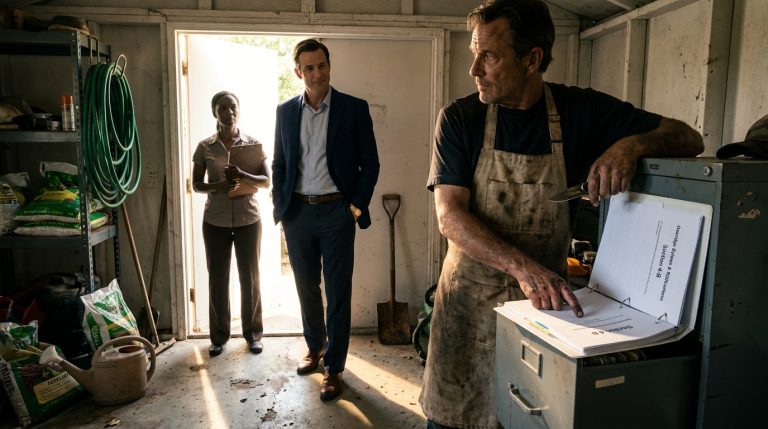
I pulled the oilcloth sleeve off the ledger. The scent of dried lavender and old leather drifted up, mingling with the damp wool of my jacket. I opened the cover, the heavy rag paper turning with a stiff, dry rustle. My fingers traced the elegant, sloping columns of Arthur’s handwriting. The entries were meticulous—notations of soil density, core samples, concrete mixtures, and property boundaries. Everything was recorded with the precision of a master builder.
But as I reached the middle of the book, where the records of the 2005 annexation began, my fingers caught on a physical discrepancy in the binding.
I leaned closer under the yellow glare of the overhead bulb. The page edge didn’t have the natural deckle of the others. It was clean, smooth, and rigid. I ran my thumb along the gutter of the book. Someone had taken a razor blade and cleanly severed an entire leaf from the linen binding stitch.
“Someone removed a section,” I said, my voice dropping to a low murmur. “Right where the Clause G Ordinance is referenced. The entry before is dated March 14, 2005. The next page starts in May. The entire month of April—the month the annexation was finalized—is gone.”
Emily leaned over my shoulder, her breath warm against my cheek. She touched the tiny, frayed threads of linen where the page had been sliced. “Who would have had access to this ledger, Jack? It’s been in our garage for fifteen years.”
“Before it was in our garage, it sat in the old community hall vault,” I said, my mind reviewing the timeline. “Arthur died in 2004. Karen took over his personal library before the assets were turned over to the estate. If she knew Arthur had embedded a protective clause into this concrete footprint, she’d want that ledger clean.”
I picked up the phone and dialed Gus. The butcher shop would be closed to the public at this hour, but I knew Gus would be in the back room, trimming cold sides of beef under the fluorescent lights.
The phone rang twice before his gravelly voice filled the line. “Callahan. You’re calling late.”
“Gus,” I said, keeping my tone even and transactional. “The order Cynthia placed for the Founders Day fundraiser. I need you to double-check the invoice you sent to the committee.”
“Already did,” Gus grunted, the sound of a metal cleaver hitting a wooden block echoing in the background. “Itemized it exactly like you asked. Labor, meat, and the specialty wood-smoking service. Cynthia signed off on it. But Jack, I got an email from the HOA main account an hour ago. Karen’s office is auditing the food vendor files. They’re demanding to see the physical business address of the facility where the curing is done.”
“They’re looking for the smokehouse address,” I said. “They want proof of a commercial operation on a residential plot.”
“She’s clever,” Gus muttered. “She knows if she catches me subcontracting to an unpermitted residential site, she can void the whole contract and fine us both into the dirt. What do you want me to do?”
“Send her the invoice, Gus,” I said, my grip tightening on the edge of the table. “But under the facility line, don’t write my address. Write the parcel number. The original 1956 agricultural parcel ID. Let her legal team try to trace that through the county archive.”
“You’re laying a trail, Sergeant Major,” Gus chuckled softly. “Just make sure you don’t get caught in your own brush.”
I hung up the phone and looked back down at the severed page in the ledger. The missing truth was there, buried in the gap between the stitched threads, and the clock was already running.
CHAPTER 6: THE EMBATTLED THRESHOLD
The line went quiet with a soft, mechanical click, leaving only the hum of the refrigerator vibrating through the floorboards. I slowly lowered the receiver back onto its heavy wall cradle. The black plastic was cold, slick with a thin film of condensation that had collected on my hand during the call.
Emily hadn’t moved. Her fingers remained resting near the raw, sliced binding threads of the 1956 Annexation Ledger, her gaze fixed on the empty space where the April entries should have been. The overhead yellow light cast deep, tired shadows beneath her eyes, exaggerating the fraying threads of her oversized flannel shirt.
“Gus will route the invoice under the 1956 parcel ID,” I said, my voice low, dropping into the steady, unhurried cadence of a tactical brief. “If Karen tries to push the commercial code violation through her board allies, she’ll be forced to file the complaint using those historical coordinates. That forces her to enter the original annexation record into the public registry.”
“But Jack, if she’s already cut the pages from this ledger,” Emily whispered, her hand moving to touch the cracked clay rim of her lukewarm tea mug, “she must have the originals. Or she burned them. If the Clause G Ordinance is only referenced in a document she controls, we’re defending a position with no rear guard.”
“You don’t burn a land covenant, Emily,” I replied softly, my eyes scanning the margins of the remaining pages. “Not when you need the legal leverage yourself. She kept them. But she couldn’t leave them in the community hall vault once the audit petition began circulating.”
I walked to the window, pulling the thin, faded lace curtain aside. The fog had grown so dense it pressed flat against the outer pane like a wet, gray sheet. The streetlamp at the edge of our lane was a dim, floating amber smudge, completely disconnected from the ground. For a second, my eyes played tricks on me—the shifting patterns of the mist near the pasture fence resembled a line of surveyors, their reflective vests glowing faintly in the dark. I blinked, the figures dissolving back into the shifting vapors of the bottomland. It was just the old pasture posts, weathered and gray, leaning against the wire.
“We need the physical signatures before the Tuesday meeting,” I said, turning back to the table. “Dave has his file ready. If we can get Mrs. Gable and the other three families on the eastern cul-de-sac to sign the recall petition before Karen can formalize the bypass easement, the board will be legally frozen. They won’t have the quorum to authorize a civil demolition.”
“I’ll walk over to Mrs. Gable’s first thing in the morning,” Emily said, her voice reclaiming its quiet strength, though her fingers trembled slightly as she pulled the lapels of her flannel closer to her chest. “She trusts me. She’s been too frightened to look at her garden since they made her dig up the roses, but she still has the original letters in her shoe box. I know she’ll sign.”
“We go together,” I said. “No one walks this lane alone while those private survey rigs are idling at the easement gate.”
I sat back down at the scratched oak table, pulling the loose sheets of our defense plan closer. The paper felt soft, slightly damp from the heavy air rolling off the marshy creek. On the table lay the blueprint, the severed ledger, and the fire marshal’s amended safety report—three separate pieces of a shattered history that had once held this valley together.
I reached out and picked up my pencil, the lead scratching softly against the margins of the 1956 Annexation Ledger as I began mapping out the exact names of the homeowners we needed to contact. Every stroke of the graphite was a quiet, deliberate calculation, a steady line drawn against the encroaching gray of the fog outside.
“We have thirty-six hours,” I murmured.
Emily sat down beside me, her small hand resting over my wrist, her warmth steady against the cold air of the room. “Then we make them count, Jack.”
CHAPTER 7: THE RECKONING IN THE LEDGER
The grandfather clock in the hall began its slow, heavy toll for midnight, the brass gears grinding with a dry, rhythmic friction before each strike. On the table, the pencil line I had just drawn under the final name—Gable—shone metallic under the yellow bulb. Emily’s touch was steady on my arm, the soft wool of her sleeve offering a quiet anchor against the growing chill of the house.
“The list is complete,” I said, my voice barely more than a low rumble in the quiet kitchen. “That’s forty-seven signatures. More than enough to trigger the emergency recall under the original bylaws.”
“But the missing page, Jack,” she murmured, her thumb lightly grazing the sliced spine of the 1956 Annexation Ledger. “How do we prove the Clause G Ordinance exists without Arthur’s original entry? If Karen has the legal backing of the highway survey team, our signatures are just names on a page.”
I didn’t answer immediately. I reached out and carefully lifted the heavy leather binding of the ledger, tilting it toward the light. My eyes weren’t looking at the cut paper this time; they were focused on the deep, recessed channel of the spine where the linen threads were bound. Under the magnification of the yellow bulb, the tiny white fibers of the sliced page were still caught in the dry hide glue. But squeezed flat against the backing cardboard of the spine, hidden beneath a secondary layer of bookbinding buckram, was a narrow, folded strip of vellum.
Arthur hadn’t just written the ordinance in the ledger pages. He had bound a duplicate copy directly into the structural spine of the book itself—a hidden reinforcement designed to survive if the primary pages were ever tampered with.
“Arthur was an engineer,” I whispered, my fingers carefully tracing the rigid edge of the hidden vellum strip. “He built redundancies into everything. He knew the risk of a single-point failure.”
With a slow, calculated touch, I used the flat edge of a small pairing knife to lift the corner of the buckram. The dry adhesive flaked away like fine gray dust, releasing the folded vellum. I smoothed it flat on the scratched oak. The text was written in the same elegant, sloping fountain pen ink, but this copy bore the wet, raised purple stamp of the Miller Memorial Trust—a legal instrument established to permanently preserve the original 1956 slab as a historical landmark, completely exempting it from municipal easements.
The realization settled in the room with the weight of a physical shield. The highway bypass couldn’t cross the property line because the concrete beneath my smokehouse wasn’t just a foundation; it was the designated geographic marker of a protected private trust.
“She knew,” Emily breathed, her eyes widening as she read the raised purple seal. “Karen didn’t want to demolish the smokehouse because of a zoning violation. She wanted to destroy the concrete before we discovered the trust ledger was locked inside it.”
“She’s running out of terrain,” I said, my voice tightening with a quiet, strategic focus. “She has the surveyors at the gate, but she doesn’t have the legal authority to cross the boundary line until the board signs the easement. And on Tuesday night, we strip her of that board.”
I folded the vellum carefully, tucking it inside the pocket of my worn utility jacket, right next to the damp fire marshal’s report. The physical pieces of our defense were finally shifting into an offensive formation. The long, exhausting campaign of paper and silent intimidation was converging on a single point of conflict.
“Get some rest, Emily,” I said softly, looking out the window at the dense, silent fog that still clung to the dark pasture. “The ground is ours. Now we just have to hold the line.”
CHAPTER 8: THE GOLDEN KINTSUGI
The final vibration of the twelfth chime slowly decayed, leaving the kitchen in a silence so profound it felt as though the fog had crept through the floorboards to cushion the room. The folded vellum of the Clause G Ordinance rested against my palm, its aged edges stiff and slightly yellowed under the pale kitchen bulb. I did not slip it into my pocket immediately. Instead, I let my fingers trace the raised, purple ink of the Miller Memorial Trust seal, feeling the physical texture of Arthur’s final safeguard.
“Jack,” Emily whispered, her voice a soft, warm breath in the chilly air. She was still sitting close, her shoulder brushing mine, her fingers gently tracing the frayed cuff of her blue flannel shirt. “We don’t wait for Tuesday. If the survey crew is at the gate now, they’ll act before the community can vote.”
“We don’t wait,” I agreed. “We prepare the hearth.”
We did not sleep. The hours of the deep night passed not in a blur of skipped time, but in the slow, methodical labor of vigil. Together, we walked down the porch steps, our boots whispering against the dew-slick grass as we crossed the hundred yards of dark pasture to the smokehouse. By three in the morning, the damp cold of the bottomland had settled into our bones, but the small firebox of the smokehouse was already breathing. I fed dry, seasoned oak splits into the iron grate, watching the small, amber sparks swirl upward into the chimney. The rich, sweet perfume of slow hickory smoke began to weave through the heavy mist, creating a warm perimeter of scent that held the dampness at bay.
By dawn, the white fog began to soften, turning into a glowing, translucent gold as the first sunlight filtered through the old-growth oaks.
The sound of footsteps on the gravel lane was the first sign of the gathering. It wasn’t the harsh crunch of contractors, but the light, hesitant steps of Mrs. Gable, who walked carrying a small, green ceramic pot containing a young, resilient rose cutting. Behind her came Dave, his thick accordion file tucked under his arm, followed by three other families from the eastern cul-de-sac. They didn’t speak in loud voices; they simply gathered around the warmth of the cedar structure, their faces illuminated by the soft golden light of the early morning.
At exactly seven, the low, heavy rumble of a diesel engine broke the quiet. A white commercial pickup truck bearing the Blackwood Development logo rolled slowly through the pasture gate, its tires sinking slightly into the soft, wet earth.
Karen stepped from the passenger side before the vehicle had even come to a complete stop. Her face was pale, the lines around her mouth drawn tight with a desperate, sharp intensity. She clutched her heavy plastic clipboard to her chest like armor, her knuckles white. Behind her, two men in bright orange safety vests stood by the tailgate, their expressions uneasy as they looked at the crowd of neighbors gathered around the smokehouse.
“This is an unauthorized gathering on an unapproved easement,” Karen called out, her voice high and brittle, cracking slightly in the cold morning air. “Mr. Callahan, the county structural review has authorized an immediate core sample of this slab. If you obstruct the surveyors, the sheriff’s department will be called to clear the perimeter.”
I stepped forward from the shadow of the cedar beams, the folded vellum document held clearly between my fingers. “The surveyors aren’t crossing the line, Karen.”
“We have the municipal easement filed under the corporate petition,” she snapped, her index finger tapping the plastic board with a rapid, frantic rhythm. “The Clause G exemption is void if the foundation slab is structurally uncertified. We have the legal right to clear this footprint.”
“You don’t,” I said softly, my voice calm, carrying easily across the damp grass. I reached out and unfolded the vellum, holding it so the raised purple stamp of the Miller Memorial Trust was visible in the sharp morning light. “Arthur didn’t leave this land to the developers, Karen. And he didn’t leave the original residents to be priced out of their homes by your highway bypass.”
She froze, her gaze locking onto the purple seal. The color drained from her face, leaving her skin looking as thin and faded as the paper in her hand. “Where did you… that ledger was archived.”
“Arthur bound a duplicate of the trust directly into the spine of the 1956 Annexation Ledger,” I said, letting the words fall with measured, indisputable weight. “The concrete slab beneath this smokehouse isn’t a zoning violation. It is the designated legal anchor of a permanent community endowment. Arthur established it to pay the property tax surcharges for Mrs. Gable and every other original resident of this parcel. The funds are tied directly to the preservation of this exact footprint.”
The silence that followed was absolute, broken only by the steady, warm crackle of the oak logs inside the firebox.
Karen stared at the vellum, her lower lip trembling slightly as the realization of her absolute defeat settled over her. The clipboard in her hands seemed to grow heavy, slipping several inches until it rested uselessly against her side. The two Blackwood surveyors behind her exchanged a brief look, quietly climbed back into the cab of their truck, and shifted the vehicle into reverse, their tires backing slowly out of the gate.
“It was Arthur’s legacy,” she whispered, her voice losing its sharp edge entirely, revealing only a hollow, exhausted grief. “He wanted to save this valley. I thought… I thought if we brought the bypass through, we could control where the growth went.”
“You don’t save a community by digging up its roots, Karen,” Emily said gently, stepping forward to stand beside me, her hand resting on Mrs. Gable’s shoulder.
Karen didn’t answer. She turned slowly, her steps heavy and uneven, and walked back down the empty lane alone, her floral dress trailing through the damp grass as the golden sun finally broke fully through the trees.
The denouement settled over Willow Creek with the slow, peaceful grace of a warm autumn sunset.
By late afternoon, the community cookout had transformed the pasture into a space of quiet celebration. The air was thick with the rich, comforting aroma of slow-smoked brisket, a scent that no longer represented defiance, but a shared, unbreakable peace. Tables were lined with mismatched plates, bowls of potato salad, and Mrs. Gable’s apple pies. Children ran through the long shadows of the oaks, their laughter echoing softly against the old cedar siding.
I stood by the side of the smokehouse, a cracked ceramic mug of warm tea in my hand. The stone chimney was warm against my back, radiating a steady, comforting heat into the cool evening.
I knelt down beside the foundation slab, where a small hairline fracture had formed in the old concrete near the doorframe. I reached into my utility pocket and pulled out a small tub of lime mortar, mixing it slowly with a hand trowel. With careful, deliberate movements, I pressed the soft gray mixture into the crack, smoothing the edges until the repair was seamless, sealing the old wound with the quiet care of a craftsman mending a broken piece of porcelain.
Emily walked up behind me, her boots crunching softly on the gravel. She knelt down beside me, her hand sliding into mine, her fingers warm and steady.
“It’s repaired,” she said softly, looking down at the fresh mortar.
“It will hold,” I replied, looking out over the golden yard at our neighbors, our friends, our home. “The foundation is finally solid.”