The Cold Calibration: A Veteran Marksman’s Retribution Against the Arrogance of Modern Military Superstition and Pride
CHAPTER 1: The Weight of Steel
The heat on Range 7 didn’t just sit; it pressed against the skin like a physical weight, thick with the scent of spent brass and the dry, mineral tang of desert dust. Lester Newton remained prone on his canvas mat, his world defined by the circular, narrow aperture of his scope. It was an old sight—blued steel, scratched, pitted by time—but as he adjusted the windage knob, he felt the friction bite back, familiar and precise.
“Sir, is that a museum piece?”
The voice was young, saturated with that specific, hollow arrogance that only comes from someone who has never felt the true, cold bite of a real conflict. Corporal Davies stood three lanes over, his modern rifle propped against his hip. It was a black-polymer machine, covered in enough optics and rail attachments to satisfy a Hollywood director. He was a creature of the modern age—efficient, loud, and blindingly confident.
Lester didn’t blink. He didn’t turn his head. He simply adjusted his grip on the worn, oil-darkened stock of his bolt-action rifle. The wood was cold, even in the heat, grounding him.
“License and registration on that thing, ‘Grandpa’?” Davies called out again, his voice rising, seeking the validation of the squad mates gathered behind him. A ripple of laughter moved through the line—a sharp, rattling sound that hung in the humid air.
Lester ignored the jab, though he felt the tension shift. He caught a glimpse of his own scope through the periphery—the deep, jagged scratch near the adjustment knob. In that split second, the sun-bleached gravel beneath him seemed to liquefy. The smell of the range vanished, replaced by a sudden, metallic stench of humid jungle rot and the ozone of incoming high-velocity rounds.
Keep her steady, Les. Make it count.
The phantom voice of Miguel, twenty years old and long dead, echoed in the center of his mind. The memory was a fracture in time, sharp and dangerous. Lester’s knuckles went white against the wood. The scratch wasn’t just a mark on the housing; it was the scar of a near-miss that had saved his life half a century ago. It was a point of pressure, a memory he kept tucked away in the marrow of his bones.
He brought his focus back to the target. It was a speck in the haze, a problem to be solved with geometry and breathing. But the rhythm of the range had been broken. Davies was still talking, his voice a drone of self-righteous entitlement.
“Better check if it’s coded as a historical artifact,” Davies jeered. “The range officer should check his eyesight, not his gear. It’s a safety hazard to have this junk on the line.”
Lester breathed in—slow, measured, disciplined. He felt the cold iron of the trigger against his finger. He wasn’t bothered by the youth’s insults; he was bothered by the lack of discipline. The silence in the air, broken by the incessant, ego-driven chatter, spoke of a decay he had been sent here to fix. He knew exactly what he was doing, and he knew exactly who was watching from the bleachers.
The shadow of the Range Safety Officer approached, boots crunching with heavy, reluctant authority. Lester felt the shift in the air. The trap was beginning to close.
CHAPTER 2: The Inspection
The Gunnery Sergeant’s boots crunched on the gravel with a methodical, heavy rhythm that felt too loud in the sudden vacuum of the firing line. The mockery from Davies and his squad had evaporated, replaced by a nervous, stifled tension. Even the wind seemed to hold its breath, leaving the shimmering heat haze to dance over the thousand-yard expanse of the range.
Lester shifted his weight, rising from the prone position with a slow, deliberate grace. He didn’t offer the rifle; he held it out, barrel pointed safely toward the dirt, his expression a neutral mask of weary patience.
The Gunny took the weapon. The moment the old wood touched his palms, the man’s posture shifted. He felt the weight of it—not the lightweight, hollow feel of the modern polymers he handled daily, but the dense, solid gravity of a tool forged to last a century. He worked the bolt, and the sound was a metallic whisper, a mechanical sigh that spoke of thousands of repetitions and decades of careful lubrication.
“Sir,” the Gunny began, his voice professional, though he couldn’t mask the waver of uncertainty. “I’ve received a complaint. Protocol mandates an inspection.”
Lester offered a simple nod. “She’s sighted in, Gunny. She’ll do the job.”
The inspector’s eyes narrowed as he turned the rifle over, his thumbs tracing the blued steel that had worn to a silver sheen along the edges. He squinted at the scope—the vintage housing, the brass fittings, the clear but dated glass. He was searching for a rattle, a loose screw, a sign of mechanical instability that would justify removing the ‘relic’ from the line. But he found only structural integrity. The steel was unyielding.
Then, his gaze snagged on the jagged, deep scratch near the windage knob. It was a vicious, irregular mark.
“What’s this?” the Gunny asked, pointing a gloved finger at the scar in the metal.
Lester’s gaze remained fixed on the horizon, but his internal world tilted. The bright, sterile sunlight of the range fractured. The smell of gun oil vanished, replaced by a sudden, choking gust of wet, hot rot—the scent of a jungle that hadn’t seen the sun in weeks. The distant, popping rhythm of the modern firing line morphed into the chaotic, dissonant roar of automatic gunfire, the distinct, gut-wrenching whine of rounds snapping through the humid air near his ear. He felt the phantom pressure of his cheek pressed against this same stock, his knuckles white, his heart a frantic bird trapped in his chest.
Keep her steady, Les. Make it count.
Miguel’s voice was a whisper over the screaming chaos. The impact hadn’t just been a scratch; it had been the vibration of a bullet striking the housing, a force that had nearly shattered the scope and, with it, Lester’s ability to stay in the fight. He had survived because the metal held. The scratch wasn’t damage; it was the physical record of his survival.
“A souvenir,” Lester said, his voice a low, steady rumble that pulled the reality of the range back into place. The phantom jungle receded, leaving behind only the grit of the gravel and the watching eyes of the Marines.
The Gunny hesitated, his thumb hovering over the jagged metal. He felt a strange, inexplicable chill. There was something about the way the old man spoke—a lack of bravado, a terrifying calmness—that made the Gunny’s next words feel like an insult he didn’t want to utter. The pressure from Davies, however, was a constant, irritating thrum at the back of his neck.
“The rifle checks out,” the Gunny announced, his voice louder than he intended, directed as much at the onlookers as at Lester. He racked the bolt once more, the sound echoing like a gavel. “But it is non-standard equipment. You can proceed, sir. However, be advised: any operational failure, any issue at all, and you will be immediately disqualified. Understood?”
“Understood,” Lester replied.
As the Gunny handed the rifle back, he couldn’t help but notice the way Lester gripped it. It wasn’t the tentative hold of a collector; it was the permanent, fused grip of a limb. The Gunny turned away, his face hardening as he walked back toward the line. He felt he had completed his duty, yet he couldn’t shake the sensation that he had just handed a live grenade to a man who knew exactly how to pull the pin.
Lester didn’t watch him go. He lowered himself back onto the canvas, the familiar bite of the gravel against his elbows providing a comfort that the modern world couldn’t replicate. The arrogance of the young men behind him had started to creep back—the whispers, the smirks, the betting. They didn’t understand the machinery they were dealing with. They didn’t understand that for some, the rifle was the only thing standing between them and the ghosts of the past.
He shifted his eye to the aperture. The target was a small, blurry smudge at the end of the world. He allowed his breathing to slow, feeling the rhythm of his own heart begin to sync with the steady, pulsing heat of the desert. He was waiting. Not for the wind, and not for the target to be ready. He was waiting for the moment when the arrogance of the firing line would collide with the reality of his presence.
The Gunny reached the edge of the line, his stride breaking for a fraction of a second as he glanced back. He caught Lester in his periphery—the old man was utterly still, a statue carved from age and iron. A flicker of something—doubt, perhaps, or a sudden, sharp recognition of a hierarchy that had nothing to do with rank—passed across the Gunny’s face before he masked it with a return to professional indifference. The trap wasn’t just set; it was beginning to tighten its coils around those who didn’t even know they were being hunted.
CHAPTER 3: The Escalation
The air on Range 7 remained heavy, saturated with the smell of scorched grass and high-grade cleaning solvents. Lester felt the canvas mat press against his ribs, a familiar, gritty texture that had anchored him through decades of change. He didn’t look at Davies, but he could feel the boy’s attention—a focused, jagged heat radiating from the neighboring lane. The Gunny’s departure hadn’t resolved the tension; it had acted as a catalyst, pushing the conflict from open mockery into something far more dangerous: a cold, tactical defiance.
Lester checked the windage again. His hands moved with a fluidity that mocked the mechanical perfection of the modern rifles around him. He felt the cold iron of the bolt, the familiar notch of the safety, and the scratch on the scope—the scar that served as his compass.
In the corner of his vision, Davies was no longer smirking. He was whispering to his fire team. It was a low, rhythmic murmur—the sound of predators coordinating a strike. They weren’t just shooting anymore; they were watching him, waiting for a micro-second of hesitation, a single trembling breath, or a mechanical stutter that would allow them to call for another safety intervention. They wanted him off the line. They wanted the “relic” discarded so they could return to the comfort of their own digital, reinforced reality.
Lester felt a flicker of something in his own chest—not anger, but a grim, calculated determination. This wasn’t a competition. It was a calibration.
A sharp, dissonant crack of rifle fire shattered the silence as Davies fired his next string. The electronic target monitor pinged—a hit, high and to the left. Not a perfect group. Davies was tight, his movements robotic, his focus entirely on Lester rather than his target. The boy was losing his composure, sacrificing his own performance to maintain the pressure.
Lester allowed himself a fractional turn of his head. He saw Davies glance toward the tower, then back to his squad, his face a mask of strained intensity. It was a subtle, almost imperceptible signal—a nod of the chin, a narrowing of the eyes. Davies was looking for an edge, something to justify a second challenge. He was desperate.
“Hey, Grandpa,” Davies hissed, barely loud enough to reach Lester over the distant hum of the target-return machinery. “That scope’s losing its zero. Don’t want you wasting the range officer’s time with a clean miss.”
Lester didn’t answer. He didn’t even acknowledge the jab. He simply adjusted his cheek weld, his focus narrowing until the entire world was contained within the circle of the glass. He could see the fibers of the target paper a thousand yards away, the minute imperfections in the range environment, the shimmering distortion of the heat.
Keep her steady, Les. Make it count.
The voice of Miguel wasn’t a phantom anymore; it was a ghost of instruction. Lester felt the rhythm of the range—the cadence of the wind, the vibrations of the firing line, the specific, hollow silence that preceded the firing of a weapon. He sensed the impending failure in Davies’ next shot before the boy even pulled the trigger.
Davies was tense. His muscles were locked, his grip too firm, his perspective entirely skewed by the need to win a war of optics.
Lester ignored the noise. He waited. He was the anchor of this range, the stillness amidst the shifting, desperate currents of youth. He knew that for Davies, this was about ego. For the squad, it was about belonging. For Lester, it was about the integrity of the line.
The range master’s voice crackled over the intercom, the static harsh and discordant. “Prepare for next relay.”
Lester felt the shift. The atmosphere on the line grew brittle. He caught a flash of metal—something reflective in Davies’ hand. A distraction. A mirror, perhaps, or the glint of a smartphone lens designed to catch the light and ruin a marksman’s sight picture. It was a petty, tactical sabotage, the kind of move that would never be detected by the tower cameras, but would be felt by anyone peering through high-magnification optics.
Lester didn’t flinch. He didn’t break his posture. He simply reached into his kit, his fingers brushing a small, worn piece of dark, non-reflective cloth he always kept tucked in the lining of his bag. He laid it over the side of his scope, blocking the potential intrusion of light without breaking his aim. It was a counter-move performed so subtly that even the observers wouldn’t have understood the necessity of the action.
The reflection vanished. Davies’ move had failed, and in the silence that followed, Lester felt the boy’s frustration peak. He could hear Davies’ breathing—erratic, shallow, and fast. The trap was holding, and the predator was starting to realize that the target he had chosen was far, far older and sharper than he had ever imagined.
The range master called for the next fire command. Lester steadied his finger against the trigger, his mind clearing of all distractions. The world was nothing but the distance, the wind, and the inevitable outcome of the shot. He wasn’t just aiming at a target; he was aiming at the arrogance of a generation that had forgotten how to serve, and he was ready to deliver a lesson that would echo far beyond the confines of Range 7.
CHAPTER 4: The Arrival
The roar of the engines arrived before the vehicles did—a low, mechanical growl that vibrated through the canvas mat and up into Lester’s elbows. He didn’t turn around. He didn’t need to. He felt the shift in the air, a sudden thinning of the arrogance that had been festering on the line like a wound.
Beside him, Davies had frozen. The boy’s finger, which had been ghosting over his trigger in a display of petulant impatience, went still. The squad mates, who only seconds ago had been whispering their bets and sharing smug, conspiratorial grins, stood up in unison, their movements jerky and uncoordinated.
Lester stayed prone, his eye locked to the scope. He watched the target, but he was listening to the world behind him. The sound of the command vehicles was not the typical, heavy rumble of logistics trucks; it was the sharp, biting whine of high-speed performance, the sound of an authority that did not ask for clearance—it took it.
Dust, kicked up in a massive, churning cloud, began to sweep over the firing line, coating the modern rifles in a fine, gritty layer of silt. The smell of burning rubber and diesel fuel replaced the scent of gun oil.
Then, the silence.
It wasn’t a natural cessation of sound; it was an abrupt, surgical silencing of the entire range. The firing stopped. The intercom hummed with the sudden, terrified absence of the range master’s voice.
Lester felt the presence of the base commander—a two-star general, if the cadence of the approaching footsteps was any indication—before the man even spoke. There was a weight to the way the boots impacted the gravel, a deliberate, rhythmic precision that belonged to a man who lived and breathed the hierarchy of the Corps.
The vehicles had pulled into a perimeter, their lights strobing in the afternoon heat, casting long, frantic shadows over the firing line. The doors opened with the synchronized precision of a guillotine.
“Cease fire! Cease fire! Unload and show clear!” The range master’s voice, now high and thin with genuine panic, cut through the quiet.
Davies scrambled to comply, his movements fumbling, his rifle barrel wobbling in a way that would have earned him a dressing down in any other circumstance. He was staring at the line of command vehicles with wide, pale eyes, his confidence effectively vaporized.
Lester slowly pushed himself up. His back ached, a deep, radiating throb that reminded him of the years, but his posture remained rigid. He didn’t hurry. He didn’t look back to see the General. He knew exactly what he was doing. He had allowed the tension to boil over, had baited the trap with his own perceived vulnerability, and now, the architects of this facility were forced to see the rot he had spent the afternoon identifying.
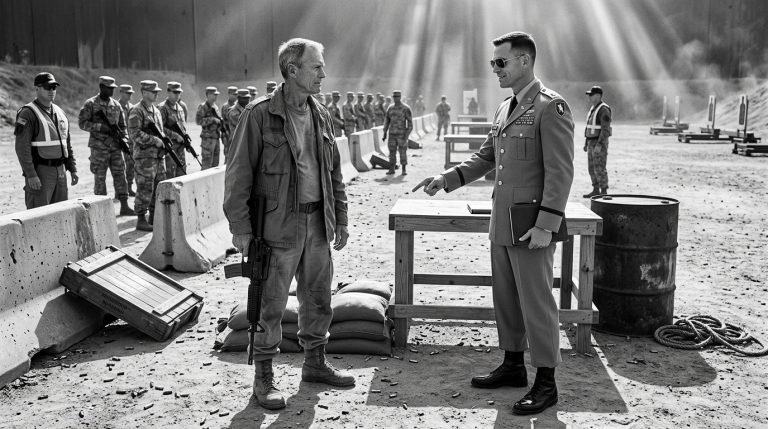
The General walked past the line. He didn’t look at the competitors. He didn’t look at the targets. His gaze was a laser, locked onto the back of Lester’s neck. The Colonel, Miller, followed a step behind, his face a grim, stony tableau.
Lester felt the familiar, cold shift in his mind. The sight of the General’s crisp, starched uniform triggered a sharp, intrusive memory—the image of a mud-caked officer in a humid foxhole, his face obscured by shadow, passing down orders that felt like death sentences. The smell of wet rot returned, clashing with the smell of new car upholstery. It was a phantom, a ghost of the war he had survived, trying to push its way into the present.
He suppressed it. He gripped his rifle, the blued steel biting into his palm.
The General stopped. Three feet. The exact distance required for an inspection. He didn’t speak. He just stood there, his eyes scanning the ancient wood, the scratched scope, and then finally, meeting Lester’s gaze. There was no mockery in those eyes. There was an intense, uncomfortable recognition.
“Mr. Newton,” the General said. His voice was a boom, a sound meant to command and to honor.
Lester gave a slow, singular nod. He didn’t stand at attention—he had earned the right to remain at ease—but he acknowledged the rank with the respect of a man who understood the architecture of the Corps.
Davies, caught in the General’s periphery, looked as if he were trying to shrink into the gravel. The Colonel, Miller, held a digital tablet, his thumbs hovering over the screen as he looked at the squad of terrified marines. The air was thick with the scent of ozone—the smell of a storm about to break.
The range was still. Not the quiet of a firing line, but the silence of a cathedral. Lester looked at the General, then at the terrified Davies. He realized then that the decoy was gone. The myth he had been allowed to embody was being stripped away, and the core truth—that he was a living reminder of everything they had compromised for the sake of modern optics and institutional ego—was about to be laid bare.
He felt the weight of the rifle, the scar on the scope, and the cold, hard logic of the situation. He wasn’t just a marksman anymore. He was the judge.
CHAPTER 5: The Exhibition
The silence was absolute, save for the rhythmic, metallic ticking of a cooling vehicle engine. The General stood like a statue of tempered steel, his hand still anchored at his brow, his blue-ice eyes fixed on Lester with a reverence that made the surrounding Marines look like children playing with toy soldiers.
Davies was trembling. It was a fine, high-frequency vibration in his shoulders that he couldn’t suppress, even with his jaw clamped shut. His squad mates were locked in place, their faces devoid of the smugness that had defined their posture only moments earlier. They were being force-fed a history lesson they hadn’t asked for, and the taste of it was bitter, sharp, and undeniable.
Colonel Miller stepped into the space between the General and the firing line. His movements were calculated, his voice a cold instrument. He didn’t look at the competitors; he looked at the range as if it were a tactical map he was correcting.
“Corporal Davies,” the Colonel’s voice was low, carrying with it the weight of professional ruin. “Stand at attention. You and your team are to remain in place until relieved. You are currently the audience for a demonstration of discipline and precision that you are fundamentally unqualified to provide.”
Davies snapped to attention so violently his boots clicked against the gravel. He didn’t dare look up. He was watching the tips of his own boots, his face a ghostly shade of grey.
The General finally lowered his hand. He turned to the range master, who was standing a few paces away, his face pale and eyes wide with a frantic, deer-in-the-headlights intensity. “Clear the line,” the General ordered. His voice was steady, quiet, and absolutely final.
The range master scrambled, his whistle a thin, frantic trill that sounded weak against the oppressive weight of the General’s presence. “Cease fire! Everyone off! Range is closed to all except Mr. Newton!”
The dispersal was chaotic but fast. Competitors—some of the best shooters in the Corps—departed with glances of profound, fearful curiosity back toward the firing line. Within thirty seconds, the wide expanse of Range 7 was deserted, save for the General, the Colonel, and the old man with the relic rifle.
Lester didn’t acknowledge the emptiness. He felt the space around him expand. He stood, his joints stiff, and walked back to his mat. The canvas was still warm from the sun. He sat, then settled into the prone position with a practiced, fluid economy of movement. He didn’t need to adjust the scope; he had been calibrated to this target for hours.
The heat shimmer on the range was extreme now, the air dancing with a predatory, liquid quality that distorted the distance. It was the kind of distortion that played with the eyes, making a static target appear to drift or breathe. It was a test of faith in one’s own internal calculations.
He didn’t check the wind. He didn’t look at the General. He felt the rifle—the weight of the wood, the texture of the blued steel—as an extension of his own skeletal structure. The scar on the scope, the physical mnemonic for his brother Miguel, felt cool beneath his thumb.
Make it count, Les.
He breathed in. He felt the internal pressure of the atmosphere, the subtle drop in temperature as the late afternoon light began to slant across the range. He exhaled, feeling his heart rate descend into the steady, glacial rhythm of a man who had long ago ceased to fear the outcome of a shot.
He squeezed the trigger. It wasn’t a pull; it was a gentle, inevitable increase in tension that resulted in a crisp, clean break.
The report was sharp, a violent crack that echoed across the valley and seemed to hammer against the chest of everyone present. It was a sound of absolute authority.
For three seconds, nothing existed but the echo fading into the scrub brush.
Then, the digital monitor above the target lane flared to life. The number appeared in bold, glowing red, casting a ruby tint over the gravel.
10.
A dead-center bullseye. But it wasn’t the score that mattered; it was the grouping. The computer’s display began to cycle through the technical readout, showing a grouping so precise it defied the physics of a thousand-yard shot. A mathematical impossiblity.
Lester stayed prone for a moment, his eye still behind the scope. He watched the target through the shimmering heat. It was a perfect, dark void in the center of the paper.
He rolled to the side and sat up, his movements slow. He looked over at the General, who was now staring at the monitor with a look of profound, quiet vindication. The Colonel stood beside him, the digital tablet gripped so tightly in his hands that his knuckles were white.
“Record broken,” the Colonel whispered, more to himself than to anyone else.
Lester stood, his knees popping, and began the process of casing his rifle. The silence on the range had changed. It was no longer the silence of intimidation; it was the silence of awe. The arrogance, the bets, the mockery—it had all been incinerated by a single piece of lead. He had not just outshot the modern optics; he had outlived the generation that thought technology could replace the man behind the sight.
He moved with a quiet, devastating grace, his eyes never straying toward Davies. The boy was still standing at attention, his face twisted in a silent, painful realization. He had come to the range to prove his superiority, and instead, he had been forced to witness the terrifying, enduring power of a standard he would never reach.
Lester walked toward the line of command vehicles. He felt the weight of his years, the burden of the ghosts he carried, but for the first time in a long time, the air felt clear. The purge was complete. He had done what he came to do.
CHAPTER 6: The Quiet Aftermath
The air inside the base museum was cool, smelling faintly of lemon polish and old, dry paper. It was a stark contrast to the sun-baked, powder-choked atmosphere of Range 7. Lester walked through the main hall, his boots clicking softly on the polished concrete. He wasn’t looking for a display; he was looking for the weight of history that he knew he would find there.
He reached the Vietnam War exhibit. It was tucked into a quiet corner, a glass-encased memorial of gear, uniforms, and photographs. He stopped before a display case containing a bolt-action rifle, its stock dark with age, its metal blued to a deep, somber sheen.
A figure moved in the periphery. Private First Class Davies—the boy who had been so loud, so arrogant, so desperate to prove his worth with plastic and polymer—was standing by a cart of cleaning supplies. He looked different. The arrogance had been scrubbed from his face, replaced by a raw, hollow exhaustion. When he saw Lester, his shoulders went rigid, and he snapped to attention with a reflex that seemed almost painful.
“Sir,” Davies said, his voice barely a rasp.
Lester didn’t demand he relax. He didn’t offer a platitude. He simply stood beside the boy and gestured to the rifle behind the glass. “That’s a good piece of work,” Lester said. His voice was soft, devoid of the authority he had wielded on the range. “Lots of stories inside that steel.”
Davies looked at the rifle, then back at Lester. The boy’s eyes were bloodshot. The punishment of the last month—the scrubbing of glass, the cleaning of brass, the endless, repetitive act of maintaining the memory of those who came before—had worked. He wasn’t the same man who had stood on the line that afternoon.
“I didn’t understand, sir,” Davies admitted, the words clearly forced out by a heavy, internal pressure. “I thought… I thought it was just hardware. I thought the tech was the point. I didn’t see the…” He trailed off, unable to articulate the concept of sacrifice.
Lester turned to face him. He saw the boy’s hands, rough and red from the cleaning agents. They were the hands of a recruit who was learning that the uniform wasn’t a costume, but a burden.
“The tech is just the tool, son,” Lester said, his tone gentle, almost clinical. “You wanted to be a hot shot because you were afraid that you didn’t have anything of your own to offer. So you leaned on the modern gear. You thought the optics would do the seeing for you.”
Davies lowered his head. It was an admission of defeat, not just in a competition, but in a philosophy.
“I was wrong,” Davies said.
Lester reached out and touched the glass of the display case. It was cool, unyielding. “The scratch on my scope,” Lester said, his voice dropping into a register that felt like a secret. “It wasn’t a defect. It was a lesson. It taught me that sometimes, the only thing that keeps you in the fight is the damage you’ve already taken. You want to be a marine? Stop trying to be a machine. Start learning how to carry the weight of what you don’t yet know.”
He reached into his pocket and pulled out a small, worn piece of dark cloth—the same one he had used to deflect the sun on the range. He pressed it into Davies’ hand. “Keep your gear clean. Not because it’s regulation, but because it’s all you have when the rest of the world goes sideways.”
Davies took the cloth, his fingers trembling. The surrender was complete. There was no more talk of rules or safety or superiority. There was only the quiet, crushing realization of a legacy he hadn’t yet begun to earn.
Lester turned away, leaving the boy standing before the history he was now tasked to guard. He walked toward the exit, his stride steady, the weight of the rifle he had carried all day now just a memory in his muscles.
He stepped out into the evening light. The base was quiet, the transition from the day’s intensity to the evening’s calm feeling like the final closing of a door. He had completed the purge. He had left behind a student who understood the value of the silence.
As he walked toward his car, Lester looked up at the horizon. The sky was turning a bruised, deep purple, the kind of color that suggested a long, cold night ahead. He felt no triumph, no residual heat from the victory on the range. There was only a profound, grounded peace. The ghosts were still there—he could still feel Miguel’s presence in the weight of his own step—but they were no longer screaming. They were satisfied. The record had been set, the arrogance had been corrected, and the line remained unbroken. He drove away, the engine of his car the only sound in the deepening shadows, leaving the base to the quiet custody of the next generation.