The Perimeter’s Edge: A Blueprint for Suburban Ruin
CHAPTER 1: THE PERIMETERS EDGE
The vibration came first, a synthetic shudder against the cold granite of the nightstand. It was 2:17 a.m. I didn’t gasp. I didn’t sit up violently. Fifteen years as a sapper teaches you that sudden movements in the dark get you killed. I simply opened my eyes, letting the heavy, suffocating silence of the suburban bedroom wash over me. Beside me, Sarah’s breathing remained a slow, fragile rhythm.
I slid my hand across the icy glass of the phone screen. It wasn’t a text. It was a Zone One breach.
The seismic grid I’d buried beneath the Carolina clay was incredibly unforgiving. It ignored the erratic, light-footed scatter of raccoons. It was calibrated for the dense, rhythmic weight of a human footfall. I slipped out of the sheets, my bare feet finding the exact floorboards I knew wouldn’t creak, and moved like a shadow down the hallway. The air in my office was dead and cool, smelling faintly of ozone from the server rack.
I tapped the spacebar on my console. The curved monitor flared to life, casting the room in a sickly, luminescent green.
Through the lens of the low-light camera disguised within a synthetic landscape rock, the edge of my property looked less like a lawn and more like a hostile border. And there she was. Karen Thompson.
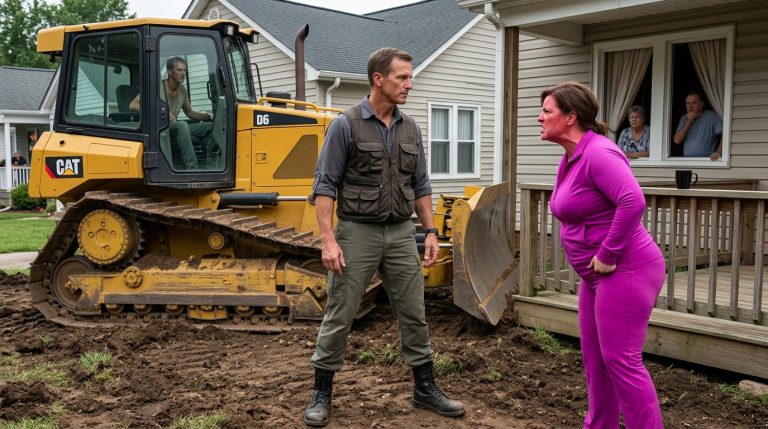
She wore a dark, heavy sweatsuit that swallowed the ambient light, her breath pluming in the damp air like exhaust. She looked utterly absurd, a middle-aged tyrant panting heavily as she wrestled with an industrial post-puller. The thick steel jaws of the tool were clamped around the base of the first western red cedar post I had painstakingly leveled in eighty pounds of concrete just forty-eight hours prior.
A few yards behind her, Gary hovered near the curb. He twitched at the distant sweep of headlights from a passing highway, his hands shoved deep into his pockets, a flashlight trembling in his grip.
I didn’t feel rage. Rage is a sloppy emotion. It makes you blind to the geometry of the battlefield. I felt only a cold, clinical focus settle over my chest. I reached for the heavy ceramic mug on my desk, my fingers tracing the sharp, chipped rim, and took a sip of dead coffee. I watched her work.
Karen threw her considerable weight backward onto the iron lever. The microphone, sensitive enough to pick up a whisper at twenty yards, transmitted a sickening, wet groan. It was the sound of tearing wood fibers and sucking mud. The post yielded, ripping free from the earth with a violent snap. She stumbled backward, her boots scraping sharply against the asphalt, a wide, malevolent smile stretching across her face in the ghostly infrared light.
She had just crossed the line. Not just the physical property line, but the invisible boundary between a nuisance and a target.
I pressed the secondary record key, routing a raw duplicate of the file to a remote cloud server. Redundancy is life. I watched as she moved to the second post, the heavy iron tool dragging through the wet grass, leaving a jagged scar in its wake. She pulled the second. Then the third. Her movements grew sloppy, fueled by adrenaline and spite rather than stamina.
By the time she wrenched the fourth post from the ground, she was gasping, leaning heavily against the splintered wood. She waved a dismissive hand at Gary, gesturing toward their house down the street. They began to drag the ruined timber across the asphalt, the harsh scraping sound cutting through the quiet night.
They were leaving. The physical action was over.
But as Gary turned to follow his wife, he hesitated. He looked back toward the gaping, jagged hole left by the final post. He glanced over his shoulder, ensuring Karen wasn’t watching, then reached into his jacket. He pulled out a small, metallic cylinder that caught a fleeting glint of the streetlight. With a quick, nervous motion, he dropped the object directly into the fresh crater in my lawn, and hastily kicked a clump of wet clay over it to bury it in the dark.
He jogged away, vanishing into the shadows.
I leaned closer to the monitor, the cold light washing over my face, my pulse finally beginning to tick faster against my jaw.
CHAPTER 2: THE COLD MORNING
The digital green of the monitor burned into my retinas, but I didn’t blink. My gaze was fixed on the small, dark crater on the screen where Gary had dropped that metallic cylinder. It wasn’t just a misstep—Gary was a man of profound, trembling cowardice; he wouldn’t have paused to tuck something into the dirt unless he was under specific, high-stakes orders.
I turned away from the console, the hum of the cooling fans suddenly sounding like a drone of accusation. The bedroom was silent, save for the steady, shallow respiration of Sarah. I pulled on a pair of work boots, the laces feeling stiff and cold against my fingers, and stepped out through the back door.
The night air was a shock, sharp and metallic. A light mist had begun to cling to the grass, turning the lawn into a patchwork of dark, glistening velvet. My flashlight beam cut through the haze, a singular, piercing lance of white light. I knelt by the perimeter. The earth here was torn, raw, and churned by Karen’s post-puller. The silence of the neighborhood was absolute—the kind of suburban quiet that feels heavy, almost expectant.
I didn’t reach for the cylinder immediately. I performed a visual sweep first, my eyes adjusting to the low-light geometry. There were no other marks, no signs of a second visit. I pressed my palm into the damp, cold mud, the grit working its way into my skin, and began to shift the displaced clay.
The cylinder was small, no longer than my pinky finger, constructed of a matte-finished, non-reflective alloy. It was heavy for its size. I wiped the mud from its casing with a corner of my shirt. It wasn’t a tracker; I knew the weight and resonance of a GPS unit. This felt balanced, purpose-built. I tucked it into my pocket, the cold weight of it pressing against my hip, and stood up, my knees popping in the quiet.
I looked toward the Thompson house. It sat two lots down, a silent, dark silhouette against the paler sky. If Karen was the hammer, Gary was the hidden spring. I began to walk the line, checking the remaining posts. They were solid, plumb, and utterly unmoved. She had taken four, but the rest stood like silent sentinels. I caught myself tracing the wood with my hand, feeling the sharp, clean grain. I had spent hours ensuring these were perfectly vertical, a testament to order.
Seeing them violated—not just pulled, but wrenched with such frantic, hateful force—didn’t trigger a desire to scream. It triggered a desire to measure.
I walked back to the house, the weight of the object in my pocket shifting with every stride. My office, when I returned, was a tomb of silent hardware. I moved to the workbench, set the cylinder down, and engaged the magnifying lamp. Under the harsh, sterile light, I saw the marking: a small, stamped code, etched in a font that looked industrial, precision-machined. It wasn’t something you bought at a hardware store.
I looked at the monitor again, reviewing the footage from the moment Gary had dropped it. I played the segment in slow motion, watching the playback of his hands. He hadn’t just dropped it; he had planted it, a quick, practiced motion that defied his usual, bumbling persona.
The realization sat in my stomach like a stone. This wasn’t just about a fence. I had assumed this was an HOA power play, a petty, narcissistic outburst from a woman who couldn’t stand a boundary she didn’t approve of. But Gary’s plant? That changed the variable.
I felt the familiar, cold shift in my mindset. I had been playing the role of the victim, the homeowner defending his yard. Now, the battlefield had expanded. I reached for my notebook, a sturdy, leather-bound volume where I recorded my observations. I didn’t write “vandalism.” I wrote “intelligence operation.”
The door to the office creaked open. I didn’t turn. I didn’t need to. I knew the rhythm of Sarah’s step.
“Mark?” Her voice was soft, muffled by the wool of her robe. “Why are you up?”
I turned, shielding the workbench with my body. I couldn’t tell her about the cylinder yet. The knowledge was a contagion; once you knew, you were an accomplice to the truth. “Sensor triggered, Sarah. A false alarm. I was just checking the seal on the gate.”
She walked over, her face pale in the dim light of the hallway. She looked at the monitor, then at my face. She knew that look—the “sapper’s face,” the one I’d worn for years when I was going through the pre-deployment checklists. “You’re not going back to bed, are you?”
“I need to finish the documentation,” I said, my voice as level as the posts in the yard. “If we want to get the insurance to cover this, we need a complete, timestamped log of the damage. Don’t worry. Go back to sleep.”
She hesitated, her eyes searching mine, then nodded slowly. She trusted me. She always had. But as she retreated into the dark, I felt a new, biting edge to that trust—the burden of protecting her from the realization that our neighborhood wasn’t just messy. It was compromised.
I sat back down, the cold weight of the cylinder still on the desk. I pulled the Karen binder toward me, the black plastic cover reflecting the screen’s glow. I opened it to the first page. The approved architectural plans were there, perfect and neat.
I picked up the cylinder, turning it over in the light. It wasn’t a weapon. It was a witness. I needed to know what it saw, or perhaps, what it was meant to tell someone else. The HOA wasn’t just an organization; it was a structure. And like any structure, if you pulled the right support, the whole thing would come down.
I wouldn’t just fix the fence. I would dismantle the foundation, stone by stone, until there was nothing left but the truth, buried somewhere deep in the Carolina clay. I reached for the precision tools, ready to see what was hidden behind that matte-alloy shell. The morning was coming, but I would stay in the dark as long as it took to finish this task.
CHAPTER 3: THE BLUE WALL
The precision spudger was a sliver of tempered steel, cold and utterly unyielding against my thumb. I wedged the microscopic flathead into the hairline seam of the matte-alloy cylinder resting on my workbench. The workshop was dead silent, the only illumination the harsh, sterile halo of the magnifying lamp cutting through the gloom.
I applied steady, incremental pressure. I didn’t pry; prying breaks things. You have to find the weakness in the engineering and let the object open itself.
A sudden, sharp scent of industrial adhesive and trapped ozone wafted up as the seal cracked. The smell was instantly, violently familiar. My grip locked. For a micro-second, the sterile walls of my suburban office dissolved, replaced by the suffocating, 120-degree heat of a Kandahar highway. The scent was identical to the bonding agent used on the copper pressure-plates of secondary IEDs. My heart slammed against my ribs, a primal, conditioned response demanding I drop the object and clear the blast radius.
I closed my eyes. You are in Oakmont Estates. The perimeter is secure. You are adapting.
I forced a slow exhale, letting the phantom adrenaline drain into the floorboards, and opened my eyes. With a final, sharp snap, the alloy casing separated into two neat halves on the anti-static mat.
It wasn’t an explosive. It was a ruggedized, high-capacity solid-state flash drive.
Gary hadn’t planted a weapon. He had buried data.
I didn’t plug it into my main network. I pulled a sterile, air-gapped laptop from the lower drawer of the safe—a machine with no wireless card, completely isolated from the world. I inserted the drive. The screen flickered, prompting a password request almost immediately. The volume name read: KT_ARCHIVE_SECURE.
I couldn’t crack a 256-bit encryption before dawn, nor was I going to try and risk a self-wiping protocol. But I didn’t need to read the files to understand the tactical geometry. Gary was terrified of his wife. He was hiding something she couldn’t afford to lose, and he was using my property—the very property she was actively destroying—as his dead drop. It was a dangerous, chaotic move.
I ejected the drive, placed it into a static bag, and locked it inside the heavy steel safe behind my desk. I spun the dial, the heavy internal tumblers falling into place with a satisfying, metallic thud.
Through the aluminum blinds, the sky was bleeding from pitch black to a bruised, bruised purple. Morning was here. The cover of darkness was gone.
I walked down the hall, listening to the soft shift of Sarah moving in the bedroom—the rustle of sheets, the quiet murmur as she checked on General, our German Shepherd, who slept dutifully at the foot of the bed. I stepped out the front door, the chilled morning air biting through my thin cotton shirt.
The physical reality of the yard was worse in the daylight.
The four gaping craters looked like wounds in the manicured grass. Splinters of bright, raw cedar and jagged chunks of gray concrete were scattered across the lawn, a violent disruption of the neighborhood’s geometric perfection. I stood at the edge of the sidewalk, my boots toes mere inches from the mud, calculating the sheer physical effort it had taken Karen to do this.
I didn’t have to wait long. I had made the call to the non-emergency line thirty minutes prior. The slow, heavy crunch of tires on asphalt signaled the arrival of a white and blue patrol car. It pulled up to the curb, idling with a low, authoritative rumble.
The officer who stepped out looked like a man who had spent thirty years measuring the depths of human pettiness. His uniform was crisp, but his posture sagged under the weight of his duty belt. His nameplate read Miller. He didn’t unclip his radio; he didn’t adjust his stance. He simply looked at the holes in the ground, then looked at me, his eyes dead and weary.
“Morning,” Miller said, his voice a gravelly monotone. He pulled a small, spiral-bound notepad from his breast pocket. “Dispatch said there was a vandalism complaint. Looks like you’ve got yourself an HOA dispute, sir.”
He preemptively clicked his pen, already summarizing the interaction in his head. Neighbor squabble. Low priority. No immediate threat.
“This is more than a dispute, Officer Miller,” I said, keeping my tone perfectly flat, projecting my voice just enough to cut through the idle of his engine. “This is a crime. Over a thousand dollars in materials and specialized labor were destroyed on my private property overnight.”
Miller let out a slow, whistling sigh, dragging his gaze from the craters back to my face. “These things get heated. People get attached to their grass. Any idea who might have done it? Kids? A landscaping crew with the wrong address?”
He was offering me an off-ramp. A way to file a ghost report that would sit in a filing cabinet until the end of time.
I took a step closer, closing the distance, entering his conversational space. “I might have an idea,” I said softly, holding his gaze. “But I don’t want to make an unsubstantiated accusation. However, I do have the entire incident on video. High-definition, low-light infrared video, with directional audio.”
The pen in Miller’s hand stopped moving.
The world-weary slump vanished from his shoulders. He straightened up, the leather of his gun belt creaking slightly as he shifted his weight. The bored bureaucrat was instantly replaced by a cop who smelled a closed case.
“You have video?” Miller’s voice had lost the gravel. It was sharp. Focused.
“Yes, sir. From a professional-grade seismic and optical security system. It clearly shows the primary perpetrator, her accomplice, the specific tools they used, and the entire physical act of destruction from the first breach to their retreat. I have it saved, duplicated, and backed up off-site.”
Miller looked at the house, his eyes scanning the eaves, the landscaping, looking for the lenses he couldn’t see. “I’ll need to review that footage, Mr. Rhodes. If it’s as clear as you say, we can move forward with warrants.”
“You will get it,” I replied, crossing my arms. “But I need to consult with my attorney first to ensure the chain of custody is bulletproof. I want this done by the book.”
Miller nodded slowly, a deep respect forming in the tight lines around his eyes. He reached into his pocket and handed me a stiff white card with a case number hastily scrawled on the back. “You call me the second that lawyer gives the green light. We’ll be very interested in seeing who decided to do landscaping at two in the morning.”
I took the card, feeling the sharp, clean edges of the cardstock. “Thank you, Officer.”
Miller turned to walk back to his cruiser. But as he reached for the door handle, the radio clipped to his left shoulder squawked, the dispatcher’s voice cutting sharply through the static.
“Unit 4, be advised. We just received a secondary call regarding your location at Oakmont. Complainant Thompson is reporting unauthorized and dangerous structures on her property line, requesting immediate police assistance to remove a hostile neighbor.”
Miller froze, his hand hovering over the door handle. He turned back to look at me, his eyes narrowing in the morning light, the dynamic shifting violently beneath our feet. Karen wasn’t just hiding; she was weaponizing the very system I was trying to use.
CHAPTER 4: THE SAPPERS COUNSEL
The radio crackle died, leaving a vacuum of silence that felt heavier than the morning fog. Miller didn’t move. His hand remained hooked near his utility belt, his eyes darting from the gaping craters in my lawn to the house where Karen Thompson lived—a fortress of beige siding and manicured denial.
“Well, Mr. Rhodes,” Miller said, his voice dropping an octave, losing its professional polish. “It seems your ‘vandal’ is feeling very litigious this morning. She’s calling in an obstruction complaint.”
I didn’t flinch. I let the information settle, analyzing the tactical implication. Karen wasn’t just reacting; she was executing a counter-move, using the local police as an extension of her board of directors. She wanted the police to declare the posts a safety hazard or a code violation, forcing an immediate ‘remediation’—which was HOA-speak for total removal.
“She’s entitled to report whatever she likes, Officer,” I said, my voice steady, deliberately void of the irritation she was counting on. “But reporting doesn’t change the fact that I have a valid permit, an active survey, and an approved architectural review on file. If she wants to involve the police in a private property dispute, that’s her prerogative. But I suggest you look at the logs on file with the city planning office before you issue any orders regarding my private land.”
Miller studied me for a long moment. He was a veteran; he knew the game of suburban warfare better than anyone. He could see that I wasn’t a homeowner who had snapped; I was a man who had built a perimeter. He looked at the holes again, then at the sturdy, undisturbed fence line.
“I’m not here to enforce HOA bylaws, sir,” Miller said, his tone softening into a grim, pragmatic truce. “But my sergeant is going to want a response to this call. If I go back there, she’s going to start screaming about safety regulations and community liability. You want to save me a headache and yourself a court date, you’ll have your paperwork ready for when we inevitably return.”
“It’s on my desk,” I said. “And the video evidence is being processed as we speak. I’m not the one creating a liability for this community, Officer. She is.”
Miller grunted, a sound of cynical agreement, and walked back to his cruiser. The door slammed shut with a heavy, final thud, and he pulled away, leaving me standing in the center of the destruction.
I didn’t turn back to the house immediately. I walked to the edge of the property, my boots crunching on the broken concrete. I knelt, pushing aside the mulch, and looked at the jagged hole. It was a failure of my perimeter, yes, but it was also a data point. Gary had been terrified. Karen was emboldened. They were moving in lockstep, but the fear was leaking through the cracks.
I stood and walked inside. The house was quiet. Sarah was in the kitchen, the soft clinking of a ceramic mug against the counter telling me she was already starting her day. I didn’t join her. I headed straight for the office, the door clicking shut behind me.
I picked up the secure, landline phone—the only one in the house that didn’t sync to the cloud—and dialed a number I hadn’t used since my time in the JAGC.
“Ben Carter,” the voice on the other end answered. It was sharp, clear, the voice of a man who dealt in the high-stakes currency of legal warfare.
“Ben. It’s Mark.”
There was a pause, a shift in the ambient noise on his end, then the crisp sound of a chair shifting. “Mark. You’re calling early. I assume the situation has escalated.”
“She’s not just pulling up posts anymore, Ben. She’s calling the police. She’s filing obstruction complaints. And she’s acting in coordination with her husband—who, as it turns out, is a hell of a lot more nervous than she is.” I told him about the cylinder, about the camera footage, and about the radio call that had just pulled Officer Miller away from my driveway.
Ben went silent. It was a tactical silence, the kind that preceded a strike. “She’s cornered herself, Mark. If she’s bringing the police in, she’s inviting them to audit her process. That’s a mistake. A big one.”
“What’s the move?” I asked.
“The move is to stop playing defense. You have the permit. You have the survey. You have the video of the crime. Now, you need to go on the offense. Not with a shout, but with a document. We’re going to file a cease-and-desist that covers everything—the property damage, the harassment, and the malicious filing of false police reports. We’re going to serve it to the entire HOA board at their home addresses, not just to her. Break the circle of her cronies. Make them choose between their loyalty to a tyrant and their own legal liability.”
“They’ll fold,” I said.
“They’ll scatter,” Ben corrected. “That’s better. Once the board realizes she’s dragging them into a criminal case, they’ll turn on her faster than you can blink. But you have to be ready, Mark. She’s going to come at you with everything she has before the paperwork hits. You need to be prepared for a siege.”
“Let her come,” I said, looking out the window at the empty street. “I’ve built my career on holding the line. She’s just a bully with a megaphone. I have the facts.”
“Facts are the ammunition, Mark,” Ben said. “But the war is fought in the documentation. Keep the logs. Keep the recordings. And do not, under any circumstances, engage her in a face-to-face. Let the paper do the talking.”
I hung up. The office felt different now. It was no longer a sanctuary; it was a bunker. I sat at the desk, pulling the black binder toward me, and began to draft the timeline. Every detail, every timestamp, every interaction with Miller. I was building a monument of evidence, a narrative so ironclad that when the time came to break the wall, it would shatter under its own weight.
I looked at the screen, at the paused frame of Karen’s face—that distorted, triumphant mask in the infrared light. She thought she was the guardian of the street. She didn’t realize she was the architect of her own exile.
I reached for the keyboard and began to type.
CHAPTER 5: THE PAPER TRAIL
The printer’s churn was a steady, mechanical heartbeat in the stillness of the office. Page after page of documentation slid into the output tray—affidavits of work, survey plats, and the meticulously cross-referenced list of fine notices. Each sheet was a brick in the wall I was building, a physical testament to the friction Karen had manufactured. I gathered them, the warmth of the fresh toner lingering on the fibers, and stacked them into a neat, squared pile. My movements were rhythmic, devoid of hesitation.
I walked to the filing cabinet—a heavy, fireproof unit I’d salvaged from an industrial liquidation sale years ago. It groaned as I slid the drawer open, the tracks needing a touch of oil. I tucked the new documents into the KAREN binder, right behind the most recent copy of her lawyer’s aggressive correspondence.
I sat back down at the desk, but I didn’t reach for the mouse. I turned my attention to the peripheral evidence I’d been collecting during my morning walks with General. I pulled up the folder labeled NEIGHBORHOOD_OBSERVATION. It contained a mess of timestamps and photos: the gnomes in Mrs. Gable’s yard, the lighthouse mailbox, and the various ‘violations’ I had meticulously snapped with my phone.
I opened the landscaping invoice I’d pulled from the company’s own public record site—a small, regional outfit called Apex Green. Karen had used them to try and remove my fence. But in cross-referencing their filings with the neighborhood’s public expenditure reports, something caught my eye.
The billing address for Apex Green wasn’t just a corporate PO Box. It was a residential address—a small, dilapidated property located in a neighboring zip code. I pulled up the county property tax records for that address.
The owner of the property was listed as Arthur Thompson.
I stared at the screen, the cursor blinking in the search bar like a slow, rhythmic pulse. Arthur. It wasn’t just a common name. I remembered the timid, nervous man on the HOA board, the one who had stammered about how Karen handled all the finances. He wasn’t just a compliant board member; he was part of the machinery.
The realization didn’t shock me. It aligned. It was a simple, brutal truth: the ‘aesthetic integrity’ of Oakmont Estates was being filtered through a proprietary bottleneck. Every fine she issued for ‘unauthorized’ landscaping was a funnel, directing capital toward vendors who were effectively extensions of her own inner circle.
I didn’t feel a rush of victory. I felt a cold, mechanical satisfaction. I was decoding the architecture of her power.
I stood and walked to the window. The neighborhood was waking up. I saw the Chen’s car pulling out of their driveway, the mother waving to a neighbor, the morning light catching the bland, uninspired beige of their front door. They were prisoners in their own homes, living under the shadow of a system they didn’t understand.
I went to the kitchen. Sarah was sitting at the island, a book open in front of her, but she wasn’t reading. She was watching the street. When I entered, she looked up, her expression guarded.
“You’ve been in there for hours, Mark,” she said, her voice quiet.
“I’m documenting the mismanagement,” I replied, grabbing a glass of water from the tap. The water was cold, a clean, sharp sensation. “I found a link between her and the primary landscaping contractor. It’s not just petty tyranny, Sarah. It’s a systemic siphon. She’s using the association’s rules to generate revenue for a vendor that’s effectively owned by her board.”
Sarah sighed, closing her book. “Does it matter? Does knowing where the money goes stop her from tearing up the yard? Does it stop her from calling the police?”
“It stops her from being untouchable,” I said, leaning against the counter. “When you fight a bully, you look for their weak point. Hers isn’t her voice. It isn’t her title. It’s the infrastructure she built. If I expose the financial rot, the board will have to act. They’ll have no choice. She’ll lose the authority to command the board, and without the board, she’s just another neighbor with a loud voice and a bad attitude.”
Sarah looked down at her hands. Her autoimmune condition had been stable lately, but I could still see the fatigue in her posture, the way she guarded her energy. “I just want to be able to walk the dog without worrying about who’s watching us from behind the blinds, Mark. I want to feel like this is a home, not a battleground.”
“It will be,” I promised, reaching out to touch her shoulder. “But first, we have to clear the field. I’m going to finish the audit. Then, I’m going to present it to the board. Not Karen. The board.”
I walked back to the office, the path feeling like a drill I’d run a hundred times. I sat down and began to draft the formal request for an emergency board meeting. I didn’t mention the video. I didn’t mention the police. I focused solely on the financial discrepancies—the invoices, the conflict of interest, the clear violation of the HOA’s own fiduciary standards.
It was a surgical strike. It required no emotion, no shouting, no confrontation. Just the weight of facts, presented in such a way that the board could no longer ignore their own complicity.
The printer began to whir again. I watched the sheets of paper feed out, the ink dry and sharp against the page. Each one was a step toward the end. I had a clear line of sight now. Karen was digging her own tunnel, and I was holding the blueprints.
CHAPTER 6: THE WIDOWS CONFESSION
I gathered the stack of invoices, the crisp paper biting into my palms, and stepped out onto the front porch. The air was thick with the scent of dampened soil, the morning fog clinging to the low-hanging branches of the oak trees. Mrs. Gable stood by my front gate, her hands tucked neatly into the pockets of a knitted cardigan. She looked frail, like a pressed flower tucked between the pages of a heavy book, but her gaze was sharp, fixed on the stack of papers in my hand.
“Mark,” she said, her voice thin but steady. “I saw the police car here earlier. And I saw you walking the perimeter line after they left.”
I didn’t answer immediately. I walked to the gate, the rusted hinges providing a sharp, metallic counterpoint to the quiet of the street. “They were looking into the vandalism, Mrs. Gable.”
“Are they going to do anything?” She tilted her head, her faded eyes searching my face. “Because I saw Karen yesterday. She was standing in her driveway, looking at your yard. She wasn’t angry, Mark. She looked… relieved. As if she’d finally done what she was supposed to do.”
I felt a cold prickle of awareness. Relieved? Karen wasn’t the type to experience relief unless she had successfully shifted the weight of her own chaos onto someone else.
“She thinks she’s winning,” I said, my voice intentionally low, keeping the conversation anchored to the sidewalk. “But she’s playing a game she doesn’t understand. She thinks this is about the fence. It’s not.”
Mrs. Gable took a small, hesitant step forward. She glanced toward the Thompson house, then back at me. She reached into her pocket and pulled out a small, yellowed envelope—the kind used for holiday cards, now worn soft at the edges. “I found this tucked in my mailbox three days ago. It was hand-delivered. No stamp.”
She held it out. The paper was heavy, high-quality, the kind you’d buy at a boutique stationery shop. It was addressed to The Homeowners of Oakmont Estates, but the handwriting was erratic, the ink smudging at the corners.
I took the envelope, the texture of the paper telling me more than the address. This wasn’t from Karen. Karen was a creature of authoritative, typed directives. This was personal. I slipped it into the inside pocket of my jacket. “Did you see who left it?”
“It was late,” she whispered. “Someone in a gray hoodie. They didn’t come to the door. They just slipped it in and kept walking. Mark, there’s been so much tension lately. Even before you moved in. Fines, threats, people stopping their garden projects. It’s like the whole street is holding its breath.”
“That’s how she wants it,” I said. “Fear is a control mechanism. If everyone is worried about their own mailbox or their own lawn, they don’t look at the big picture.”
“And what is the big picture?” she asked, her voice hovering on the edge of a question she was terrified to have answered.
“The picture is that the association isn’t just managing the neighborhood, Mrs. Gable. It’s draining it. Every fine you paid, every gnome you had to move, it was all part of a budget that doesn’t add up.”
She looked stunned, a pale tremor crossing her lips. “I thought it was just me. I thought I was the one who was being ‘tacky,’ like she said.”
“You weren’t the target,” I told her. “You were the bank.”
I wanted to say more, to show her the evidence I’d printed, but the street was too exposed. A delivery truck rumbled toward us, its heavy tires crunching rhythmically on the asphalt, breaking the spell of the morning.
“Go inside, Mrs. Gable,” I said, my tone shifting to the clinical, protective edge I’d used to command teams. “If anyone asks, we were just talking about the garden. Don’t tell them about the envelope. Don’t tell them I’m asking questions.”
She nodded, a quick, jerky motion, and turned toward her house. I watched her go, the fragility of her walk reminding me exactly what was at stake. It wasn’t just the fence. It was the human cost of the power dynamic Karen had engineered.
I turned back to my own home, the envelope burning a hole in my pocket. I retreated into the office, locking the door behind me. I sat down, the quiet of the room returning like a held breath, and carefully opened the letter.
It wasn’t a threat. It was a list.
12/04/24 – Apex Green: $3,500.
02/12/25 – Architectural Review Fee (Bypass): $1,200.
05/20/25 – Emergency Landscaping Fund: $5,000.
It was a trail of dates and dollar amounts, written in the same shaky hand as the envelope. Someone on the inside—someone who knew the books—was leaking. I looked at the numbers, then at my own binder. They matched the discrepancies David had found.
This wasn’t just an anonymous tip. This was an invitation to a trial. I leaned back in my chair, the sunlight hitting the edge of the desk, illuminating the dust motes dancing in the air. The trap wasn’t just closing around Karen; the pieces of the puzzle were starting to lock together, revealing a depth of corruption that went far deeper than a few pulled-up fence posts.
The neighborhood was ready to break. I just needed the right moment to apply the final, necessary pressure.
CHAPTER 7: THE NEIGHBORHOOD SYNDICATE
The silence in the office was a physical weight. I stood up from the desk, my joints popping in the quiet, and looked down at the pile of documentation. It was a precise, lethal weapon. I moved to the safe, tucked the documents inside, and spun the dial. The thud of the tumblers was final, a secure end to the planning phase.
I walked out of the office and into the hallway. The house felt different tonight. Usually, the quiet was a comfort, a buffer against the world, but now every shadow in the corner of the living room felt like an observer. I pushed the front door open and stepped out onto the porch, the night air cooling the sweat on my forehead.
The street was dark. Oakmont Estates was a collection of identical brick facades, glowing softly under the amber light of the streetlamps. Somewhere in the distance, a dog barked—a sharp, lonely sound. I walked down the path, my footsteps echoing against the concrete, and headed toward the property line where the fence had been.
The holes were still there. Dark, jagged reminders of Karen’s midnight tantrum. As I stood by the curb, I saw a figure emerge from the shadows of the neighbor’s hedge two houses down. It was David, the retired accountant. He moved with the slow, deliberate pace of a man who had spent his life reading ledgers.
“You’re out late, Mark,” David said, his voice a low, raspy murmur. He didn’t come any closer, staying within the safety of the darkened sidewalk.
“The documentation is ready, David,” I replied, keeping my own voice quiet, tuned to the frequency of the night. “I have the invoices, the vendor cross-references, and the timeline of the board’s ’emergency’ fund allocations. It’s a closed loop.”
David nodded, his face obscured by the brim of his cap. “I’ve been looking at the property tax records for the vendor Karen’s been using for the ’emergency’ repairs. You were right about the ownership. It’s not just an oversight, Mark. It’s a direct conflict of interest that violates the state’s nonprofit association statutes. But that’s the legal side. The social side? That’s going to be harder.”
“People are afraid of her,” I said.
“People are afraid of being the next one on her list,” David corrected. “You’ve got the proof, but proof doesn’t always defeat a bully. You need the community to feel like they have permission to stand up. If we go to the board meeting with just a pile of papers, she’ll steamroll us. She’ll call it a personal vendetta. She’ll make it about you, not about the money.”
“Which is why we aren’t going to the board alone,” I said.
“You mean the others? The Chens? Mrs. Gable?”
“I mean the entire street. If we can get ten percent of the homeowners to sign the recall petition before the next meeting, we can force an agenda vote. She won’t be able to suppress it. She won’t be able to dismiss it as a ‘vocal minority.'”
David remained silent for a long moment, looking at the house where the Thompson’s lighthouse mailbox blinked its erratic, solar-powered light. “Ten percent is a high bar, Mark. People here are exhausted. They think it’s easier to pay the fines than to fight. You’re asking them to take a risk.”
“I’m asking them to reclaim their homes,” I said, the words feeling heavy in the cold air.
“Then we need to be smart,” David said, stepping out of the shadows just enough for me to see the determined set of his jaw. “Don’t present this as a legal case. Present it as a budget relief plan. Tell them how much money they’ll get back if we stop paying for her brother-in-law’s landscaping company. Speak to their wallets. That’s the only language the board understands.”
I looked at him, surprised by the cold, tactical pragmatism. He wasn’t interested in justice; he was interested in the efficiency of the ledger. And that was exactly what I needed.
“I’ll draft the pitch,” I said. “You verify the numbers. We meet at my place on Tuesday. No board members, no Karen, just the people who are tired of being the bank.”
David nodded, his silhouette merging back into the darkness. “Tuesday. And Mark? Keep your head down. I noticed a car parked at the end of the block earlier. It didn’t move for an hour. It looked like Gary’s sedan.”
The chill in the air suddenly felt sharper. I didn’t look down the street. I didn’t look for the car. I simply turned back toward my house, the weight of the surveillance now a constant, nagging pressure at the base of my skull.
I walked into the kitchen, the light spilling across the granite counter. Sarah was sitting there, a cup of tea in her hand, staring into the steam. She looked up as I entered, her eyes reflecting the kitchen lights.
“You’re not stopping, are you?” she asked.
“I’m close, Sarah,” I said, walking to the counter and leaning against it, the fatigue finally beginning to seep into my bones. “We’re close. Once the petition is signed, the board has no power. She’s just a neighbor.”
“I hope so,” she said, though the doubt remained in her voice.
I went back to the office, the door clicking shut. I sat at the desk, the room feeling smaller, tighter. I started drafting the petition, the words clear, direct, and legally bulletproof. But as I typed, I couldn’t stop thinking about the car at the end of the block. They were watching. And if they were watching, they were waiting for me to make a mistake.
I wouldn’t. I was a sapper. I had spent my life clearing paths through places where every step was a trap. This street was no different.
CHAPTER 8: THE LEGAL TRAP
The final period on the cease-and-desist document looked like a period in a sentence I had been writing for weeks. I sat back, the leather of the office chair groaning, and stared at the screen. The document was a masterpiece of legal restraint—sharp, cold, and entirely devoid of emotion. It didn’t accuse Karen of being a bully; it accused the board of fiduciary negligence and systematic violation of state statutes. It was a document designed not for a conversation, but for a courtroom.
I hit the print command. The printer’s mechanical whir began, a steady, rhythmic clatter that felt like the steady pulse of an engine. I watched as the pages fed through—five copies, one for each board member, plus an extra for the HOA’s registered agent. I clipped them together, the steel staples punching through the thick, high-quality stock with a satisfying, clean click.
I didn’t rush. Rushing is a sign of desperation, and desperation is what Karen was feeding on. I took the time to organize the packets, ensuring each was accompanied by the supporting evidence: the cross-referenced landscaping invoices and the timeline of the fines.
By the time I finished, the sky outside the office window had shifted from a bruised purple to a pale, clinical gray. It was the color of a waiting room. I stood up, feeling the fatigue of the long night pressing against my shoulders, and headed for the door.
I grabbed my jacket—a sturdy, field-ready layer that felt like a shield—and tucked the packet for the HOA’s primary board member, Arthur, into my inner pocket. He lived three blocks over, in a house that looked exactly like mine but felt entirely different—a home that belonged to a man who had chosen to be a cog in a broken machine.
Stepping out into the neighborhood, I felt the air shift. It wasn’t just the change in weather; it was the atmosphere of the street itself. For the first time, I looked at the houses not as sanctuaries, but as nodes in a network. Every driveway, every mailbox, every flicker of movement behind a curtain was a signal.
I walked down the sidewalk, my boots making rhythmic, measured strikes against the concrete. I didn’t try to hide, but I didn’t advertise my presence either. I kept my pace steady, efficient—the pace of a man who had an objective and a clear line of travel.
When I reached Arthur’s house, I stopped. The lawn was perfect—too perfect, a display of compliance that made my skin itch. I walked up the driveway, the gravel crunching underfoot, and knocked on the door. The sound was flat, uninviting.
A moment later, the curtain in the sidelight shifted. Arthur appeared, his face tight, his eyes darting toward the street before he cracked the door open. He looked like a man who was constantly expecting a catastrophe.
“Mark,” he said, his voice hesitant. “Is something wrong?”
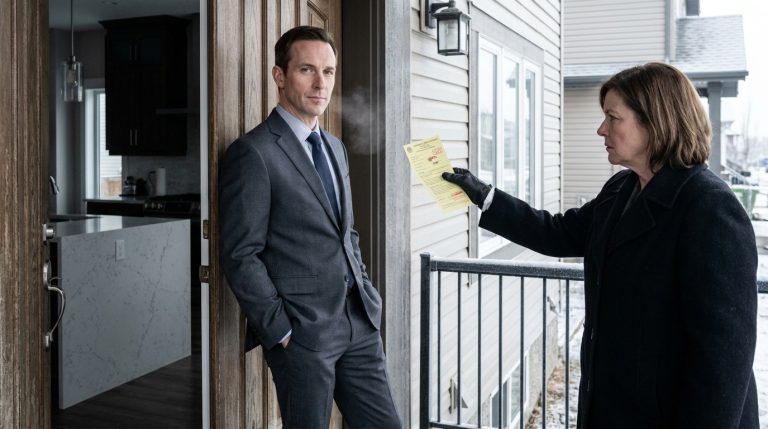
“Something is being corrected, Arthur,” I said, my voice measured, keeping the tension at a distance. I pulled the packet from my pocket and held it out. “This is a formal cease-and-desist, along with a request for a special board meeting. I’ve included a brief summary of the financial irregularities I’ve uncovered regarding Apex Green. You might want to read it before your next board vote.”
Arthur looked at the papers, his hand trembling as he reached out to take them. He didn’t open the packet. He looked like he wanted to drop it, as if the paper itself were contaminated.
“Karen won’t like this,” he whispered, his gaze flickering back to the street.
“Karen doesn’t get to decide what the board sees anymore,” I said, my voice hardening just a fraction. “The board is responsible for its fiduciary duty. This document proves that duty has been violated. If you choose to ignore it, that’s your decision. But the legal record will show you were served with notice of the irregularities today.”
Arthur looked at me, his eyes widening. He was starting to realize the trap, starting to see that his loyalty was a liability that was rapidly becoming too expensive to maintain.
“What are you going to do?” he asked, the fear finally bubbling to the surface.
“I’m going to follow the process,” I said. “And I’m going to make sure the truth becomes the only option left. You should read those pages, Arthur. You might find your name appearing in places you didn’t expect.”
I turned and walked away, the gravel crunching loudly under my boots as I headed back toward the street. I didn’t look back to see if he opened the door. I didn’t need to. I had delivered the first shot, the one that would turn the board against its own leader.
The walk back to my house felt longer, the weight of the day finally beginning to settle. I had moved from the shadows to the light, and I knew that the next move wasn’t mine to make. I had laid the trail. Now, I just had to wait for the fire to catch.
CHAPTER 9: THE ARROGANT REPLY
The office was a vacuum, the air stagnant and thick with the smell of overheated circuitry. I sat at the desk, the silence pressing against my eardrums like deep water. I didn’t reach for the binder. I didn’t reach for the files. I simply waited. I had served Arthur the papers an hour ago, and in the geography of a small HOA, news of a legal challenge traveled faster than light.
A tremor of motion caught my eye through the window—the sleek, dark silhouette of an SUV pulling into the driveway of the Thompson house. It wasn’t the usual, erratic arrival of Gary; it was a deliberate, sharp movement. A door slammed, a sound that carried across the street like a gunshot.
I stood, my muscles tense and ready, and moved to the edge of the window, peering through the slats of the blinds. Karen emerged from the driver’s seat. She wasn’t wearing her usual lurid pink tracksuit. She was dressed in something dark, structured, her stride purposeful and aggressive as she marched toward her own front door. But she didn’t enter. She stopped, her head snapping toward my house, her gaze piercing the distance as if she could feel me watching.
She knew.
My phone, resting on the desk, lit up with a notification. It was a digital message from an unknown sender, routed through a proxy server. I didn’t need to open it to know it was from her, or at least from the firm she was paying to do her dirty work. I sat back down, the chair groaning in protest, and unlocked the secure terminal.
It was a scanned document, high-resolution and sharp. A formal rebuttal, drafted by the HOA’s legal council. The language was blistering, saturated with the kind of indignant vitriol that could only come from a mind that viewed the law as a personal accessory. It didn’t just deny the financial irregularities I’d documented; it painted them as a malicious, conspiratorial smear campaign designed to destabilize a “duly elected board of volunteers.”
It was a masterpiece of projection.
“The association considers these allegations not only defamatory but evidence of a pattern of harassment,” the document read, the text bolded and aggressive. “Cease and desist all communication with board members immediately, or face a comprehensive civil suit for damages.”
I leaned back, a humorless laugh escaping my throat. It was exactly the response I had predicted. She was fighting with the only tools she had: volume, intimidation, and the assumption that the person on the other side would blink first.
I didn’t blink. I started typing. I didn’t respond to the threats. I responded to the document’s specific denial of the financial records. I attached the bank statement from Arthur’s shell company, Apex Green, alongside the association’s official payment log. It was a simple, damning juxtaposition. I hit send, routing it directly to the email addresses of every board member on the association’s distribution list.
The notification sound—a soft, digital chime—rang out in the office. Sent.
The effect was nearly instantaneous. My phone buzzed again, then again, then a third time—notifications from the HOA’s internal group thread. I opened the application. It was an unfiltered, messy stream of internal panic.
Arthur: Does anyone know about this?
Board Member #2: Mark Rhodes just sent me a payment history. This isn’t right.
Arthur: I didn’t approve that invoice.
Board Member #2: Karen, explain this. Why is the landscaping company registered to Arthur’s address?
The thread was chaos. The mask was slipping, not because I had ripped it off, but because the weight of her own deceit was finally too much for the architecture she had built. The system was failing. The “duly elected board of volunteers” was revealing itself to be nothing more than a group of terrified, complicit strangers, each one desperately trying to find an exit.
I watched the chat scroll by, the frantic messages piling up in the digital space. I felt a surge of cold, analytical satisfaction. This was the moment where the power shifted. They weren’t fighting me anymore; they were fighting each other.
The door to the office, which I had closed tight, suddenly groaned. A sharp, rhythmic hammering started against the wood—loud, insistent, and panicked.
“Open the door, Mark!”
It was Arthur.
I stood, my movements precise and deliberate. I checked the camera feed once more. Karen was standing in her driveway, her phone held to her ear, her face a pale, distorted knot of fury, watching my house as if she were waiting for the ground to open up and swallow it.
She didn’t know yet that her own board was disintegrating in real-time. She was so consumed by the need to fight me that she hadn’t realized her own foundation had already collapsed.
I walked to the door, my hand hovering over the handle. The hammering continued, but the panic in the rhythm was unmistakable. Arthur wasn’t here to threaten me. He was here to beg for a way out.
I gripped the knob, the steel cold and solid under my palm. The confrontation was no longer an option; it was a necessity. I pulled the door open, the light from the hallway spilling onto Arthur’s face—a face that looked as though it had aged ten years in the last ten minutes.
“You have no idea what you’ve done,” he whispered, his eyes wide and vacant.
“I know exactly what I’ve done, Arthur,” I said, my voice cutting through the silence of the hall. “I’ve started the audit.”
CHAPTER 10: THE LEDGERS GHOST
Arthur didn’t wait for an invitation. He pushed past me, his movements jerky, uncoordinated, the stride of a man whose center of gravity had been permanently shifted. He stumbled into the office, his eyes locking onto the screen where the HOA’s internal thread continued to scroll with frantic, red-alert intensity. He didn’t look at me. He looked at the evidence.
“You don’t understand,” he gasped, his fingers clutching the collar of his shirt as if he were choking on the very air in the room. “The Apex payments… I didn’t see the full scope. Karen said they were for specialized maintenance. She told me the accounts were audited by an outside firm.”
“And you never checked?” I asked, my voice steady, stripped of any empathy. I didn’t move toward him. I stayed by the door, blocking the exit, observing the way his eyes darted toward the safe—the repository of the real truth.
“I was a volunteer,” he snapped, his voice hitting a high, brittle pitch. “I’m a retired teacher, Mark! I don’t know the first thing about forensic accounting! She handled everything—the books, the vendors, the correspondence with the lawyers. If there’s an audit trail, it’s all in her head.”
I walked toward the desk, my boots heavy on the hardwood. I stopped right in front of him, forcing him to meet my gaze. “If you didn’t approve the invoices, Arthur, then whose signature is on them? I have copies of the payment logs. Your name is on every single release form.”
He froze. The color drained from his face until he looked like a statue carved from gray stone. “That’s impossible. I only signed what she gave me. She said they were digitized approvals, that the board had already voted in absentia.”
“Digital signatures,” I whispered, the mechanical logic of her strategy clicking into place. “She wasn’t just using your position. She was using your identity.”
I turned to the computer and pulled up the most recent Apex Green invoice from the folder. I magnified the signature block. It wasn’t a scan of a handwritten signature. It was a digital stamp, a precise, pixel-perfect replication.
“She had a key, didn’t she?” I asked. “To your accounts, to your digital portal, to everything.”
Arthur collapsed into the chair, his hands covering his face. “She said it was for efficiency. She said it would save us hours of paperwork.”
I didn’t answer. I leaned over the keyboard, my fingers flying across the keys, searching for the access logs. I found them buried in the back-end of the association’s management portal—a series of logins from an IP address that didn’t belong to Arthur. It belonged to the Thompson house.
The scope of the operation wasn’t just embezzlement. It was identity theft. She hadn’t just stolen the neighborhood’s money; she had weaponized her board members to act as the legal shields for her crimes, ensuring that if the house of cards fell, they would be the ones to take the collapse.
“You’re not the only one she’s compromised, Arthur,” I said, looking at the screen. “Look at the logs. She’s been doing this for three years. Every fine, every ‘correction,’ every board vote was routed through her server.”
Arthur looked up, his eyes glassy. “We’re going to jail, aren’t we?”
“That depends,” I said. “If you go to the police right now and tell them exactly how she forced your hand, if you provide the evidence of the digital signature manipulation, you might have a path. But if you try to bury this? If you try to protect her? You’re going down as the primary architect.”
He stood up, his legs shaking. “She’s at the house. She’s packing. I saw Gary loading the car earlier.”
“They’re not packing,” I said, a sudden, sharp clarity cutting through the air. “They’re destroying the evidence.”
I grabbed the binder—the KAREN binder, now thick with the weight of the financial rot—and moved toward the door. I didn’t need to be told what was happening next. The pattern was clear. She wasn’t fleeing; she was purging the system. If the servers went down, if the hard copies disappeared, we wouldn’t have a case.
“Stay here,” I commanded. “If you leave, you’re an accomplice. I’m going to the Thompson house.”
“You can’t,” Arthur stammered. “She has a security system. She has—”
“I know exactly what she has,” I interrupted, moving past him into the hallway.
The house felt like a trigger waiting to be pulled. I stepped out onto the porch, the night air now charged with the static of an impending storm. The Thompson house was bathed in the harsh, white glare of their exterior security lights. A car door slammed. I saw the flash of movement in the driveway—a heavy, leather-bound box being shoved into the trunk of their SUV.
I didn’t run. I walked, my pace steady and relentless. The perimeter was broken, but I was going to be the one to seal the final entry. The truth wasn’t just a ledger anymore; it was an act of physics. And I was the one who was going to force the collision.
CHAPTER 11: THE GATHERING STORM
I didn’t stop at the curb. The driveway was an open stage, lit with a hostile, white-hot intensity that flattened everything into high-contrast silhouettes. The SUV sat with the trunk lid open like a gaping mouth, half-filled with plastic bins and stacks of documents. Karen was by the bumper, her hands working with a frantic, animal speed, shoving files into a bin. She wasn’t packing; she was obliterating.
She froze as my footsteps echoed on the concrete. She didn’t turn around immediately. Her shoulders went rigid, the line of her spine sharpening under the thin fabric of her dark jacket.
“I told you,” she said, her voice strained, pitched high. “I told you I’d take care of it.”
“The audit is underway, Karen,” I said, stopping twenty feet from the bumper. I kept my hands visible, clear of the pockets where the heavy binder might look like a weapon, but my posture was loose, ready. “The board has the invoices. They have the digital logs of your remote access to the association’s portal. It’s over.”
She spun around then. The mask of the HOA president was gone. Her face was a landscape of raw, unfiltered terror—splotchy, red, and wet with sweat. She wasn’t just losing a petty battle; she was witnessing the structural collapse of her life.
“You did this,” she hissed, taking a step toward me, the bins forgotten. “You came into this neighborhood and you wouldn’t just accept your place. You had to tear everything apart because you couldn’t stand the order I kept.”
“You didn’t keep order, Karen. You kept a ledger of who you could exploit.”
Gary appeared in the doorway of the house, his face pale, his hands empty and shaking. He looked at me, then at Karen, his eyes pleading for a way out that didn’t exist. He didn’t come down the steps. He knew the ground was already lost.
“Where’s the server, Karen?” I asked, pointing to the trunk. “You’re not moving. You’re clearing the drive. But you can’t delete the cloud backups. The law firms already have the data.”
“It’s fake!” she shrieked, the sound tearing through the quiet of the cul-de-sac. “It’s all fabricated! You’re an engineer, you know how to forge digital signatures! You did this to destroy me!”
“I didn’t forge the invoices, Karen. I just found the ones you forgot to hide.”
I took another step forward. She flinched, her back hitting the open trunk, the metal of the frame digging into her shoulders. I saw the flash of movement in her hand—not a weapon, but a phone. She wasn’t calling for help. She was recording.
“Go ahead,” I said, stopping again. “Record this. Put it on the community feed. Let them see you trying to salvage the wreckage of your own fraud.”
She looked down at the phone, then back at me, her eyes darting toward the street. The neighborhood was starting to stir. I saw a porch light flip on at the house across the way, then another. The roar of our argument had broken the seal of the suburban silence.
“You’re not going to win,” she whispered, her voice finally losing its volume, dropping into a jagged, broken rasp. “I worked for this. I built this neighborhood. I kept the property values high. I did everything, and you… you’re just a parasite who wanted to build a fence.”
“I wanted a home,” I corrected. “You wanted a kingdom. And now the walls are coming down.”
I saw the realization finally hit her—not the realization of guilt, but the realization of the absolute, crushing finality of her situation. There were no more board meetings. There were no more fines. There was no more cover.
A patrol cruiser turned the corner at the end of the street, its headlights cutting through the darkness, illuminating the scene—the open trunk, the scattered documents, the two of us standing in the center of the driveway like actors frozen mid-scene. Miller was behind the wheel.
Karen didn’t look at the lights. She looked at me, a flicker of something that might have been regret crossing her eyes before it was replaced by a cold, hollow emptiness.
“It wasn’t enough,” she said softly.
“What?”
“The fence,” she said, her voice barely audible over the hum of the approaching cruiser. “It was never just the fence. I just… I had to keep it going. I had to.”
She turned, abandoning the trunk, abandoning the papers, and walked toward the patrol car, her head held high, a hollow, desperate mimicry of the authority she no longer possessed. I didn’t move. I stood in the driveway, the cold rain starting to pit the concrete, watching the red and blue lights begin to pulse against the house—the first sign of a cleanup that would take years.
The battle was shifting. The legal phase was ending, and the reckoning was about to begin.
CHAPTER 12: THE QUEENS COURT
The interior of the patrol car was a capsule of sterile, artificial light. Karen sat in the backseat, her wrists cuffed behind her, the plastic links biting into her skin. She wasn’t fighting anymore. The fire that had animated her for months—the righteous, suffocating anger that had defined the neighborhood—was gone, leaving behind a husk of a woman who looked, for the first time, exactly her age.
Officer Miller had left me standing in the driveway, the rain beginning to turn into a steady, gray downpour that blurred the edges of the Thompson house. I didn’t go inside. I didn’t return to my office. I walked toward the patrol car, the crunch of gravel under my boots sounding like bones breaking in the quiet.
“You’re not coming with us, Mr. Rhodes,” Miller said, his hand resting on the door handle. He was a man who knew when the law had finished its work and the aftermath had begun. “I have enough evidence to process the initial booking. The rest… that’s going to be in the hands of the DA.”
“I have the master file,” I said, my voice barely audible over the rhythmic swish of the wipers. “The financial audit. The digital logs. It’s all here, Miller. If you need it, you know where to find me.”
Miller nodded, a brief, sharp movement. “I’ll be in touch.”
He climbed in, the car lurching forward, its tires spraying a fine mist of oily water against my legs. I watched the taillights fade into the gray, two fading rubies disappearing into the suburban mist.
I turned around. Gary was still standing on the front porch of their house, a ghost in the doorway. He hadn’t moved. He watched me with a look of profound, paralyzed bewilderment, as if the reality of the scene—the flashing lights, the cruiser, the absence of his wife—hadn’t yet penetrated his shell.
I didn’t talk to him. There was nothing to say that wouldn’t sound like a judgment, and judgment was a luxury I couldn’t afford.
I walked back toward my house. The neighborhood was awake. Porch lights were flickering on one by one, a stuttering, uncertain constellations of curiosity. I saw silhouettes in windows—neighbors, the ones I had spent weeks documenting, the ones I had organized—now standing in their doorways, looking at the scene with a mixture of shock and, in some cases, a very quiet, very profound relief.
When I reached my front door, I found Mrs. Gable waiting on the porch. She was wrapped in a thick, woolly shawl, her hands tucked inside the fabric.
“Is it over?” she asked.
“The immediate threat is, yes,” I said, unlocking the door and stepping aside to let her in, out of the rain.
She walked into the living room, the space I had turned into a theater of tactical operations, and looked around, her eyes catching on the stacks of paper, the binders, the cold, glowing monitors in the adjacent office. “You look tired, Mark.”
“I am,” I admitted. I walked to the kitchen, the floorboards groaning under my weight, and started the kettle. The sound of the flame ignition was loud, aggressive in the silence of the room.
“I heard her shouting,” Mrs. Gable said, sitting at the kitchen island, her hands folding over one another. “She sounded like she was screaming at the house itself, not at you. As if she couldn’t believe it wasn’t holding together anymore.”
“She believed her own lie,” I said, watching the water ripple in the kettle. “She believed that if she just pushed hard enough, the world would have to conform to the rules she wrote. But the world doesn’t care about bylaws, Mrs. Gable. It only cares about the truth.”
I poured the hot water, the steam curling into the cool air of the kitchen. I didn’t offer her tea. I just stood there, holding the mug, the heat a grounding, tactile anchor.
“What happens now?” she asked.
“Now, the audit begins for real. The board is going to have to account for every dollar, every fake invoice, every misused resource. They’re going to have to rebuild. And they’re going to need people who aren’t afraid of the truth.”
I looked out the window at the empty street. The Thompson house was dark again, its security lights finally off, the facade no longer a fortress but an empty shell. The storm was passing, but the damage was done. The neighborhood would never be the same. The silence that now settled over Oakmont Estates wasn’t the silence of fear. It was the silence of a reset.
I took a sip of the tea, the scalding, bitter flavor cutting through the numbness that had settled in my mind. The battle was won, but the cost—the time, the energy, the necessary coldness I had to adopt to clear this path—was something that would stay with me long after the final invoice was reconciled.
I looked at my hand, the one that had held the ledger, the one that had documented the collapse. It was shaking, just a little, the fatigue finally catching up to the adrenaline. I set the mug down, the ceramic clinking against the granite, and turned to look at the house, finally, truly, mine.
CHAPTER 13: THE LEDGERS GHOST
The house remained quiet, an eerie, hollow silence that seemed to vibrate in the floorboards. I stood in the office, the safe door still agape, the light from my headlamp cutting through the gloom. The KAREN binder lay on the desk, its pages thick with the paper trail I had built, but the truth wasn’t in the invoices. It was in the personal effects I had discovered at the back of the safe—a cache of documents she hadn’t bothered to load into the SUV.
I reached inside, my fingers brushing against the cold steel of the interior shelves. I pulled out a small, unassuming file folder. It wasn’t HOA business. It was a stack of foreclosure notices, bank repossession warnings, and a final, ominous notice from the IRS—all addressed to Karen and Gary Thompson.
I sat back down, the chair’s leather upholstery cracking under my weight. I unfolded the documents, the paper dry and brittle. They weren’t just financial problems; they were a roadmap to total ruin. Karen wasn’t just embezzling to afford a lifestyle; she was embezzling to stave off a total, irreversible collapse. Every fine, every ‘correction,’ every vendor fee was a desperate, panicked attempt to keep the bank from seizing the house.
The arrogance I had seen in her—the smug, iron-fisted control—wasn’t just the narcissism of a small-town tyrant. It was the frantic, clawing terror of someone who knew they were seconds away from losing the only thing that made them feel significant. She was drowning, and she was trying to pull the entire neighborhood down into the undertow with her to stay afloat.
I looked at the dates. The start of the embezzlement coincided perfectly with Gary’s medical leave three years ago. The sudden loss of income, the skyrocketing healthcare costs, the crushing weight of a suburban life designed on credit—it was a mirror. I remembered the years I had spent navigating the same precipice, the feeling of looking at a stack of bills and seeing the end of the world.
But I had chosen to build a perimeter. She had chosen to build a trap.
I felt a sudden, sharp ache in my chest—not for her, but for the fundamental, tragic mistake of her desperation. She had turned the neighborhood into a battlefield because she couldn’t face the fact that her own life was failing. She had sacrificed her reputation, her marriage, and her freedom for a house that was already effectively gone.
The door to the office creaked open. I didn’t look up. I knew the footsteps—steady, measured. It was Arthur. He stepped into the light of the desk lamp, his face drawn, his eyes weary.
“I couldn’t stay at home,” he whispered. “Every time I look at the walls, I see the invoices. I see the signatures.”
I held up the IRS notice, the bold red lettering stark against the white page. “Look at this, Arthur. Look at why she did it.”
Arthur leaned over, his eyes scanning the lines. The shock on his face shifted into something else—a profound, devastating confusion. “She was bankrupt? She’s been doing all of this… for a foreclosure stay?”
“She was terrified,” I said. “She wasn’t trying to build an empire. She was trying to hide a grave.”
Arthur sat down, the chair feeling too small for him. “If this comes out… if the police get this… she isn’t just going to jail. She’s going to be destroyed. Everything.”
“Everything is already gone,” I said, pointing to the foreclosure notice. “The only question left is whether you’re going to be the one to sign for it, or if you’re going to let the police find it on their own.”
Arthur looked at me, his gaze lingering on the file. He wasn’t a hero, and he wasn’t a villain. He was a man who had been used, and now he was being forced to witness the total disintegration of the life he thought he knew.
“What do I do?” he asked.
“You tell them everything,” I said, my voice cold, final. “You tell them about the digital signatures. You tell them about the Apex Green shell accounts. You tell them the truth, Arthur. It’s the only way to stop the rot from spreading to the rest of us.”
He nodded, a slow, solemn motion, and stood up. He walked to the door, his silhouette framed by the light of the hallway. He didn’t look back. He was going to the police station. He was going to complete the surrender.
I sat alone in the office, the files spread out before me. The storm was finally breaking. The house was quiet. Outside, the rain continued to fall, washing the streets clean, the water running in rivulets toward the storm drains, carrying away the debris of a war that had been fought in the dark. I closed my eyes, the exhaustion finally pulling at my edges, and let the truth settle in the silence. The ledger was closed.
CHAPTER 14: THE DIGITAL GUILLOTINE
The community center was not a courtroom, but tonight, the air inside was thick with the same suffocating, heavy gravity. I stood at the back of the room, the KAREN binder tucked under my arm like a shield. The room was packed—a sea of faces, some angry, some bewildered, all waiting for a resolution to the months of petty tyranny that had bled the neighborhood dry.
At the front of the room, Karen sat behind the folding table, her royal blue pantsuit stark against the drab, fluorescent backdrop. She was a woman cornered, though she still held her head high, the practiced, rigid posture of someone who believed the veneer of authority was still enough to hold back the tide. Beside her, the remaining board members were scattered, distant, their eyes fixed on their own laps.
“We have an agenda,” Karen said, her voice strained, the crack in it betraying the thinness of her control. “And we will proceed with the business of the association. Mr. Rhodes, if you have a grievance, you may submit it in writing at the conclusion of this meeting.”
The silence that followed was absolute. I stepped forward, the floorboards groaning under my boots, the sound amplifying through the cavernous room.
“The business of this association, Karen, is currently the subject of a criminal investigation,” I said, my voice measured, carrying easily to the back of the room. “And it is currently the subject of a forensic audit.”
I moved toward the front, the crowd parting to let me pass. I didn’t head for the microphone; I headed for the projector I’d set up earlier, tucked near the corner of the stage. Karen’s gaze snapped to me, her eyes widening, the color draining from her cheeks. She knew. She had seen the Binder, she had seen the look on Arthur’s face.
“You have no right!” she shrieked, half-rising from her chair. “Security! Remove him!”
No one moved. The security she thought she commanded were the same neighbors who had been paying the fines. They were the ones who had watched their gnomes vanish, their doors repainted, their peace shattered. They didn’t move to help her; they moved to watch.
I connected the drive. I didn’t offer a speech. I didn’t offer a monologue. I simply hit the switch.
The screen flared to life, casting the financial audit—the stark, cold reality of the Apex Green invoices—directly onto the wall behind her. The numbers were large, clear, and damning. The crowd began to murmur, the sound rising like a swell of water. I flipped to the next slide: the digital signature logs, the IP addresses, the trail of the money from the HOA accounts directly into the shell companies she and her family controlled.
“She wasn’t protecting property values,” I said, letting the words hang in the room, sharp and clear. “She was protecting her own bankruptcy.”
The projection didn’t lie. It didn’t stutter. It laid out the life she had been building on a foundation of stolen equity. The room was no longer silent; it was a cacophony of realization. People were shouting, pointing, demanding answers. The board members at the front table looked like they wanted to dissolve into the floor.
Karen stood there, paralyzed, her face turning a blotchy, mottled gray as she watched the projected evidence of her own life’s work being dismantled. She looked small. She looked diminished. She looked like a woman who had finally run out of ground to stand on.
She turned to the door, a desperate, flighty motion, but the crowd was there—a wall of people who had finally found their voice. She stopped, her shoulders slumping, the veneer of the ‘President’ finally shattering.
She didn’t run. She stood there, the evidence of her ruin burning on the wall behind her, a ghost of the queen she had pretended to be. I watched her, the cold, clinical distance finally giving way to a profound, hollow sense of clarity. The fence was rebuilt. The audit was done. The neighborhood was no longer a kingdom of one, but a community of many.
I looked at the screen one last time, the numbers glowing in the dark, then turned and walked toward the exit. The job was finished.
CHAPTER 15: THE FINAL PLUMB LINE
The afternoon sun hung low and golden over Oakmont Estates, painting the brick of our ranch house in long, soft strokes of warmth. It was a week since the community center meeting, and the neighborhood felt like a room where the air had been suddenly, violently replaced. The tension was gone, washed away by the tide of legal proceedings and the slow, inevitable grinding of the justice system.
I walked into the backyard, the gate swinging open with a smooth, silent glide. I had repaired it yesterday, oiling the hinges until they were as fluid as water. I moved toward the fence line where the four posts had been torn out weeks ago. The new cedar was already beginning to take on the cool, silver-gray patina of the existing structure. It was solid. It was level. I pressed my palm against the wood, feeling the grain, the structural integrity of the boundary I had fought so hard to establish.
Inside the garage, I heard the rhythmic thump-thump of a hammer. I walked in, finding Sarah there, her hands steady as she helped me organize the remnants of the project—the leftover bags of concrete, the trowels, the rolls of stain-soaked rags. She looked at me, a soft, quiet smile touching her face, the kind of expression that hadn’t graced our home for months.
“The neighborhood looks… quiet,” she said, her voice light, echoing off the concrete walls.
“It’s not quiet,” I said, picking up the spirit level from the workbench. I held it up, the bubble perfectly centered between the black lines. “It’s just balanced. No one’s pushing too hard in one direction anymore.”
I walked back out to the garden. General, our three-legged German Shepherd, was loping across the lawn, his movements a symphony of determined, singular focus. He chased a ball with a ferocity that made me smile. He didn’t care about property values. He didn’t care about bylaws. He cared about the patch of grass beneath his paws and the sun on his coat.
I sat down on the back step, the wood warm and weathered against my legs. This was the five-pillar catharsis, the slow, grounded denouement I had fought for. The antagonist was gone, her downfall earned not by a grand gesture, but by the relentless, grinding pressure of the truth she had tried to bury. Poetic justice hadn’t arrived in a strike of lightning; it arrived in the form of a forensic audit and the slow, public realization of her neighbors that they had been sold a lie.
The denouement wasn’t just the absence of conflict. It was the presence of peace. I reached out and picked up the garden gnome Mrs. Gable had given me—the ‘captain of the guard’—and set it carefully atop the final post of the new fence. It looked out over the yard, a small, painted sentry watching over the perimeter.
Sarah came out, holding two mugs of coffee. She sat beside me, the warmth of the ceramic radiating into my hand. We watched the sun dip behind the neighbor’s roofline, the long, purple shadows stretching across the yard.
“Do you think she’ll ever understand?” Sarah asked, her voice soft, not wanting to disturb the quiet. “Why she did it?”
“I think she understands now,” I said. “She was just like anyone else, afraid of the dark, afraid of the cliff. She just built her barricades out of other people’s lives.”
I turned to look at the fence, the perfect, straight line it cut through the yard. It wasn’t an aggressive wall. It was a line of demarcation, a space of our own, a boundary that allowed for connection precisely because it was defined. I had spent fifteen years as a sapper building and dismantling under fire; I had thought that was my identity. But here, in the quiet, dusty reality of a suburban afternoon, I realized my life wasn’t about the blast or the breach. It was about the repair.
I looked at my hand, the one that had held the ledger, the one that had signed the affidavits, the one that was now resting on the warm cedar of the fence. It was steady. The shaking had stopped.
The garden was healing. The gnomes were back. The street was no longer a network of secrets, but a neighborhood of people, finally looking up from their own feet to see who else was walking beside them. I took a sip of the coffee, the bitter, rich flavor grounding me in the present. The war was over. The perimeter was secure. And for the first time in years, the silence was exactly what I wanted it to be.