The Weight of Stone and Iron: How One Retired Engineer Stood His Ground Against Suburbia’s Iron Fist
CHAPTER 1: THE LINE IN THE DUST
The gravel beneath my boots crunched with a dry, flat finality, echoing the exact distance between my property line and Karen Miller’s pristine white sneakers.
Twenty-two years in the Army Corps of Engineers taught me one immutable law of terrain: never build your fortification where the enemy wants you to stand. You look for the high ground, you measure the load-bearing weight of your foundations, and you keep your mouth shut until the trigger is pulled.
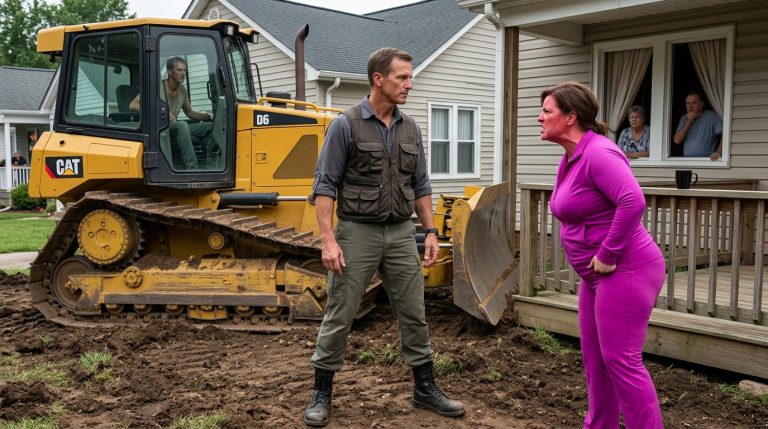
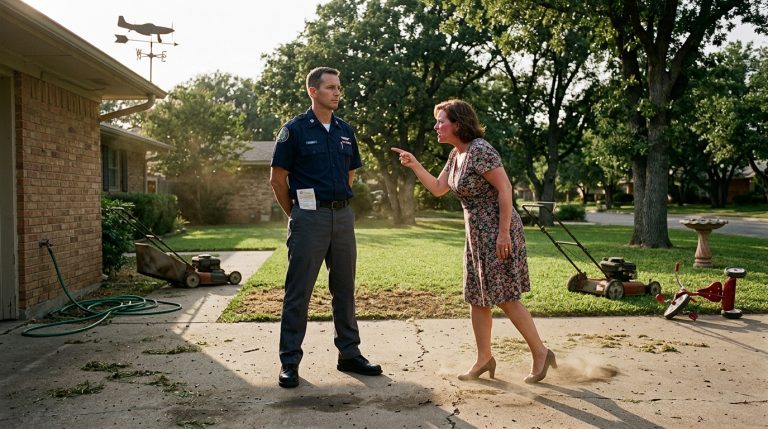
Karen didn’t look like a general. She looked like a pastel pink grenade wrapped in synthetic polyester, holding a clipboard like it was a scepter meant to govern five acres of Virginia red clay.
“Five thousand dollars, Arthur,” she said, her voice carrying that sharp, nasally friction of someone who had never had to scrape grease off her own knuckles. “And that structure goes by Friday. It’s a liability. A dirt hole dragging down every appraisal on this cul-de-sac.”
She pointed a manicured finger past my shoulder toward the root cellar. Built a century ago by hands far tougher than mine, its rough-hewn granite blocks sank deep into the hillside, half-swallowed by wild ivy and stubborn weeds. My great-grandfather had laid those stones dry-fit, without a drop of modern mortar, trusting gravity and time to hold them together. It wasn’t just a root cellar. It was the spine of this homestead.
I didn’t blink. I stood there with my hands hooked into the belt loops of my work jeans, feeling the dry heat of the afternoon bake the dust off the driveway. Behind her, a late-model pickup sat idling, its exhaust smelling faintly of unburned fuel.
“That cellar has stood here longer than this county has had paved roads, Karen,” I said, keeping my tone flat, stripped of any rising inflection that might feed her adrenaline.
“Things rot, Arthur. And eyesores get filled in,” she snapped, tapping her clipboard. A loose staple caught the midday glare.
That was when I noticed the small discrepancy—the missing iron boundary stake near the corner of the barn, replaced by a fresh wooden peg driven six inches inside my fence line. A subtle shift. The kind of quiet, administrative encroachment you only make when you’ve already promised someone else what’s underneath the dirt.
She turned on her heel, her sneakers kicking up tiny puffs of dry earth, and marched back toward her idling vehicle without waiting for an answer. She expected me to shout. She expected a red-faced explosion so she could pull out her phone and log another complaint into her digital ledger.
I didn’t shout. I watched her climb into the passenger seat, watched the brake lights flash once, and listened to the tires grind against the gravel as she rolled away.
When the dust finally settled back onto the driveway, I walked over to the edge of the root cellar and pushed my boot against the old oak door. It didn’t budge. The heavy iron padlock was still secure, but something caught my eye along the lower timber frame—fresh gouge marks, deep and deliberate, as if someone had spent the previous night trying to pry the latch open with a crowbar.
CHAPTER 2: THE ENGINEERING OF BUREAUCRACY
The freshly scored grooves in the timber frame didn’t come from a homeowner’s frustration. They were clean, parallel, and spaced with the precise geometry of a crowbar applied by someone who knew how to pop an antique latch without splintering the underlying heartwood. Someone had been here before the sun was high, checking clearances, testing the structural resistance of a century-old anchor.
I let go of the iron ring, wiping my thumb across the rough grain of my denim pants. The metal was cold despite the midday heat pressing down on the Virginia hills.
Across the acreage, past the empty stretch of dry grass where my grandfather used to stack split oak for the winter, the perimeter fence line looked quiet. But quiet on a five-acre homestead was rarely peace; it was just the space an adversary used to measure your blind spots. Karen Miller wasn’t the type to get her own hands dirty with a pry bar. That meant she had help—municipal contractors or county work crews looking to clear an easy path for whatever multi-use zoning parcel they were quietly stitching together behind closed doors at the township office.
I walked back toward the porch, my boots crunching rhythmically against the dry gravel. Every step felt like a calculation. In the Army Corps, when you found an obstruction you couldn’t blast through with raw force, you didn’t throw more men at it. You pulled the drainage maps, checked the soil saturation, and found the structural vulnerability in the enemy’s logistics chain. Karen’s logistics chain was paperwork. Every threat she mailed, every arbitrary fine she levied, and every unauthorized survey peg she dropped on my property line left a paper trail. And paper trails, unlike people, didn’t lie when you held them up to the light of state ordinance.
Inside the kitchen, the air was cool and smelled faintly of old coffee grounds and cedar. I pulled out the heavy, oil-stained leather binder I’d used during the barn-painting dispute two years ago. The vinyl spine was cracked down the middle, smelling of decades-old dust and institutional bindings.
A sudden, sharp memory flared behind my eyes—my grandfather sitting at this exact laminate table back in ’94, running a calloused thumb over a disputed property tax map while the county surveyor tried to claim our north pasture sat inside a watershed easement. “They don’t win with iron, boy,” he’d muttered, coughing into a handkerchief that smelled of turpentine. “They win by making you tired enough to stop checking the math.”
I opened the binder. Inside were neatly filed copies of county codes, old deed transcriptions, and the original agricultural exemption forms filed when the homestead was first zoned back before the subdivision creeping in from the highway had even been a surveyor’s blueprint.
I grabbed a red grease pencil and a yellow legal pad, sitting down at the wooden table. If Karen wanted to play a game of municipal attrition, I wasn’t going to shout at her on the driveway. I was going to construct a bureaucratic fortress out of her own rulebook. Every single permit she bypassed, every administrative shortcut her architectural committee took to fast-track their notices, had to be documented, cross-referenced, and filed with duplicate copies sent directly to the county seat before she could even draft her next warning letter.
The kitchen clock ticked with a heavy, steady rhythm, measuring out the afternoon while the shadows lengthened across the linoleum floor. By the time the sun dipped low enough to paint the ridge line in shades of bruised orange and slate gray, I had three distinct violation notices drafted against the HOA’s recent common-area drainage modifications—modifications that conveniently channeled stormwater straight toward my western fence line.
I set the grease pencil down and rubbed the bridge of my nose, feeling the dull ache of tension settling into my shoulders. The first phase of defense wasn’t about winning; it was about locking them into a defensive posture where every move they made required an environmental review they hadn’t budgeted for.
Then, the landline on the wall chimed.
It was a sharp, analog ring that hadn’t changed its tone in thirty years. I stood up slowly, my joints popping in the quiet kitchen, and walked over to lift the receiver.
“Arthur,” a gravelly voice came through the static. It was Arthur Vance, the retired history teacher from three properties down, his breathing raspy and low. “You might want to step out on your front porch and look toward the county access road. A black sedan just parked by your mailbox, and they aren’t from the power company.”
CHAPTER 3: THE KANGAROO COMMITTEE ROOM
The plastic telephone receiver was still vibrating slightly against my palm from Arthur’s abrupt warning when I set it back on the wall cradle. The metallic click echoed sharply in the small kitchen.
I didn’t rush to the window. In the Corps, when you knew you were being scouted, you didn’t press your face against the glass to let the watcher know they had your attention. Instead, I picked up a dry rag, walked over to the counter, and methodically wiped down the laminate surface where my red grease pencil had left a smudge. Outside, through the sheer curtains, the outline of a dark sedan sat idling near the county access turnoff, its tinted windshield reflecting the flat, merciless glare of the midday sun.
They weren’t hiding anymore. Karen’s administrative harassment had officially graduated to physical surveillance.
Ten minutes later, I walked out the back door, stepping over the threshold into the dry heat of the afternoon. I didn’t head for the mailbox; I looped around the side of the weathered barn, moving through the narrow shadow cast by the corrugated tin wall until I reached the rusted access gate leading toward the community assembly hall two blocks down. If they wanted to play intimidation politics, I would deliver my paperwork directly to their doorstep before their afternoon session even came to order.
The community hall smelled of industrial carpet cleaner and stale artificial lemon. Inside the wood-paneled conference room, the air was trapped, heavy with the collective body heat of three people who viewed five acres of Virginia history as an administrative bottleneck. Karen Miller sat at the center of the mahogany-veneered table, her pastel blazer looking pristine under the buzzing fluorescent lights. Flanking her were Gary, a heavy-set man whose fingers drummed a frantic, impatient rhythm against a stack of colored folders, and Brenda, whose lips were pressed into a tight, bloodless line.
They hadn’t even bothered to open the heavy, oil-stained leather binder I had dropped off three days ago. It was sitting on the corner of the table, closed and ignored, half-buried under a freshly printed preliminary site plan for a commercial utility corridor—a corridor that conveniently cut right through the western edge of my root cellar.
I didn’t wait for an invitation to pull out a metal folding chair at the opposite end of the table. The legs scraped against the low-pile carpet with a harsh, grating screech that made Karen flinch.
“Arthur,” Karen said, her voice dropping into that performative, saccharine cadence she reserved for people she considered liabilities. “This meeting is closed to non-members. You received our final notice regarding the demolition timeline and the five-thousand-dollar fine. We aren’t here to re-litigate property maintenance.”
“I see you’ve got the site plan out, Gary,” I said, ignoring her completely as I rested my forearms on the table. My voice was low, flat, stripped of any rising inflection. I tapped a calloused finger against the corner of the development document exposed beneath my leather binder. “Funny thing about utility easements. They tend to require federal environmental clearance when they intersect with documented historical foundations.”
Gary stopped drumming his fingers. His eyes darted sideways toward Karen, a micro-expression of panic flickering across his face before he managed to mask it behind a stern frown.
“The committee has reviewed your file, Arthur, and your structure constitutes a public nuisance,” Brenda chimed in, reading stiffly from a pre-written index card. “Failure to comply by Friday noon will result in immediate execution of the county abatement order.”
“Did you review the structural engineering report attached on page four?” I asked, leaning slightly forward, keeping my weight balanced and my posture entirely relaxed.
Silence stretched across the room, heavy and absolute, save for the low hum of the ceiling vent overhead. None of them had opened the binder. They had judged the case before the ink on the complaint forms had even dried, entirely because a municipal developer had whispered promises of increased property appraisals if the old homestead footprint was wiped clean and paved over for parking access.
Karen’s jaw tightened, the skin around her mouth pale. “We don’t need a structural report to know a dirt hole in the ground violates community standards.”
“You’re denying an architectural appeal without reviewing the engineering data or the historical survey records,” I said, pulling a duplicate copy of the receipt from my breast pocket and laying it flat on the mahogany surface. “That’s a matter of public record now. And every single signature on this denial sheet is tied directly to a board that is currently operating outside its chartered jurisdiction.”
Karen stood up abruptly, her chair legs slamming back against the wood paneling. “You think you can intimidate us with a stack of old papers? This is our neighborhood, Arthur. That cellar is coming down, with or without your permission.”
I didn’t blink. I locked my eyes onto hers, letting the silence between us stretch until the fluorescent lights overhead seemed to buzz louder.
“Try it,” I said softly, the words dropping like lead shot onto the table.
CHAPTER 4: THE ATTIC ARCHIVE
The front door groaned on its cast-iron hinges as I stepped back into the dim hallway, the air inside thick with the smell of old cedar and sun-baked timber.
Karen’s threat in the assembly room wasn’t just empty bluster; a board meeting that refuses to open an engineering file is a board hiding an execution date. If the county commercial utility corridor was moving forward under the table, they wouldn’t wait for the Friday deadline. They would push the municipal permits through emergency zoning exemptions while my attention was tied up in verbal skirmishes down at the office.
I dropped the heavy leather binder onto the kitchen table, shedding my jacket, and walked straight to the narrow staircase leading up to the second-floor landing. The wooden steps complained under my boots, each creak a familiar register of the house’s aging frame.
My grandfather had spent forty years locking his private records away in the low-ceilinged crawl space above the eastern bedroom—a space everyone in the family simply called the dry loft. When I reached the top of the stairs, I didn’t turn on the overhead bulb. I pulled a battery-operated work light from the shelf, clicked it on, and swept the harsh white beam across a dozen stacked cardboard cartons and footlockers sealed with yellowed packing tape.
This was where the physical trail lived. If there was a flaw in the county’s commercial encroachment plan, it wouldn’t be found in the current zoning office drawers; it would be buried in the original property patent maps signed back when this acreage was carved out of the Virginia backwoods.
I knelt down in front of a heavy, metal-reinforced footlocker near the chimney stack. The brass latch was cold and pitted with green oxidation. I slipped my pocketknife into the seam, wedged the blade, and forced the lock open with a dry metallic snap that kicked up a cloud of microscopic dust particles.
Inside sat bundles of stiff parchment tied with faded cotton twine, land grants bearing nineteenth-century wax seals, and ledger books with water-stained cardboard covers.
I pulled the top bundle out, my fingers sliding over the coarse, fibrous paper. As I untied the twine, a folded blue-backed document slid out from the center of the stack, catching the edge of my work light. It wasn’t a standard land grant. It was an official state preservation certificate issued by the Virginia Historic Landmarks Commission, dated back to the autumn of 1974.
My breath caught in my throat. I unfolded the heavy rag paper, running my thumb across the raised embossed seal in the bottom right corner.
It wasn’t just a record of an old stone cellar. It was an explicit architectural and historical designation marking the subterranean stone structure as a documented structural component of the mid-nineteenth-century transit network—a federally protected waypoint utilized long before the modern state highways sliced through the valley. The document explicitly stated that any structural alteration, municipal encroachment, or commercial excavation within a fifty-foot radius of the foundation constituted a federal historical violation carrying mandatory felony penalties.
My grandfather hadn’t just built a root cellar. He had spent decades quietly ensuring that no local zoning board, no matter how politically connected or greedy, could ever legally touch it.
I sat back on my heels, the dust motes dancing lazily in the beam of the work light, feeling the heavy, cold realization settle into my chest. Karen and her municipal developers hadn’t just filed a routine nuisance complaint; they were attempting to push a commercial access road straight over a federal historical site without doing their due diligence.
A sharp scrape from downstairs broke the silence of the attic—the distinct sound of the back screen door latching shut, followed by the heavy thud of boots on the kitchen linoleum.
I froze, my hand still resting on the parchment certificate. Someone was inside the house.
CHAPTER 5: THE LINE IN THE DUST AT SUNRISE
The weight of the parchment certificate felt cold and rigid inside the front pocket of my heavy canvas jacket. I didn’t rush down the narrow wooden attic stairs; instead, I stepped deliberately, letting the boards creak beneath my boots so whoever had breached the back door knew precisely where I was.
When I reached the lower landing, the heavy scent of damp earth and oil-slick grease drifted up from the mudroom. Standing near the edge of the kitchen table was Gary, his bulky frame silhouetted against the weak morning light filtering through the small window above the sink. He had an open folder spread across the laminate surface—not my legal binder, but a confidential municipal site survey map marked with red grease pencil lines tracing straight across my property line and through the stone foundations of the root cellar.
He turned sharply as my boots hit the linoleum, his face flushing a dull, mottled red.
“You shouldn’t be poking through old boxes, Arthur,” Gary said, his voice dropping into an awkward, defensive register as he tried to slide the survey map underneath a stack of junk mail. “The county has already cleared the primary zoning permits for the utility corridor. Fighting it at this stage is just creating unnecessary liability for yourself.”
I didn’t answer right away. I walked over to the counter, keeping my movements slow, measured, and entirely deliberate. The silence in the room stretched thin, humming with the low vibration of the refrigerator motor and the distant rattle of wind against the old corrugated barn roof outside.
“You didn’t come here to discuss zoning permits, Gary,” I said, my voice flat and stripped of any threat. “You came to see if my grandfather left any copies of the original land patent in the house before Karen brings the heavy machinery over on Monday.”
Gary’s hand hovered over the folded map, his fingers twitching slightly against the slick paper. In a town like this, men like Gary didn’t lead the push; they were just the blunt instruments used by developers who promised inflated property appraisals in exchange for looking the other way while history was buried under crushed concrete.
“Karen has the county commissioners in her pocket, Arthur,” Gary muttered, lowering his voice as he stepped back toward the screen door. “You can’t fight a municipal utility upgrade with old paperwork. The trucks are scheduled for dawn on Monday. They’re going to fill the cellar in, grade the slope, and clear the entire strip for the new access lane. You’re fighting a ghost.”
“A ghost is a lot harder to pave over when it’s backed by a federal historical designation,” I replied, my hand sliding into my jacket pocket to brush against the stiff edge of the preservation certificate.
Gary froze with his hand on the metal door handle, his eyes narrowing as he tried to calculate whether I was bluffing. The air between us felt heavy, thick with the realization that the game they had rigged was about to collapse under its own weight. Without another word, he pushed the screen door open, letting it slam shut behind him as his boots crunched rapidly across the gravel driveway toward an idling vehicle parked down by the road.
I watched him go through the small kitchen window, my reflection ghosting faintly against the glass. The line had been drawn, and Monday morning was coming whether they liked it or not.
CHAPTER 6: THE DEDICATION OF THE STONE
The diesel engine rumbled through the early morning fog before the sun had even cleared the eastern ridge line. A heavy, dual-axle flatbed truck rolled slowly down the asphalt access road, its tires hissing against the damp morning dew. Behind it came Karen Miller’s silver sedan, its headlights cutting sharp beams through the gray mist.
I stood motionless at the edge of my property line, my boots planted firmly on the cold, packed earth. My heavy canvas jacket was zipped to the chin, and in my breast pocket, the stiff parchment of the 1974 Virginia Historic Landmarks Commission certificate rested against my ribs like a sheet of armor.
The flatbed came to a halt twenty yards from the dry-laid stone entrance of the old root cellar. The driver cut the ignition, letting the massive engine die with a low, metallic shudder that rattled the loose gravel. Karen stepped out of the sedan immediately, her pastel suit looking entirely out of place against the raw, desaturated landscape of the Virginia countryside. Behind her stepped a municipal heavy equipment operator carrying a clipboard and a roll of boundary tape.
“I told you Friday was the final notice, Arthur,” Karen called out, her voice sharp and brittle, carrying easily across the damp grass. She walked with the stiff, practiced stride of someone accustomed to unresisting compliance. “The county development board has executed the final utility easement order. That structure is a public liability, and today it gets filled in.”
I didn’t move. I watched her approach the boundary stake, my weight balanced evenly on my heels.
“You didn’t check the historical registry before you signed off on the commercial utility corridor, Karen,” I said, my voice carrying a flat, steady weight that cut through the idling hum of the truck.
She stopped ten feet away, her jaw tightening as she forced a thin, unconvincing smile. “There is no historic designation on a dirt hole, Arthur. Gary checked the standard municipal index.”
“Gary checked what the county land office wanted him to see,” I replied.
I reached slowly into my jacket pocket, withdrew the thick rag-paper certificate, and unfolded it with a sharp, crisp rustle. The heavy embossed seal caught the pale morning light as I held it out toward her.
“This is the state preservation certificate issued under the historical landmarks act,” I said, every word measured and distinct. “It designates this subterranean structure as a federally protected mid-nineteenth-century transit waypoint. Any unauthorized excavation, commercial grading, or structural alteration within a fifty-foot radius carries mandatory federal felony charges.”
Karen’s face drained of color. Her eyes darted from my face down to the raised seal on the stiff parchment, her fingers twitching against the edge of her clipboard. She turned sharply toward the heavy equipment operator, her voice rising in a panicked shriek. “Don’t listen to him! It’s an old piece of paper! Fill it in—start the grading now!”
The driver climbed down from the flatbed cab, took one look at the official state seal, and immediately took a step backward, shaking his head. “Lady, I move dirt for municipal projects, not federal violations. My rig stays parked right here.”
Within minutes, the local sheriff’s cruiser rolled up behind Karen’s sedan, its blue lights flashing silently against the pale morning fog. The deputies stepped out, reviewed the documents I handed over, and confirmed the federal boundaries without a moment of hesitation. Karen’s municipal leverage evaporated into the cold morning air, her authority collapsing under the weight of the very bureaucracy she had tried to weaponize.
The legal battles and HOA board recalls that followed over the next month were swift and surgical. Stripped of her position and facing administrative inquiries, Karen resigned from the association by the end of the season.
A year later, the morning sun broke warm and clear over the Virginia hills, illuminating a polished bronze historical marker mounted securely to the granite face of the root cellar. The deep gouges on the oak doorframe had been carefully sanded and treated with linseed oil, restoring the dark, dense grain of the timber to its original strength.
Around the stone entrance, neighbors and community members stood together in the quiet air, sharing stories and coffee without a trace of artificial rules or fear. I rested my hand against the cool, rough surface of the stone wall, feeling the absolute, unyielding stillness of the earth beneath my palms. We hadn’t just protected a piece of history; we had secured the foundation of everything that mattered.