The High Voltage Boundary Line and the Unraveling of Suburban Entitlement
CHAPTER 1: THE THREESECOND CIRCUIT
The scarred steel socket wrench felt cool and heavy in my palm as I rolled it across my knuckles.
It was 1:45 in the morning, and the steady, quiet hum of my old mini fridge was the only sound inside the shed. I stripped the insulation off the thin copper wire, standard twenty-gauge, and tucked it clean into the output terminal of the Raspberry Pi.
Twenty-five years in defense electronics leaves a man with certain habits. You don’t build a circuit to cause a fire, and you don’t build it to make a mess. You build it to execute a single task with absolute precision.
I mounted the black plastic enclosure housing the relay module directly behind the dual-gang outlet box on the interior wall. From the outside, the weathered cedar siding looked completely untouched. To anyone looking for free power, it was just a regular twenty-amp outdoor receptacle sitting twenty-two feet inside my marked property line.
My thumb pressed down on the relay casing, feeling the small plastic tabs click into place. The micro-controller’s green LED gave a single, steady pulse.
Power on. Three seconds of closed contact. Voltage drop detection. Hard open circuit.
When her heavy gold-trimmed cart pulled that initial draw, the Pi would count down three seconds, disconnect the primary line, and hold the circuit dead until the load was completely unhooked and re-inserted. It wouldn’t pop a breaker. It wouldn’t leave a burn mark. It would just sit there, dead as a fence post, until she unplugged it and tried again.
I adjusted the socket wrench in my grip, giving the mounting screw on the junction box one last quarter-turn until the metal bit scraped against the steel casing.
Out on the pavement, a low, rubbery whir cut through the chirping crickets.
I leaned my forearm against the wooden workbench, looking through the narrow dust-filmed window toward the driveway. The white golf cart glided past my mailbox, its headlights turned off, coasting on momentum down the gentle slope of the cul-de-sac.
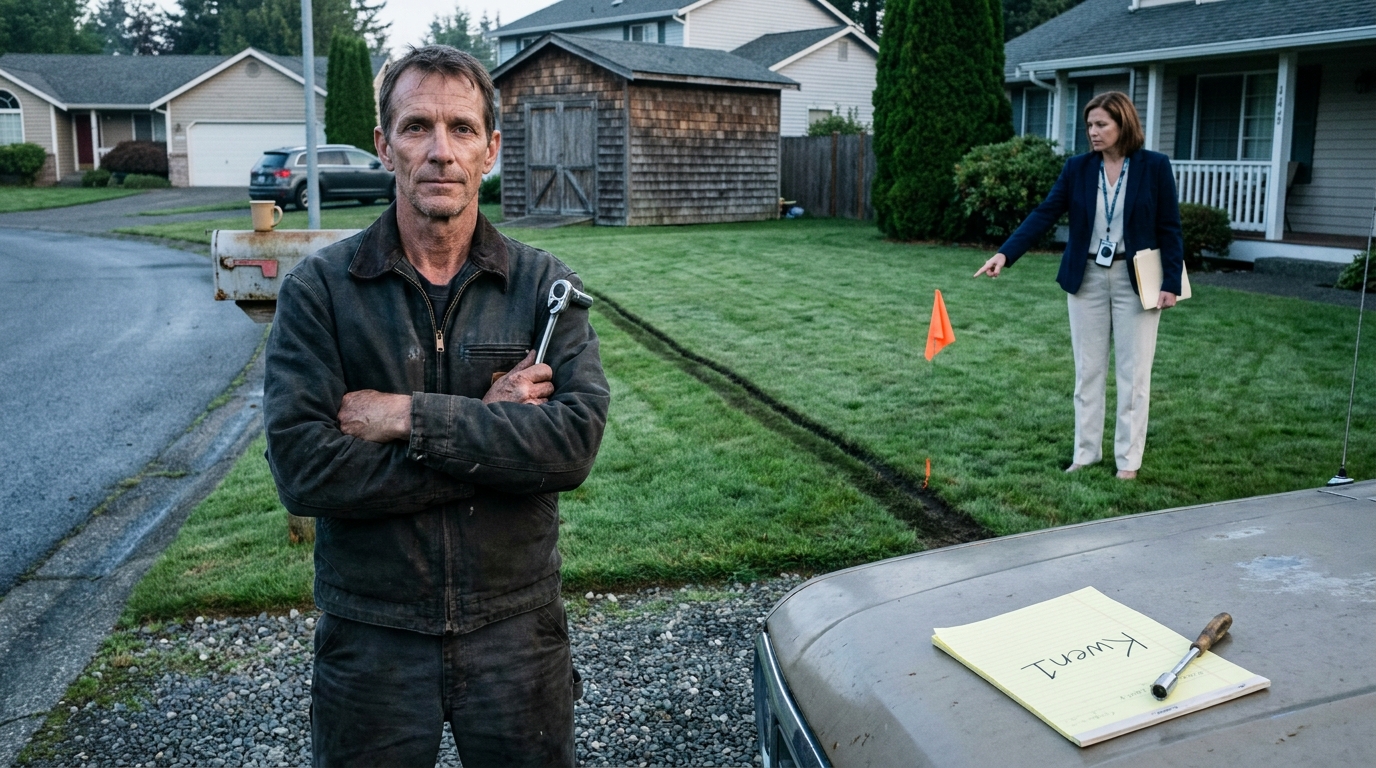
The chrome badge on the front cowl caught the moonlight: KWEN1.
She cut the wheel hard, riding the tires right over the edge of my lawn without slowing down. The rubber left a dark, pressed groove in the damp bluegrass before coming to a stop three inches from my shed door.
I didn’t move. I didn’t reach for a phone or step into the light. I just watched her foot hit the grass in a pink terrycloth slipper.
Karen pulled the thick yellow extension cord from her cart seat, snapped the rubber safety cap off my outlet, and jammed the plug home.
Inside the wall box, the tiny relay gave a quiet, metallic clack.
Across the lawn, the digital dash on her cart lit up with a bright blue glow, highlighting the oversized collar of her bathrobe. She leaned back against the frame, resting her hands on her hips while whistling a flat, off-key tune under her breath.
One.
Two.
Three.
The relay clicked again. The blue dashboard light vanished, plunging the cart back into blackness.
Karen froze. She stepped forward, slapped her hand against the top of the plastic outlet cover, and squinted at the dark dashboard. She grabbed the yellow cord, yanked it free, and slammed it back into the socket.
The dash flared blue.
One.
Two.
Three.
Click.
Darkness.
A low, guttural huff escaped her chest, loud enough to drift right through the thin shed wall. She yanked the plug out, rubbed the metal prongs against the sleeve of her bathrobe, and rammed it back in with enough force to flex the cedar siding.
Blue light.
Click.
Nothing.
She stood in the damp grass for two full minutes, staring at the outlet like it had personally insulted her family honor. Finally, she kicked the front tire of her cart, wrapped the yellow cord tightly around the steering column, and muttered something foul into the night air.
The electric motor whined in protest as she backed the dead weight of the cart onto the asphalt, rolling slowly away in the dark.
I set the socket wrench down on the workbench. It hit the rusted iron plate with a sharp, heavy ring.
CHAPTER 2: THE PAPERWORK RECOIL
My palm stayed pressed flat against the chilled steel of the socket wrench until the last whine of Karen’s electric motor died out completely.
The three-second relay had performed like a defense-grade circuit board. No smoke, no blown fuses, just a cold, deliberate wall of dead current.
By 06:00 AM, the morning damp was still hanging thick off the cedar siding. I was out front in my canvas work jacket, holding a hot mug of black coffee, watching the neighborhood wake up. A pair of crows argued over something in the gutters, and three houses down, a garage door rattled open.
A neon-orange municipal flag caught my eye near the edge of my lawn.
It hadn’t been there yesterday. Someone had pushed a heavy metal stake straight into my bluegrass, six inches past the gravel edge, right where the shed’s concrete footing settled into the soil. Tied to the top was a laminated neon tag with fresh black sharpie print: PROPOSED EASEMENT ENFORCEMENT – ZONE 4.
I didn’t bend down to pick it up. I just took a slow sip of coffee and looked across the street.
Karen was standing on her front porch in a crisp navy-blue blazer and cream slacks, a manila folder tucked tightly under her elbow. She didn’t have her hand broom this morning. She had a clip-on digital camera hanging from a lanyard around her neck and a pair of white leather walking shoes that looked like they’d never touched dirt.
She met my eyes across forty feet of fresh asphalt and didn’t blink.
“Morning, Karen,” I called out, my voice flat against the morning chill. “Looks like someone lost a survey flag on private land.”
She walked down her front steps with the stiff, deliberate rhythm of a court officer serving a summons. She didn’t cross into my grass. She stopped right on the edge of the asphalt, pointing a single, manicured finger at the orange flag.
“That flag was placed by the Architectural Review Committee at seven this morning,” she said. Her voice had that practiced, sing-song cadence people use when they think the law is sitting in their back pocket. “Your outbuilding encroaches on the perimeter maintenance corridor.”
“It’s twenty-two feet off the easement,” I said. “I checked the county recorder’s plat before I poured the slab.”
“The county records reflect outdated municipal boundaries,” she replied, tapping the manila folder against her hip. A small, involuntary twitch caught the outer corner of her left eye—the only sign that four hours of sleep and a dead golf cart were taking their toll. “The HOA board updated the peripheral utility bylaws during the quarter-three meeting. Common access covers all secondary power structures within thirty feet of the service corridor.”
“You don’t rewrite deed lines with a board vote, Karen.”
“We enforce community standards,” she said, stepping half an inch closer to the orange stake. “And right now, your non-compliant junction box is causing a grid variance. My utility meter showed a four-hundred-watt deficit last night. I’ve logged it as intentional circuit tampering.”
“Is that right?” I set my coffee mug down on the flat top of my mailbox post. The porcelain clink was the only sound between us. “Your meter dropped four hundred watts because you plugged a forty-eight-volt battery bank into a dead receptacle.”
Her face went pale, the color draining so fast the rouge on her cheekbones stood out like dry paint. She snapped the manila folder open, pull-strapping a yellow carbon copy sheet out with enough force to tear the corner.
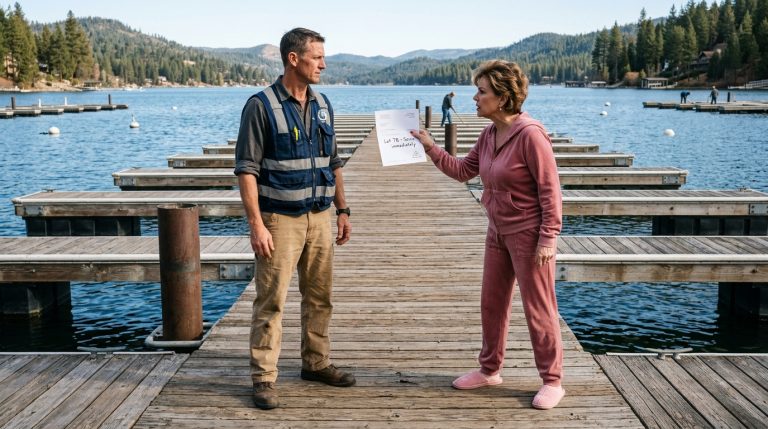
“Effective immediately,” she read aloud, her voice tightening until it almost cracked, “you are being assessed a two-hundred-and-fifty-dollar daily fine for unauthorized modification of neighborhood infrastructure. Further non-compliance will result in an immediate lien against the property.”
She didn’t hand the paper to me. She slapped it face-down onto the damp hood of my truck, turned on her heel, and marched back toward her driveway.
I picked up the paper. The ink was still fresh from a thermal printer, stamped with a generic HOA seal. But right at the bottom, listed under the utility audit line, was a single twelve-digit account number that didn’t belong to the residential grid.
It was a commercial industrial circuit code—the kind used for high-draw municipal transformers.
I folded the yellow sheet in half, pulled the scarred steel socket wrench out of my jacket pocket, and tapped the cold iron gently against my thumbnail.
Karen had just handed me her first major mistake on a piece of paper.
CHAPTER 3: BUREAUCRATIC SANDPAPER
I flattened the yellow paper on my hood, using the heavy socket wrench to pin down the fluttering edges against the morning wind.
The twelve-digit account code at the bottom was printed in a faded, low-ink matrix font: UTIL-COMM-9902-X.
Standard residential accounts in our township always started with a single-digit zip code prefix, followed by a six-digit household index. A double-alpha prefix like UTIL-COMM meant only one thing—it was a commercial dedicated feeder line, rated for sixty-cycle, three-phase high-draw infrastructure.
It didn’t belong on a residential fine notice issued by a suburban neighborhood board.
I tapped the steel socket against the truck hood, once, twice, three times.
The lock on my driver-side door clicked open.
The clerk behind the county registrar’s desk was named Arthur, a silver-haired man wearing half-moon reading glasses suspended by a beaded cord. He pulled the leather-bound survey ledger across the scarred oak counter, his gnarled thumbs flicking through the yellowed parcel maps from twenty years ago.
“Oakridge Estates,” Arthur murmured, running his index finger down the columned plot numbers. “Developer dedicated a ten-foot utility easement along the southern boundary back in ninety-eight. Water, gas, low-voltage fiber.”
“What about secondary power distribution?” I asked. I slid the yellow paper across the polished counter between us. “Specifically account code UTIL-COMM-9902-X.”
Arthur pulled his glasses down to the bridge of his nose and squinted at the matrix print. A small crease formed between his white eyebrows. He reached for a heavy grey desk telephone, dialed a three-digit extension, and waited while holding the receiver pressed tight to his ear.
“Marge,” he said, keeping his voice low. “Pull the sub-grid junction schematics for Parcel 4B. The old drainage easement behind the tennis courts.”
He listened for thirty seconds, his eyes drifting over my shoulder toward the street window. His breathing was steady, rhythmic, carrying the weary composure of a man who had seen forty years of property line disputes come and go through his lobby doors.
“They didn’t install a transformer there,” Arthur said slowly, setting the receiver back onto its cradle with a soft, plastic thunk. “Utility company log shows a closed municipal permit from four years ago. A secondary industrial step-down unit. Rated for seventy-five kilovolt-amps.”
“Who signed the installation authorization?”
Arthur flipped the ledger page over. His finger stopped on a signature block stamped in purple ink.
“Signee listed as HOA Executive Management,” he said. He looked up, his grey eyes locked directly onto mine through his half-moon lenses. “Billing address isn’t the clubhouse. It’s routed through a private holding company registered out of a PO Box in town.”
I reached out and retrieved my yellow paper, folding it cleanly into quarters.
“Does that holding company have a named agent?”
Arthur didn’t answer right away. He adjusted his glasses, picked up his red fountain pen, and uncapped it with a deliberate twist.
“I can’t print holding company filings without a formal court sub-poena,” he said softly, tapping the red cap against the ledger. “But I can tell you that the annual corporate tax statement for that PO Box is co-signed by an owner named K. Wentworth.”
KWEN1.
I tucked the yellow paper into my jacket pocket alongside the cold steel wrench.
Karen hadn’t just created an arbitrary rule about lawn flags and garage paint shades. She had spent four years embedding a high-capacity commercial power draw right into the quietest corner of our neighborhood—and she was using everyday property owners to pay for the footprint.
CHAPTER 4: THE MIDPOINT FRACTURE
The green metal utility casing sat half-hidden in the overgrown sumac bushes, twenty yards past the tennis court fence.
It was a standard municipal junction box, four feet tall, painted faded olive drab. But the heavy padlock hanging off the front clasp wasn’t a standard city-issue brass tumbler.
It was a heavy-duty combination lock with a plastic weather guard, brand new, shining against the rust.
I knelt in the damp mulch, pulling the socket wrench from my belt line. I didn’t touch the lock. Instead, I ran my fingers along the bottom seam of the metal housing where it met the poured concrete pad.
A fresh, thick black conduit ran straight out from under the slab, snaking three inches below the dirt before disappearing toward the tree line separating my lot from the common area.
I followed the line with the tip of my boot, scraping back the wet oak leaves until the PVC pipe resurfaced at the base of a utility pole.
Attached to the pole was a secondary digital meter, its LCD face flickering in the grey afternoon light.
The display wasn’t reading in standard kilowatt-hours. It was cycling through a diagnostic loop: VOLT: 240V | DRAW: 185A | CIRCUIT: UTIL-COMM-9902-X.
One hundred and eighty-five amps continuous.
That wasn’t powering golf cart chargers. That wasn’t running tennis court floodlights or a seasonal irrigation pump. That was enough raw, unfiltered current to run a light-industrial machine shop forty-eight hours a week.
A sharp rustle in the dry brush made me turn my head.
Dennis, Karen’s quiet husband, stood ten feet away on the dirt path holding a pair of hedge shears. His faded green windbreaker was zipped up to his chin, and his knuckles were pale where he gripped the wooden handles.
He didn’t raise the shears. He just stood there, looking at the exposed PVC pipe in the mud, then up at the digital display on the pole.
“She told me you were digging up the easement,” Dennis said softly. His voice lacked the sharp, rehearsed edge Karen used. It sounded old, tired, and thin.
“I’m not digging up the easement, Dennis,” I said, standing up and dusting the mulch off my knees. “I’m tracing a seventy-five KVA transformer draw that’s being billed to the residential sub-grid.”
Dennis looked down at his boots. His jaw worked silently for a second, his teeth clicking together twice before he spoke.
“She’s got three board members signed onto that holding account,” he muttered, barely loud enough to carry over the wind in the pines. “They think it’s a capital reserve investment for the neighborhood reserve fund.”
“And you know what’s actually drawing one hundred and eighty-five amps out of that box?”
Dennis didn’t answer. He adjusted his grip on the shears, turned around, and began clipping a dead branch off a dogwood tree with slow, mechanical snips.
“The board meeting is tomorrow night at eight,” Dennis said to the bark of the tree. “She’s filing the property lien papers at noon.”
Layer 1 was completely exposed now. The junction box wasn’t an HOA utility asset; it was a private, illegal grid-tap running directly through a shell company.
And Karen was about to use a falsified land lien to force me off the property before I could expose it to the county inspector.
CHAPTER 5: ESCALATION ON THE TURF
The sharp snip of the blades rang out twice before Dennis turned his back on me completely, dragging his boots through the fallen leaves toward his driveway.
I didn’t waste time watching him walk away.
By 11:45 AM, fifteen minutes before Karen’s noon lien deadline, a commercial tow rig backed onto the asphalt at the end of my driveway. The hydraulic bed groaned, the heavy steel ramps dropping onto the pavement with a loud, metallic slam that rattled my front windows.
Karen stood right beside the winch operator, wearing a yellow high-visibility vest over her blazer and holding a clip-board stacked three inches thick with red-stamped forms.
“Clear the driveway access,” she shouted through a battery-powered megaphone, her voice cracking with static. “Pursuant to Bylaw 14-B, vehicles parked on disputed common easement areas are subject to immediate impoundment.”
My truck was parked squarely inside my concrete apron, six feet past my property line.
I stepped off my porch, keeping my hands resting casually in the pockets of my canvas jacket. The scarred steel socket wrench sat heavy against my right hip.
“You’re standing on private property, Karen,” I said, stopping three feet from the tow truck operator. “And that flatbed driver is about to commit commercial trespass.”
The driver, a burly guy in grease-stained overalls, paused with his hand hovering over the hydraulic control lever. He looked at my truck, then down at the painted concrete boundary line, then back at Karen.
“He’s non-compliant,” Karen snapped, stepping around the driver and thrusting a red-stamped paper two inches from my face. Her breathing was ragged, her lips drawn into a thin, white line. “The board issued an emergency seizure order at eleven. The easement is under temporary municipal receivership.”
“Show me the county judge’s signature,” I said.
“This is an authorized HOA enforcement action!” Her voice hit a high, screeching register as she stepped directly onto my concrete apron, her heels clicking hard. “We don’t need a county judge for community infrastructure violations!”
“The county clerk disagrees,” I said smoothly. I pulled the folded yellow fine paper out of my pocket and held it up so the tow truck driver could read the bottom line. “And so does the county tax assessor, who currently has UTIL-COMM-9902-X flagged for commercial utility fraud.”
The tow driver’s eyes narrowed as he read the code. He slowly pulled his hand away from the winch levers.
“Whoa, hold on,” the driver muttered, backing away toward his cab. “Lady, you said this was a simple abandoned vehicle pull on public right-of-way. I ain’t getting caught in the middle of a grid-tap dispute.”
“Get back on those controls!” Karen yelled, her face flushing a deep, mottled purple as she slammed her clipboard against the side of the truck bed. “I am the president of this association! You take orders from the board!”
“I take orders from my boss, and my boss doesn’t like lawsuits,” the driver said. He climbed up into his cab, slammed the door, and engaged the power takeoff.
The hydraulic bed began to slide back into place with a loud, grinding screech.
Karen turned on me, her fingers digging into the plastic edges of her clipboard so hard her knuckles turned grey. She didn’t have a legal leg to stand on, and she knew it—which meant her overreach was about to turn ugly.
“You think you’re clever because you used to fix wires for the government?” she hissed, dropping the megaphone to her side. “By eight o’clock tonight, the board will vote to freeze your deed access. You won’t even be able to sell this place when I’m done.”
She slammed her heel into the gravel, turning hard to follow the retreating tow truck.
I reached into my jacket pocket, my thumb running over the worn steel handle of my wrench.
She was running out of time, and when people like Karen run out of time, they make noise where they shouldn’t.
CHAPTER 6: THE ANOMALY IN THE GRASS
By seven o’clock that evening, the sun had dropped behind the tree line, leaving the neighborhood in a dull, violet twilight.
I walked the gravel perimeter path behind the tennis courts, keeping my boots silent on the packed earth. The air was cool, dipping toward fifty degrees, but as I rounded the northern chain-link fence, the temperature spiked four degrees in three steps.
A wall of dry, warm air swept across my face, smelling faintly of heated aluminum and hot dust.
I stopped near the padlocked HOA utility shed, an eight-by-twelve cedar structure sitting thirty feet behind the court lights.
A high-pitched, continuous whine cut through the rustle of the evening wind—a steady sixty-hertz resonance layered under the high-velocity whir of small cooling fans.
I reached out and laid my palm flat against the exterior cedar wall. The wood was vibrating, humming like an idling engine.
Along the lower foundation seam, three industrial-grade exhaust louvers were blowing dry, heated air straight into the damp grass, turning the lawn within a ten-foot radius into dry, brown straw.
I pulled a small digital thermal probe from my jacket pocket, pressing the tip against the exhaust grate.
The readout jumped instantly: 114°F.
No lawn mower, pool pump, or sprinkler control board generates a constant hundred-and-fourteen-degree exhaust stream in fifty-degree weather.
I stepped closer to the padlocked door, peering through the quarter-inch gap between the door frame and the jamb.
Inside, stacked in custom aluminum rack towers from floor to ceiling, were forty individual server chassis. Arrayed across their front faces were hundreds of tiny green and amber status LEDs, blinking in erratic, high-speed patterns.
Heavy black copper cabling ran straight out from the back of the racks, plunging directly through the floorboards into the concrete pad below—heading straight toward the commercial junction box I’d mapped earlier.
It wasn’t just a grid tap.
Karen had turned the community’s shared utility infrastructure into a high-density, off-grid cryptocurrency mining facility, drawing hundreds of amps off the neighborhood grid while masking the power surge as “common area maintenance.”
A floorboard creaked inside the shed.
The LED array flickered as someone shifted weight in the narrow aisle behind the racks. A heavy metal latch clicked open from the inside.
I didn’t step back into the dark. I stood right in the center of the gravel path, holding the cold steel socket wrench flat against my thigh.
CHAPTER 7: THE COUNTERTRAP
She froze six feet away on the gravel path, her jaw dropping as she saw me standing right under the thermal exhaust vent with my thumb resting against the cold steel socket wrench.
The green and amber lights of her forty server chassis reflected off her glasses, flickering like static across her pale face.
“You’re trespassing on board maintenance grounds,” she whispered, her voice lacking its usual microphone boom. “This is a restricted security enclosure.”
“Forty crypto rigs drawing one hundred and eighty-five amps continuous off a stolen commercial line isn’t security, Karen,” I said, stepping forward. “It’s a federal utility crime.”
She didn’t scream or wave her clipboard. Instead, her hands trembled as she clutched the tablet to her chest, her thumb rapidly tapping the screen.
“The board authorized this server bank as a digital asset reserve for community improvement,” she blurted, her voice tightening into a rapid, defensive stammer. “We’re offset-mining to cover neighborhood landscaping fees! It’s completely legal!”
“Routing commercial power through a shell company PO Box and billing the variance to private homeowners isn’t an investment,” I said. “It’s grand larceny.”
She took two steps back, pulling the shed door shut and slamming the brass padlock home with a hard, metallic click.
“You have no proof,” she hissed, her confidence surging back as the deadbolt caught. “The grid logs are encrypted on a private board server. You can’t touch that junction box without a court order, and by eight o’clock tonight, the board will vote to bar you from the grounds!”
She turned and marched double-time down the gravel path toward the clubhouse, her shoes crunching loudly on the stones.
I didn’t run after her. I didn’t need to.
I walked straight back to my garage, pulled my laptop off the workbench, and hooked a USB programming cable directly into a spare Raspberry Pi board.
If Karen wanted to rely on a high-draw commercial feed to run her illegal mining operation, she was about to learn how delicate three-phase industrial current really is when an engineer introduces a precise diagnostic frequency into the line.
I coded a simple reverse-voltage pulse script into the micro-controller—a ninety-hertz square wave designed to trigger the safety relays on high-draw server power supplies.
It wouldn’t damage the power grid. It wouldn’t pop the main transformer.
It would simply send a rapid, three-second voltage interruption downstream every time her mining rigs attempted to pull over fifty amps from the sub-station, forcing every server unit into an indefinite diagnostic reboot loop.
I soldered the micro-controller to a standard three-prong pass-through adapter, picked up my steel socket wrench, and walked out the door toward the clubhouse.
The board meeting was starting in five minutes, and Karen was about to find out what happens when you try to bully a retired defense engineer with his own grid.
CHAPTER 8: THE PUBLIC UNMASKING
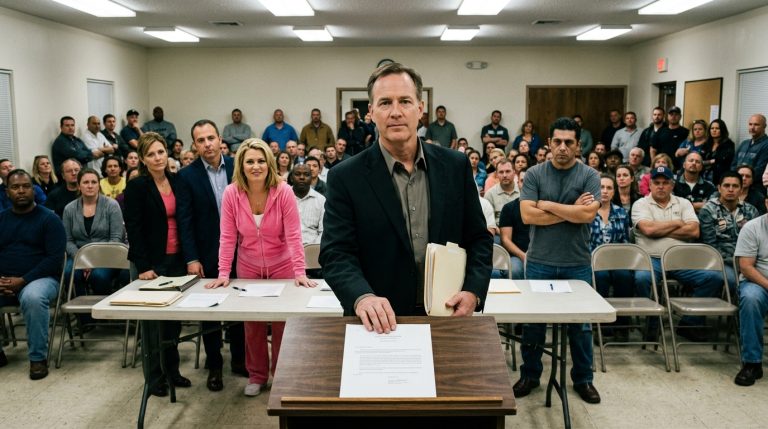
The oak gavel struck the brass sounding block three times, the heavy clack carrying clearly through the carpeted aisle of the clubhouse.
Karen sat behind the long mahogany dais at the front of the hall, flanked by her two silent board members. Her cheeks were flushed bright red, and her clipboard was gripped so hard in both hands that the plastic frame bowed under the strain.
“Agenda Item 4,” Karen announced into her goose-neck microphone, her voice vibrating through the wall speakers. “Emergency Motion to declare Parcel 4B a restricted utility corridor and initiate immediate deed enforcement against non-compliant lot owners.”
Twenty residents sat in the folding chairs, murmuring nervously as they glanced at the thick legal packets resting on their laps.
I pushed through the double doors, my boots making a steady, heavy crunch against the industrial carpet as I walked straight down the center aisle.
“Point of order, Madam President,” I said, my voice cutting cleanly through the ambient chatter.
Karen’s head snapped up. Her glasses slipped down the bridge of her nose as she gripped the microphone stalk. “You are out of order! You do not have floor privileges during executive voting!”
“I have a lot owner’s right under State Statute 720 to present certified public records,” I said. I stopped at the podium, reaching into my canvas jacket.
I didn’t pull out a speech. I set two items flat on the wooden lectern: the certified county tax ledger co-signed by K. Wentworth, and my Raspberry Pi pass-through adapter wired to a digital oscilloscope screen.
“What is the meaning of this disruption?” the board member on her right demanded, leaning forward with a deep frown.
“That paper is a certified tax filing for holding account UTIL-COMM-9902-X,” I said, turning to face the room of neighbors. “It’s the commercial power feed running through the padlocked utility shed behind the tennis courts. Karen’s been running forty high-draw cryptocurrency servers off that line for four years.”
A collective gasp swept through the folding chairs. Two neighbors in the second row stood up to peer at the paper on the lectern.
“That’s a lie!” Karen screamed, slamming her flat palm onto the table so hard her glass of ice water sloshed over her legal notes. “He’s retaliating because of a legal code enforcement fine! Security, escort this man out!”
“The county inspector is already at the shed with two deputy sheriffs, Karen,” I said calmly. “And when I plugged this diagnostic relay into the primary junction box ten minutes ago, it dropped your server array into an indefinite diagnostic reboot loop.”
Right on cue, her tablet on the dais lit up with a barrage of bright red system alerts. The internal cooling fans in the distant utility shed died out, the quiet hum that had buzzed through the neighborhood for months suddenly vanishing into absolute silence.
Karen looked down at the flashing red screen. The color drained from her face completely. Her mouth opened, but no sound came out—her rehearsed bureaucratic authority collapsing under the cold weight of physical evidence.
“Arthur at the county registrar’s office verified the signature,” I added, looking straight at her two board colleagues. “And the state utility commission has already logged the grid draw as commercial power theft. Every household in this room has been subsidizing her electric bill by a hundred and twenty dollars a month.”
The room erupted into furious shouting. Three residents surged toward the dais holding their monthly HOA assessment notices, demanding an immediate audit.
Karen shrank back into her leather high-back chair, her hand trembling so violently she dropped her wooden gavel onto the floorboards, where it rolled beneath the table and came to a stop against the baseboard.
Dennis sat quietly in the back row, his arms crossed, watching his wife’s seven-year reign collapse without uttering a single word.
The morning sun came up clear and bright over the cul-de-sac.
The orange easement flag was gone from my lawn, pulled clean out of the bluegrass and tossed into the recycling bin behind my shed.
Across the street, a commercial van from the State Public Utility Commission sat parked in Karen’s driveway, two technicians in high-visibility vests loading heavy black server chassis out of her garage into the back doors.
A formal notice from the state attorney general’s office was taped squarely over her front door handle.
I sat on my front porch steps, holding a warm mug of black coffee in my left hand.
In my right hand, I held the scarred steel socket wrench. I gave the mounting bolt on my porch railing one last, smooth turn, feeling the iron bite down tight into the timber until the metal held firm and silent.
I set the wrench down on the wooden step beside me, took a slow sip of coffee, and listened to the quiet morning air.