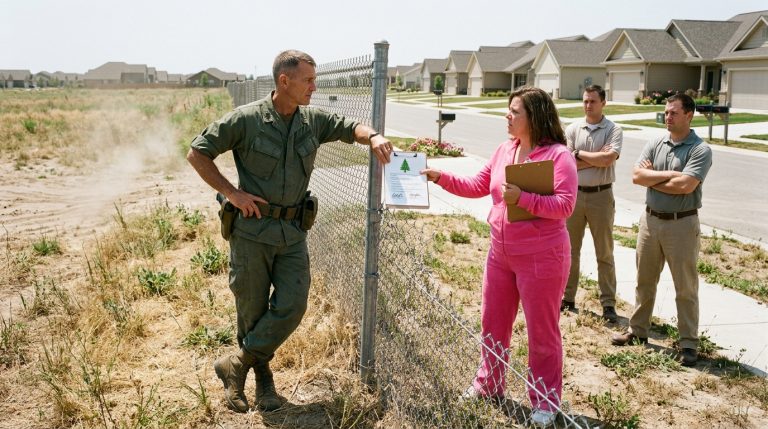
Rusted Iron and Dry Earth: Defending the 40-Acre Perimeter Against the Silver Creek Ledger
CHAPTER 1: The Iron Boundary
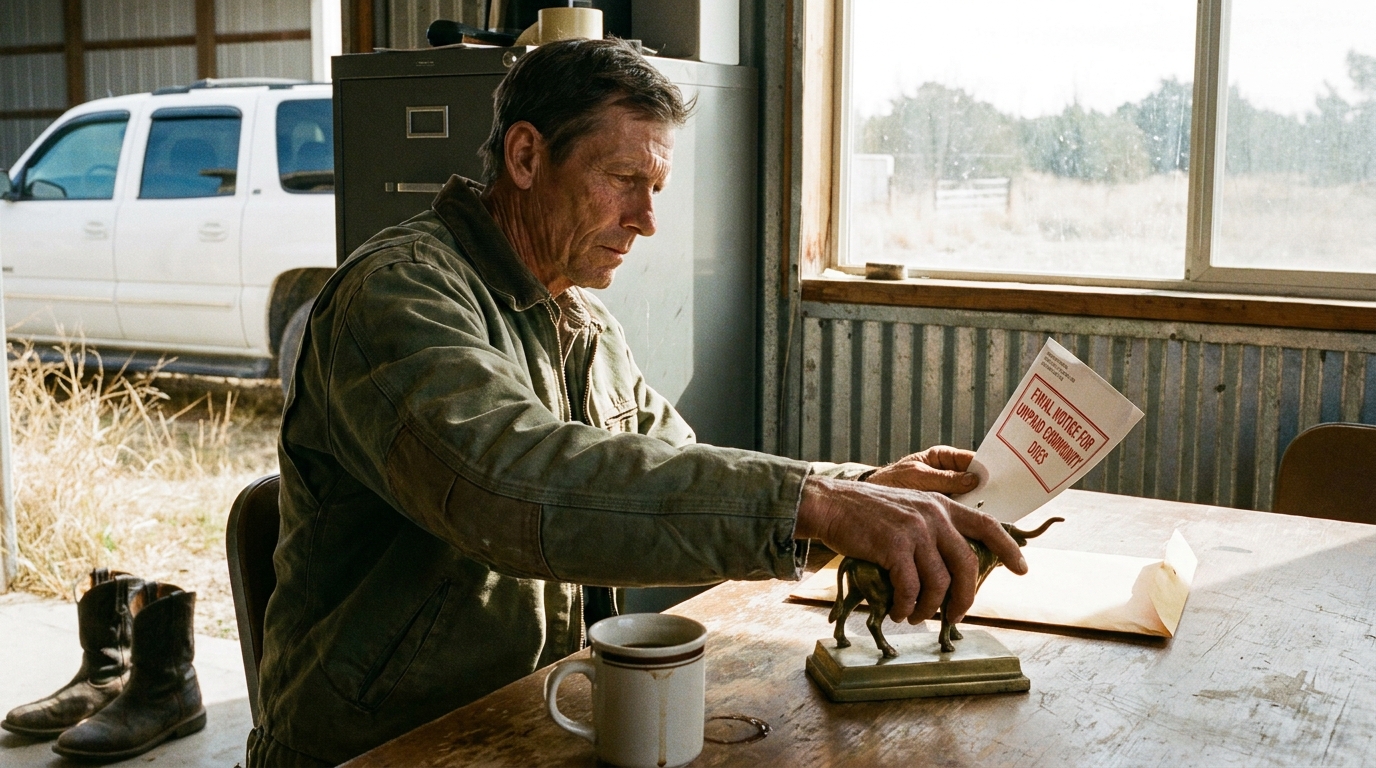
The coffee on the wooden table was cooling, a dark ring settling against the ceramic while the wind dragged dry grass across the corrugated metal siding outside. Mornings out here belonged to endurance and maintenance, to the heavy friction of boots on packed dirt and the constant labor of keeping a forty-acre spread fenced clean against the elements.
Then the envelope arrived.
Thick stock, an official-looking seal, and red letters stamped brutally across the top demanding final notice for unpaid community dues. I stared at it, the corners curling slightly in the dry heat, before letting out a dry, humorless sound. It made no sense. My ranch sat miles outside any boundary belonging to Silver Creek Estates. There were no shared gates, no common land, and no covenants tied to my deed. Just dirt, sky, and forty acres of hard-won isolation.
The title insurance policy resting in the heavy steel filing cabinet downstairs didn’t miss things like this. Title companies trace every foot of earth and every historical encumbrance down to the iron pins buried in the dirt. If Silver Creek Estates held a legitimate claim, it would have been logged in black and white before my signature ever touched the closing table. Instead, the record was clean.
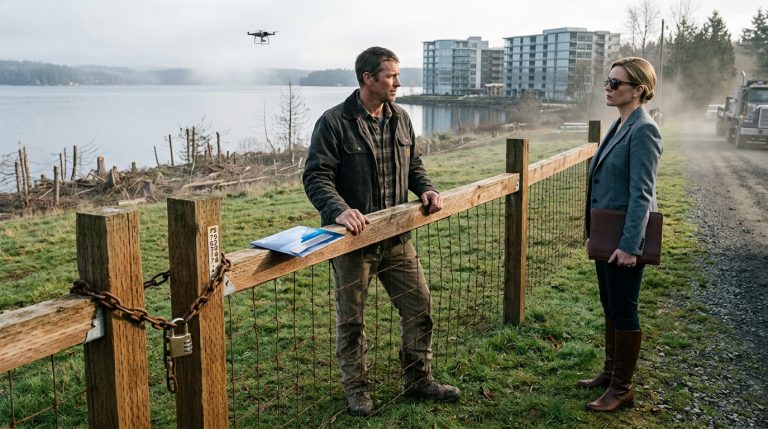
Outside the kitchen window, a white SUV rolled at a crawl along the outer fence line, its tires crunching heavily over the gravel. It didn’t stop, but it didn’t hurry either. Tinted glass caught the harsh midday glare, and a phone camera flashed once, capturing the perimeter like property belonging to a landlord who hadn’t yet learned how hard iron is to move.
I picked up the envelope again, running a thumb over the stiff edge. They were banking on a very specific kind of wear and tear. They were betting that the constant friction of formal threats, printed warnings, and manufactured legal urgency would break my routine before I ever bothered to dig up the county records.
The silence of the ranch pressed in around the room, heavy and unyielding, but the rhythm of the day had already been broken. I pulled the keyboard closer, opened a clean file, and began drafting my response—cold, direct, and entirely pragmatic—asking for the single piece of evidence they couldn’t produce: the county-filed annexation document.
My finger hovered over the enter key as the phone on the wooden counter buzzed harshly with an incoming alert from an unknown number.
CHAPTER 2: The Paper Trail
The phone stopped buzzing, the single-tone echo fading into the dry air of the kitchen like a bad transmission. I let my hand drop from the edge of the counter, turning back toward the table where the certified envelope lay opened next to the cold coffee. Out on the porch, the wind dragged a loose piece of corrugated metal against a wooden post, a dull, rhythmic thud that had marked forty acres of isolation for as long as I had owned the place.
The white SUV was gone now, its tire tracks fresh and dark in the gravel near the cattle guard, but the weight of its passage lingered. They wanted a reaction. They wanted haste, panic, a hurried phone call made in the heat of anger where mistakes could be made and leverage could be handed over on a silver platter.
I didn’t give them haste. I gave them iron discipline.
Dragging the heavy wooden chair closer to the table, I reached down and pulled the metal drawer of the filing cabinet open. It protested with a dry, metallic screech, the grease on the slides long since turned to dust by the dry valley air. From inside, I lifted the thick manila folder containing the title insurance policy and the original county deed.
Title companies do not deal in assumptions. When I bought this land, every square foot of the perimeter had been walked, measured, and checked against a century of public records. I spread the documents across the scarred wood of the table, pinning the corners down with a heavy brass paperweight I had salvaged from an old workshop years ago.
Line by line, description by description, I traced the property metes and bounds. The northern border ran parallel to an old dry creek bed, marked by rusted iron rebar driven deep into the limestone bedrock by county surveyors back when Eisenhower was in office. The southern boundary met the county right-of-way cleanly, with a twenty-foot buffer that left no room for overlap, shared easements, or community loops.
Silver Creek Estates did not touch this land. Their closest planned lot sat a mile and a half down the valley, separated by a steep ridge and an entirely different watershed.
I picked up the blurry PDF the association had emailed earlier, the one with the hand-traced red circle swallowing my ranch whole, and laid it directly over the official county plat. The contrast was stark. The county map was precise, stamped with official seals, dates, and surveyor registration numbers. The HOA’s document looked like it had been sketched by someone sitting in a dim office with a dry marker and a desperate agenda. It lacked a scale. It lacked a North arrow. Most importantly, it lacked a county recording stamp.
A man who works with his hands learns early on that you never build a structure on a cracked foundation. If the foundation is out of square, every board you nail after that only widens the gap. Silver Creek Estates was trying to build an entire financial structure on a lie, hoping the owners at the edge would be too tired or too intimidated to look closely at the footings.
I pulled out a fresh pad of lined paper and a heavy brass-barreled pen.
Rule number one of handling a perimeter dispute: you don’t argue with the noise. You document the silence.
I began drafting the response, keeping every sentence stark, transactional, and stripped of emotion. I didn’t threaten them back. I didn’t accuse them of fraud, though the shape of it was becoming clear. I simply itemized the exact discrepancies, referenced my parcel number, and demanded the single piece of paper that mattered: the recorded county annexation resolution bearing a proper book and page number.
If they had it, they could produce it. If they didn’t, every threat they mailed from that point forward ceased to be an administrative notice and became something else entirely.
As I finished the final sentence, the light outside shifted, the sun dipping low enough behind the western ridge to cast long, skeletal shadows across the porch rails. The wind picked up, rattling the dry grass against the lower wire of the fence.
I folded the letter neatly, slipped it into a clean envelope, and set it beside the keys on the counter. The work for the morning was done, but the perimeter had been tested, and a good fence only holds if you check the posts yourself. I grabbed my heavy canvas jacket off the hook by the door, pulled on my work boots, and stepped out into the yard to walk the northern boundary line before total darkness settled over the valley.
CHAPTER 3: Walking the Rust
The screen door banged shut behind me with a dry, rattling thud, the worn spring groaning against the frame. Twilight was sliding fast down the valley, dragging long, indigo shadows across the dry pasture and turning the barbed-wire fence lines into thin, rusted threads cutting through the brush.
I didn’t rush. Out here, moving too fast in the dark meant tripping over a gopher hole or missing a snapped wire. My boots crunched over the gravel driveway, the sound sharp and deliberate, before transitioning into the muffled, yielding thud of packed earth as I reached the northern perimeter.
The air smelled of dry sage, crushed juniper, and the faint, coppery scent of old iron.
In my pocket, the folded paper containing my formal demand to Silver Creek Estates felt heavy, a block of solid intent against my thigh. But paper only mattered if the ground beneath it held firm. That was the rule of the frontier, whether you were running cattle or just trying to be left alone forty miles from the nearest traffic light. If you don’t walk your lines, someone else will eventually draw new ones for you.
I reached the first corner post—a cedar trunk weathered silver by fifty winters, its base anchored in limestone and packed shale. I stopped there, running a gloved hand along the top wire. It was tight, singing faintly with the evening wind. No one had cut it. No one had crossed it today. But the tracks of that white SUV from the morning were still visible a hundred yards out on the county easement, a pale smear of dust across the alkali flats that proved they were mapping the edges, testing the friction points.
A sharp, intrusive memory flickered behind my ribs—years ago, helping an old-timer clear brush along this exact creek bed, listening to him talk about how men don’t fight over good land; they fight over the margins where nobody is watching. Silver Creek Estates understood that math better than most. They weren’t looking to seize the ranch house or tear down the barns. They wanted the soft edges, the quiet tax rolls, the invisible compliance of an owner who would rather mail a check than argue with a letter stamped in red ink.
I crouched down near the base of the cedar post, brushing away a layer of dry tumbleweed debris until my fingers hit cold metal. The old survey pin. A half-inch iron rod driven deep into the bedrock by the county decades ago, its top capped with lead stamped with registration numbers that pre-dated the incorporation of half the subdivisions in this county.
I tapped it with the knuckle of my work glove. It didn’t budge. It was anchored in stone, untouched by corporate bylaws or board meetings.
The friction between my world and theirs wasn’t going to dissolve with a single polite email. The silence that followed my refusal to pay would only stretch so far before they decided to test the wire themselves. And when they did, they would find out that iron doesn’t bend just because a management company drafts a new fee schedule.
I stood back up, wiping the dust from my palms, and turned to face south toward where the distant valley lights of the suburban expansion flickered against the horizon like a swarm of trapped yellow insects. The ranch was dark, quiet, and completely steady.
I adjusted my collar against the rising night chill and began the long walk back along the fence line, keeping my eyes fixed on the shadows, stepping deliberately into the dark.
CHAPTER 4: The Edge of the Grid
The crunch of gravel under my work boots sounded too loud in the midnight stillness of the yard. I stepped up onto the wooden porch, the boards groaning under my weight, and reached out to twist the doorknob. Before my hand made contact, my fingers brushed against a fresh white envelope wedged tightly into the wooden frame of the screen door.
It hadn’t been there when I left an hour ago to walk the northern boundary.
My pulse didn’t spike; it flattened out, turning cold and heavy, the way it does when an engine starts missing beats on a steep grade. I pulled the envelope free. No postage stamp. No postmark. Just my name written in sharp, block letters with a black marker, pushed into the wood like a calling card left by someone who knew my routine down to the minute.
I pushed the door open, stepped inside into the warm, stale air of the kitchen, and flipped the wall switch. The overhead bulb flickered once before casting a harsh, yellow glare over the scarred wooden table where the first notice still sat beneath the brass paperweight.
Tearing the corner of the envelope open, I pulled out a single sheet of cheap copy paper. There was no formal letterhead this time, no corporate logo for Silver Creek Estates, no mention of late fees or legal counsel. Just two sentences printed in a centered font: Compliance avoids unnecessary friction. The board expects resolution by Friday.
Friday. Three days away.
They weren’t mailing letters anymore. They were hand-delivering them while I was out walking the lines, testing to see how close they could get to the house without triggering a response. It was a tactical escalation, a quiet reminder that my forty acres of isolation wasn’t as impenetrable as I liked to think.
I set the paper down next to the cold coffee cup and walked over to the small desk by the window. I didn’t call the number listed on their previous emails. Calling them would mean playing on their turf, reacting to their timeline, shouting into a telephone where words could be twisted or recorded out of context. The rule of the road was simple: when a fence is being tested at an unrecorded gate, you don’t yell at the trespasser—you check the latch and look for tracks.
Pulling my flashlight from the counter drawer, I stepped back outside onto the porch and walked straight down to the end of the driveway where the gravel met the county road.
The beam of the flashlight cut a sharp, white tunnel through the dust and dark. I dropped to one knee, bringing the light low against the gray earth. The wind had died down, leaving the surface crisp. Across the normal pattern of my own truck tires and the faint tracks of the delivery service from Tuesday, a fresh set of tread marks cut sharp into the soft dirt of the shoulder.
Narrow tires. Deep treads. Independent suspension. Not a heavy farm truck, and not a local utility vehicle. It matched the white SUV I had spotted idling past the fence line earlier in the week. They had pulled right up to the cattle guard, killed the engine, and stepped out onto my property long enough to slide that note into the screen door.
A slow, steady anger settled in my chest—not the hot, blind flash that causes mistakes, but the cold, heavy fury of a man who watches someone track mud across a clean floor. They thought distance and isolation were weaknesses. They thought that living miles outside town meant there was no one to witness a quiet squeeze.
I stood back up, sweeping the flashlight beam across the dark expanse of the pasture. The fence posts stood tall and straight against the starlight, silent sentinels holding the line. If they wanted to play a game of pressure and quiet intimidation, they had picked the wrong property.
I walked back inside, locked the heavy wooden door behind me, and dropped the anonymous note squarely on top of my growing file of evidence. Friday was three days away. By the time they showed up expecting compliance, I planned to have a very different kind of answer waiting for them down at the county seat.
CHAPTER 5: The Certified Line
The sun didn’t rise over the valley so much as it burned its way through the gray haze clinging to the foothills. By six in the morning, I had the truck idling by the barn, the heavy diesel engine vibrating through the chassis with a low, mechanical growl that chased the chill out of the metal cab.
On the passenger seat sat the manila folder, fat with deeds, title policies, and the printed emails from Silver Creek Estates, topped by the hand-written warning left in my screen door twelve hours earlier.
The drive into town took twenty minutes down the washboard county road, the tires throwing up twin plumes of fine, gray dust that drifted slowly across the dry sagebrush. I kept my speed steady, watching the rearview mirror. No white SUV tailed me this early, but the reminder of their tire tracks in the shoulder stayed sharp in my mind. They were shifting tactics from administrative pressure to quiet intimidation, testing the perimeter to see where the wires would slacken.
I didn’t head straight for the county seat. Before dealing with the legal foundation of the land, I needed to check the local pulse—the kind of information you don’t find in clerk’s filing cabinets, but across a counter where people traded complaints about weather, feed prices, and overreaching boards.
The feed store sat at the southern edge of town, a long, weathered tin building smelling of molasses, burlap, and dry grain. The gravel parking lot was empty except for a faded flatbed truck parked near the loading dock. Inside, the fluorescent lights hummed with a high-pitched whine, casting a sterile glare over stacks of salt blocks and heavy-duty fencing wire.
Tom, the owner, stood behind the scarred wooden counter, wiping down the laminate with a damp rag. He looked up as the screen door slapped shut behind me, his eyes squinting through wire-rimmed glasses before recognition smoothed out the lines on his weathered face.
“Morning,” Tom said, tossing the rag onto a shelf beneath the counter. “Heard you were keeping busy out past the ridge.”
I walked over, leaning my forearms against the scarred wood. “Word travels fast in a town this size.”
“Out here, silence travels faster,” Tom replied, leaning in slightly, his voice dropping to a gravelly lower register. He reached behind a stack of invoice pads and slid a small, folded piece of yellow scratch paper across the counter. “Had someone asking about you three days ago. Suit and tie, driving a late-model utility rig. Wanted to know if you bought your feed in cash or ran an account.”
I unfolded the paper. No names, just a note scrawled in hurried handwriting: Silver Creek inquiring about peripheral parcel accounts.
“They’re digging into supply lines now,” I said, my voice flat.
“They dig wherever they think they can find a loose bolt,” Tom muttered, shaking his head. “They tried that same routine with a rancher over on the west ridge four years back. Sent bills for road maintenance on a road he doesn’t even use. Wore him down until he paid just to get them off his back. Once they find a soft spot, they lean until it cracks.”
“This land doesn’t crack,” I said.
Tom looked at me for a long moment, studying the set of my jaw, then gave a slow, approving nod. He reached down and tapped the counter. “Then you better make sure your paperwork is sharper than their lawyers. They aren’t used to anyone looking past the letterhead.”
I folded the yellow note and slid it into my pocket alongside the rest of the file. Tom didn’t say anything else, turning back to stack a row of empty feed sacks, but the warning was clear. The pressure wasn’t just digital anymore; it was creeping into the commercial margins of the local community, looking for leverage wherever it could latch on.
I walked back out to the truck, the morning heat already beginning to bake the asphalt in the parking lot. I threw the door open, climbed into the cab, and shifted the gear selector into drive.
The feed store was behind me, but the direction was set. It was time to drive down to the county clerk’s office and find out exactly what official seal—or lack of one—was holding Silver Creek Estates’ paper empire together.
CHAPTER 6: The County Record
The county clerk’s office smelled of stale coffee, old toner, and decades of damp paper stored too close to the floor. Fluorescent tubes hummed overhead with a steady, clinical drone, washing out the shadows and throwing a pale, flat light across the linoleum counters.
I parked the truck three blocks away, walking the final stretch with the manila folder tucked firmly beneath my arm. Out on the ranch, the silence was absolute; here, the background noise was a relentless clatter of dot-matrix printers, ringing desk phones, and the low, heavy murmur of people dealing with property taxes, probate filings, and municipal liens.
Taking a numbered ticket from the metal dispenser near the entrance, I sat down on a hard plastic chair against the back wall. The clock above the service window ticked forward in sharp, aggressive increments.
My mind drifted back to the warning Tom had handed over the counter. They dig wherever they think they can find a loose bolt. Silver Creek Estates wasn’t just sending letters to isolated owners for fun; they were systematically probing the margins of the township, looking for commercial accounts, supply chains, or rural parcels where owners might pay out of sheer fatigue. It was a cold, calculated operation disguised as community maintenance.
“Number twelve,” a clerk called out, her voice bouncing flatly off the walls.
I stood up, walked to window three, and laid the folder flat on the worn laminate counter.
“Morning,” I said, keeping my tone level. “I need to pull the complete plat and historical annexation records for parcel four-eight-two out in the west valley. Specifically looking for any recorded expansions or boundary adjustments involving Silver Creek Estates.”
The clerk, an older woman with iron-gray hair pinned back in a tight bun, didn’t look up immediately. She typed a sequence into her terminal, the keyboard clacking like a woodpecker against dead wood. A green screen reflected off her wire-rimmed glasses as she scrolled through digital registry logs.
After a minute, she stopped clicking. Her brow furrowed, a faint crease forming between her eyes. She clicked a couple more times, then adjusted her glasses and looked straight at me.
“Silver Creek?” she asked.
“That’s right.”
“According to the primary database, their southern and western boundaries were fixed when the original tract was platted back in ninety-four,” she said, tapping a fingernail against the edge of the terminal. “No formal expansions have been recorded for that development since incorporation.”
“Are there any pending filings?” I asked. “Or historical requests that were closed out?”
She turned her monitor slightly, studying a secondary archive window. “Let me check the historical docket.”
The silence stretched between us, broken only by the mechanical clatter of a printer three desks down. I kept my hands resting flat on the counter, feeling the cool, smooth laminate beneath my palms. Every second spent staring at that screen was another nail driven into the foundation of the HOA’s paper claims.
“Well,” the clerk said softly, leaning closer to the glass. “There was an application filed by their board about six years ago. They tried to push their district line half a mile west to pick up the edge parcels.”
My pulse ticked upward, steady and sharp. “And?”
“Denied,” she said, pointing a finger at a highlighted red entry on the screen. “County commissioners rejected it outright. Lack of contiguous ownership consent, zoning conflicts with agricultural land designations, and an improper filing format. The docket was closed permanently with prejudice. No appeal was ever lodged.”
I pulled a small notepad from my pocket and jotted down the docket number and the date of denial.
“Can I get certified copies of that entire file?” I asked.
“Printer is right behind me,” she said, reaching for a stack of request slips. “Fill out the duplication form, pay the fee at window four, and I’ll have the whole packet stamped and ready in ten minutes.”
I filled out the slip with slow, deliberate strokes of my pen. The missing piece of the puzzle wasn’t missing anymore. It was sitting right there in the county’s digital archive, locked behind an official seal that Silver Creek Estates had chosen to ignore entirely. They hadn’t made a clerical error. They had known precisely where their boundary ended, and they had chosen to cross it anyway, banking on the assumption that nobody would ever drive down to window three to check the docket history.
I paid the fee, waited for the heavy thud of the stamp hitting the certified copies, and tucked the fresh packet into my folder. The drive back to the ranch would be quiet, but the weight in the truck had completely shifted.
CHAPTER 7: The Surveyors Grid
The drive back to the ranch was a slow, steady climb up the valley, the engine humming against the long incline while the afternoon sun caught the rusted barbed wire lining the shoulders. On the passenger seat, the fresh packet of certified records sat inside the manila folder, the ink from the clerk’s stamp still smelling faintly of fresh chemicals.
I didn’t head straight home. Instead, I turned the truck down a rutted dirt track a mile short of my northern gate, pulling up outside a weathered metal pole barn with a hand-painted wooden sign reading Miller Surveying.
Arthur Miller had been marking lines in this county since before Silver Creek Estates was anything more than a dry wheat field and a developer’s blueprint. He didn’t use digital tablets or satellite overlays; he worked from brass caps, wooden stakes, historical triangulation logs, and a pair of eyes that had spent forty years squinting through a transit under a glaring desert sun.
When I cut the truck engine, the silence rushed in immediately, broken only by the ticking of the cooling exhaust manifold. Arthur was standing by the open bay door of the barn, leaning over a wide wooden worktable spread with brittle, yellowed paper maps that smelled of old linen and linseed oil.
He looked up as my boots crunched on the gravel, a pair of heavy wire-rimmed magnifiers dangling around his neck by a leather cord.
“Thought I recognized the sound of that transmission,” Arthur said, his voice like dry sandpaper grinding over river stones. “You look like a man carrying a heavy load of paper.”
I stepped into the cool shade of the barn, setting the folder down on the corner of his workbench. “I pulled the docket from the county clerk’s office regarding the Silver Creek expansion attempt six years ago.”
Arthur let out a dry, rasping chuckle, reaching for a stained coffee mug before thinking better of it and letting his hand drop. “Ah. The great land grab. Everyone in the valley remembers that circus. They tried to redraw their perimeter to swallow half a dozen independent parcels along the western ridge. Thought they could slide it past the commissioners while everyone was looking at the highway expansion.”
“The clerk’s records show it was denied with prejudice,” I said, unzipping the folder and sliding the certified county documents across the table.
Arthur adjusted his magnifiers, leaning down over the pages. He didn’t read every word; he didn’t need to. His finger traced the official seals, the commissioner signatures, and the formal denial stamps with the practiced ease of a man who could spot a forged baseline from ten paces away.
“They got slapped down hard,” Arthur murmured, shaking his head slowly. “Zoning incompatibility, lack of contiguous owner consent, and a failure to provide proper metes and bounds descriptions. It wasn’t just a rejection; it was a permanent block.” He looked up, his faded blue eyes sharp under heavy brows. “So why are they sending you final notices and threatening liens?”
“Because a denial on a public docket doesn’t stop a balance sheet from shrinking,” I said. “If they can’t expand legally, they expand financially. They bill the edges, send out red-stamped notices, and rely on the fact that most people won’t drive down to window three to check the historical docket.”
Arthur stared at the certified papers for a long moment, a slow, grim smile touching the corners of his mouth. A paranoid, fleeting thought crossed my mind—wondering if even these county records were just temporary paper shields against an organization that operated entirely outside conventional rules, relying on inertia and exhaustion rather than law. But the steel pins in the ground out past my fence line didn’t care about corporate bluffs.
“Paper is cheap,” Arthur said, tapping a finger against the county seal. “Truth is expensive. Most folks don’t want to pay the price of admission to prove they’re right. They’d rather write a check for five hundred bucks and call it a day.”
“I’m not writing a check,” I said.
Arthur reached over, pulled a rolled topographical map from a vertical bin beside the table, and unrolled it across the center of the bench, weighting the corners down with a pair of brass plumb bobs. He pointed a thick, calloused finger at a jagged red line marking the true, unalterable western boundary of my ranch.
“If you’re going to push back, you don’t do it by arguing with their emails,” Arthur said, his tone dropping into a lower, tactical cadence. “You put their fake map right next to this certified county grid, hand it to their board, and make damn sure they understand that every single notice they’ve mailed constitutes a recorded paper trail of attempted extortion.”
I studied the lines on the topographic map, tracing the exact ridge where my northern fence met the county easement. The pieces were falling into place. The letters, the white SUV tracking the perimeter, the inquiries at the feed store—they were all part of a crumbling structure trying to hold itself together by manufacturing pressure.
I rolled up the certified documents, slid them back into the folder, and shook Arthur’s hand. The grip was dry, hard, and steady.
The ground rules were set. The defense was no longer passive. It was time to take the evidence back to the ranch and prepare for the next move.
CHAPTER 8: The Financial Ledger
The silence inside the ranch house was different now. It wasn’t the defensive quiet of a man waiting for the next shoe to drop; it was the measured stillness of a workshop where all the tools are laid out and the work is finally marked out by scale.
I unrolled the certified county parcel maps across the center of the wooden table, pinning the curling edges down with the heavy iron wrench I usually kept by the back door. Next to them, I laid Arthur’s topographical overlay and the stack of public financial disclosures I had quietly printed out from the county’s municipal archives earlier in the week.
Outwardly, Silver Creek Estates projected the polished, unyielding image of a thriving residential community. Their annual letters spoke of community integrity, routine maintenance, and standardized improvements. But numbers printed on public financial disclosures do not care about corporate image. They operate on a much colder, more honest logic.
I pulled a yellow legal pad toward me and began calculating the columns, my pen scratching rhythmically against the paper.
For the past three fiscal years, the association’s annual maintenance expenses had climbed steadily, driven by rising costs for common area landscaping, storm drainage repairs, and escalating management fees. At the same time, their reserve funds—the mandatory cushion required to handle structural emergencies—had steadily shrunk, dipping dangerously close to the statutory minimum required by state oversight guidelines.
They weren’t broke, but they were uncomfortable. And an uncomfortable board with a shrinking reserve fund always starts looking for low-risk avenues to balance the ledger.
Edge properties. Rural parcels sitting just outside the formal gates. Owners who lived miles away, who didn’t attend monthly meetings, and who were unlikely to mount a formal legal defense over a few hundred dollars in annual assessments. It was a clean, frictionless revenue stream. If half the edge owners paid out of fatigue or intimidation, the board plugged their budget deficit without ever having to raise dues on the voting residents inside the gates.
The strategy was brilliant in its simplicity, provided nobody looked too closely at the county dockets. But they had made a fatal miscalculation. They had assumed that a man living forty acres out on a dirt road would treat a red-stamped notice the same way a suburban homeowner treats a parking ticket—with a quiet sigh and a check mailed to make the noise stop.
I reached into the file and pulled out the denial record from window three. The commissioners’ formal rejection stamped six years ago sat right beneath the current billing notices. Two completely contradictory pieces of paper generated by the exact same entity. One proved they had no legal standing; the other proved they were actively billing for a jurisdiction they knew they didn’t possess.
In legal terms, that crossed the line from a clerical misunderstanding into something significantly heavier.
I arranged the documents into two distinct piles on the table. On the left: the noise. The unrecorded maps, the unsigned emails, the anonymous warnings left in the screen door, and the inflated balance statements. On the right: the law. The original deed, the certified survey pins, the county plat records, and the permanent denial docket.
The contrast was absolute.
I didn’t need to draft an angry response. I didn’t need to call the HOA president and trade threats over a telephone line. When you have the physical framework and the public record locked down, you don’t raise your voice—you simply set the stage so that the truth becomes impossible to ignore.
The sun dropped lower through the western windows, casting long, amber slants across the wood grain and turning the dust motes in the air into slow-moving sparks. I gathered the organized files, slid them back into the heavy manila folder, and set it squarely in the center of the desk.
The next move belonged to them. And the community hall meeting on Tuesday night was only four days away.
CHAPTER 9: The Hall Door
The community hall smelled faintly of stale instant coffee, commercial floor wax, and the dense, damp warmth of sixty people crammed into a room built for forty. Folding chairs lined the rows in uneven alignment, their metal legs scraping against the worn carpet whenever someone shifted weight or leaned forward to catch a whispered conversation.
At the front of the room, a long folding table draped with a dark green vinyl cloth served as the dais. Behind it sat the board members of Silver Creek Estates, their nameplates arranged in neat, rectangular blocks. The HOA president occupied the center seat, her posture straight, her expression composed behind a polished leather folio. Above them, a banner reading Silver Creek Estates: Community Integrity & Order was stretched taut against the faux-wood paneling.
I didn’t take a seat near the front. I walked straight down the center aisle, my heavy work boots striking the floor with a rhythmic, measured cadence that cut through the low murmur of the room. Heads turned. A few neighbors in the middle rows recognized me, their gazes dropping instantly to the thick manila folder under my arm before sliding away.
I took an empty folding chair near the back corner, right beside the emergency exit where the cool draft from the parking lot slipped under the door. I didn’t pull the folder out yet. I simply sat, folding my hands over my knees, and watched the rhythm of the room.
The meeting was deep into its routine agenda. A board member was droning through a report on upcoming landscape maintenance contracts and drainage clearing along the internal easements. The words rolled past like white noise—bureaucratic machinery turning over familiar gears, designed to reassure everyone present that order was being maintained.
Up at the front, the HOA president listened with a practiced, attentive nod, her pen resting beside her notes. But there was a subtle stiffness in her shoulders, a coiled tension that wasn’t there during ordinary budget reviews. Word of the edge parcels, the unanswered emails, and the quiet pushback had leaked past the administrative firewall. People on the fringes were starting to ask questions about where the boundaries actually ended.
The landscaping report wrapped up with a polite scatter of applause from the first few rows. The president cleared her throat, leaned into the gooseneck microphone, and adjusted her notes.
“Before we open the floor to general resident comments,” she said, her voice smooth and polished, projecting effortlessly across the hall, “the board wants to briefly address a few administrative matters regarding community compliance and uniform assessment standards.”
The room tightened. Conversations died down instantly.
“We pride ourselves on fairness,” she continued, her gaze sweeping slowly across the rows of folding chairs, pausing just for a fraction of a second when her eyes crossed my corner. “Rules only protect a community when they apply universally. When exceptions are permitted at the margins, the integrity of the entire district begins to fray.”
The implication hung in the air, heavy and direct. No names were named, but the direction of the pressure was unmistakable. She was framing the dispute not as a legal boundary question, but as a moral failure of cooperation—a threat to the collective stability of the neighborhood.
A murmur rippled through the middle rows. A man three seats ahead of me shifted uncomfortably, his fingers drumming a nervous tattoo against his knee.
The strategy was clear. Before anyone could ask about the legal foundation of their billing, the board was locking down the narrative, wrapping their administrative overreach in the flag of community protection. They were betting that public pressure and social conformity would do the work that their missing annexation documents never could.
I let her finish. I let the silence settle over the room, heavy and expectant, waiting for the moment the floor would open to the public. The folder rested on my lap, the certified county denial docket and the true survey maps waiting silently beneath the cover.
CHAPTER 10: The Floor Is Open
The pause that followed the opening of the floor was brief, filled only by the muffled scrape of a chair leg and the dry rustle of paper up at the dais. A homeowner near the front stood up to ask a routine question about pool maintenance schedules, their voice carrying a slight, nervous edge. The HOA president answered smoothly, her tone returning to its practiced rhythm, though her eyes flicked once toward the back of the room before settling back on the speaker.
I didn’t move immediately. I let the administrative routine play out for another five minutes, watching the board members lean in and whisper among themselves. They were operating under the assumption that the evening would follow the usual script—a few minor complaints about trash bins or parking, followed by adjournment and coffee in the lobby.
When the pool question was settled and a brief silence settled over the room, I stood up from my folding chair.
The movement wasn’t loud, but in a room tuned to tension, it caught attention instantly. The metal chair gave a faint clatter as it tipped back against the wall. Heads turned in the middle rows. Up at the dais, the president stopped mid-sentence, her pen hovering an inch above her leather folio.
I didn’t rush down the aisle. I walked with the slow, deliberate pace of a man checking fence posts in a high wind, keeping my hands empty and my shoulders level. The heavy manila folder stayed tucked firmly beneath my arm, its edges square against my ribs.
When I reached the center aisle, about ten rows back from the front, I stopped and squared my shoulders toward the long green-draped table.
“Yes?” the president said. Her voice retained its professional polish, but the pitch had tightened just enough to let the room know the script had changed. “State your name and address for the record, please.”
“I own the ranch property situated just outside the western boundary of Silver Creek Estates,” I said, keeping my tone flat, even, and entirely devoid of heat. “My name is on the deed, and my parcel sits clear of your district lines.”
A low, collective murmur rippled through the rows around me. Someone three seats back whispered something to their neighbor, but the words were swallowed by the hum of the fluorescent lights overhead.
The president’s expression didn’t crack, but the corners of her mouth tightened into a hard, white line. “If your property is outside our district boundary, sir, then this meeting’s agenda is restricted to registered association members and formal community business. Administrative matters regarding external parcels are handled through our management office via correspondence.”
It was a clean exit strategy. She was trying to shut the door before the conversation even started, using procedural walls to keep the record closed.
“Correspondence requires an answer,” I said, not raising my voice an inch, letting the quiet weight of the words fill the space between us. “For weeks, your management office has sent certified notices, billing statements, and threats of legal liens regarding my property. You’ve claimed jurisdiction based on historical understandings and internal board reviews.”
Up at the dais, one of the board members seated to the left shifted uncomfortably, reaching for a glass of water.
The president leaned closer to her gooseneck microphone, her eyes narrowing slightly. “The board acts in accordance with established community agreements to ensure fairness and uniform standards across all connected lands. This matter has already been reviewed by our administration.”
“Reviewed, yes,” I said, stepping one pace closer down the center aisle. “But never recorded.”
The silence that hit the community hall was absolute. The background hum of the old air handler seemed to drop an octave.
“Can you show this room a single county-filed document, book and page number, that legally binds my land to Silver Creek Estates?” I asked.
The president didn’t answer immediately. She looked down at her polished folio, her fingers resting flat against the leather, then glanced sideways toward an empty chair at the end of the table where legal counsel usually sat. The chair was empty tonight.
“We are not required to air internal administrative documents to non-residents,” she said, though the smooth rhythm of her delivery had broken, leaving a jagged edge exposed for anyone paying attention to hear.
I didn’t argue. I didn’t raise my voice to match her defense. I simply reached under my arm, pulled the heavy manila folder free, and held it out where the fluorescent light caught the official red and gold stamps of the county clerk’s office. The stage was set for the evidence to speak for itself.
CHAPTER 11: The Shift in the Room
The silence lasted long enough for the hum of the old ceiling ventilation to feel heavy, pressing against the eardrums of everyone jammed into the rows of folding chairs. Up at the dais, the HOA president’s hand remained frozen against the leather folio. Her fingers had curled slightly into the grain, knuckles whitening as she stared past the podium, refusing to look down at the heavy manila folder I held in my hand.
Nobody moved. The board members to her left and right sat rigid, caught in the sudden vacuum between their prepared script and an unyielding physical reality.
Then, three rows ahead of me, a man near the center aisle shifted his weight. The metal leg of his folding chair shrieked against the commercial carpet. It was a small sound, but in that room, it cracked the tension like dry cedar under a boot heel.
He didn’t turn around immediately. He stared straight ahead at the green vinyl-draped table for another three seconds before standing up. It was Miller, the same neighbor who lived closer to the valley floor whom I had run into at the feed store weeks ago. He wasn’t loud, and he wasn’t aggressive, but his shoulders were squared with the steady, weathered patience of a man who spent his life fixing broken fence lines.
“I’ve got a question for the board,” Miller said, his voice flat and deliberate, carrying clearly across the hall without a microphone.
The president’s gaze snapped away from me, darting toward the center aisle. Her professional composure strained, pulling tight across her features like old canvas stretched over a warped frame. “Mr. Miller, this time is reserved for specific agenda items—”
“I’m making it an agenda item,” Miller interrupted, turning slightly so the room could see him. He looked back at the rows of his neighbors, meeting eyes left and right. “For five years, I’ve paid annual assessments on my parcel because the board told us every property along the ridge was bound by the original district covenants. But looking around tonight, I’m wondering why we’re the only ones paying for common maintenance while properties sitting a mile out are getting threatened with liens over boundaries that don’t even exist on county books.”
The room erupted into a low, jagged wave of overlapping murmurs.
A woman in the fourth row turned sharply toward her husband, whispering something fierce and rapid. Another man near the front row leaned back, crossing his arms over his chest, his eyes darting back and forth between the dais and the back aisle where I stood. The narrative control the board had spent the entire evening constructing was dissolving in real-time, replaced by a sudden, collective recalculation.
The president slammed her palm down flat against the green vinyl table. The sharp slap echoed off the faux-wood paneling, cutting through the murmurs instantly.
“Order!” she commanded, her voice finally losing its polished veneer, sharpening into a hard, defensive edge. “The association operates under lawful guidelines established to protect every homeowner in this district. We will not entertain unverified accusations or disruptive interruptions from the floor.”
“They aren’t accusations,” I said, stepping another two paces down the center aisle, closing the distance toward the front. I lifted the manila folder just enough for the official seals to catch the light again. “They are public records. Filed six years ago. Denied by the county commissioners with prejudice. No appeal, no recording, no jurisdiction.”
The president’s eyes locked onto mine, burning with a cold, concentrated fury. She realized then that this wasn’t an argument she could manage with parliamentary procedure or delay tactics. The paper trail was too clean, the physical evidence too heavy to talk past.
One of the junior board members to her right looked down at his own notes, then slowly slid his pen away, shaking his head by a fraction of an inch. That single, subtle motion was the final fracture in the board’s unified front.
The room held its breath once more, the air thick with the realization that the foundation they had trusted for years was built entirely on hollow ground.
CHAPTER 12: The Special Notice
The heavy silence that followed the president’s outburst didn’t settle back into routine obedience; it curdled into an uneasy, watchful stillness. The room was no longer listening to the board as an authority; they were watching them as defendants caught in a trap of their own making.
I didn’t step back. I kept walking down the center aisle until I stood just twelve feet from the long green-draped table, my boots planted firmly on the worn commercial carpet.
“You can talk about community standards and uniform rules all evening,” I said, keeping my voice low, steady, and entirely level. “But rules require legal foundation. And an association that tries to cover up a county-denied annexation by billing independent landowners isn’t maintaining order. It’s running a revenue shortfall on borrowed paper.”
The president’s breath caught audibly in her throat. She gripped the edges of her leather folio so tightly her knuckles shone white against the dark leather. For a second, her composure fractured completely, revealing the raw panic of someone realizing that the administrative bluff they had relied on for years had finally met an unyielding wall.
“That is enough,” she whispered, her voice cracking slightly before she forced it back into a harsh, controlled register. She looked frantically to her left and right, searching the faces of the other board members for support.
One by one, they avoided her gaze. The junior member who had dropped his pen earlier now leaned back in his chair, staring fixedly at his hands. Another board member quietly closed her notebook, sliding it beneath her folio as if trying to shrink away from the table entirely.
“We received a formal notice last week regarding a special closed session,” a voice called out from the third row—a woman who had sat quietly through the entire meeting until now. She stood up, her eyes fixed on the dais. “The board said it was to address boundary adjustments with legal counsel present. Are we paying for legal counsel to fight a boundary the county already rejected years ago?”
The question dropped into the room like a heavy stone into a stagnant pond, sending ripples of realization through the surrounding rows. Heads snapped toward the speaker, then back to the dais.
The president tried to speak, but the words tangled in her throat. Without an attorney sitting in the empty chair at the end of the table to field the blow, and without a recorded annexation document to hide behind, the administrative machinery had completely seized up.
“The notice for the special session was right,” I said, turning my gaze slowly from the president to address the entire room. “You are going to need legal counsel. But not to enforce boundaries that don’t exist. You’re going to need them to explain why the association has spent years issuing unauthorized demands against properties outside its jurisdiction.”
The weight of those words settled over the hall with absolute finality. No one shouted. No one argued. The realization was too stark, too heavy for performance or theater.
The president slowly released her grip on the leather folio, her shoulders sagging by an inch as the last vestige of her artificial authority drained away. She looked down at the blank notepad in front of her, her voice barely carrying across the table when she finally spoke.
“The… the board will take this matter under immediate advisement,” she murmured, her eyes fixed on the wood grain of the table. “A special notice will be issued to all residents regarding review of district boundaries.”
She didn’t wait for a motion. She didn’t call for a vote. She simply reached out, closed her folio with a dull snap, and pushed her chair back from the table.
The meeting was over. Not because it was adjourned according to parliamentary rules, but because there was nothing left of the illusion to sustain it.
I turned around, tucked the heavy manila folder securely beneath my arm, and began the long walk back up the center aisle toward the exit. The crowd parted quietly before me, neighbors nodding in silent acknowledgment as I passed.
When I pushed the emergency exit door open, the cool night air rushed in to meet me, sharp and clean, carrying the scent of dry earth and wide-open space. The noise of the hall faded instantly behind the heavy metal frame. The work wasn’t entirely finished yet, but the ground had been cleared, and nothing on the other side of that door was ever going to push back again.
CHAPTER 13: The Unwritten Ledger
The drive back to the ranch was wrapped in an absolute, uninterrupted silence. The valley road stretched ahead of the truck’s headlights like a pale ribbon of dust and gravel, cutting through the dark silhouettes of sagebrush and barbed-wire fences.
There was no white SUV tailing my bumper tonight. There were no flashing phone cameras, no anonymous warnings jammed into the screen door, and no red-stamped notices waiting on the kitchen table. The machinery of intimidation had completely ground to a halt the moment the actual record was laid out under the lights of the community hall.
When I pulled up to the gate, the ranch stood dark and steady, its timber and tin absorbing the cool night wind without a sound. I killed the engine, letting the diesel settle with a few metallic ticks, and stepped down into the dry dirt. My boots crunched familiarly against the gravel as I walked the perimeter of the yard, checking the latch on the gate and running a gloved hand along the top wire of the fence.
The ground hadn’t changed. The iron survey pins buried beneath the roots of the cedar posts were exactly where they had always been—anchored in stone, untouched by corporate bylaws or board meetings.
Three days later, the formal letter arrived by certified mail.
I stood on the front porch in the bright morning sunlight, holding the heavy white envelope between my fingers. There was no urgency in the delivery this time, no courier waiting with an aggressive pen. When I opened it, the language inside was clean, stark, and final, drafted by an attorney who understood that the association’s exposure had reached its absolute limit.
It confirmed in plain text what the county dockets had proved and what the surveyor’s maps had mapped down to the millimeter. My forty acres were formally and permanently recognized as entirely outside the jurisdiction of Silver Creek Estates. All prior demands, late fees, and threatened liens were formally withdrawn and expunged from the administrative record. An apology for the administrative inconvenience was tucked neatly into the closing paragraph, a polite concession wrapping up a failed revenue strategy.
I walked back inside the house, pulled the heavy manila folder from the desk drawer, and slid the letter into its place beside the county denial records and the original deed.
The stack was complete. The investigation was closed.
Over the following weeks, the wider ripple effects of that Tuesday night meeting began to settle across the valley. I heard secondhand through the feed store that two members of the board had quietly stepped down from their posts, replaced by residents demanding a full audit of the association’s shrinking reserves and boundary accounts. Other edge property owners who had spent years paying disputed dues began questioning the ledger entries, forcing the board to issue blanket clarifications and release long-standing liens that had never had any business being on public record in the first place.
Silver Creek Estates didn’t vanish, and the community didn’t dissolve. But the illusion that authority could substitute for evidence was permanently broken.
On a quiet Saturday afternoon, weeks after the final paper was filed away, I walked the full length of the northern boundary line. The sun was warm, hanging low over the western ridge and casting long, golden shadows across the dry pasture.
I stopped near the old cedar corner post where the first survey pin rested half-buried in the shale. Reaching down, I brushed a thin layer of dry earth away from the lead cap with my bare hand, exposing the stamped numbers that had marked the truth long before any board was ever incorporated.
The land didn’t care about the letters, the meetings, or the noise. It just held its ground. And standing there in the wide silence of the valley, I knew that nothing on the other side of the fence would ever be able to push it—or me—back again.
CHAPTER 14: The Return of the Silence
The finality of the paper trail did not arrive with a celebration or a dramatic announcement; it settled over the forty acres like a heavy mist that refused to be burned off by the midday sun. I walked back out onto the wooden porch, letting my hand rest on the weathered grain of the railing. Out past the cattle guard, the county road stretched north and south into the open expanse of the valley, empty of white SUVs, corporate surveyors, and unfamiliar vehicles testing the margins.
The physical toll of the dispute remained logged in the quiet corners of my routine—the hours spent sorting through county dockets, the deliberate pacing of conversations at the feed store, and the careful calculation of every letter dropped into the mailbox. But looking out over the dry grass and the rusted wire of the northern fence, the friction had completely vanished.
Inside the house, the manila folder rested inside the steel filing cabinet drawer alongside the original deed and the title insurance policy. It no longer represented a defense against an ongoing siege; it was simply a record, heavy with stamps and dates, proving that boundaries do not shift because an organization discovers a hole in its ledger.
The 5-pillar closure required by the architecture of this terrain was not about vengeance or public ruin. It was about restoration.
The payoff had already been delivered not through force, but through the unyielding weight of public record, stripping the association of its manufactured leverage and forcing them back behind their own legal limits. The poetic justice had taken its course naturally: Silver Creek Estates had attempted to weaponize administrative pressure against an edge property, only to have their own unrecorded claims expose the structural rot of their financial shortfall to every homeowner inside their gates.
I stepped off the porch and walked across the packed earth of the yard toward the western fence line, where the steel gate hung from its heavy cedar posts. A hinge had taken a slight beating from the dry valley winds over the past month, squeaking faintly whenever the breeze caught the wire mesh.
Stopping by the post, I pulled a small oil can and a heavy wrench from the back pocket of my canvas trousers. I set to work methodically, tightening the upper bolt until the slack disappeared, then applying a few drops of oil to the rusted pivot point until the metal stopped its dry complaint.
Symbolic closure requires physical interaction with the things neglected while the noise was loud. A gate must swing true. A wire must stay tight. A marker must remain exposed to the open air.
As the wrench clicked back into my belt holster, I reached down and picked up a small river stone that had worked its way loose from the base of the post, pressing it firmly back into the dry earth with the heel of my boot. The micro-actions of maintenance—measuring twice, checking the fittings, respecting the lines—formed the bedrock of endurance.
Back on the porch, I sat down in the wooden rocking chair as the sun began its slow descent behind the western ridge, painting the sky in deep shades of amber and slate. The quiet that wrapped around the ranch wasn’t the fragile calm of a truce; it was the deep, permanent silence of a boundary that had been tested, measured, and held against every weight brought against it.
The letters were gone. The board had retreated behind its legitimate walls. And the land, untouched and absolute, answered to nothing except the county, the law, and the steady turning of the seasons.